No One Will Save You. Directed by Brian Duffield. Hulu, 2023.


There are over 1.65 million home invasions per year.
This one is different.
The trailer for No One Will Save You suggests a fun romp in the home invasion genre with an alien twist. The film projects the aura of a sleek and spooky indie project done on a decent budget and gives vibes of recent, fresh horror/sf films like Prey (2022, dir. Dan Trachtenberg, also from Hulu) and Nope (2022, dir. Jordan Peele), films that explicitly revel in the audience’s familiarity with genre and what it can do. No One Will Save You delivers exactly that, and more, and is easily one of the most exciting and refreshing sf films of the past year. It’s a testament to how mid-budget films, which seem to be in terminal health (1, 2), can be spaces for cinematic experimentation (already I’m frustrated by how little I can say about this rich text in the 2,500 words that follow). The film is also a disturbing meditation on social isolation, psychological alienation, and the complex interplay between trauma and personal consequence. Plus, the aliens are really fucking cool.
No One Will Save You is the second film directed by Brian Duffield, who also wrote the screenplay. His directorial debut was Spontaneous (2020), a teen horror comedy romance about finding love in the midst of an apocalypse of spontaneously combusting bodies, a twisted take on the Christian fundamentalist concept of the Rapture (Duffield grew up the child of missionaries and went to an evangelical college) and a commentary on teenage hormones. Duffield also wrote the screenplays for the hilarious Satanic Panic horror comedy The Babysitter (2017) and the Lovecraftian horror film Underwater (2020). Duffield is thus no stranger to the admixture of humor and horror with effective twists on genre, tone, and form—a directorial approach on display in No One Will Save You.
This home-invasion-meets-alien-invasion thriller stars Kaitlyn Dever, probably best known for her co-starring role in the high school dramedy Booksmart (2019, dr. Olivia Wilde). Here, Dever lives a quiet life as the secluded and mysterious Brynn, alone in huge, Instagram-aesthetic farm house on the edge of “small town America” (it was filmed in Louisiana, but could be Ohio, western Massachusetts, rural Georgia, or anywhere else where green trees grow in small towns). She seems to have a Etsy-creator sort of job either sewing dresses or upcycling vintage ones. Her job means she doesn’t really interact with anyone except for groceries and to mail out her dresses. When she going into town, it’s an anxious affair that Brynn prepares for assiduously, fussing over what to wear, breathing heavily and glancing around nervously as she pulls into town. We learn through hints and clues that she isn’t welcome; she refuses eye contact, folks whisper about her and laugh in the distance (at her?), and she jumps into hiding when an older couple (a sheriff and his wife) walk by.
All of this is very mysterious and the film gives nothing away. Brynn returns home, where her living room is half-occupied by a massive model of a town, which she carefully crafts and in which she poses little figures of people—a nice nod to Ari Aster’s Hereditary (2018). She writes a letter to a friend named Maude (the older couple was Maude’s parents, we learn from the text), and prepares a picture-perfect dinner before practicing a dance to the tune of Ruby Murray’s 1956 hit “Knock on Any Door,” which is about nostalgic longings for “that old home town of mine” where you can knock on any door and find yourself welcome. The song is very odd, since for an American audience it’s clearly an “oldie” but is largely unfamiliar to American ears, having been a hit in the UK by an Northern Irish singer. The singer could easily be American—I ask myself if I should know this song, but as it plays on I’m becoming convince that it might not be a real song, as it has strange references to things like “Turkey carpet” and “chrome armchairs,” further adding to its estranging quality. Moreover, its the first time in the film (maybe 20 minutes in) that anyone speaks words, and Brynn mouths them, as she counts out the beats to her ballroom dance practice with a non-existant partner. So far, no aliens, but the mystery of Brynn and her place in this community, or better yet her ostracization from it, are already promising.
And then the aliens do come. At first, it’s just one anthropomorphic alien that looks like a creepier version of the stereotypical little green men (only grey). Brynn is awoken by clanging sounds (classic “raccoon in the garbage cans” E.T. reference) after sleeping through her lights and record player turning on and off of their own accord. She discovers her front door is wide open and a slender being is creeping around. A floorboard creaks, it cocks its head, she runs, it pursues. It’s classic horror. This pattern repeats a few times throughout the house until eventually it catches her using powerful telekinesis, but in the process it accidentally spins her too fast and the object she’s holding (a bell tower from her model town) brains it. She sits and stares at the dead body until sun up, when she decides to go into town for help. On the way she sees evidence that another house may have been affected and there’s a USPS truck overturned by her house. In town, her search for safety meets a dead end: on entering the police station, the sheriff and his wife have an awkward standoff with Brynn that ends when the wife spits in Brynn’s face. She then tries to flee the town entirely, by bus, but as it’s leaving town she’s attacked on the bus by people (including the missing mailman from that USPS truck) who have undulating tentacles moving under the skin of their throats, suggesting they have been taken over by the aliens, like yeerks from the Animorphs.
Since her community has turned from ostracizing to life-threatening, and her way out cut off, Brynn returns home and prepares for another night of third-kind encounters. The aliens come for the body of their dead friend and, recognizing that Brynn might be a handful, send some others down to deal with her. Another of the grey humanoid fellows pursues her through the house, where we discover a bedroom full of letters she’s written to Maude, and childhood pictures of Brynn and Maude, all hanging like decorations. Here things begin to shift in the tenor of this alien’s pursuit, for on seeing the pictures it becomes curious about Brynn, cocking its head and considering her. When she escapes the humanoid alien she runs into another one, this time with long muscly arms and short legs, like a monkey. When she escapes the monkey-alien she runs into another one, this time ten or fifteen feet tall, with huge arms and legs like a spider. When she escapes (and kills—fire, gas, boom!) the spider-alien she is finally caught by the humanoid alien who vomits a yeerk into her mouth.
At this point, we enter the dreamworld created by the yeerk to soothe the mind of its host so it can keep control over its body, but it backfires. In this dreamworld Brynn wakes up as though the alien (home) invasion had never happened and, downstairs, her friend Maude is waiting, just as old as Brynn is now. Brynn is brought to tears with happiness, this is what she wants, what she’s needed for a decade. But the distance between her desire and the pain of reality is a yawning void. “I’m sorry, Maude. I’m sorry,” she says, one of the only lines of dialogue in the entire film (there are a few background phrases elsewhere, but the quietude of the film, the lack of human language is palpable throughout). The dissonance of memory and fantasy shatters the yeerk’s mind control and allows Brynn to yank the creature out of her throat.
The aliens are annoyed and show up immediately in their weird accordion-esque flying saucers, this time to bring her aboard and figure out why she’s causing them so much trouble. On board, a crowd of the humanoid aliens approach and mentally probe Brynn. She is thrown into her most powerful memories, those of her childhood—the same age she and Maude were in the photos hanging in that bedroom. We finally discover what the narrative has been hinting at, what was so powerful that the yeerk could not suppress the reality, the prime trauma of Brynn’s life: a moment of fury and childish anger between best friends that, because a stone was close at hand, ended in death. What has happened in the decade since we can only guess, and whether everyone in the town blames and hates Brynn, or whether she just imagines and fears it (with the exception of Maude’s mother), we can only guess. The aliens’ curiosity about Brynn offers her the opportunity to confront her past in vivid detail. This moment of confrontation with the origin of her pain and the cause of her isolation (whether socially or self-imposed or both), causes the aliens to reevaluate Brynn. They release her, perhaps recognizing a kinship in her, and give her a different kind of dreamworld to end the film.
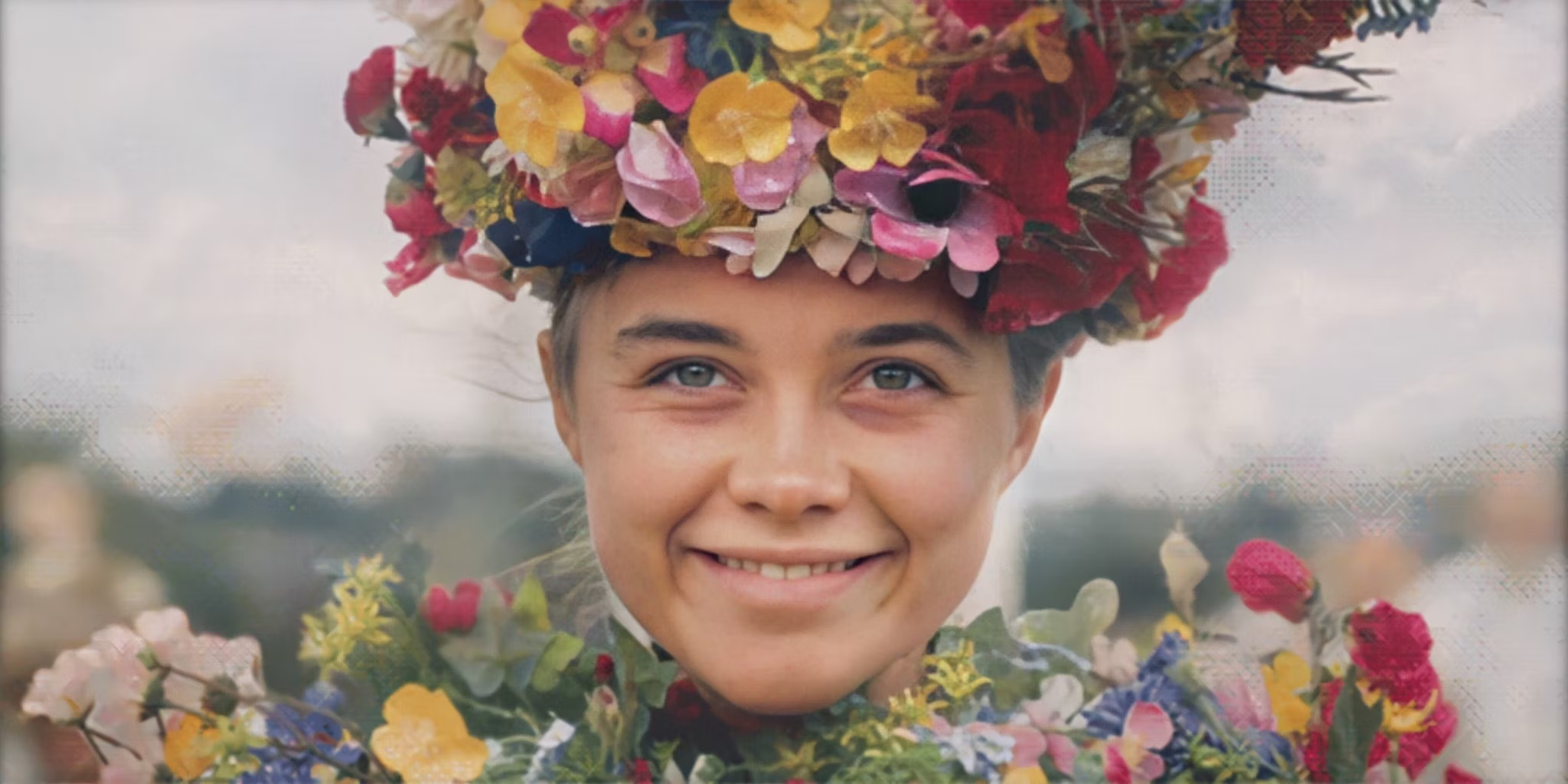
The final scene of No One Will Save You is blissful and happy, reminiscent of of the last moments of Midsommar (2019, dir. Ari Aster), when the camera slowly zooms in on the Dani’s face, which shifts from hopeless abjection to peaceful freedom, even giddiness, as Dani watches her (ex-)boyfriend burn alive in a bear costume (really, we just see the building burn, so it’s not a particularly savage image: it’s beautiful). The ending of Midsommar has been the subject of plenty of “ending explained” YouTube videos and a lot of critical commentary about what the end means from the perspective of feminism, academia, cults, trauma, grief, relationships, the Trump era, and more. Is Dani truly happy, is she coerced into happiness by the cult, what will happen when the Midsommar ceremony is over, will she stay in this community, is she some sort of pro-psycho killer (qu’est que c’est) person now, and so on—these questions all vie for our attention as the slow dawning of Dani’s realization of her freedom from everything weighing on her takes hold, whatever the consequences. And it comforts us, too, pushing away these moral questions with the slowness of the fade from the burning building to Dani’s face. We almost forget what she’s looking at and find instead solace in Dani’s smile, in this first genuinely happy moment she’s had the entire film (a film that is so thoroughly about her grief, trauma, rejection, dejection, and more).
No One Will Save You also leaves us in a similar place, watching Brynn perform the small-town community life she so desired, the one she practiced for, alone in her house, for who knows how long. We know she is free from the aliens’ parasitic hold, that all of her community is infected with the alien yeerks, and that they seemingly perform this communal “home town” happiness for her. Yet Brynn is totally happy; there’s no compromise here, as we might imagine in Midsommar, where Dani’s happiness is underwritten by a sense that she is emotionally broken. Brynn, by contrast, is the picture of unqualified bliss only seen in Hollywood musicals. Safe in her alien-controlled town, on a dance floor blanketed in Turkish rugs (a nod to the “Turkey carpet” from above) and soft yellow lights, “a smile on every face” in the community as they take turns dancing with her, she rushes toward the camera, welcoming the audience in, and seems ready to burst into song as the nostalgic notes of “Knock on Any Door” play the scene out.
Murray’s promise of belonging (“down in that old home town of mine”) carry the background dancers on into the night, Brynn returns to dancing with her enyeerked “friendly kind of folks who never ever let you down,” and the camera pivots to a sky peacefully occupied by alien spaceships.

It took yeerks controlling everyone around Brynn for the stigma of her childhood actions to fall away and allow her to find acceptance, welcome, and community again. Here she finds “a welcome rain or shine,” a place she could knock on every door, even if those at home aren’t really people anymore… Some people welcome our new alien overlords, and No One Will Save You suggests that maybe it’s because the aliens and their yeerk-brained human puppets make for better people than regular people do. They’re happier folks to belong among, like in the movies and songs and our nostalgic visions of better-whens. They aren’t burdened by memory, prejudice, or ideology. But, like those movies and songs and visions, the happiness is just a fantasy. How we live in the wake of that knowledge is up to us, and the choice we make, whether to accept or fight, tells us a lot about the world the fantasy papers over.
There is too much to say about No One Will Save You for one c. 2,500 essay. It’s the sort of film that critics yearn for because it can generate so much conversation, not just about the plot and tone and form, but about genre and ourselves. Here, silly and spooky aliens who chitter and warbled and do erratic dances to communicate with their spaceships become a rhetorical tool for examining about what we owe to each other as people, as folks who will leave the movie and return lives made up of friends, families, and communities who are bound to us through memories—some traumatic and, hopefully, many more positive ones—and to whom we are ultimately responsible. All of that from a film that has also inspired me to do my own alien dances and warbles for my partner’s entertainment.
No One Will Save You is a brilliant film that utilizes conventions from several genres to play out the psychodrama of a character whose isolation and unspoken traumatic past call out for audience identification. The mystery of Brynn’s personal history—why she lives alone in a house, who is Maude and why has she spent ten years writing letters to her, where is her mother, why do the people in town give her strange looks, why does the sheriff’s wife spit on her, and so on—weighs more heavily on the audience than the central shock of aliens invading Brynn’s house and the community that ostracizes her. The who and what and why of the aliens is, in the end, much less interesting that the who and what and why of Brynn and her social web.
The film is smartly aware of this and builds the mystery into the plot, revealing the trauma/crime only at the last minute, leaving the question of why the aliens react the way they do—why they free her and leave her the only human in a yeerk community—totally open. Is it because they empathize with her outsider status, because she is alienated socially, because she lives a metaphorical alien life that resonates with their real alienness? Does her alienation mean that the aliens have nothing to worry about, since she has no social or personal debt to the humans around her (though, we should note the bus driver tries to save her and the sheriff is clearly torn between empathizing with Brynn and being loyal to his wife’s feelings toward her)? Or do they recognize her as kindred in another way, as a killer? Or perhaps, as highly complex beings, they suspect that her depth of emotional complexity, through the intensity of the memories they see, set her apart and demonstrate that maybe some humans are different, above being yeerked? Still, what if it’s just good alien colonization policy to satisfy a difficult-to-control subject’s desperation for community so they stop rebelling?
Duffield’s perplexing ending leaves the field wide open and resists easy closure. It’s unsettling because most of the answers, whether to the aliens’ motivations or Brynn’s willingness to acquiesce to their fantasy, lead to uncomfortable conclusions about our complicity in regimes of power, identification, subjectification, nostalgia, and more. No One Will Save You speaks directly to its viewers both in its title and in Brynn’s final sweeping gesture toward the camera, at the audience, and to the state of the world and communities we inhabit—to the skies (metaphorically) occupied by aliens.
No One Will Save You shifts from the personal horror of home invasion, which is already a metaphor for our fear of social collapse, to the global threat of alien invasion, which catalogues any number of fears (ecological, social, racial, economic) that regularly rise to the fore of apocalypse stories. The film terrifyingly suggests that if the circumstances are just right, if our memories are just painful enough that what comes next could be easier, almost a release or even a wish fulfillment, then we might be willing to put up with just about anything. Yeerks included.
To get notifications about new essays like this one sent directly to your inbox, consider subscribing to Genre Fantasies for free:

 Genre Fantasies
One thought on “Watching “No One Will Save You” (2023)”