Linghun by Ai Jiang. Dark Matter INK, 2023.
Also read by this author:
I AM AI (2023)
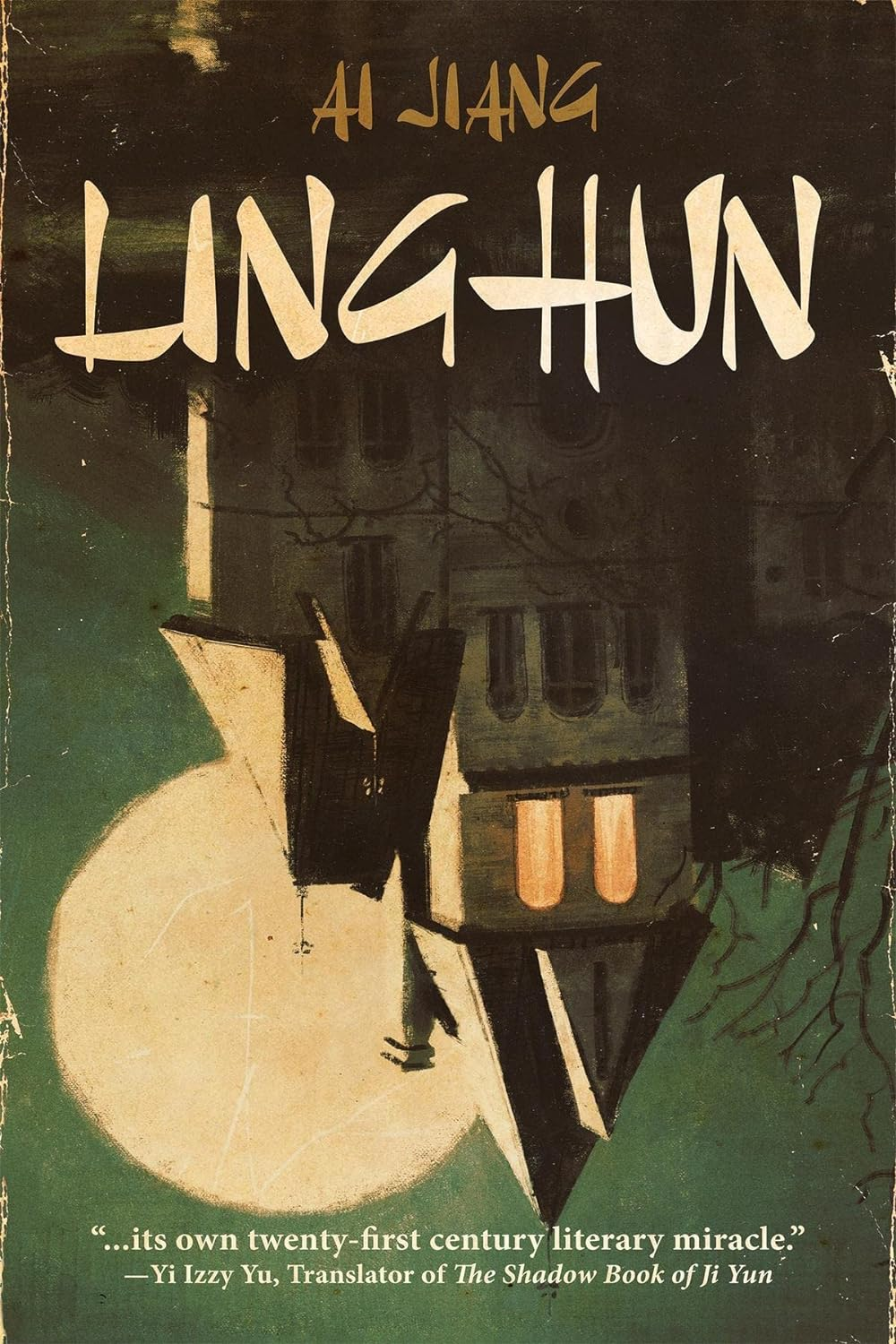
Ai Jiang is a new name for me, discovered by chance at my local anarchist bookstore, on an exquisite cover featuring what I was sure must be a haunted house but spun upside down. Annoyingly, the cover had no descriptive copy, opting instead for blurbs—mostly blurbs that say nothing about the book itself and why I would read it (when has “…a twisted-neck demon…” compelled someone to read a book? and having read the book, I have no idea what the blurber meant!), though one blurb came from Cassandra Khaw and another suggested this book was “…the blueprint for a new Hill House,” referencing the 1959 Shirley Jackson novel and, more recently, the 2018 Mike Flanagan adaptation. While I find those sorts of comparisons rather trite—a reader shouldn’t be searching for the next Hill House, they should be searching for the next thing that sets its own standard for horror—it was an intriguing proposition.
For those who pay attention to short fiction (I don’t), Ai Jiang is not a brand new name; she was nominated for a Nebula and a Locus, for the short story “Give Me English,” in 2022 and won an Ignyte Award for speculative poetry in 2023. The book that brought her name into my orbit, Linghun (2023), also just won a Nebula and a Bram Stoker—when was the last time a book won both? (Horror is often on the far outskirts of the Nebula, Locus, and Hugo nominations, let alone winners.) Already, her novelette I AM AI (2024) has been shortlisted for the Nebula, Hugo, and BSFA. I no longer follow the awards very closely, since my reading has drifted away from the hyper-contemporary of the genre except in horror, but within the first few minutes of starting Linghun I had put the book down to order I AM AI and bookmark her forthcoming novella duology A Palace Near the Wind (2025). While I can’t exactly say that Linghun is “its own twenty-first century literary miracle,” as Yi Izzy Yu claims on the front cover blurb, it is a powerful and compelling novella; it’s moody, grief-stricken, contemplative, hopeless, and beautiful.
With her novella Linghun, Jiang rewrites the haunted house story for herself, to vibrate at the frequency of her personal and cultural experiences with death, dying, and grieving, but more than that, she turns haunting into a critique of something as simultaneously mundane and impactful as the urban housing crisis of Toronto and its suburbs (which will resonate with people across the world), and molds grief for lives lost, and the time spent mourning those lives, into a metaphor for immigration and all the baggage it brings.
Moving HOME
Linghun is told from the perspectives of three characters and narrated in three points of view that match those characters. Wenqi is, for all intents and purposes, the “main” character of the novel, with more than half of the novella in her first-person voice. Wenqi has just moved into a house in the neighborhood of HOME, where she, Mother, and Father expect to be haunted by the ghost of her long-dead six-year-old brother, Tianqi. Liam is a lingerer; his family lives on Wenqi’s lawn in the hopes of one day owning a house in the neighborhood so they, too, can be haunted by a lost loved one (Liam’s sister). Liam’s story is told in the third person. And there is the mysterious older woman, resident longest in HOME, and known only as Mrs. Her chapters are narrated in second person and we later learn that she was called (or, rather, renamed) Linghun by her white husband and that her original name, in China, was Huijia. Mrs. may have been the first resident of HOME, as she lived in the house since the 1950s with her long-dead husband, who refuses to haunt her. All three perspective characters are Chinese or Chinese-Canadian (I could be wrong about Liam, though I recall a now-forgotten moment in the novel where Jiang seemed to imply he was Chinese; in any case, he’s not from Fujian province, where both Wenqi and Mrs./Huijia emigrated from).
As noted above and suggested in the character descriptions, Linghun is a novel about haunting. But not the “oh no we accidentally bought a haunted house” variety; there are no Indian burial grounds to symptomize colonialism, no rageful “evil places” drawing on the moral decrepitude of alcoholic fathers, no Satanic forces seeking to corrupt the pure and virginal. Instead, in Linghun, the locus of haunting but also of human life—think, “home is where the heart is” and the differences implied semantically and rhetorically when people quibble over whether a place is just a house or, something more, a home—is transformed into a real estate concern: the neighborhood of HOME, a buzzy acronym for Homecoming Of Missing Entities, which sits somewhere outside Toronto. HOME turns the supernatural into a commercial proposition. HOME makes haunting, the return of the dead for the sake of those grieving, into a commodity. Now the dead’s return can be purchased, if you’re willing to live in a neighborhood where the waiting list for housing means you must live, unhoused, on the lawn of the house you hope to later buy and, when the house goes to auction, to risk your life in the gladiatorial matches that can win you one of twelve chances to bid.
The novella starts when Wenqi and her family move in—the first to move to HOME in some time without becoming lingerers and participating in the deadly auction for housing. Mother bullied a family member who previously lived in the neighborhood to give up the house, citing some old family debt. Though it has been many years since Tianqi’s death and Wenqi hardly remembers what he looks like (though she vividly remembers the moment of his death, run down by a car), Mother is obsessed with reuniting with her son’s ghost. After all, he was the favored child, the hope of the family; Father is a sad, ambivalent figure who neither contradicts Mother nor fully commits to her obsession with Tianqi. As promised, Tianqi’s ghost shows up everyday and becomes the focus of Mother’s love and attention; Wenqi is sidelined, forgotten, scolded, and, worst of all, sees only a blank oval where her brother’s face should be. Meanwhile, Liam notices Wenqi’s dislike for HOME and its obsession with the dead, its disregard for the living and life, and schemes to get Wenqi to move out so that his family (who live on her lawn) can take the house and be done with their grief. He, too, disdains HOME and the way that the desire to reunite with the dead has totally engulfed his parents’ lives. And, across the street, Mrs./Huijia broods over her husband’s refusal to haunt her and schemes a way to get into another house to call his ghost.
Linghun tells its story with admirable brevity and emphasizes both the necessity of grief as a life-affirming process and the ways in which grief can subsume life in service of the dead. There are the lingerers, sad figures who sit on lawns all day, observe the families in haunted houses, and eat gray slop for their meals, only to rouse themselves for an auction to commit murder if they have to for the chance to live in a haunted house, to see their dearly departed again. There are those in the haunted houses, who give up everything to live in the ghostly presence of the dead, to inhabit the same routines day in and day out in service of the dead who, in Wenqi’s experience, are just the reflection of personal memories. And there is Mrs./Huijia, whose husband brought her to China as a mail-order bride (her words), changed her name to Linghun, and ignored her for decades until his death. Mrs./Huijia, who died once in her heart when she left Fujian, came to Canada, could not communicate with her white Canadian husband, and lived the life of a ghost; and who now lives enthralled to the idea of getting that same, uncaring husband to return to her as a ghost, but is denied.
The term linghun (靈魂) in Chinese refers to the soul but also to something more. As Yi Izzy Yu puts it in her foreword to Linghun, the word “means soul—either the soul of a person which survives death, or the soul of an artistic work so extraordinary in execution that it seems alive.” This dual sense of soul permeates the book, both as the eerie name given by (dead) Liam to his (then) wife Mrs./Huijia, which he misinterprets as spirit, and as the same name he gives to his house, ostensibly the first in the HOME neighborhood. Ironically, he does not haunt either Mrs./Huijia or his former house, no matter how much his widow makes it into a shrine to him. And Houses are both commercial objects in the novella as well as supernatural ones; homes to ghosts are the economic cornerstone of real estate agent Tricia Yemen’s business. The haunted and the lingerers alike seek out the souls of the departed, obsesses of them, turn their lives into husks until there’s nothing left but the hope to see the dead again. The dead themselves are souls, but they also become the artistic work of the memories of those who survived them, alive not so much as themselves but as the imitation of themselves as crafted by those who remember what they can.
The novella is a sumptuous feast for the critic; the prose is spare, but the ideas are multilayered and moreish. Moreover, there’s likely something intelligent to be said about the use of narrative voice—first, second, and third—but I’m not really the person to say it. I did note, however, that combining first and second person are interesting because they both implicate the reader but in different ways; we are meant to be Wenqi, to see things through her lens, and we are meant to be addressed by Mrs./Huijia, either as ourselves the reader or, more likely, as Wenqi. This is appropriate since, on her death, Mrs./Huijia gifts Wenqi her house and asks that she return a suitcase (filled with pictures and all the documents that remain to tell of her life) to her home village in Fujian—a village which no longer remains, 70 years after Huijia left it. Moreover, Huijia tells us that she was once called Wenqi, that her husband was Liam, that she sees in this younger Wenqi and Liam the version of herself and her husband that she wishes had been.
Central to all of these discourse of death, haunting, memory, and narrative perspective is role of culture, language, and place. Death and grieving are highly personal—Mother’s obsession with making youtiao and only youtiao, every day, is specific to a Chinese family from Fujian—but they are also communal, cultural. Language is important and multivalent here: it’s a barrier (can dead-Liam haunt Mrs./Huijia if she calls to him only in Chinese, which he never bothered to learn?); it’s an opportunity (that Wenqi speaks Chinese allows Mrs./Huijia to communicate with her, to finally find a way past her circumstances); it’s a memory (life back in Fujian is a life lived in Chinese, whereas in Canada, it’s a life lived in English); and likely much more than I’m missing. The Chinese-ness of Linghun is central to the novella and one that, gladly, Dark Matter INK did not shy away from by, say, forcing Jiang to adopt a translated term or a more “Western” title. And rightfully so, because while stories of grieving and death, but also of immigration and of growing up, are in some sense “universal” (I would say in a sense so big as to be virtually meaningless as a distinction), such stories are also personal, regional, cultural, etc.—in short, they are shaped by something particular to their author. And they are the more meaningful for it. There is no Michael McDowell without Alabama, no Hayao Miyazaki without the childhood in wartime and postwar Japan, no Stephen King without Maine, no Ai Jiang without her being who she is.
TL;DR
Linghun is a rich generic text, criss-crossing the haunted house genre, subverting expectations about the purpose and mood of the haunted, indexing the suburban hellscape of (post)neoliberalism as the locus of horror, and ruminating nearly constantly on death, dying, grief, and the ties that bind us to the past, to family, to community. As a Chinese-Canadian writer, Jiang has infused all of this generic richness with her own experiences of immigration, of witnessing death and dying in a transpacific Chinese family; she brings those personal touches to Linghun and and layers them in the histories of characters who cross generations and experienced China, Canada, and both differently. One might say that Linghun is a Chinese-Canadian suburban Gothic, since through the experiences of the author and the story she tells, that is in some sense precisely what it is and the set of concerns it speaks to. But then who needs such hyper-specific generic pigeonholes when it’s the playfulness, the unpredictability, the un-pin-down-able-ness of texts like Linghun that make them so exciting, so refreshing, that make you take notice of a new star in the sky?
Ai Jiang’s Linghun deserved its awards, and more, and marks the emergence of a new writer to watch. I haven’t been this excited since Stephen Graham Jones popped into the horror scene, and already Jiang is moving beyond generic restrictions, within two years winning and being nominated for awards in both horror and science fiction, prose and poetry, and tackling haunted houses, cyberpunk, and (in 2025) fantasy.
There’s very little to be excited about lately, but then there’s also Ai Jiang.
To get notifications about new essays like this one sent directly to your inbox, consider subscribing to Genre Fantasies for free:

 Genre Fantasies
One thought on “Reading “Linghun” by Ai Jiang”