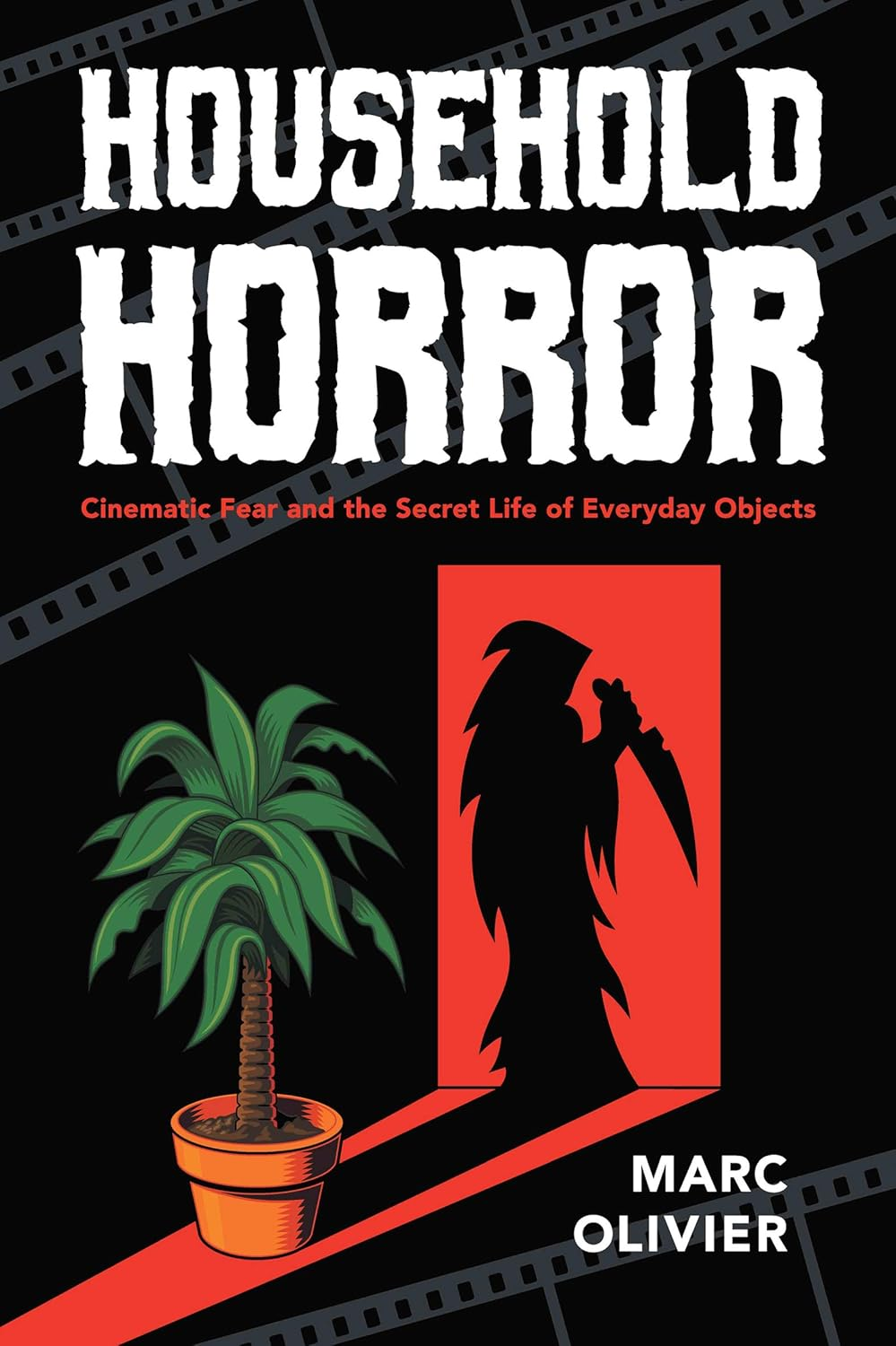
Household Horror: Cinematic Fear and the Secret Life of Everyday Objects by Marc Olivier. Indiana University Press, 2020.
Please, N-OOO More!
Object-oriented ontology (or OOO) is spiritualism for the twenty-first century humanities. Practitioners, we might call them, “hear” objects “speak,” as one critic puts it:
[object-oriented ontology] exhibits a very strong humanism and a rather traditional ontology in that they claim to hear things “speak,” recording things’ voices, registering their presence, and heeding their indifference. Indeed, this ontology is so traditional as to be just another instance of logocentrism and ontotheology, those ancient traditions in which things speak their being and call out yearningly to the observer.
Object-oriented ontologists give objects inner lives, experiences, perspectives, and vitalities of their own, not merely as metaphor—for example, to say that the mirror “sees” us—but as statements of flat ontology that give objects life, that is, that make objects “human,” briefly anthropomorphizing them so that we might see objects as “like us,” as worthwhile of analysis, as agents in narratives, not merely things acted upon, used, and whatever phrases express our supposed passive non-acknowledgment of objects and things as significant.
It’s a mode of thought that gives objects primacy alongside the human or the monstrous (hence its popularity in studies of Lovecraft and other authors of the Weird; weirdly, I see very little in their discourse about the animal, an ontological difference I have much more sympathy for despite the occasional oddities that emerge from animal studies). In my own world of literary and cultural studies, object-oriented ontology seems like a reaction to the materialism of the 20th century but that cringes from the politically valuable material analyses of Marxism.
In short, I think object-oriented ontology is mostly bullshit (and here I invoke David Graeber’s notion of bullshit jobs, though I don’t think object-oriented ontology damages society in the way bullshit jobs do; at best, you can largely ignore object-oriented ontology, at worst you have to suffer through its blathering to find what few useful kernels it obscures). No object-oriented analysis I’ve read adds anything to the critical conversation by virtue of its object-oriented analysis; put another way, object-oriented analysis doesn’t, as a method or a theoretical approach, add anything that can’t be gotten elsewhere. Discard the object-oriented ontology and you might have something worthwhile. What object-oriented ontology does add, is a self-congratulatory wankery that prioritizes metaphors, unwieldy connections with topics far beyond the critical concerns at hand, and an unfounded surety that the analysis just given somehow makes objects come to life, tells us something special we didn’t know—without telling us much of anything.
And yet, making things the subject of analysis makes total sense. Things, objects are everywhere; there’s no life, no being human, without things: food, clothing, shelter. At every moment in human history, we’ve lived thingful lives. Yet, scholars and especially historians have been doing analysis of things for, well, decades, in the forms of material analyses, histories of commodities, studies of the material relations within a society, and so on. Historians, sociologists, anthropologists, and more have had very few qualms about focusing on the thingful lives humans lead. Object-oriented ontology has taken over primarily in philosophy and literary and cultural studies (though, even in series like Bloomsbury’s Object Lessons, co-edited by Ian Bogost and Christopher Schaberg, object-oriented ontology is not the primary method of analysis driving the volumes). Object-oriented analyses are often practiced not in studies of objects qua objects, but in studies of objects as represented in literature, media, culture, etc. That is, objects as mediated through narratives of various kinds, thereby revealing their “secret,” “inner,” or “hidden” lives—an important distinction since it is precisely this vitalist metaphor of objects’ lives that is made possible through the narrative techniques of literature, film, games, comics, and so on.
As noted above, object-oriented ontology has been especially prominent in studies of horror and the Weird, thanks in large part to the influence of scholars like Graham Harman, Timothy Morton, and Michel Houellebecq, who have through their disparate philosophies informed the creation of speculative realism and object-oriented ontology, the former of which has been described as a kind of “continental materialism” (though that seems an oversimplification of the intellectual diversity of the continental tradition’s engagement with materialism). Horror, in particular horror films, make a lot of sense as the subject of analysis for a field focused on objects. The slash of a knife, the mask of a killer, the tantalizing pseudo-opacity of the shower curtain, the door behind which something lurks, the doll possessed by a demon. Horror is a rich megatext where objects both literally and figuratively take on life. So a mode of scholarship that turns its attention to the “lives” of objects finds purpose here. It’s almost a “see, we told you!” for the field.
Household Horror
Marc Olivier’s Household Horror: Cinematic Fear and the Secret Life of Everyday Objects is the first book-length study to bring the practice of object-oriented ontology to horror, and specifically horror film. As Olivier argues in his introduction,
Horror recovers the wonder and fear of objects in a way that approaches the sincerity of a child frightened by the shapes of objects in the dark. My object-focused view of horror decenters the human in a similar manner to OOO and speculative realism.
The book’s approach is to offer a series of readings of different “everyday” objects found around the house and which take on new meaning in the context of horror films. Olivier’s filmography is wonderfully expansive—Possession (1981), Gremlins (1984), I Saw What You Did (1965), Black Christmas (1974), Noriko’s Dinner Table (2006), Sisters (1973), Poltergeist (1982), Carrie (1976), The Silence of the Lambs (1991), May (2002), Invasion of the Body Snatchers (1978), The Exorcist (1973), A Nightmare on Elm Street (1984), Halloween (1978), The Others (2001), The Shining (198), Misery (1990), A Tale of Two Sisters (2003), Eraserhead (1977), The Bad Seed (1956), Rosemary’s Baby (1968), The Exorcism of Emily Rose (2005), and Psycho (1960)—and seemingly driven by the need to speak about certain objects. (Olivier admits to leaving out films that might seem appropriate for a given object, but doesn’t explain why beyond the admission; generally, I think that’s the prerogative of the author and a book can’t do everything!)
Olivier’s chapters map to specific objects and are organized into sections based on the room they “belong” to: refrigerator, microwave, telephone, and dining table in the kitchen; (sleeper) sofa, remote, sewing machine, and houseplant in the living room; bed, typewriter, and armoire in the bedroom; radiator, pills, and shower curtain in the bathroom. Some of these objects don’t seem, to me, to “belong” to those rooms (and they don’t appear in those rooms in a number of the films covered), but the logic of “mapping” objects to the domestic space is a smart approach to breaking up the relations between objects, domestic life, and the ways in which those two things become imbricated in horror films.
Importantly though awkwardly, Olivier distances himself from object-oriented ontology in his introduction, noting that Household Horror is “object-centered” but “not strictly speaking about object-oriented ontology.” And yet he claims Ian Bogost as “the patron saint of this book” and refers regularly to other key “patrons” of object-oriented ontology throughout the chapters that follow. For Olivier, the distinction between an “object-focused” book and one “about” object-oriented ontology seems to mean that his book does not address philosophical arguments about materialism found in Kant, Heidegger, Houellebecq, and others—that is, he does not address the arguments at the base of object-oriented ontology. That’s fine; many literary and film studies do not address the arguments at the base of, say, Marxism or queer theory, even as they participate in conversations that are clearly Marxist or queer, though they don’t claim to not be Marxist or queer in the way Olivier claims not to be doing object-oriented ontology.
Still, Olivier claims:
I start from a position of belief in the dehierarchizing principles of object-centered thought, and then I see how the objects in scary movies take on new dimensions when seen through 3-O lenses. I agree with the object-oriented crowd that “cautious anthropomorphism” is a useful weapon in the fight against anthropocentrism.
In other words, despite the hand-wringing distancing Olivier is doing, Household Horror definitely is a work of object-oriented ontology. But, rather than using horror films to drive forward our understanding of object-oriented ontology, Olivier uses object-oriented ontology to drive forward our understanding of horror films and the objects in them. As noted above, this is a pretty typical literary and cultural studies approach to using theory (that is, a scholar typically wouldn’t say “this is not a feminist work but I use feminist analysis”), so it’s unclear why Olivier tries to make such a distinction except to set aside the deeper questions in speculative realism and object-oriented ontology that don’t come up here.
At this point, I’ve written nearly 1,500 words mostly complaining about object-oriented ontology and without saying much about what it is Olivier does in this book aside from the scope of its filmography and its objects-in-rooms structure. That’s because, for me, Household Horror accomplished very little. I admit, obviously, to being not just a skeptic but an intellectual enemy of the object-oriented ontology project, but I was nonetheless thrilled by the premise of Olivier’s study and excited by its range of films, some expected, some new to me, and some delightfully repurposed to offer interesting analyses of various objects. Moreover, Olivier is an engaging and often funny writer, which comes through in his prose and is exemplified in the fact that he was trained as scholar of seventeenth-century French literature and has impressively moved into the realms of film and horror studies without betraying that he wasn’t doing this all along.
Where Household Horror shines is in its analyses of the role of objects in everyday life as they intersect with the role of those objects in horror films’ narratives. This is done perhaps most successfully and convincingly in Olivier’s chapters on the microwave, typewriter, and shower curtain. In these chapters, Olivier offers excellent cultural historical analyses of these three objects and intersplices those with analysis of scenes from Gremlins (microwave), The Shining and Misery (typewriter), and Psycho (shower curtain). Olivier provides material histories of these objects, tells us about their changing relationship to people over the course of the twentieth century and the cultural narratives that built up around them, and generally does some excellent cultural studies scholarship. The analysis of scenes from these films are then enriched by these material histories and he uses the scenes to further explore the role horror played both in real life (e.g. fear of microwave radiation or the chemicals in plastic shower curtains) and in the narratives at hand. Most importantly, these are chapters where Olivier’s efforts to “bring the objects to life” really wane, since both the cultural history and the scenes themselves are rich enough to propel his analysis without needing to resort to overwrought metaphors and pseudo-experimental stylistic choices to make his point.
By contrast, take, for example, Olivier’s chapter on the remote, which begins with a discussion of how the remote made it possible for us to channel surf, to avoid advertisements, to make new artistic connections between televised broadcasts thanks to the material and technological intervention of the remote allowing us to flip rapid-fire between channels. There’s some interesting but mostly fluffed up philosophizing here that draws on McLuhan before Olivier turns to the chapter’s primary film, Poltergeist. Of course, the film is absolutely about an object: the television. Poltergeist is pretty famously associated with TVs in the cultural imagination, both because of the film’s poster, but also because of the scenes of Carol Anne staring into the static of the TV, her talking about the “TV people,” and her getting reverse-possessed into the TV. But Olivier chooses to focus on the remote, on the idea of changing the channel, mostly because it allows him to talk about one scene where Steve Freeling and his neighbor change each other’s channels because their remotes are able to affect each others’ TVs. Olivier also adopts an artistic approach in this chapter, offering a series of rapid-fire sections, each a few paragraphs, that switch between facts (sometimes rather random) about TVs and remotes, and analysis of scenes from the film. The idea here is to reproduce, in some sense, the experience of flipping between channels. It’s a cute idea, and he does similar things throughout the book, but it hardly works, it doesn’t add to the analysis, and the choice to focus on the remote and try to bring in quantum physics makes Olivier’s reading of the Poltergeist somewhat incoherent.
Beyond this, which I chalk up to an admirable desire to break the (often boring) mold of academic analysis, and to rightfully attempt to bring a playful aspect to scholarly writing, what’s more damning—more specifically, about the book’s use of object-oriented ontology—is that Household Horror doesn’t really do what it says, theoretically and methodologically, it’s intending to do. Olivier’s study doesn’t re-orient the hierarchies of human and non-human, it doesn’t flatten the ontologies in any way except through metaphor, and that hardly suffices as a critical endeavor. Moreover, Olivier concludes by asserting that “to engage objects is thus to witness terrifying density through monstrous deformations. Object-oriented ontology […] is a horror story.” But this is meaningless, because it is only the asserting of object-oriented analyses and of the (supposed) density they reveal as monstrous, that makes them monstrous and therefore makes the flattening of hierarchies into a horror story. For others, flattening or destroying hierarchies is liberatory and joyful. These are chosen metaphors, ideological positions ratified as realities through their very assertion. It’s maddening!
As noted, Olivier interjects lengthy discussions of the cultural and material history of objects, and I think this is intended to take up the “flattens ontologies” part of the methodology, but this doesn’t result in a study of horror, say, through the eyes of the objects no matter how many active and agential verbs are assigned to objects. Olivier points out in the conclusion:
Rich interpretive possibilities emerge from the mundane once we see things no longer “hazily as bland instruments of our will” but rather as beings “marked by sincerity”—that is, as things that exhibit their own inner life.
And that,
We can walk through a house of objects bathed in multitude and see a vitality that questions human exceptionalism.
These claims suggest that by seeing objects as alive with an inner life, giving them vitality, we can question human exceptionalism. This raises two major concerns with the whole project of object-oriented ontology. The first is that things don’t need to be “alive” or to have an “inner life” to be valuable subjects of analysis. What an odd claim! The second is that objects don’t need to have life, to be alive, in order for us to challenge human exceptionalism—and anthropomorphic metaphors, even if “wary,” is a questionable way to undo human exceptionalism by metaphorically making things human in order to both see value in them and undermine the value placed in humanness.
Object-oriented ontology, in the framing offered here by Olivier in his final goodbye to the reader, is not only intellectually lazy but absolutely—purposefully?—apolitical. Instead of turning to the many, many, many (many!) theoretical projects of the last 40+ years that both give value to the non-human and challenge human exceptionalism, object-oriented ontology invents a way of using metaphor and other neat tricks to give objects life and then to bask in the horror of that inner life revealed. It’s Theory Bro bullshit that never ceases to amaze me.
TL;DR (Still, Please, N-OOO More!)
Despite its pretensions, Household Horror is something more like a material analysis of horror narratives and, more often than not, a competent and welcome cultural studies approach to horror films that focuses on the objects in networks of relations with humans. It doesn’t manage, ever, to convince me of the bigger picture of flattening hierarchies, of somehow shifting to an object’s perspective, since it never accomplishes such a flattening or an assigning of vitality to objects—a project that, to me, is already suspect.
As a cultural history of objects in horror, Household Horror is a pretty competent study undone by its weird attempts to be a work of object-oriented ontology. While it has its moments and provides some worthwhile readings, as an example of object-oriented ontology, it doesn’t show me what, exactly, that means beyond a cultural historical and material analysis of horror narratives. Olivier leaves me still convinced that object-oriented ontology is mostly theoretical bluster about how, if you do this one crazy trick, it will completely shift the way we think about blah blah blah. It won’t.
In other words, Household Horror would be a great book for someone to write.
To get notifications about new essays like this one sent directly to your inbox, consider subscribing to Genre Fantasies for free:

 Genre Fantasies
2 thoughts on “Reading “Household Horror: Cinematic Fear and the Secret Life of Everyday Objects” by Marc Olivier”