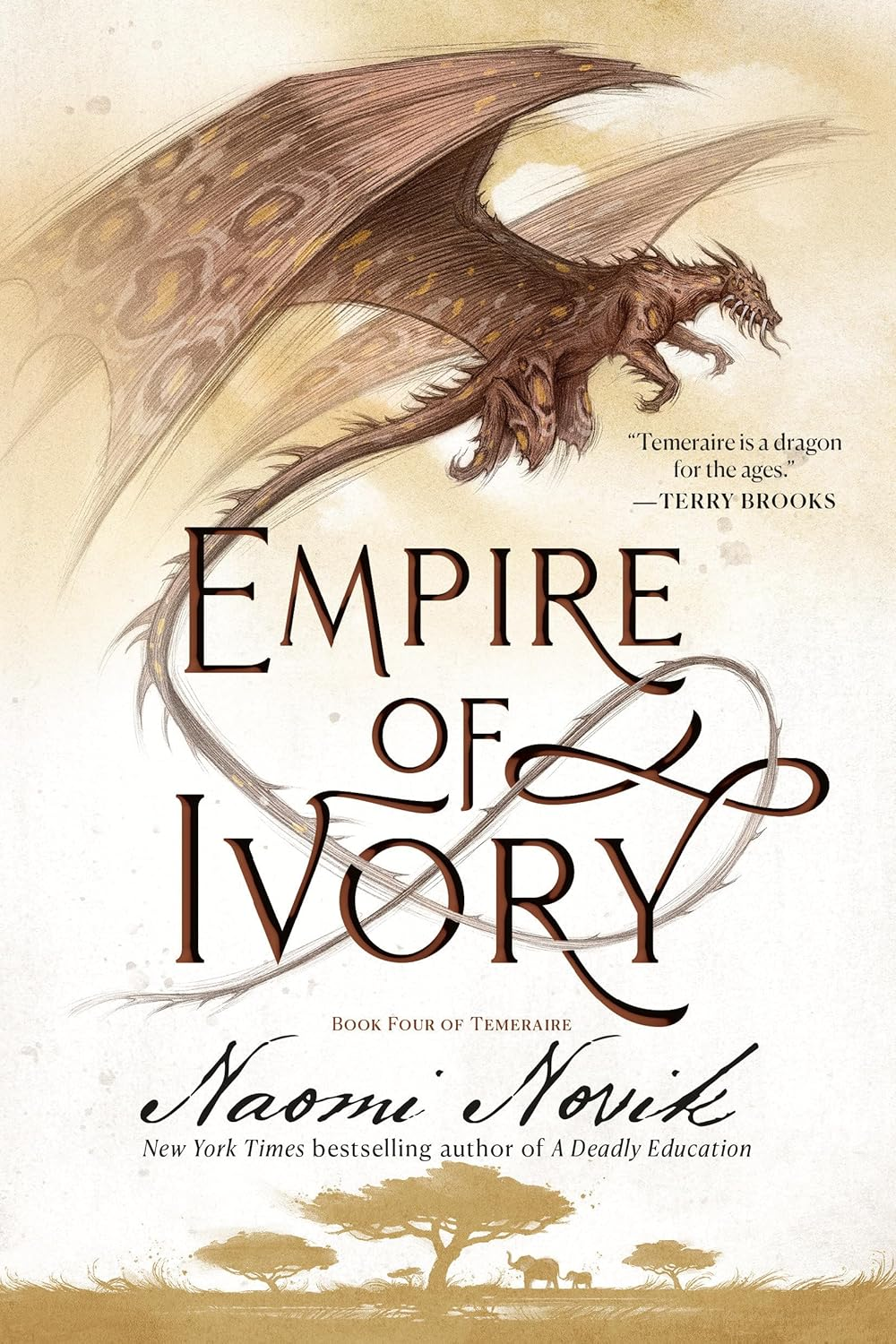
Empire of Ivory by Naomi Novik. 2007. Del Rey, 2022. Temeraire 4.
Also read in this series:
Black Powder War (2006) (Temeraire 3)
Months ago, in my essay on the third novel in the series, Black Powder War (2006), I opined about the many things that make Naomi Novik’s Temeraire series so thoroughly underwhelming, if not disappointing, while wondering why I continued to read it. Continue I did, despite my misgivings, with the fourth novel—largely because, as with the previous two novels, it promises a trip into a new part of the world touched by Novik’s alternate history fantasy: southern Africa.
Empire of Ivory (2007) is by far the most substantively interesting of the Temeraire novels so far. And it only took c. 900 pages of mediocrity to get here! Though, while it’s certainly a much more interesting novel, it isn’t any great literary revelation and maintains the series’s nearly soulless focus on plot to the exclusion of all else that could be interesting. Empire of Ivory rises above damning with the faint praise of “ok, yeah, that was fun!” in large part because it has, as evidenced by this essay, provoked more than 7000 words of response from me. And while Novik’s fourth book in the series has led me to some insights about strategies of alternate history narrative and worldbuilding, the novel nonetheless leaves me doubting whether I should continue the series.
Temeraire in Africa (and in England and on a Boat and in France)
Empire of Ivory picks up right on the tail of Black Powder War: Temeraire, Iskierka, the “feral” dragons from Central Asia, and their crews flee across the North Sea from continental Europe to the British coast, Prussian soldiers—survivors of Napoleon’s victory at Danzig—hanging on for dear life. In the first third of the novel, Temeraire and crew return to a Britain that is eerily dragonless and learn that, while away on their Chinese sojourn and travels back through the Ottoman empire, a Dragon Plague (similar to the one Temeraire had early in Throne of Jade) has spread through the Aerial Corps and is likely to leave the British Empire nearly dragonless if allowed to progress without a cure. Recalling that Temeraire was cured of his earlier ailment while berthed in the Cape Town colony, Laurence and crew, accompanied by the rest of Temeraire’s wing (Lily, Maximus, Dulcia, Nitidus and crews) and a formerly enslaved minister, his wife, and their children (the Erasmuses), are sent on the Allegiance—a massive ship used to carry multiple dragons and captained by Laurence’s former Navy friend, Tom Riley, whose family is rich from Caribbean slave plantations—to southern Africa in search of a cure.
The second third of the novel takes place in Cape Town and its surrounds as Temeraire, et al. search for the cure to Dragon Plague, which they remember was a stinky mushroom. Only, the mushroom is rare and the team needs help from locals who know the southern African bush… so they decide to contact the “natives” and ask for help, since the local British garrison doesn’t really know any Africans, apparently, and the Boers don’t want to help the British. Temeraire and co. fly into the bush and meet two young Xhosa boys, Demane and Sipho, whose dog can find the mushrooms. Through pantomime and a few words Mrs. Erasmus has learned, Laurence convinces the boys to help them find mushrooms in exchange for a cow. They find plenty of mushrooms to cure Temeraire’s wing, but not enough to cure the Dragon Plague across the British Empire: they need more!
Convincing the Xhosa boys to stay with them longer, Temeraire and the smaller dragons risk a flight “into the interior” of unsettled southern Africa. And, damn, they find a whole cave of the mushrooms, but discover that it belongs to an autochthonous African kingdom—the Tswana—who are not at all friendly to Europeans, since they are enemies of the slave trade and the African polities who sell enslaved Africans to the Europeans. What’s more, dragons also have a prominent role in Tswana society (more later). But the Tswana won’t treat with the captured British dragon crews, so Temeraire and the other dragons break them out and in a breakneck final chapter of the section Temeraire’s wing escapes from the Tswana stronghold of Victoria Falls/Mosi-oa-Tunya back to Cape Town, which is in the midst of being sacked by the Tswana. They escape Cape Town on the Allegiance and proceed back to England.
The final third of the book begins with their return to England via the Western coast of Africa, where they discover that the major European ports of Benguela and Luanda (in our modern Angola) and Cape Coast (in our modern Ghana) have also been sacked by the Tswana, who flew their considerable dragon armies incredible distances across the continent to destroy all of the major European slave-trading ports, in doing so virtually ending the transatlantic slave trade, which was dominated in Temeraire’s world as in our own by the British and their allies, the Portuguese. (It’s not entirely clear where the French fit into this in the world of Temeraire, since Novik’s novels play up the tension in England around slavery and the abolition movement, emphasizing in particular both Laurence and Temeraire’s disgust for slavery, but the French were the third most active slave-trading nation in Europe, which led to the transportation of more than 1 million people in less than 300 years.)
On returning to England, they begin curing the Aerial Corps dragons with the additional dragon-loads of mushrooms they (accidentally) stole from the Tswana, but Laurence and his fellow pilots are called to account for what the British military leaders see as their recklessness in provoking a war with the Tswana that led to the loss of four major Atlantic ports—with the exception of Admiral Horatio Nelson, who points out that the French lack ports in Africa, and who seems generally enamored of Laurence and Temeraire after an earlier meeting. The British leaders view the Tswana as savage and irrepressibly violent (Laurence doesn’t seem to disagree with the latter). They do not see the Tswana’s attacks against slavery as justified, since they both view the Tswana in colonial-racial terms as inferior (though, note that at this time Britain had not claimed the massive portions of Africa that it later would during the Scramble for Africa) and in nation-state terms as having attacked without provocation (for though the British may practice slavery, which the Tswana see as a moral and ethical blight, as well as a colonial enterprise against the peoples of Africa, the British believe that it should be of no concern to another nation-state what the British do under their own laws).
At their meeting with the British leaders, Laurence and his fellow captains also learn that the admiralty knowingly dispatched a captured and now Dragon Plague-infected French dragon back to France, and have thus purposefully engaged in germ warfare to weaken Napoleon at the expense of the French dragons’ lives. Temeraire rightfully understands this to be a war atrocity and yet another example of the British Empire’s treatment of dragons as animals. In his rage at this war crime, Temeraire decides he must steal some of the mushrooms that the British have now begun to grow and give them to France to prevent unnecessary dragon deaths. Laurence, who agreed with the grossness and dishonesty of the admiralty’s actions but was unwilling to do more than fume about it in an oh-so-gentlemanly way, resolves to accompany Temeraire, knowing that doing so is treason. They sprint to Scotland, nab some mushrooms, and escape to France.
In France, Temeraire and Laurence see that Napoleon, through his association with the Chinese dragon Lien, has utterly transformed Paris into a dragon-friendly city where, as in China, dragons roam about as equal citizens—this reflecting the changes Laurence and Temeraire had already observed in the French military in Black Powder War. Laurence is welcomed and lauded by Napoleon, who offers both him and Temeraire a home in France for the bravery and selflessness of their actions. He does not ask Laurence to fight for France, but simply to remain in France so that he is not executed in England. But Laurence is a man of honor and he really really really hates the French. Not only does he claim in this segment that he is glad never to have been born French, but he regularly refers to Napoleon as a petty tyrant, despite the narrative never showing Napoleon to be anything but generous and open-minded. In fact, Napoleon points out to Laurence that his own England is ruled, in theory, by a king (like Napoleon) and its supposedly democratically representative Parliament is ensnared by the whims of a few oligarchs and military men (Napoleon’s France also had a Parliament and the Napoleonic Code increased equality between the classes and between men and women, though his wars caused enormous suffering and unnecessarily extended French imperial control across Europe, and he was indeed an autocrat). Laurence decides to return to England to surrender for treason, to face the consequences of his actions; Temeraire accompanies him, knowing they both face death or life imprisonment.
Empire of Ivory is, as the foregoing suggests, a much more interesting novel than any preceding one in the Temeraire series. There is decidedly less naval-military action than in the earlier three—I find descriptions of battles in literature quite boring—and the novel introduces an interesting new polity, describes a new social relationship between dragons and humans, deals with major political questions like slavery and just warfare, and gestures toward the series eventually saying something more about dragon rights and gender relations. When the novel is more interesting than its predecessors, it is still often just as frustrating for the way Laurence acts and how the narrative is always framed through Laurence’s politically apathetic and Empire-loving worldview. But I want to focus on perhaps the most interesting and conceptually productive aspects of Empire of Ivory in the next three sections: (1) the Tswana Kingdom and their dragons, (2) tensions between narrative and worldbuilding in alternate history, and (3) the geopolitical stakes of racial slavery in the series.
The Tswana Kingdom and Its Dragons
One of my greatest complaints about the series so far is how very little dragons seem to have changed the course of human history, in large part, it would seem, because the “taming” of dragons appears in most cases to have occurred in the cultures that already, in our world, rose to regional and global prominence, meaning that on the geopolitical whole, nothing was all that different. Perhaps this makes sense. Perhaps not. But there have been inklings around the edges of the narrative’s storyworld that some things might be different. For example, rarely do we ever here about the Americas, which might lead to some speculations about the status of the United States and of earlier British colonies in the Americas in Temeraire’s world. We know that the British have Canada, since there are dragon breeding grounds in Newfoundland, and we know that Indigenous Americans have dragons, since a dragon from the Indigenous Dakota people was traded (I believe, as a prisoner of war) into the Welsh breeding grounds—and it was this dragon who brought the Dragon Plague. But as of Empire of Ivory, we know very little of the world beyond Britain, China, the Ottoman Empire, and continental Europe; we had been to Cape Town before, but saw nothing of it.
Empire of Ivory gives us a major world-historical shift, and a relatively interesting one that Novik elaborates with a new social relationship between dragons and humans, by introducing the Tswana Kingdom as a major regional force—and, later, an ally of the French, thus taking on geopolitical importance. To be clear, the Tswana are a real people, part of the larger Bantu ethnolinguistic group that occupies the vast majority of subsaharan Africa. Today, the Tswana are the dominant ethnolinguistic group in Botswana and are closely related to the Sotho people of Lesotho (an independent nation inside of South Africa). They are occasionally referred to as the Sotho-Tswana people. The Tswana were a significant political force in southern Africa, as the Dutch and British learned; they maintained partial political autonomy in the Victorian era, resisted South Africa’s attempts to gain control of their nation (and its resources) in the postwar period, and gained political independence in 1966 as Botswana.
Novik’s alternate history doesn’t take the obvious tack to raising up a major political force against the British in southern Africa. We might expect her to make the Zulu or the Xhosa into the African polity that changes southern African and, indeed, world history, since both groups warred against the British (and Dutch before them) over the course of a century and remain significant political actors in southern Africa to the present day. Or we might expect more northerly people of southern Africa to be given the mantle, such as the Swati/Swazi or Ndebele and Nguni peoples, both of whom had major kingdoms in what would become Cape Colony. Or we might expect to see a multi-ethnic coalition of southern African peoples. Or that there might have already been significant resistance by dragon-riding southern African peoples.
But the Tswana make an interesting choice because they are neither historically nor geographically the obvious one. It’s entirely possible to quibble the minutiae here and explain why this is not the best choice, in terms of alternate history worldbuilding, for XYZ reasons, but I’m not exactly inclined to purist historical alternatives (or, at least, I try not to be, though I think anyone with an interest in alternate history and history itself occasionally fall prey to that trap). I might argue here and there about the likelihood of worldbuilding choice or its narrative, political, and critical implications, but I welcome surprising alternatives that extrapolate well. What’s more, Novik gives us excerpts, as an appendix, from the fictional nonfiction book The Tswana Kingdom: A Brief History (1838) by Sipho Tsuluka Dlamini (we can assume this is the same Xhosa child who ends up joining Temeraire’s crew when he and Demane are forced to flee Cape Town), that provides great alternate historical context that rationalizes the growth and development of the Tswana as a joint kingdom of the Sotho and Tswana people united by their ethnolinguistic ties, practices of “dragon rebirth,” and elephant herding.
In Temeraire’s early-19th century southern Africa, the Dutch (then called Boers, today called Afrikaaners) have not progressed all that far into the continent, and the British have hardly done more than place a garrison in Cape Town in the 13ish years since the British took Cape Colony from the Dutch. This is owing largely to a fear of feral dragons living in the veldt and forests of southern Africa. Beyond the “frontier” of settler farmland, the British seem to have no idea what’s “out there,” they speak no African languages, and can apparently find no Indigenous people who can provide information about the world around Cape Town—in arrogant settler-colonial fashion, they simply don’t care: if there’s anything out there, they’ll conquer it when they need to. But the Tswana are out there, we learn, and they will not be conquered.
Our first encounter with the Tswana comes in the form of a dragon, whom Temeraire and crew take to be one of the feared southern African ferals, but they soon learn that the dragons here are not feral—in the sense of wild, monstrous, unthinking animals who cannot be reasoned with, which is an odd implication of the concept of “ferals,” given that Temeraire and co. have befriended a dozen “ferals” who speak a language, have a culture, and learn to cooperate, even if they are portrayed as greedy and childish—but are a part of the Tswana themselves. Our second encounter with the Tswana is with their mycoculture. The British think they’ve discovered a cave full of wild Plague-curing mushrooms only to learn that they are, in fact, deliberately cultivated by a people who live intimately with dragons as quotidian parts of their lives. Even more, the dragons in Tswana culture are both people, like they are in China, and family.
When Laurence and co. are captured by the Tswana, they quickly learn what a complex culture—and regional power—they have been somehow missing the existence of. But the Tswana know them, or at least, they know that Europeans mean slavery and they are so staunchly against both slavery and other African kingdoms participating in the slave trade that they kill the reverend Mr. Erasmus who travels with Laurence when Mr. Erasmus tries to speak with the Tswana and reveals he was born among the Lunda. The Lunda, a people from the southern Congo, have recently been defeated by the Tswana in a war to end the Lunda’s participation in the slave trade. Because the slave trade has decimated the populations around the kingdoms of the coast participating in it to their leaders’ financial benefit, the search for new Africans to enslave has migrated further and further away from the coasts, making the Lunda of central Africa a new participant in the trade, and affecting too the Tswana, who have lost members of their tribe and their families—like Mrs. Erasmus, who turns out to be Tswana—to the slavers.
Though she is introduced, it seems, to play a small but key role as a translator for Laurence, since she learns languages quickly—apparently quicker than Temeraire, who despite knowing they are in Africa, doesn’t learn to speak any Khoisan or Bantu languages!—Mrs. Erasmus becomes a pivotal character. Not only is she Tswana (her name is Lethabo), and thus quickly accepted back into Tswana society so that she is able to speak positively on Laurence’s behalf, but she is the granddaughter of Kefentse, the fierce dragon who captured Laurence and co. With Lethabo as our translator, we learn that the Tswana not only live with dragons and include them in all levels of society as workers and soldiers, but that they see dragons as people, or, rather, that they see them as the reincarnations of dead family members. This is possible because dragons listen to and learn from humans while in their eggs, and we see in one scene among the Tswana that dragon eggs are placed in positions of reverence in their communities and are told the stories and achievements of the people whom they will be the reincarnation of. In Tswana cosmology, Kefentse is the dragon-reincarnation of Lethabo’s grandfather and she slowly remembers having grown up with the hatchling Kefentse before she was enslaved by another African people and sold to the Portuguese to work in Brazil.
Dragon-people are held in such esteem in Tswana society that they may even become the reincarnation of the king, as the Tswana are ruled by a female dragon reincarnation of the human king Mokhachane I (based on a real Sotho ruler from this period). It is this dragon-king, Mokhachane, who organizes the Tswana to wage war against slavery, first to defeat the Lunda and then to sack the British and Portuguese slave ports. Under Mokhachane, the Tswana have consolidated regional power in northern southern African and southern central Africa and have begun to industrialize their mining and weapons manufacturing in order to produce European-style weaponry.
That dragons are intimately intertwined with Tswana society means that they Tswana have significant advantages over neighboring peoples and are considered, in the eyes of Laurence, to be a society as advanced as those of Europe and China. They have complex agriculture, mining, and art, having husbanded massive herds of elephants over generations and built a grand city in the caverns around what we call Victoria Falls, what in Tswana is called Mosi-oa-Tunya, the Kingdom’s capital city, with carved walls of ivory stretching up hundreds of feet and a massive arena to rival the Roman colosseum, used for political rallies and community gatherings. In short, the Tswana are a magnificently powerful civilization and within just a few weeks of Laurence “discovering” the Tswana—for, seemingly, no Europeans had ever heard of this major regional power before!—they have manufactured rifles for their army, mobilized for war, and destroyed all the major European ports within 4000 miles.
The Tswana Kingdom and Alternate History Worldbuilding
The Tswana Kingdom and their integration of dragons into their society are a truly interesting creation of Novik’s. But so little time is spent with them in Empire of Ivory, a total of c. 50 pages, and they are never experienced in their own words, only through the translations Lethabo makes to Laurence. They seem, as a result, more of a plot device than a fleshed out part of the storyworld. As I note in the paragraph above, they seem to be doing all of this just in time for it to be highly inconvenient to Laurence and Temeraire’s mission to save the dragons of Britain. So, I want to offer some thoughts on the Tswana Kingdom and what working through those thoughts has suggested to me about the narrative and worldbuilding strategies at work in Novik’s approach to alternate history.
If the Tswana have such a complex social relationship with dragons, such that they become family and participate in all levels of Tswana society (for example, taking on roles in labor), it has to be asked why no other African people have similar complex relationships with dragons. Not the Khoisan, who are described in the narrative as merely hunter-gatherers. Not the Xhosa, who, we understand from Demane and Sipho, fear dragons and think of them as monsters. Not the Lunda whom the Tswana have recently and very quickly subdued. Not the peoples in West Africa where the Cape Coast colony is and where several notable major kingdoms rose and fell in medieval and early modern African history. And not the peoples around Benguela or Luanda.
This is perhaps one of those “it’s just how it is” tautologies of fantasy worldbuilding that I have to accept, and I don’t mean to play historical purist—in fact, my concern here isn’t about historical purity, but about historical realism in an alternate history fantasy that is otherwise very interested in historical realism—but the Tswana are treated here as something unique so much so that the British admiralty are shocked, surprised, and horrified at the idea of a major African political power, let alone one that, in the era of warring nation-states with formal militaries and, of course, dragons aerial corps, has suddenly arisen on the scene guns blazing and dragons roaring. In other words, the Tswana have a history, descend from a common Bantu ancestry, and interacted and intermarried with dozens of other peoples across southern Africa, but somehow, alone, developed this unique human-dragon relationship, created a powerful civilization with grand architecture, and no one else in Africa realized what a benefit it might be to have dragons integrated into their society (even as weapons of war, like Europeans use them). All of this is to say that Novik’s Empire of Ivory has particular orientation to Africa, whereby only just enough knowledge is acquired to make things work for the story (Novik cites a trip to Botswana, which may be her reason for choosing the Tswana, as well as two resources: Basil Davidson’s African Civilization Revisited, an anthology of primary source excerpts that included little about southern Africa, and UNECSO’s General History of Africa, a multi-volume edited collection that even when it was published between 1981–1993 was considered a mixed bag with an often outdated historiography), but that knowledge misses the rest of African history and ultimately makes for a lopsided view of such a rich and diverse continent—something I’ve written about recently in a very different context.
This is, I think, a purposeful choice that results from the storyworld being pulled in tension against the history that matters to the series—the Napoleonic Wars—and in doing so helps us theorize a bit about alternate history as a narrative and worldbuilding practice. In the Temeraire series, which emerged from the premise “Napoleonic Wars but dragons,” the storyworld has to remain largely the same as ours so that the Napoleonic Wars (its battles, key figures, major powers) can recognizably play out for history buffs so that the differences that do arise are valuable. In other words, the history that matters (perhaps a strong word choice) to the narrative needs to remain intelligible to those who know about it, in order for Novik to achieve her purpose.
Put another way: the needs of the narrative motivate the limits of the storyworld, rather than the storyworld motivating the limits (or possibilities) of the narrative. This is understandable, in the case of Temeraire, because if what we now know about the Tswana from Empire of Ivory were understood as part of a narrative motivated by and subservient to the logic of its worldbuilding, then Temeraire’s Africa would be so wildly divergent from our own as to make world history from the late 1400s onward very different in the series’s storyworld, and that would result in a much less recognizable Napoleonic Wars, if they were had at all.
We see a case of the storyworld motivating the limits and possibilities of the narrative, rather than the obverse, in Moniquill Blackgoose’s To Shape a Dragon’s Breath (2023), which is also set in a realistic alternate history fantasy world where there are dragons and no magic. In Blackgoose’s narrative, however, the emphasis isn’t on retelling or riffing on a particular moment in history, like the Napoleonic Wars, though it is a novel about the experiences of the Indigenous peoples of the Americas on the northeast coast of our United States and Canada. But on account of the dragons, the history of the world, its major polities, the religious and political forces, all look very different in Blackgoose’s alternate 19th century. Safia H. Senhaji’s review of the novel in Strange Horizons, linked above, carefully details some of the clever worldbuilding choices, how they motivate the narrative, and how the novel uses both world and narrative to say something important about history, power, and the construction of narratives—all things that I find lacking in Novik’s Temeraire series.
Purposeful though Novik’s narrative-first strategy and the way it affects her alternate history version of Africa may be, I have to raise a curt objection, but I also have to take Temeraire as Temeraire, reading it as the book it is, motivated by the reasons it is, and critique it as such. One particular concern I have, then, in this context, is that because the worldbuilding in this alternate history fantasy of southern Africa is strongarmed to the needs of the Napoleonic War-focused narrative, the Tswana feel completely out of place in the texture of their own world. Everything about them is “just in time,” almost too good to be true, as though their incredibly powerful human-dragon kingdom has only just come into existence to both cultivate the Plague-curing mushroom in large enough quantities to save the British Aerial Corps and to serve as an antagonist to both the British and the slave trade—two timely topics for Laurence and Temeraire’s journey, since they care deeply about the success of the British Empire in this increasingly global war and they are anti-slavery.
We might say that history is just like that, it’s a series of ever more complex threads being woven into an ever more complex-er tapestry, and the forces of historical change do at times clash and erupt dramatically, with the disparate goings on in infinite locales coming together in a multilayered, multisited global history. This very complexity leads to global wars like the Napoleonic, which stitched together long-seething conflicts across the poles of numerous European empires and their peripheries. The wars are named for Napoleon, but they are far from explainable by simple reference to Napoleon’s desire for a personal empire (as the Temeraire series suggests). So perhaps it is an unfair criticism to suggest that Novik’s Tswana Kingdom seems, narratively and historically, a little too good to be true.
I want to offer a brief counter by suggesting that worldbuilding or narrative complexity are not the same phenomena as narrative convenience. And to me the Tswana read like a convenience more than an organic part of the storyworld. Not only do they feel “just in time” for the narrative, as described above, but in a larger sense, the Tswana feel “just in time” within the storyworld. As we learn later in Empire of Ivory, and for the first time in the series, Indigenous people around the world have used dragons to successfully resist European colonial expansion for centuries. When meeting with the admiralty after returning to England, Laurence describes the following:
Several measure of recapturing the ports were proposing which had not the least chance of success, [Aerial Corps Admiral] Jane forced to recall to their Lordships […] the parade of failures which had been occasioned by all the attempts to establish colonies in the face of organized aerial hostilities: by Spain, in the New World; the total destruction of Roanoke; the disasters in Mysore.
This is brand new information in the series that suggests that the Indigenous peoples of the Americas and in the Kingdom of Mysore (perhaps even a still existing Vijayanagara Empire across southern India?) have dragons and power enough to rebuff European colonial advances, and we know from tidbits in earlier books that the Inca still rule an empire in South America some 300 years after Atahualpa was executed by the Spanish in our world.
It would stand to reason, then, that African peoples would also have dragons, since in Novik’s alternate history it is suggested that every major regional and world-historical culture has had dragons as a constituent feature of its society and especially its military. But Africa, especially subsaharan Africa (North Africa is quite different, having been tightly integrated into the Mediterranean world for thousands of years), where humans both evolved and where some of the earliest settled cultures developed, has thus far in the 300+ years of European expansion around and into the continent not shown a dragons-using society. Now enter the Tswana, to the huge surprise of the British.
Perhaps the coastal peoples never had dragons, and now, because the expansion of the slave trade by Europeans and allied African peoples has reached further and further into Africa, finally Europe is touching the darkest interior where dragon-people kingdoms stand ready to resist. And that does make some sense. But it also doesn’t make sense that, by comparison, the empires and kingdoms of West Africa (Ghana, Mali, Oyo, Dahomey, etc.), which had contact with the Arab and Mediterranean world for hundreds of years, did not have dragons and were not, therefore, difficult to conquer. In that world, there would be no Cape Coast for the Tswana to sack.
I could go back and forth on this, and I don’t mean for this to take away from what interesting things Empire of Ivory does introduce, but I want to hold the tensions between worldbuilding and narrative up for further consideration and critique: as an alternate history, politics are at work in both narrative and worldbuilding choices. Perhaps all the more so because it is alternate history and the way it builds its world in relation to ours—that is, what it does with history—takes on special significance. I admit, too, that my reading is motivated by my explicit interest in how fantasy (and by extension alternate history fantasy) makes use of history.
The Tswana Kingdom and the Geopolitics of Slavery
With these larger questions of the strategies and politics of alternate history and its uses of history in mind, I want to turn to how Novik handles slavery and the Tswana’s response in Empire of Ivory. As we (hopefully) know, there is clear and obvious moral rectitude in the Tswana’s efforts to end slavery. After all, Empire of Ivory depicts an early-19th century Britain still thriving from slavery as practice and trade. And in the novel the question of slavery is considered a moral stain—that is, the novel and its protagonist are on the right side of history—but not one so great that Laurence would, say, make an enemy of his friend Captain Tom Riley, whose family is rich from slave labor (at most they have a disagreement that stops them from chatting for a few weeks) or that, despite his rejection of the practice, Temeraire would do anything to free the slaves he sees sold in Cape Town. Instead, it is played off as a political disagreement to be settled in Parliament; to go against further would go against Crown and Country.
So it is perhaps unsurprising, though nonetheless jarring, to see the destruction of Cape Town, Benguela, Luanda, and Cape Coast described very clearly as atrocities. The narrative voice of the series has always been a tight, limited-omniscient third-person perspective on Laurence (that is, Novik uses free indirect discourse in an appropriate imitation of Austenian style), and here describes the sacking of these major slave ports in tones of horror and dread, decrying “the magnitude of the disaster.” The narrative also describes the Tswana’s method of attack as leading to mass graves (you know, the kind of thing usually found in war crimes and genocides) of British soldiers and settlers. This could be read, most generously, as a description of the weakening of the British Empire at a time of war against the French, where every foothold, every advantage, every soldier is a matter of life or death in the face of Napoleon. To be fair, these “crimes” of the Tswana are then juxtaposed against the horrors of slavery, when Laurence and Temeraire find a band of slavers hiding out in the jungle around Cape Coast with emaciated, abused slaves chained in cages—they release these slaves and Laurence is later sued by the slavers for loss of property (more on this below).
The Tswana’s sack of the British and Portuguese’s African ports leads to no immediate territorial or military gain for the Tswana, since each of these ports is more than a thousand miles from the Tswana heartlands at Mosi-oa-Tunya (and Cape Coast nearly 4000). The military action is a purely moral and ethical one undertaken not solely in the name of the Tswana, but in the name of those who are the subject of the slave trade: Black Africans. It is not articulated as a form of pan-Africanism, but in the context of this alternate history it is nonetheless a form of racial solidarity against colonialism that leads to a kind of early pan-Africanism. Moreover, the Tswana’s outlook is also decidedly “modern” in the sense of seeing the British, their military, and their settlers as, if not exactly responsible, then certainly implicated in and benefiting from slavery and the slave trade.
Laurence tries to convince dragon-king Mokhachane that he and his crew have nothing to do with the slave trade, but to the Tswana, if the slavers are British then all the British are to blame. This is of course technically correct, especially with regard to military representatives of the British Empire who have, in the Tswana’s understanding, transgressed their borders as military representatives and stolen from resources that are important for the health of their dragon-people. Moreover, if the British legally support slavery and profit from it, and if the military is meant to uphold that law and British power across the world, and if the slave ports are the physical manifestation of the British Empire and its legal support of slavery, then Laurence and co. are indeed partially to blame as official representatives of the British Empire (Laurence even believes that, if abolition had passed, he and the ports would have been spared). The Tswana have a more politically interesting understanding of the geopolitics of slavery that anything offered by Laurence, since they are claiming in essence that even the presence of slavery in a society, whether any given individual is pro- or anti-slavery, infects the whole of that society—an implied version of the dictum said, in different ways, by Martin Luther King, Jr., Audre Lorde, Nelson Mandela, etc. that so long as anyone remains unfree, so do I.
We might expect, then, for the narrative, for Laurence, or for Temeraire to comment on this, to agree or disagree with the Tswana’s actions, to debate them philosophically as they have on occasion thinly debated why dragons are feared among the English and how to change it. But they don’t. Instead, Laurence sees the dragon-king Mokhachane and his human-son Moshueshue as being unreasonable, refusing to understand that he and his crew have nothing, personally, to do with slavery, and Novik goes to great lengths to show that the Tswana are a warlike people full of pomp and anger and misplaced hate for the British. The Tswana’s outlook is fair and rationalized by the circumstances, but it is narrated through Laurence’s typically unyielding, pro-Empire worldview and, aside from that, seen as an impediment to the supposedly unpolitical plot of helping dragons survive the Dragon Plague.
This is typical of Novik’s plotting in Temeraire, and a major frustration for me: when she encounters something in the storyworld that could be a moment for political insight, reflection, or growth, she often eschews any sort of interestingly political critique for the contrivances of plot, whether it be the rights of dragons, gender equality in the Aerial Corps, or the rightful grievances of the Tswana against slavery. The ideas are briefly entertained, but they are rarely integrated into the novels’ (or Laurence’s) ethical vision of the world. It’s almost as if the Novik knows she has to deal with slavery, since it was a historical reality, but that she doesn’t want to come down too negatively on the enslaving society, since in that society are a few good eggs—even slave-owning Captain Riley is a good egg because he’s… gentlemanly? friends with Laurence?—or at least doesn’t want to commit her characters to a fully partisan—in other words, a politically radical and therefore actually interesting—view.
The scene of Laurence freeing the slaves in Cape Coast perhaps offers an important counter to the rest of the narrative’s tone, one that troubles the earlier narrative voice’s concern at the major disaster that is the loss of the four slave ports, but it highlights that political issues in the series—whether we want to say “for Laurence” or “for Novik” is something we can argue about—are often framed as merely personal, slights against honor and decency as individuals experience them, rather than as broad political problems that are to be tackled at the societal level. I want to point out the irony of qualifying the political-personal as “merely,” given the valuable rhetoric of “the personal is political” in so many justice movements, but I want to also be clear that what I mean here is that Laurence or Novik or the narrative (wherever you want to place the political valence of the series) see politics in purely individualistic terms, something you do for yourself and those you love, rather than to motivate broad change.
I have no doubts Laurence would like to see slavery abolished (he is a friend of Wilberforce, who appears in this novel and mostly comes across as poncy and pompous)—as he would like to see Temeraire enjoy a society like that in China or Tswanaland or, now, France that openly accepts dragons in the streets as full beings—but in all encounters with slavery he holds it at an arm’s distance, as something that makes the British look bad, yes, that is morally wrong but not so objectionable that he should break social peace or impugn his gentlemanly standing. The partnership between Laurence’s obsessive duty to Empire (which might wane in later books) and his centrist, anti-progressive approach to political change make for an awkward dynamic that regularly raises the question of social and moral failings in society without doing or even saying much about them.
Perhaps this is a productive tension, and that a more nuanced, maybe even a reparative, reading of the series is possible—perhaps the Temeraire books are best read only as a series, and not each by itself. But is telling that the recognition of dragons’ personhood and rights seems a much more likely political outcome for Novik’s series than the abolition of racial slavery or women’s suffrage.
Coda; Or, An End to My Reading Temeraire?
After finishing Empire of Ivory and feeling absolutely unenthused about it, all the more so in comparison to how much I am enthused by the idea of the series, and despite the clearly productive response this book got from me, I think I’ve come to the conclusion that the Temeraire series is not for me. I hold out some small glimmer that, because this book helped to clarify some things about alternate history narrative and worldbuilding strategies, perhaps reading the entirety of the series is worthwhile. And that gives me serious pause.
My main frustration with the Temeraire series, I think, is that it feels like the novels exist purely in service of plot, and I don’t find that sustaining. The books feel as though they have nothing to say, they take hundreds of page to commit to basic ideas like that dragons should have rights and that Laurence should help Temeraire get them, they wishily-washily condemn slavery but decry the sacking of slave ports as a disaster, but even then these feel like things that have to be said not because the novels have a serious conviction about them (indeed, Novik is trying her hardest to delay having to truly deal with these issues by regularly interrupting them with scenes of action or needful duties that necessitate putting the conversation on hold) but because it would be odd not to deal with them and, a cool bonus, they create some tension between characters that further drive the plot. Novik seems to want readers to think she has something interesting to say about gender or slavery or dragons rights—and maybe she does by book 9!—but that doesn’t convince me it’s worth reading 9 novels to hear that dragons should have rights and that they might get them, or that Laurence has finally shed his Georgian notions of gender.
Why read 2800 pages to reaffirm basic liberal notions of rights when a novel like Blackgoose’s To Shape a Dragon’s Breath (2023) does so much more, and in such radically political and literarily interesting and storyworld-creative ways, in just 500 pages within the same conceptual framework than Temeraire has done in 1200?
So, perhaps that means goodbye, Temeraire—unless someone can convince me there’s reason aplenty to stay! Please do let me know your thoughts, because I remain hopelessly, annoyingly conflicted.
To get notifications about new essays like this one sent directly to your inbox, consider subscribing to Genre Fantasies for free:

 Genre Fantasies
One thought on “Reading “Empire of Ivory” by Naomi Novik (Temeraire 4)”