I AM AI by Ai Jiang. Shortwave Publishing, 2023.
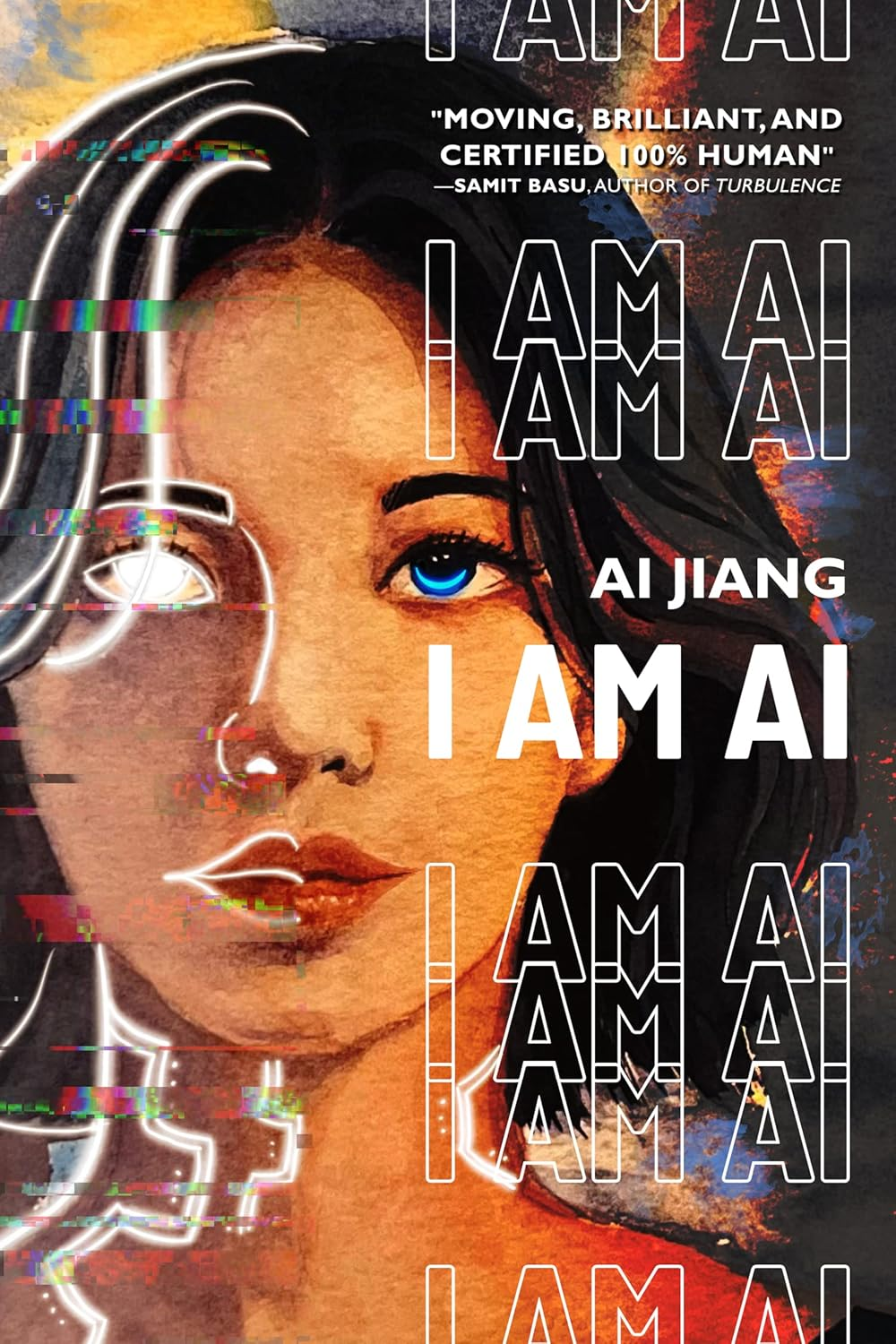
Ai’s story starts near the end of things, at the limits of exhaustion. Her battery is at 8%. To be a more efficient worker in the gig economy of independent, freelance labor, she’s hooked in an internal battery that lets her body stretch itself beyond normal human capacities of wakefulness (just a few more hours, really), but in the process made life—and work—more “difficult and dangerous”: if Ai’s battery runs out, her heart stops pumping, she dies. This short, one-page set up is dense with critical possibilities and serves as the intro to Ai Jiang’s second book, the novelette I AM AI.
Published just two months after her novella Linghun in 2023, I AM AI was nominated for BSFA, Hugo, and Nebula awards. In my essay on Linghun, I ended by saying, “There’s very little to be excited about lately, but then there’s also Ai Jiang.” I AM AI is indeed something to be excited about, even more so than Linghun. For such a short book—around 12k words total, per Kobo (certainly no more than 19k words, the novelette category’s cutoff)—I AM AI is rich with meaning, the kind of text critics can lose themselves in; it is a writerly work, in the Barthesian sense, something that invites us to think along with it, to see in and through it what the text offers as a means of understanding the world we live in. And here, unsurprisingly, the text is concerned with AI and so much more, since, as debates over the past two years have shown, the “AI question” is bound up with just about every facet of our global neoliberal, neocolonial capitalist society. I AM AI throws into stark relief all of those descriptors of the societal conditions we live under, making them readable as active, co-constituent, “difficult and dangerous” forces that structure life as we know it.
Cyberpunk’s Specter
In an interview with Locus, Jiang described I AM AI as “meta-cyberpunk-biopunk-dystopian fiction” Indeed, the specter of cyberpunk’s (now retro)futurity haunts the novelette. I imagine the world of the novelette in the visual style of Citizen Sleeper set to the synthwave sounds of artists like Synthwave Goose and Project Lazarus/Проект Лазарь. The world Jiang scripts is immediately recognizable as a future projection of contemporary, already dystopian social, economic, and political realities that transforms our fears about AI into business as usual. This isn’t the Terminator or I, Robot (2004) future where AI becomes sentient, takes over the world, and forces brave humans into underground resistance; this is the future of capitalism as we know it made all the more exploitative through “cutting edge” AI that stagnates creativity and turns humans into meat-sack servitors of global corporate monopolies.
In this (possible) future, the eponymous Ai lives at the outskirts of the city Emit, which is home to the monopoly New Era—an Amazon- or Alibaba-like corporation with near total control over life and commerce (it’s unclear where in the world this takes place, or if it’s even on earth), and with little government to speak of (it’s possible New Era has privatized government). Ai lives in a honeycomb-like apartment community under a crumbling bridge leading into Emit; she feels the weight of the community on her shoulders, since through her cyborg enhancements she powers the whole community. Doing so figuratively and literally drains Ai: her body is run on the same battery that also charges (and therefore is depleted by) the community. She needs the battery to work longer hours as a freelance writer, and she can only charge up (there is seemingly no infrastructure for power outside of Emit) while working in an independent internet cafe (Mao Tou Ying) at the edge of the city, across the bridge. When she’s gone, working to support herself and her community, the latter is without power; when she’s there, she’s drained each night almost completely to death, waking up each day with increasingly less power—8% 5%—just barely enough to get to Mao Tou Ying.
Hardly the liberated body promised by cyberpunk posthumanism, Ai’s body is both a site for the reproduction of social, political, and economic forces, and a locus around which the community is brought into being. In the far-future world of New Era and the here-and-now reality of 24/7 capitalism, where the limits of human bodies compete with the seemingly limitless capabilities of machines, time is quite literally money. For creatives who compete directly with machines, whether the artist or the writer, in science fiction or reality, there is strong incentive to “upgrade” and incorporate time-saving practices that often rely on new, more expensive software and hardware (not to mention ever increasingly energy costs), and which in Ai’s world are literalized as cyborg “enhancements” to the human body. The “time-costing habits” of being human—for example, engaging in any way with her community—are almost too much to bear when the work to just barely survive is already at the limits of human possibility.
We get only one, brief indication of when in the future the novelette takes place: Ai, in narration, explains the rise of the monopoly corporation New Era, noting that people expected the company would collapse under the weight of its own devastating effect on the labor pool by working people so hard, for such long hours, that the life expectancy plummeted to 45–50 years—“nothing compared to our ancestors a thousand years ago, in 2022” (emphasis mine). Ai’s story takes place in 3022 or thereabouts, yet the world of the story, the type of labor, the kinds of lives lived, everything is strikingly familiar, like a slightly more hightech version of the here and now, the kind of story you assume is 30 or 40 years in the future. It has the flavor of Ridley Scott in 1982 imagining what 2019 might look like in Blade Runner. But the recursive productions of AI and the related, exponentially increasing requirements of labor to provide incrementally smaller outputs of capitalism, have created a world that, yes, has the sort of advanced biotech of 1982’s 2019, but has ultimately stagnated. This is no utopia, no far distant future so greatly changed that we can barely fathom it. No, this is a world too much like our own that, at the going rate of global neoliberal capitalist practices today, has only eked forward into the now-retrofuturist, then-near-future imaginings of the cyberpunk era.
I AM AI
Plotwise, the novelette is quite simple. Ai wakes up; is briefly hassled (as she sees it) by community members like Auntie Narwani and Nemo; goes to work at Mao Tou Ying (just barely making it before her battery depletes and she dies); takes freelance writing gigs through an app she built called I AM AI, where she poses as generative AI to complete fiction and nonfiction writing for clients who like the slightly-more-human edge they think this supposedly AI-run app offers; interacts briefly with Mao Tou Ying’s owners Wushui and Niao, and with her artist friend Hermes, who also works out of the cafe; and goes home. The major beats of the story center around Ai’s depleting battery, conversations with Hermes (who stands in as a sort of utopian believer in the power of art to transform the world), the gigs Ai takes on for clients through the I AM AI app, and the cyborg “enhancements.” Some of these beats are repeated as we see Ai cycle through her working days, but they never feel repetitive, since Jiang splices each with important storyworld and character information that put life in the shadow of New Era into context: from the death of Ai’s parents through overwork at New Era to the deleterious debt system that transfers debt to whomever a deceased person was “closest to” (sometimes just physically) in life, ensuring debt is never erased, to the polluted lake that is cleaned up by a cyborg underclass, called Roaches, who have been transformed to survive on waste (perhaps a sly, though not direct, allusion to Chen Qiufan’s Waste Tide).
The central drive of the novelette is Ai’s desire to be able to work harder and longer, to pay off her parents’ debt, transferred to Ai when they died at thirty and twenty-nine, shortly after taking jobs at New Era (both the best way to financially “get by” and an early death sentence). Ai already has a battery that helps her work for 11+ hours a day, as well as enhancements all over her body that “optimize” her ability to type/think/subsist on the bare minimum, and that make her life increasingly more expensive even as she’s able to earn ever so slightly more money with each body modification. She is almost able, for example, to complete a 150,000 word writing assignment—a “research paper on the benefits of AI writing and art”—in less than 24 hours.
As I let this review essay percolate, NaNoWriMo published a statement that called the critique of the use of AI in writing “ableist and classist”; of course, NaNoWriMo is financially supported by a generative AI writing company, ProWritingAid. I couldn’t help but think that NaNoWriMo, and so many others who lean into generative AI as a normative part of the creative process, as being on the side of history that, extrapolated outward, leads to the future slowly killing Ai in I AM AI. The novelette makes readable the ways human labor competes with AI labor in the ideal future of AI tech startups where AI generates most of the content we interact with. Ai is not AI, but she cosplays AI, tries to out compete it through the novelty that she is a boutique, and unique, AI—not one of New Era’s cheaper, shittier, less creative (because not human) apps.
The climax of the book is Ai’s heart replacement, which swaps in a new, better battery and will ensure that she no longer succumbs to exhaustion, no longer feels the effects of her long working hours on her mind and body. But the loss of her human heart is something of a step too far away from her humanity. Here, the heart is not just a metaphor for being human, in the emotional sense, but its physical loss—its rhythmic beating, pumping blood through the body, and the very presence of human blood instead of “fluid” and electricity—transforms Ai into an increasingly unhuman figure. As soon as she loses it, she ignores her community, she stays away all night to work tirelessly, she turns her back on Hermes and her ideas about art and humanity, and she plunges single-mindedly toward the goal of making enough money to erase her debt and leave the honeycomb community. In addition to rendering Ai more robotic—the metaphor we use, here literalized, for an uninteresting person who gives little thought to interpersonal relationships and anything beyond their immediate goals—the loss of her heart makes her work suffer from the lack of its human touch. Clients unsubscribe from her I AM AI app because her writing now “sounds like every other AI generated story. It doesn’t have its usual emotion and humanity,” the very things that gave Ai, posing as AI, an edge over actual AI competitors.
The app—as the title of the novelette, which is itself an allusion to the author, who gives her name to the character and, to make it more on the nose, has written this novelette that is digitally available as part of a global creative economy just beginning to struggle with AI—is a testament to who Ai is and puts into stark relief not only the changes she goes through but the labor she’s forced to compete with. It’s a subtle, polysemous play between Ai and AI whereby the all caps allows Ai to say “Here I am! It’s me!” and also “I am the machine service you are looking for!” She is both/and to the consumer, which is just as good as saying that the freelancer in today’s gig economy—under all of capitalism, really—is treated as merely a creative service provider. Input coin, get media. Don’t like the media? Downvote the app, insert coin elsewhere, get media. Jiang’s powerful little novelette critiques both the creator gig economy, but also our media consumption habits that search for authenticity, a certain something that gives the media we consume just enough verve to feel different, unique, but not too much so lest it fall outside of our increasingly blinkered parameters of what we want from a genre, a sitcom, a beach read, a cozy this or that.
In the end, a shock power outage makes all the difference, rupturing the always-now, always-working world of AI, and causing Ai to nearly lose power/die. She is saved, however, by Wushui, Niao, and Hermes, who hook Ai up to a back-up generator. Returning home early, she is then greeted by her community sharing what little resources they have to make a communal soup. When she tastes it, she cries and thanks Auntie Narwani (not really her aunt, but a term used in many non-Western cultures of older women) for the kindness, but Auntie reminds her “There is no need to thank family.” Ai witnesses the beautiful life of the community she has been sustaining, without participating in, and slightly disdaining:
Behind Auntie Narwani, people from the community gather outside their units, on the stair landings, shouting conversation across to one another: Mrs. Gem holds her newborn, a child who likely won’t last the year, as many children don’t unless they have New Era’s support; Nemo has left us and is now sprinting from unit to unit, pausing periodically to wheeze, hands on knees—her asthma is getting worse. The sound of the electric drill goes off again—something else broken.
I look away from them all and shut out the sounds.
Rather than gratitude, it is the return of the pain I felt when I lost my parents that stirs within my mind. The phantom of a heart throbs and tugs. The warmth, the sense of community, though both beautiful things, always risk loss and hurt.
Though she has spent so many years as a loner, working to pay off her parents’ debts, and only grudgingly dwelling in the only community she could afford, Ai recognizes that the family she longed for, but was too hurt to seek, was already around her, was thankful for her, and already considered her family. With this revelation, Ai decides to get her (or a) heart back, to—in the framing of Jiang’s novelette—become human again. Even so, the novel ends with Ai discovering that Hermes, the friend she has been pushing away, sold her painting of their honeycomb community to New Era to help Ai afford the brain implants she wants. As they sit outside by the lake, New Era flashes the painting against the highest skyscraper in Emit, with the slogan “Like a hive, we must work as one! Join our family!” Here, actual, non-AI art is spun with the sloganeering of faux communalism by a corporation that owns the world, that is destroying the world, profiting from what minimal gains are still possible, and killing everyone through debt, labor, and pollution. Under capitalist (hyper)realism, all alternatives can be commodified.
But, somehow, the ending is not bleak. The final worlds of the novelette open a narrative space for something other than drudgery and the bleakness of Ai’s—and, probably, our—outlook to bloom:
For the first time, I’m grateful for the quiet of our home under the bridge; of our offline connections; of our eyes reflecting not the light of screens, but the dark of the natural waters, even as it often threatens to drown us during heavy storms; and the choking thought at the back of our minds of the alarming loom of floods with the continuously rising sea levels.
And for the first time, I realize the beauty of fragility, the value of ache—to be able to bleed, to be able to fear, to tick and struggle ticking: to be truly human.
This is both a hopeful gesture, and one that recognizes, as so many of our brief utopian moments do, that there really is no alternative that cannot be co-opted, and that all we have is (1) being human (which carries a particular social and political weight in this novelette) and (2) each other. This seemingly schmaltzy sentiment doesn’t necessarily lead to political change, and some might describe it as apolitical (not for nothing, New Era has created a world in which “Protests are rare now, if any”) but it’s an important strike of the match in the dark of the everyday.
The Future Already Here
Put another way, under capitalist (hyper)realism, in Ai’s world as in our own, there still remains some power in saying “at least we have each other,” and living in that togetherness, since it is often the only form of autonomy left to us to create our own meaning under interlocking systems of oppression and in the collapse of any semblance of futurity. Like other forms of art born from a pervasive sense of a collapse of futurity—here, I’m thinking of the broad genre of synthwave music, which has spawned disparate forms such as spacewave, vaporwave, and Sovietwave—the novelette locates a real glimmer of possibility not only in community—that is, in the ability to create interpersonal relationships that transcend the regimes of power which seek to restrict intimacy (think, Orwell’s 1984 or even Lowry’s The Giver)—but also in retrofuturist sensibilities, where the past becomes a window into another future.
Here, that sensibility is delivered in the form of an antiquated, analogue alarm clock that appears again and again in the story as Auntie Narwali tries to charge it with electricity from Ai’s body. To Ai, who never asks, the clock is the odd obsession of an old woman, a familiar thought to anyone whose grandparents collected weirdly specific things (cuckoo clocks, Hummel figurines, Elvis memorabilia). But we learn later that the clock is a community tool, marking the time for their communal supper, which Ai never attends until the power outage hits. What’s more, when Ai has her revelation that she already belongs to this honeycomb community, this found family of which Auntie Narwali seems the matriarch, we see that the clock has been rigged with a solar panel—itself an antiquated technology that New Era has tried to eradicate. The solar panel, a clear nod to the alternative futurity of solarpunk, offers the literal ability to produce power without indebting oneself to the electrical infrastructure and price-gouging schemes of New Era. The clock, that complicated early machine that allowed for a rigid structuring of time in the era of industrial modernity, which allowed bosses and workers to measure labor effort with exploitative precision, and which has become both increasingly important in a world of nanoseconds and derivatives trading, and yet also increasingly obsolete with the rise of global 24/7 capitalism—here, that machine, a remnant of the old, is layered with multiple meanings. It is a reminder for the community to come together, to eat as one; a reminder of a past and its other possible futures; and a gesture at the possibility that people could become financially and infrastructurally independent from the corporate monopoly.
I AM AI is dense with details that make readable a whole host of issues composing our polycrisis, from the inescapability of debt to the rapid rise of global corporate monopolies, from unlivable labor conditions to the ravages of climate catastrophe, from the battle over generative AI to the destruction of artists’ livelihoods through both labor conditions and competition with AI, from the need to enhance our hardware (bodies and technology) to compete against machines to the seeming foreclosure of once-possible futures by unregulated neoliberal expansion. For a novelette of just a dozen thousand words, I AM AI reaches beyond itself as a powerful cipher for critically reading the world we find ourselves in and the futures it might trap us in. It is an exciting, provoking, damning, and hopeful text, and much more besides.
True, the end of I AM AI offers no systemic break—even as Ai’s revelations about her community and her humanity are caused by a rare power outage that itself demonstrates the possibility of rupture, the precarity of power—but Ai and her community stand in for readers who, many of us, face shockingly similar circumstances of increasing workloads in a gig economy that underpays while prices rise and corporate forces, including tech companies behind generative AI, grab more and more power over our daily lives. And for much of the developing world, Ai’s future is even less of an extrapolation of “similar circumstances” to future realities: the violence and fundamental unliveableness of Jiang’s future is already here. Fittingly, for a novelette described as “meta-cyberpunk-biopunk-dystopian fiction,” I AM AI offers another cognitive mapping of the mantra of the cyberpunk generation universally attributed to William Gibson: “The future is already here, it’s just not evenly distributed.”
I AM AI reinscribes the dictum of the cyberpunk generation and in doing so serves as a painful and necessary reminder that the uneven distribution of the futurity of the 1980s and 1990s remains with us, extrapolated to even more disgusting extremes, decades on. Ai Jiang’s novelette also shows us that the critical capacities of cyberpunk to map the worst aspects of our present remain alive and well. With just a few thousand words, Jiang reboots cyberpunk to jack us into the fight against new technological, political, and economic orders.
To get notifications about new essays like this one sent directly to your inbox, consider subscribing to Genre Fantasies for free:

 Genre Fantasies
2 thoughts on “Reading “I AM AI” by Ai Jiang”