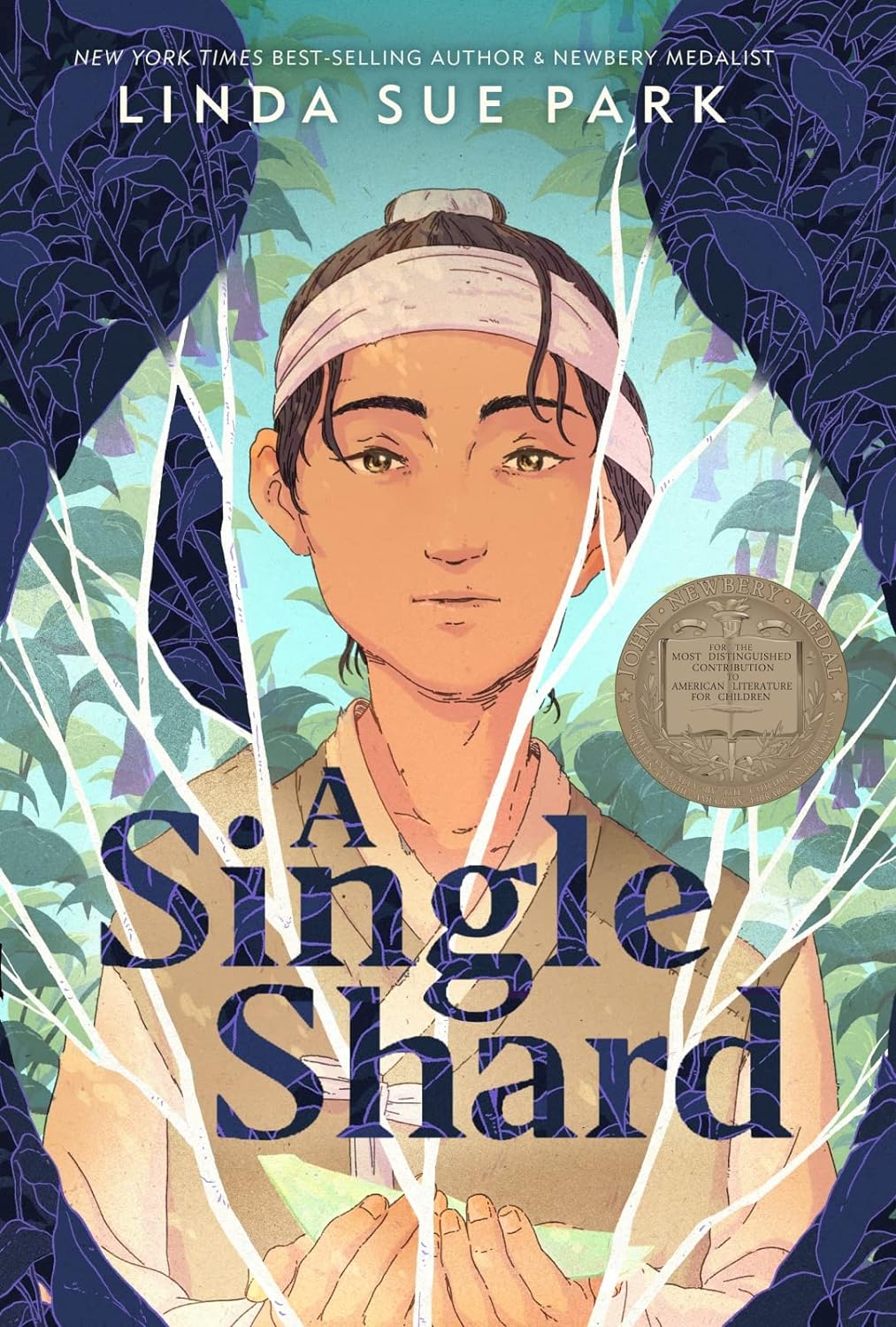
A Single Shard by Linda Sue Park. Clarion Books, 2001.

Also read by this author:
SeeSaw Girl (1999)
The Novel that Lingers
I remember reading very few novels in my childhood. Mostly, for fiction, I read the Harry Potter novels, Star Wars novels, Dungeons & Dragons novels, and not much else. I tended to prefer nonfiction, especially history books about the ancient and medieval world, and about cultures not my own, especially those of East Asia. Now that I’m older, I look back at the wealth of children’s fiction—and most especially of children’s historical fiction—and I feel almost angry about how little I read, how much I didn’t experience. Yes, I loved Harry Potter, Star Wars, and D&D novels, and the latter in particular became an important storyworld that I built a great many of my imaginings around (I mostly played alone as a kid, telling stories about the Forgotten Realms in my head while I meditatively rode my bike in a circle), but I think in retrospect my childhood was poorer for not having dipped more into the treasury of children’s historical fiction that I’m only just now discovering.
There are other books, however, that I do remember, as few and far between as they may be. Gary Paulsen’s Hatchet (I wanted to survive in the wild!), Louis Sachar’s Holes (I remember it, but I don’t recall liking it; the film made more of an impression), Andrew Clements’s Frindle (I found the idea of trying to change a word, just to prove a point, quite annoying), a few Roald Dahl books (I wasn’t much of a fan), Katherine Paterson’s Bridge to Terabithia (this one felt, at the time, very adult and thus very exciting to read, though it devastated me), Robert C. O’Brien’s Mrs. Frisby and the Rats of NIMH (I cherish it to this day), and Laurence Yep’s Lady of Ch’iao Kuo (a volume in the Royal Diaries series and very clearly a “girl’s book,” though I was obsessed with it; despite this and to my great disappointment today, I never learned about Yep’s other novels, which are many).
But one children’s novel stood out above these; I remembered it fondly long after my adolescence, and have since returned to it numerous times in the past twenty years, finding it more charming and emotionally powerful each time: Linda Sue Park’s A Single Shard.
Park’s A Single Shard
A Single Shard won the 2002 Newbery Medal, beating out Polly Horvath’s Everything on a Waffle and Marilyn Nelson’s Carver: A Life in Poems. It was Park’s third novel after SeeSaw Girl (1999) and The Kite Fighters (2000)—all historical novels set in Korea. Like these earlier novels, the story of A Single Shard is easily recounted, and in the fashion of truly good art, the simplicity is textured with brilliance. There are no great heroes, no magnificent deeds, no calls to greatness: just a boy hoping to learn, find his place in the world, do good in his community, and make something not merely beautiful but masterfully artful. Like many of Park’s other works, the novel explores multiple aspects of Korean culture and attempts to present a sense of the lived reality of medieval Korean life, from the social life of a small village to the political economy of pottery (especially celadon ware) in 12th century northeast Asia. It also heavily stresses ethical questions by framing a series of tough choices the main character must puzzle through and act accordingly in order to best live in social harmony with others.
A Single Shard is the story of Tree-ear, a homeless orphan living in the seaside village of Ch’ulp’o (transliterated today simple as Chulpo), where he has been raised under a bridge by a disabled older man called Crane-man, and where he spends his free time watching the master potter Min create beautiful works of celadon greenware. Tree-ear’s curiosity about the potter’s craft gets the best of him one day and he accidentally breaks a set of nested porcelain boxes Min is preparing. In penance, Tree-ear offers to help the aging Min with the hard work of being a medieval potter: chopping firewood for the village’s shared kiln, cutting clay from the river bank, sifting clay and water to produce finer and finer slip, and more. Tree-ear’s secret hope is to be taught the potter’s craft. Working for Min, Tree-ear also becomes close with Min’s wife, Ajima (an honorific, like saying “Auntie” to any middle-aged-ish woman, and usually transliterated today as Ajumma), who gives Tree-ear extra food for him and Crane-man to share, in return for which Tree-ear helps her with small chores.
As the year progresses, Min is chosen to present his superior wares, using a new inlaying technique, to the king’s master of pottery ware, in the hope of Min securing a royal commission. Too old to make the journey, Tree-ear volunteers on his behalf to transport two celadon vases by backpack (jiggeh) to the then-capital Songdo (“city of the pines”; today Kaesong, North Korea). But calamity strikes when two hungry bandits mistake the contents of the jiggeh for rice and, disappointed, throw the vases from a cliff. Determined to keep his promise to Min, Tree-ear carries on to Songdo with just is a single shard of Min’s masterwork vases—a shard so clearly demonstrating Min’s skill that he is awarded a commission, and Tree-ear is adopted as his son, to be trained as a potter.
Park’s approach to narrating history in A Single Shard is to give detail and texture to the mundane, to the everyday work of being poor in medieval Korea and going about a potter’s work. Perhaps the most interesting aspect about Park’s style as a writer of historical fiction is that she respects her readers enough to meticulously document where her information comes from, what specifics references or scenes allude to, and when and why she departs from historical knowledge for the sake of fiction. She does this in all of her novels through author notes at the back of the book.
Most interesting among Park’s choices to depart from history is her comment that “until very recent times, few people in Korea were homeless,” owing to the widespread care afforded the poor by both Buddhist and Confucian tradition, with many poor—and especially orphans—“succored by the Buddhist temples.” Not only is Park’s language fascinating, since her choice of words often shows a deep respect for the intelligence of her audience (a feature of the best children’s fiction, which is as sophisticated as the best “adult” fiction), but this decision allows Tree-ear and Crane-man to live a unique life that affords them freedom from the routines of the Buddhist temple and allows Park to focus on Tree-ear finding his place in a highly structured, hierarchical society where only children of potters can become potters. Park points out that Tree-ear and Crane-Man “would indeed have been curiosities in their time, but surely such individuals have existed in every age and society.” There is, here, a bit of a libertarian, individualist streak, with Park allowing the two of them to both live on their own and fend for themselves, so to speak, and to live through the hardships of poverty with “honor.”
Care, Community, and Character
Children dealing with difficult things, and modeling for readers how to bear up under the pressure of social and economic hardships, is a major theme in Park’s novels and a major concern of children’s literature generally. But while Park’s narrative is focused on the individual story of Tree-ear’s rise from orphan to adopted son of a master potter with a royal commission, and therefore a potter-in-training himself by the end of the novel, is counterbalanced with a narrative sense that, for the most part, people are generally good. Rarely does Tree-ear encounter a truly unkind person; even the figure of the Emissary Kim, the king’s master of pottery, who we might expect to be cynical and unkind, to punish Tree-ear for only bringing a single shard of Min’s pottery as evidence of his abilities, is a generous spirit: “There was kindness in his eyes—like Crane-man’s, like Ajima’s.” With the single exception of the bandits who ruin Min’s pottery and who are meant as examples of what wrong action looks like, every adult in the novel is generally kind to Tree-ear, despite his status as an orphan; in other words, he’s never shunned or made to feel bad about being poor or orphaned, a nice surprise in a book with an orphan protagonist.
Park’s novel assumes a generally kind, generous society within which Tree-ear moves and suggests a sort of historical and perhaps utopian ethics of care in community, even if there are aspects we can question—e.g., the poor are allowed to harvest the meager remainder from the rice fields after farmers have harvested their crop; that’s nice and all, but it’s not exactly equitable. Indeed, A Single Shard is very much interested in ethics and in how we make ethical decisions as the basis of the community of care Park writes into her historical fiction of Goryeo Korea.
In some ways, it’s curious that Park chose not to have Tree-ear raised in the nearby Buddhist temple (the explanation is that, when he was brought as a baby to the village, there was sickness in the temple, so Crane-man under the bridge volunteered to look after him, and simply ended up raising him), given that significant space is in the novel is spent on discussions about right action that almost certainly stem from a Buddhist ethos that considers how one should best act in order to not harm others, and which regularly questions what constitutes social harm and honorable behavior in challenging circumstances. Mostly, these conversations take place between Tree-ear and Crane-man, with Crane-man acting as an almost monk-like stand-in, pondering questions, debating with Tree-ear, getting down to the truth of things: Is it wrong to wait to alert the farmer that rice is leaking from his jiggeh, so that the orphan will have more rice to pick from the ground? Is it wrong to tell Min of another potter’s newly discovered technique, if that potter kept the technique a secret and knowledge of the secret technique was obtained by spying? Is it right to expect free food from someone who is willing to give it, without providing labor in thanks? These and other questions—ones that look very much like the concerns of many adults, given the state of the AITA subreddit—enliven the book and given depth to Tree-ear. They make him easy to empathize with, to get into the mindset of, and they also help readers feel like part of this world, since we too are made to have a stake in these questions and to see how they might be relevant to our own lives.
In addition to staging excellent ethical conundrums within a unique historical and cultural situation, Park also crafts wonderful, memorable characters. Crane-man is the father figure I never had at his age: attentive, kind, humorous, and intellectually engaged with Tree-ear. And Min is the classic irascible old man with the heart of gold (even if it does sort of drive home the idea that you can be an asshole if your art is good enough). Ajima, unfortunately, is barely present and as much a stock figure as Min, but not so deeply drawn: she is the kind older lady who is nice to the child protagonist, but about whom we learn absolutely nothing.
Tree-ear is driven and talented, and understands that through hard work he can and will grow the skills he needs to become a master potter like Min. Indeed, partway through the book he admits to having carved a single leaf from clay so well that Min could not tell that Tree-ear had replaced one of Min’s own carved leaves before the pot was fired. And when Tree-ear is faced with the worst news of his life (so far), that he is not able to become an apprentice to Min because only sons can, he nonetheless volunteers to take a seemingly impossible journey on foot to Songdo on Min’s behalf, knowing full well that getting a royal commission will fulfill Min’s own dream when Tree-ear has no hope of achieving his. Of course, returning to Ch’ulp’o changes Tree-ear’s and Min’s life: Crane-man has died while Tree-ear was gone, and on losing his father figure, Tree-ear gains an adoptive father and mother, and is able to fulfill his dream of becoming a master potter, if one whose greatest work will remain anonymous. There is greatness, Park says, merely in producing that which is beautiful.
Giving Voice to a Masterwork
The origin of Park’s novel is a vase, a real one. One that might seem unassuming now in the age—if I may be cliche—of the mechanical reproduction of art, of the digital reproduction and quick printing of just about any design, on any surface, sold anywhere, at anytime, but which in actuality testifies to an unsurpassed level of artistry possessed of an anonymous potter living seven or eight hundreds years ago. It is the Thousand Crane Vase, today officially National Treasure No. 68, held in the Gansong Art Museum in Seoul, South Korea. The vase—in a style called maebyeong in Korea, meiping in China, prunus in the West—not only shows the luminous, creamy jade of Goryeo-era Korean celadon pottery, but is also carefully inlaid with white and black designs of cranes and clouds, each alive crane alive with different purpose through the careful skill of unknown hands, each cloud whisping in and out of the milk-green sea of ancient clay fired into fine porcelain.
But the vase never appears in the novel. Rather, it is implied that Tree-ear will grow up to be the anonymous artisan behind what Park describes as “among the most prized of Korea’s many cultural treasures” and “the finest example of inlaid celadon pottery ever discovered.” Park’s book is an exercise in humanizing a beautiful work of art that, despite its beauty, doesn’t really have a story to it, in the way that a famous painting by a well-known artist with a dramatic life does. She gives life to its creator, gives him a name, a background, a dramatic story, and a deeply personal reason for both being motivated to produce a great work of art and for choosing the emblem of the crane to adorn it so vibrantly. And at the same time that she restores a life, a human imprint, on the Thousand Crane Vase, Park keeps us grounded in the reality that Tree-ear’s name will never be known, as the novel closes with the line, “Its maker is unknown.” It’s a great and careful moment of closure; through our knowledge of both the real history and this imagined history, both are kept in wonderful dialectical tension.
I read A Single Shard at a time when it wasn’t easy to look something up when the whim struck, so when I read this book I had never seen celadon pottery, and I never thought to look it up after reading it; I probably didn’t connect the celadon pottery described in the novel to actual celadon pottery for probably another decade or so. To me, it wasn’t the actual look of the pottery that mattered—though Park is a master of ekphrasis and there are half-a-dozen detailed descriptions of medieval Korean celadon ware in the novel—but the almost religious experience of it, the deep-felt desire to make something beautiful not to meet a client’s needs, but simply for the sake of having made something one is pleased with, to become a master of an art. It’s an experience that has eluded me, then as now, and a feeling of satisfaction through creation that I still, perhaps pointlessly, pursue. I’m no Min or Tree-ear, but through Park’s novel I get to experience a shadow of what it might be like to feel pride in one’s art and accomplishments.
A Single Shard is mundane, quiet, cerebral, and touching. Not a moment of it is wasted, as Park’s sparing prose paints a lively socio-historical world with just a few sentences, and as she lingers on what little is said (or unsaid) between people who love each other deeply in different ways. I enjoy the novel a little more each time and consider it a masterpiece of historical fiction and children’s fiction alike—the rare novel from my childhood that not only holds up, but becomes all the more meaningful as I age, seeing myself now less in Tree-ear than in Min’s wife or in Crane-man.
And what a legacy it would be, not to be the artist, but to be the one remembered and immortalized on a vase of a thousand cranes.
To get notifications about new essays like this one sent directly to your inbox, consider subscribing to Genre Fantasies for free:

 Genre Fantasies
One thought on “Reading “A Single Shard” by Linda Sue Park”