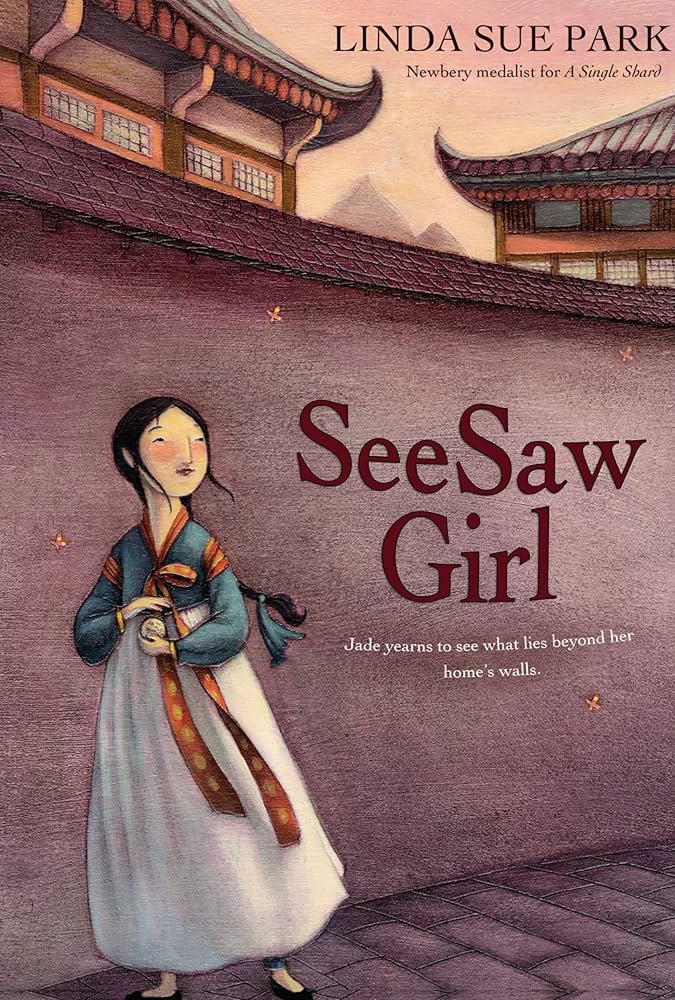
SeeSaw Girl by Linda Sue Park. Jean and Mou-Sien Tseng, illustrations. Clarion Books, 1999.

Also read by this author:
A Single Shard (2001)
After my recent return to Linda Sue Park’s A Single Shard, which I read for the fourth or fifth time on a blustery November day in a coffee shop in Lund, Sweden, I decided it was time to read through the rest of Park’s major historical novels, which include SeeSaw Girl (1999), The Kite Fighters (2000), When My Name Was Keoko (2002), and the more recent Prairie Lotus (2020). I decided I’d start from the beginning and read them in publication order.
Park’s First Novel
SeeSaw Girl was Linda Sue Park’s first novel, the first of four books that came out back-to-back, once a year between 1999 and 2002, all published by Clarion, and all historical fiction set in Korea, each focused on a different aspect of social, political, and to some extent economic life, from the Goryeo period in the 13th century to the lengthy Joseon dynasty to the period of Japanese occupation and colonial governance. Though her first novel, SeeSaw Girl takes place in the middle of this time span, sometime between 1654 and 1656. Park was, even with her first book, meticulous about her dating and her emphasis on historical verisimilitude, detailing when and where and why she departs from known history in an “Author’s Note” at the end of the novel, as in A Single Shard; here, even she adds a full bibliography that takes up the final page of the book and ranges across folktales, trade nonfiction, university press titles, and obscure volumes translated by the Royal Asiatic Society. As with A Single Shard, Park’s respect for her audience is admirable and means that this short little book doesn’t have to be the end of someone’s journey, should the world detailed in SeeSaw Girl pique the reader’s interest.
SeeSaw Girl is quite a short novel at just under 90 pages and it contains a number of black and white pencil illustrations by Jean and Mou-Sien Tseng, making this feel physically and aesthetically like a book for much younger readers than A Single Shard, but the narrative voice and complexity of the prose remain the same; the novel could be for adults, but for its packaging. It is also a somewhat somber novel tinged with melancholy that lays bare the structural inequalities of gendered life for seventeenth century Korean women of the upper classes.
The novel concerns the end stages of Jade Blossom’s youth as she grows up an eldest daughter in the household of a noble family. Her father is a scholar and chief advisor to the Joseon king Hyojong (r. 1649–1659). Jade lives in her family’s compound in Seoul, capital at that time of the Joseon kingdom but not yet built by Tree-ear’s story in A Single Shard. Jade and her cousin Graceful Willow chafe at the constraints placed upon them by their girlhood: they are made to clean, serve food to, and do laundry for the men of the household (since the men are taken care of principally by female upper class family members, not by servants); they are not taught history and literature and art like the boys, but instead remain illiterate and practice only the art of embroidery; and they may not leave the inner courtyard of the family compound, let alone leave the family compound at all. As Jade makes painfully clear, a woman of her station can expect to leave the family compound first when she marries into another household, and then after only if there is a major wedding to attend or perhaps if her mother dies. By contrast, her brothers and father venture out into Seoul’s streets regularly, go to the market for sweets, visit the palace, and beyond the city pray at the tomb of their ancestors on the mountains outside Seoul (probably Bukhansan).
The stage is thus set for a classic children’s adventure, one of breaking the rules and exploring beyond one’s “station” in life, but Park isn’t so cliche. Yes, Jade does go on a brief adventure: after Graceful Willow is married into another family, Jade decides to go visit her and makes a daring escape in a cabbage cart pulled by a servant. She is shocked by all of the people and three important things happen on her escapade: the learns that girls and women of the lower classes are allowed to leave their family compounds (because they have none), she sees European men who are being transported as prisoners to the king’s palace, and she is turned away from Graceful Willow’s new home because her cousin is trying to remain respectfully of tradition and social order in the new household she belongs to. When Jade returns home, she is emotionally crushed by the rejection of her cousin’s affection and the recognition that life is changing and she, too, will soon find herself in Graceful Willow’s position. Moreover, the servant who unknowingly helped her escape is dismissed, leaving Jade guilty.
But Jade remains curious about the outside world and continues to chafe at the limits of being a girl/woman in her society. Much of the remainder of the novel is taken up with Jade learning embroidery and then painting, and she becomes obsessed with seeing the mountains. The idea of not being able to honor her ancestors by traveling to and praying on the mountainside with her father and brothers particularly bothers her, and she comes to see the mountains as her symbol of freedom from life inside the compound. As a result, she endeavors to capture the mountains in art, first through embroidery, which is regarded as women’s art, and then through painting, which she learns by practicing in secret using paper, brushes, and paint given to her by her older brother. But painting the mountains proves difficult when she cannot regularly study them, and this leads to her inventing the titular seesaw, or neolttwigi in Korean, which allows her to see over the wall, glimpse the mountains, and paint it.
Amidst all of this, Jade is also brought into the confidence of her father, who understands that a curiosity not sated will lead to further problems, and who therefore keeps her informed about the European men she saw in the market and their fate. Park chose to set the novel in the mid-1650s because of these European men, a band of Dutch sailors under Hendrik Hamel whose ship sank off the coast of Jeju; he and his crew were imprisoned by the Koreans, who at the time kept their borders closed. Instead of being executed, though, King Hyojong allowed them to live in Korea and forbade them from leaving the country. Hamel and seven of the thirty-five who initially landed on Jeju later escaped to Japan and were repatriated to the Netherlands, where Hamel wrote and published what is often described as the first Western account of Korea (I hesitate to confirm that it is the first Western account; the account can be read in this book, published in 1885 by William Elliot Griffis). Of the thirty-five survivors, most died but some survived to live in Korea and one even married into Korean society and founded the Byeongyeong Nam clan. Park admits that she fudged the timeline a bit so that Jade could both see the Dutch captives brought to Seoul and learn about the King’s decision to let them live in Korea; in reality, there were about 2 years between these events. Although Jade doesn’t have much insight into court life, through her discussions with her father and brother, we learn that the choice to let the Dutchmen live in Korea is a contentious one, might very well have been her father’s idea, and that this conversation led the king to declare that his advisors may speak freely without worrying about whether their opinion dissents from his. It is therefore a momentous event Jade is privy, too, though it’s not particularly central to her story.
Making It Enough
As noted above, it’s the mountains and her desire to see them—ultimately, to paint them—that concerns the final arc of Jade’s growth. Where at the beginning she delights mostly in pranking her brother, and is slowly brought to awareness that life will change as she gets older and becomes a woman and marries (as shown through Graceful Willow), by the end of SeeSaw Girl Jade has come to realize that her life is not her own, and that this is in large part because of the gender. Her life is to serve her family, and more specifically she exists to eventually her husband’s family and the children she bears. As this reality is dawning on Jade, she has a conversation with her mother, who understands the impetus behind her adventure in the market, who gets how limiting the life of elite women stuck in the inner courtyard can be. Her mother offers some perspective in a heartbreaking exchange:
“At the end of the day, when I am so tired from the laundry and preparing the food and caring for all the people in our household, sometimes I stand here like this. Everyone has eaten well and has clean clothes. Soon everyone will go to sleep in neat, orderly rooms. I have helped with all that. It is partly because of my work that the house of Han is at peace.”
She looked down at Jade and stroked her hair. “It is a very satisfying feeling, Jade. And someday you too will feel it. This is what I wish for you.”
In the touch of the gentle hand on her hair, Jade felt forgiveness. But part of her was still uneasy. She turned her head and looked up into her mother’s face.
“Mother,” she whispered.
“Yes?”
“This feeling that you speak of. Is it enough for your happiness?”
Jade thought her mother looked sad for just a moment, but then her face was smooth again. “Yes, Jade,” she answered. “I have learned to make it enough.”
This moment is a bit of brilliance; it neatly showcases the limits placed from birth on Jade’s life but also how women, like her and like her mother, have learned to live within those limits. I say “within,” purposefully, because Park is very clear that this is a life with unfair and inequitable limitations, that this is a life that is not wholly one’s own, if you’re a woman; Jade’s mother, the only adult woman we meet in the novel, has great sadness, but she finds a way to make the life “enough,” for what other option is there? And Jade’s story is essentially the story of a girl on the verge of adulthood coming to terms with what a life with limitations will be. But Jade is determined to carve out something for herself within the inner courtyard. She is determined to have the mountains, to have painting, to learn about the outside world through her brother and her father.
And here the seesaw is at the crux of it all. The neolttwigi is more than just a nice plot point to explain how Korean seesaws are different from ones we have in the West—and they are quite different, allowing people to safely jump to incredible heights. When I first read the novel, I could not imagine what Park was talking about it, I remember closing the novel and thinking, “OK, I get the symbolism of the seesaw, but Jade wouldn’t actually be able to jump high enough to see over the wall, to see the mountains and paint them.” Well, yes, she could have! In fact, neolttwigi may very well have developed in the Joseon era as a way for Korean elite women stuck in their family’s compounds—girls and women like Jade!—to see beyond the walls that gave them limits. Not only is the seesaw offer a great metaphor for Jade’s empowerment, since Park’s story suggests that Jade is inventing the neolttwigi outright, but the story of the neolttwigi is itself tied to small, everyday efforts by girls and women in Jade’s position to carve out meaning for themselves.
The novel ends with Jade acknowledging that, though she may now be able to see the mountains using the neolttwigi, though she may be able to capture it through painting, though she may hold on to painting as an art form in a time when women don’t paint—Park says in her notes that “in every place and age there have been people possessed of such courage” to defy the limitations posed by patriarchy—“It’s not enough… But I will learn to make it enough.” In many ways, this ending is deeply sad but expresses a painful truth: that people—especially marginalized people, depending on their historical circumstances, whether women, people of color, the poor, or the disabled—have to come to terms with what life affords them. Some, like Jade, will strain at the strictures of their social, political, and economic place in life, while others will seemingly make the most of it, like Graceful Willow and Jade’s unnamed mother. But even making do is sometimes not enough, as Jade’s mother’s deeper sadness hints at. And Jade knows this, but seeks something that will give her inner life meaning in the coming years, when she leaves her family’s house to become a wife and daughter-in-law to another family, where she’ll take on even more duties, have children, oversee a household, and more—all without any greater level of freedom.
Parting Reflections
SeeSaw Girl is both sad and powerful because it is about coming to terms with this limitation, but it is also perhaps hopeful because, for so many people throughout history—and now—coming to terms with life’s limitations is all we can do to stay sane. For a children’s book, it’s a hard thing to pull off, to both suggest that the situation is unfair and, in many ways, untenable, but also that it cannot be changed: Jade Blossom lived at a certain time, in a certain place, here is what we know about that time and place, it was different to our time and place in XYZ ways, and similar in XYZ ways, but her life was not less meaningful because of the differences, because of the limitations imposed on her. Park’s own comments about why she wrote SeeSaw Girl come from a place of disgust and frustration with what she read about Joseon Korean women’s lives, but the novel itself, and the need to imagine a real and full life for its characters, let alone its protagonist, forced Park to empathize with the historical circumstances of that world.
We could suggest that this is a conservative response, because it does not imagine an alternative, but it is also a historical reality that captures how people might really have lived. But I think there is something liberatory in Jade’s story—not that every book needs a liberatory point, but it’s nice to have—not only in the way she knowingly and calculatedly bucks tradition, not only in how she continues to advocate for herself and others (the servant, the cabbage seller’s son Chang), but also in how she seeks knowledge, skill, and experience that will satisfy her: not enough, but something she can make enough. She learns to embroider and make meaning there, she learns of the mountains, and ultimately she learns to paint so that she can experience the mountains, build a metaphysical relationship with them. And, in the end, she invents a seesaw so that she can continue to see the mountains. It’s an almost Blochian utopianism that finds meaning and hope in the everyday.
SeeSaw Girl is not nearly as impressive and introspective a novel as A Single Shard. It reads comparatively messy, but it is a perfectly fine novel and an excellent first novel. There is so much going on in such a small package: marriage customs and family structures of Joseon Korean social elites, ekphrastic discourses on embroidery and painting, social and political ramifications of Korea’s hermitness, changing royal policy about what advisors can and can’t say, how a Korean seesaw works, and more! It might seem like too much, perhaps, but Park writes with such a beautiful economy of prose and with such depth of emotion, that the narrative never feels crowded. In just 87 pages she paints a sparring, melancholy, but hopeful—within reason—narrative of a girl who, like Tree-ear, seeks something more but, unlike Tree-ear, must cope with the rigid boundaries set for her by society and those around her, whom she loves (mother, father, brothers), who uphold those boundaries, giving way where they can to allow Jade to be(come) herself.
To get notifications about new essays like this one sent directly to your inbox, consider subscribing to Genre Fantasies for free:

 Genre Fantasies
One thought on “Reading “SeeSaw Girl” by Linda Sue Park”