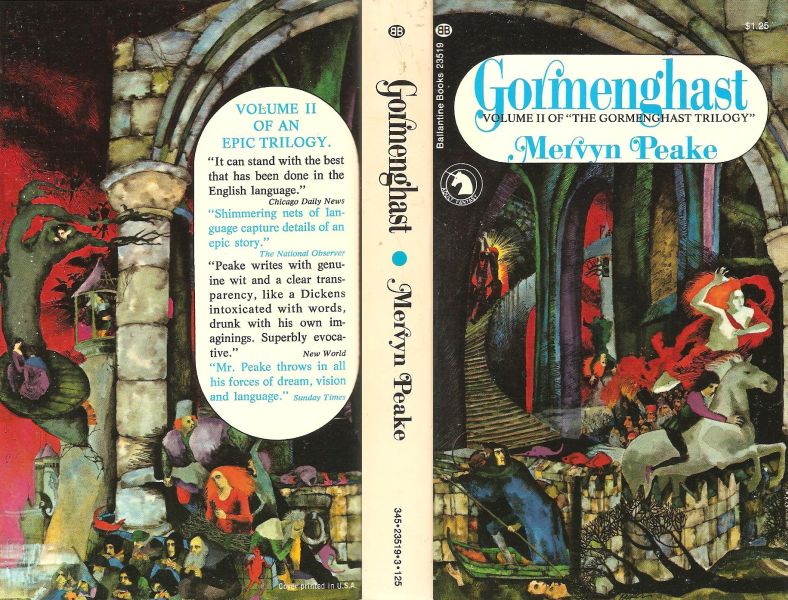
Gormenghast by Mervyn Peake. 1950. Ballantine Books, Oct. 1968. [My version: First printing, Oct. 1968]
This essay is part of Ballantine Adult Fantasy: A Reading Series.
Table of Contents
Reading Gormenghast
No Gods, No Masters
Titus Rode Out of His World
Mervyn Peake’s Titus Groan ends portentously—
Through honeycombs of stone would now be wandering the passions in their clay. There would be tears and there would be strange laughter. Fierce births and deaths beneath umbrageous ceilings. And dreams, and violence, and disenchantment.
And there shall be a flame-green daybreak soon. And love itself will cry for insurrection! For tomorrow is also a day—and Titus has entered his stronghold! (542–543)
—and sets the tone and tenor for the series’s second novel, the aptly named Gormenghast (1950).
In Gormenghast, Peake transforms its predecessor’s parting portends into the substance of a narrative that shepherds Titus from boy to man, from earl to traitor, and from a subject of the Law into a free person unencumbered by the umbrageous weight of Gormenghast’s history, institutions, and power. For all its whimsy-tinged weirdness, the novel is a clear-eyed critique of fascism and authoritarianism, but it goes far beyond a simple triumph over evil and a restoration of the prelapsarian world, and instead challenges the very order that sustains the world of Gormenghast and the Groans, rejecting both dictatorship by the petty antagonist Steerpike but also the consensus reality governed by Law and Ritual.
For Ballantine, searching for a follow up to Tolkien’s success and building on their republication of Eddison’s enigmatic tomes, Gormenghast is “Volume II of an Epic Trilogy” albeit one wholly different to the fantasies they had published so far. With Peake, they struck upon something of a literary treasure, and their blurbs from various newspapers covering the back of the book and the inside copy place Gormenghast not in an emerging fantasy tradition alongside Tolkien and Eddison (remember, Eddison was compared heavily to Tolkien in Ballantine’s cover copy), but in the tradition of the English language’s finest literature. “It can stand with the best that has been done in the English language,” the Chicago Daily News proclaims, while The National Observers describes how in Peake’s books “Shimmering nets of language capture details of an epic story,” and New World describes him (derogatorily?) as “like a Dickens intoxicated with words.” Language, the power of his imaginative vision, the “forces of dream,” the finest writing in the English literary tradition: the Gormenghast books were cast by Ballantine as masterworks of literature. And, with the one-two punch of Titus Groan and Gormenghast, they weren’t wrong. For the genrefication project Ballantine was taking on, Peake’s presence was a boon as well as a challenge.
Gormenghast is a fantastic novel made all the richer for its predecessor. Together, the first two novels of the Gormenghast series—which Peake and many scholars refer to more accurately as the “Tituts novels,” given that the novels were intended to go past the published third novel, with those plans cut short by Peake’s early death, and that the novels are as much if not more so about Titus than Gormenghast—act as an independent duology that offers a thousand-page critique of history, time, social order, class, state power, war, fascism, aesthetics, and more. It’s easy to see in the richness of Peake’s writing—in the way this complex, convoluted, whimsical yet horrifying world comes to life across the first two sprawling volumes—how and why readers, critics, and scholars become obsessed with these novels; the Titus novels have become, and understandably so (though anyone can be forgiven for not liking them; I totally get it!), a sort of litmus test for those who appreciate the truly literary in fantasy fiction. As such, Peake sits rather neatly alongside Tolkien and Eddison in Ballantine’s late-1960s/pre-BAF trifecta of fantasy trilogists (the major irony being that, of the three writers, only Eddison intended to write a fantasy trilogy—Zimiamvia: Mistress of Mistresses, A Fish Dinner in Memison, The Mezentian Gate—and Ballantine didn’t seem to know, at first, which novels belonged to it!). Even if Ballantine doesn’t make the generic connections clear until later reprintings put the BAF series’s unicorn emblem on the cover
Reading Gormenghast
Much like Titus Groan, Gormenghast spends close to 400 pages slowly and meticulously building its world before thrusting forward in an extended, 200ish page climax that rushes breathlessly, inevitably to its end. And, like Titus Groan, I felt the first two thirds of Gormenghast to be a bit of a drag, while the final third was unputdownable. Both novels encompass multitudes and are somehow able to allow lengthy periods of boredom while sustaining this reader with beautiful prose and the occasionally deep insight. The boredom of such periods is forgiven when the novel hits a terrific stride and Peake reaches the heights of his critical and artistic talents. Reading Gormenghast clarified for me that Peake’s narrative style—more specifically, his approach to what comes next in the story—is such that one is never quite sure where he’s going and he regularly surprised me as the narrative meandered on and on through sometimes stranger, sometimes duller, occasionally outlandish, and always inventive new territories.
To that end, the writing in Gormenghast feels almost distracted at times, as though Peake seeks out scenes that will allow him to layer in the various poetic thoughts that have stuck in his craw, to play them out and see where they go, and in doing so to give weird texture to an already weird and ponderous world. This makes for a readerly experience of Gormenghast that is much more literarily expansive than that of Titus Groan. Here, Peake has grown well beyond the intense focus of the Gothic and the social satire in that novel to play across literary experiences, and to heighten them at the same time. Take for example the poetic musings on a bluebottle fly dancing about Titus’s classroom; over two pages, the fly’s movements become freighted with ever more meaning as the scene goes on and on, becoming more abstracted from reality, veering into the poetic, touching on math and time and rhythm and purpose, overwhelming the scene in which it started—Titus bored in a classroom, discovering the idea of color—in a breathless push that can only end with a full stop, a section break in the chapter for the reader (and Peake) to catch a break before returning, a little more calmly, to the narrative proper. There are many such moments throughout Gormenghast involving all sorts of characters. And, to be sure, Peake heaps the book with characters.
The world of Gormenghast in Gormenghast is larger and more populated than the castle of its predecessor. Where Titus Groan focuses tightly on a small set of characters, leaving in the shadows the vastness of the castle and the social world that we know must sustain it, and must do so in great numbers, as evidenced in a few scenes populated by the faceless masses of the castle, Gormenghast by contrast explodes that tight focus on the Groans’ immediate circle. Gormenghast is revealed as home to far more than the Groans and their oddments, not just more servants with key roles and names, but with a whole society, a “citylike home” (108) with generations of youth taught by forty professors, each group with its social hierarchies and squabbles mirroring Peake’s shrewd critical eye to British society. In Gormenghast, Peake shows us a world that is in some ways more real, for all its inhabitants and details of the rituals of Gormenghastian life that are more intricately documented here. But also in other ways more unreal, for its greater attention to the infrastructure of the castle and its social world (the better to demonstrate the domination of its institutions within the storyworld), revealing the ridiculous, impossible hugeness of Gormenghast, which is hermetically isolated from anything else such that it appears to be the sole extent of the world within the novel (an idea reinforced by several characters, the Countess foremost).
In this way, Gormenghast more fully explores the titular castle, not just its sheer, overwhelming, unimaginable physicality, but its social realities. Titus Groan is the perfect preface, since it lingers so much on the characters—their personalities and psychologies—of the small circle who attend directly to the Groans, and as a result only shows us glimpses of Gormenghast the institution. Put another way, where in Titus Groan we see Gormenghast as the shadow it casts on the lives of these characters, who eke out circumscribed meaning in its halls, in Gormenghast we see the castle and its social being more clearly. Put yet another way, Titus Groan is much more so about the social world as it exists in Peake’s delimited fantasy, and Gormenghast about why that social world exists: how it reproduces itself, how it can be resisted, and how it responds to such resistance. Titus Groan is a specific view of Peake’s world, Gormenghast the view of its totality. And this is crucial to the political project of the novel.
Gormenghast picks up about a decade after Titus Groan. In the opening pages, Peake takes us on a self-referential (“Who are the characters? And what has [Titus] learned of them and of his home[…]?” (2)), whirlwind tour of the castle’s inhabitants, personalities, and the key elements of their lives, which serves also to recap Titus Groan. Titus is a boy, living and learning alongside the other boys of the castle (whose children? we never learn, they are simply there; ostensibly the children of servants of the lower classes of the Groan demesne). Flay lives in exile in the woods. Fuschia is her usual self, withdrawn and mightily strange, and the only person besides Titus who is critical of the world they live in. Steerpike has made himself the indispensable acolyte of Barquentine, the Master of Rituals, and through his high position and secret schemings he has come to know everything about everyone (thanks in large part to his periscope-like apparatus that allows him to spy on every inhabitant of the castle at all times). Little else is changed about the other characters, except that the Countess—an aloof woman in Titus Groan who lived purely to care for her birds and cats—has become fixated on her deeply felt sense that something is “wrong” in the castle, that rebellion and insurrection are brewing. She confides in Doctor Prunesquallor and together they spend most of the novel passively attending to signs of rebellion. Unsurprisingly, rebellion and insurrection are at first wonderfully, maddeningly vague concepts from the lips of the Countess, but they concretize in two very different forms by the novel’s end: Steerpike and Titus. Gormenghast is fundamentally a novel about rebellion.
Titus’s growth from boy to man, from earl to traitor, is the crux of the novel’s narrative. So, too, is Steerpike’s ascent and steep fall. We could subtitle the novel: The Rise and Fall of a Rebel—and leave vague who the singular insurrectionist is; the doubled nature of rebellion is crucial to the novel’s point and to Peake’s critique of power. Titus and Steerpike both rebel, though to different ends. Titus’s story is one of self-awareness and his passage from boyhood to manhood is framed as a journey from the unfreedom of a life lived in subservience to Ritual, to the freedom of a life that recognizes power for what it is and rejects it. Titus’s awakening, as it were, occurs in stages, first as the boyish reaction against being told what to do. In the early parts of the novel, Titus regularly escapes to the woods and in doing so jeopardizes some Ritual or other, while also usually endangering his life, and in these moments he reflects on the pointlessness of his life as earl—the substance of Tradition is a “why?” answered merely by “because”; he is symbol, not person—and finds examples of life outside of Gormenghast (in the form of the exiled Flay, who in Titus’s mind lives a Robinson Crusoe-esque adventure). In the end, Titus’s encounter with the child of Keda—a wild-child raised by Nature, rejected by her kin the Outer Dwellers, and simply named the Thing—proves that Law can be broken, that one can live freely, and so Titus leaves Gormenghast.
But not before bloody deaths and retribution and a cataclysmic flood rock Gormenghast to its foundations. At the same time that Titus learns about (un)freedom, Steerpike is on the rise. Having succeeded in dispatching the Master of Ritual Sourdust in the previous novel, Steerpike failed to account for the institutional failsafes of the ancient castle, and now in Gormenghast has to contend with Barquentine. Barquentine is a callous and monstrous figure, personifying the unfeeling nature of Ritual and Tradition that sees the Groans not as people who matter in and of themselves, but as symbols of Law whose presence reifies the reality of Gormenghast. Steerpike, though, is a still greater monster, the arch-fascist who manipulates and schemes, who surveils all, who dispatches and murders as needed, and allegorizes the panoptical state in his thin, blonde, disturbingly high-foreheaded person. When at last Cora and Clarice, the twin sisters whom he flattered into obeisance, rebel against him and attempt his murder, Steerpike leaves them to starve. Then he kills Barquentine with fire, but not without being burned himself. With no one to step up, Steerpike assumes the mastership of Ritual with the goal, ultimately, to somehow become earl himself.
Steerpike is ultimately undone by his own actions. The scope of his surveillance and manipulation turns against him. First with Cora and Clarice, then with Fuschia, who sees through Steerpike’s efforts to woo her after he breaks character just once—but that is enough, a crack through which to see the light. His abuses are discovered by Titus, Prunsequallor, and Flay, though Flay is murdered, and Steerpike is sent on the run, hiding throughout the castle and randomly murdering servants he comes across. Though his mask has been peeled back, his final fate is entwined with Titus’s. For when the Thing disrupts the Ritual of the Bright Carvings by snatching a beautiful raven figurine meant for destruction in the fire, and when Titus further breaks the Law by leaving the Ritual unfinished in order to seek the Thing, this embodiment of freedom, in the forest—the flood comes. Like the lightning that strikes the Thing dead just after she has her first human connection, with Titus, the flood manifests Nature’s response to the upsetting of the storyworld’s order. It is not, I think, Nature’s reaction to Gormenghast’s Law being broken, but rather an expression of the storyworld’s insistence that, should the Law be broken, should things-as-they-were fundamentally change, should an earl of the Groan line reject the totality of this world’s existence, then the world would be fundamentally different; it would need to be remade. The Flood is a literalization of the figurative cataclysm wrought by the Thing and Titus.
And the flood lasts months as rain unceasingly buries the castle in an unfathomable ocean. These are some of the novel’s best chapters and take up most of the final third of the novel, where Peake both rushes to his end but also takes his time. For if he spends 400 pages touching on everything from the petty squabbles of the professors’ lounge to the largely inconsequential plot wherein Irma finds a husband, Peake seems constitutionally incapable of neglecting to paint for us the rising floodwaters, the movement of goods and cattle and people from floor to floor, the building of a navy, the reconstitution of social order in the midst of crisis, and so on. And all the while Steerpike is at large. Things come to a final head when Fuschia, having rejected the idea of living in the harsh, loveless world of Gormenghast, decides to commit suicide, but slips and dies anyway; Titus, the Countess, and the others take this to be Steerpike’s work.
In the prolonged finale, Steerpike is tracked down and slain by Titus. From here, the rains stop and the water slowly recedes, having washed Gormenghast symbolically and literally clean. And in the end, Titus refuses to reconstitute the social order of Gormenghast. He decides on his freedom and the rejection of rule: his own over Gormenghast, and Gormenghast’s over him. Surpassing Steerpike’s rebellion—which, as James Gifford points out in his compelling reading of the series (122–145), is the logical outcome of Gormenghast’s machineries of domination, whereas Titus rejects this order of things entirely—and naming himself a traitor in his mother’s eyes, perhaps the one she sought all along, Titus “rode out of his world” (568).
No Gods, No Masters
Gormenghast’s is as much a “fuuuuuck”-provoking ending as that of Titus Groan, but weighted with five hundred further pages of buildup and a sharp, philosophically grounded critique of power, freedom, and identity that is latent but not fully realized in the first novel. I won’t belabor this point too much, since I’ve outlined some of the key ideological work Peake does in the summary above, and since Gifford does such a thorough job of reading Peake’s radicalism in historical context. But some summary of Gifford’s argument and a discussion of Peake’s antiauthoritarian ethos in these first two Gormenghast novels is helpful to my larger project in studying fantasy, yes, but also popular fiction generally—that is, principally, to reject the notion that the popular has no political value and, secondarily, to reject the notion that genres are fixed political forms (hence, my deep engagement with Jordan’s The Eye of the World, despite it being, really, a quite mediocre novel).
Gifford’s A Modernist Fantasy: Modernism, Anarchism, and the Radical Fantastic (2018) challenges one of the most important literary critical approaches to the fantasy genre, namely the Marxist historicist reading of fantasy primarily forwarded by Dark Suvin and Fredric Jameson and those drawing on their scholarship, especially Rosemary Jackson and Carl Freedman. To simplify a very complex argument, which Gifford unfolds across the first ninety pages of his book, the Marxist critique of fantasy claims that fantasy, as a generic form, is fundamentally reactionary; unlike science fiction, there is no potential for radical politics in fantasy. This is, of course, patently absurd and shows, more than anything, that most Marxist scholars who have written about fantasy have frankly not read very much of it. And yet, claims about fantasy’s “inherent” bourgeois conservatism were repeated uncritically for decades by Marxist critics until China Miéville said, essentially, “guys, wtf are you talking about?” (see his afterword to Red Planets); others had said this before, too, but were generally dismissed. Since then, many have softened, but by and large the economic determinist reading of fantasy as a form has remained a mainstay of Marxist critique of fantasy, with some dissenters who occasionally make an exception for this or that novel, but who often see their pet leftist fantasists as distinct from what they perceive as the vulgar, conservative tradition of medievalist epic (i.e. Tolkienian) fantasy. It’s giving “but s/he’s not like other fantasy writers” vibes.
Gifford’s project, then, is largely to critique the Marxist emphasis on economic form in its readings, and to turn instead to an anarchist approach that attends to discourses of power, authority, and subjectivity. Gifford does this in large part by bringing together fantasy writers with diverse anti-authoritarian and anarchist sensibilities—William Morris, Hope Mirrlees, Peake, Poul Anderson, John Cowper Powys, Henry Treece, Michael Moorcock, Samuel R. Delany, and Ursula K. Le Guin—writing across roughly a century. By attending to the way each writer engages radical political thought, how they critique economic determinist approaches to society and oppression, and how they forward broadly anarchist (in some cases more explicitly libertarian) ideas, Gifford demonstrates both the radical potential of fantasy fiction and the shortcomings of Marxist readings of fantasy. Gifford’s purposefully loose definition of anarchism is occasionally irksome, but A Modernist Fantasy is one of the most accomplished studies of fantasy to date. It argues, from meticulous knowledge of theory, what should be common sense but which has nonetheless led generations of scholars to write fantasy off (except the Tolkienists, who do their own completely separate thing). And for that alone, it would be a magnificently important book, but beyond that it is also an excellent example of good, curious, theory-driven literary criticism.
Peake is a central figure in Gifford’s book. Gifford traces the author’s connections not only with modernist writers, publishers, and movements, but also their anarchist politics and his own, explicit engagement with those politics. Most significantly, Gifford shows that Peake contributed poems and stories and illustrations to the New Romantic and New Apocalypse movements, which were framed as explicitly anarchist through a sort of “politics of the unpolitical”—another way of saying, essentially, a politics that attends to the social and the ethical, that is, to power’s operation in day-to-day lives, but which rejects the official state apparatus. A politics that understands the state’s final interest to be the maintenance of the state, whether the liberal welfare state or the fascist state or the communist state, and so rejects the state as the arbiter of authority. To our purpose here, early excerpts and illustrations from Titus Groan first appeared in the anthology The New Romantics, which sought to revive Romanticism as a response to modernity, one that saw the free, artistic self as the ethical response to the relationship between the individual, power, and society.
There are, of course, tinges of individualism in this stuff that hints at what, in other contexts, transforms into libertarianism, and one might argue that Titus’s rejection of Gormenghast and his sense of freedom as an individual freedom—a liberating of himself from the order of social domination—is perhaps too individualist. This is true in a sense, I think, but a limited reading. I have asked myself, why does Titus not fight to liberate the people of Gormenghast? Why does he not, say, burn the books that contain all the knowledge of the Ritual? Partly, there is a strong pessimism in Peake’s work, and Gifford affirms this to some extent, arguing that Gormenghast is a total social world: for its residents, there is no out because there is no other world and, except for Titus (and perhaps Fuschia, who refers to those who follow the Law as “beasts” throughout both novels), none seem to have ever had the suggestion of alternative possibilities. Moreover, Peake died before he could complete what was intended to be a multivolume cycle, and we know that Peake intended for Titus to return, eventually, to Gormenghast with knowledge of the wider world he experiences (first in Titus Alone and later, as finished by Peake’s widow Maeve Gilmore, in Titus Awakes). But even had Titus not returned to the castle, even if Gormenghast had been the end of it all—the last book Peake wrote or left notes for—even then the novel would supply us, essentially, with a 568-page version of Le Guin’s “The Ones Who Walk Away from Omelas.” Gormenghast is not a utopia, but nor is Omelas.
The significance of the political vision in Gormenghast is not that Titus overthrows society and radically remakes it—for, how could he? The novel is clear that no one knows how to think beyond the ideology of Gormenghast, they are only able to use Gormenghast and its institutions, so that even a rebel like Steerpike is merely appropriating the machinery of Ritual’s domination for his own selfish purposes, but to what end, aside from simply having more “power,” is always unclear (for he does not know). Only the Thing, raised in Nature, shunned by the Outer Dwellers whose miserable lives are circumscribed by and subject to Gormenghast, only she stands outside of it and breaks the Law openly, carving out a space of radical possibility, and in doing so prompts the young earl, who has had deep feelings of discontent, to explore that space. This is not total social revolution, but it is powerful allegory. Titus’s awakening to his own self, to how his self and identity are wholly dominated by the social forces of Gormenghast—by, in a word, authority—offers an object lesson in how many of us, individually, come to recognize our own subjectivity under systems of domination.
And so while Steerpike might rebel and cause insurrection, seeking to usurp power from the Groan family, he is also accepted in his social rise because of his deep knowledge of the institutions of power and their operation—of Ritual and Law—and so his abnormal position within the castle hierarchy is not abjected, but embraced, because it has to be. The reproduction of the social order demands it. When he kills Barquentine, there is no alternative. And when he is hunted by the Countess for his crimes, the Poet is forced to step up, but this too is outside of Tradition, and yet upholds it nonetheless because there is no alternative. Steerpike is a rebel because he disturbs the peace, because those who have long sat in power might have to cede some ground in order for their power to be maintained—or they can die; that, too! Off with their heads! But what next? Germany lost its Kaiser, ceased to be an empire, became a republic, and quickly ceded its leadership to one who could manipulate the levers of power; not a total perversion of the system, but a product of it, a bending of it to new uses. Not for nothing, Steerpike is regularly read as an allegory for Hitler and the rise of fascist governments in Europe in the early twentieth century.
But Titus rejects it all, the very mechanisms that allowed Steerpike’s rise. And for that he is branded not a rebel, but a traitor. No gods, no masters. There is no “return” or “restoration,” in Clute’s narratological language of fantasy; there is no king to remake the kingdom. Titus does not stay to rebuild Gormenghast in the wake of the biblical flood. And perhaps for those who stay behind, his leaving will shatter the symbols that uphold Law; who knows what Gormenghast will become when Titus has left. Where Titus Groan ends with the titular earl entering his stronghold, Gormenghast ends with Titus riding out his world. That world, a world of Law and authority, where the self exists merely as symbol reifying its own material place in the social order, where love is as lifeless as the romance between Irma and Bellgrove, as nonexistent as the Countess’s regard for her children—that world, as Fuschia put it, “It’s all so inhuman” (354).
Titus Rode Out of His World
Gormenghast is at once heartwrenching, beautiful, contemplative, whimsical, and weighted with deep concern for what it means to be human, to be an artist, to be an individual in a world that circumscribes all possibilities through power—the state, capitalism, religion, propriety, education, the monarchy, war—and which alienates us from one another as deftly as from ourselves. For Ballantine’s readers in 1968 and throughout its multiple reprintings in the BAF series in the 1970s, Peake was no doubt a stunning revelation and carried a political critique as powerful as the one they found in Tolkien (“Frodo Lives!” and Titus, too!), and as beautifully wrought as that of Eddison. It offered a politics of the unpolitical for a generation deeply concerned with the power of the state and a growing need to confront how change can be made: America as Gormenghast, Nixon (who did indeed have a large forehead) as Steerpike, the counterculture as Titus. The new New Romantics. Traitors to the Law. No gods, no masters.
And so Titus rode out of the inhuman world of Gormenghast and into the third novel, Titus Alone, a wild and strikingly different novel, one that divides opinion among fans and critics, and which I am deeply excited to read!
To get notifications about new essays like this one sent directly to your inbox, consider subscribing to Genre Fantasies for free:

 Genre Fantasies
5 thoughts on “Ballantine Adult Fantasy: Reading “Gormenghast” by Mervyn Peake (Gormenghast 2)”