Moondust by Thomas Burnett Swann. Ace Books, 1968.
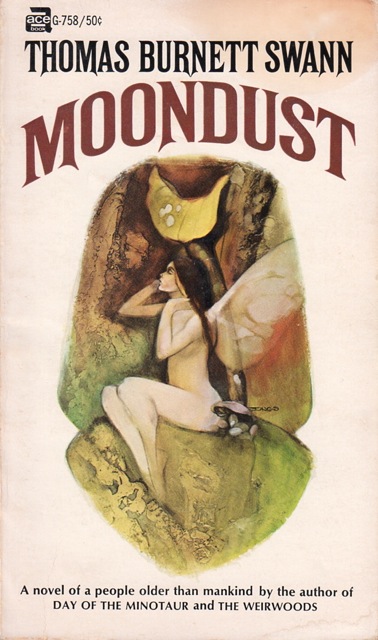
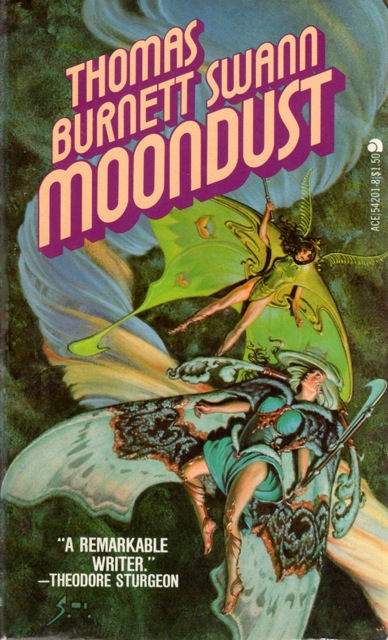
From left to right: Ace cover by Jeffrey Catherine Jones (1968), Ace cover by Stephen Hickman (1977). Both courtesy of ISFDB.
And the trumpets began to sound,
And Joshua commanded the children to shout,
And the walls came tumblin’ down.
— “Joshua Fit the Battle of Jericho”
Thomas Burnett Swann’s third novel, Moondust, is fascinatingly weird. Of the five Swann novels I’ve read so far, it’s also his most uneven, largely because it awkwardly mixes a well-known Tanakh narrative—the story of the Israelites’ sack of Jericho and their massacring of its entire population: “man and woman, both young and old, and ox, and sheep, and ass” (Joshua 6:21) —with Swann’s usual mythological vision of a prehuman world losing ground to humanity. But whereas the relationship between Swann’s unique vision and the mythology he adapts is often relatively seamless, or at least an understandable stretch, Moondust is wildly inventive in how it joins these stories, to the point that it’s unclear why the Battle of Jericho occurred to Swann as the narrative and temporal locus for his story about Bard the Cretan potter, Zeb the Canaanite priest, and Rahab the mythical mothwoman. The story hinges on the latter, the “harlot” of Jericho who protected Israelite spies Aram and Salmon during their reconnaissance mission, and offers a partial explanation for how the walls of Jericho fell, ironically undercutting the theological claims of the book of Joshua that Yahweh alone affected their tumbling down.
Moondust represents several firsts for Swann. It was Swann’s first standalone novel, not fixed-up from earlier stories. It was also Swann’s first (of two) novel(s) to draw on ancient Hebrew mythology rather than Greco-Roman or Egyptian mythologies, which made up the majority of the novels that fit into his prehuman history. And it is also his first novel to obviously explore the queer themes that become much more explicit in his later work, especially his second novel based on Hebrew mythology, How Are the Mighty Fallen (1974), which retells the story of King David—but queer. (Notably, Moondust ends with the birth of Boaz, the great-great-grandfather of David.) And while the novel is quite uneven in its overall tone and quality of story, especially the odd mixing of tanakhic narrative with what is easily the second-bizarrest fantasy invention in Swann’s oeuvre, Moondust deftly develops the themes of gender, masculinity, and love that began in his first novel, Day of the Minotaur (1966), and will continue to animate his fiction until his death in 1976. It also continues Swann’s critique of slavery, begun in his second novel, The Weirwoods (1967).
Moondust is a first-person narrative told from the perspective of Bard, a refugee from Crete after its fall to the Mycenaeans, presaged in Day of the Minotaur. At sixteen, he is already a master artisan whose skill at crafting realistic animal figurines is shaped by his memories of Crete and techniques taught by his mother. Bard lives with his mother and younger brother, Rhadamanthus or Ram, in a house atop the thirty-foot outer walls of Jericho. Life among the Canaanites is hard for the Cretan refugee family, who consider the Jerichites uncouth, uncivilized, backward louts compared to their lost civilization; words like “fat” and “obesity” and “slovenly” are tossed about in description of the Jerichites, almost as if justifying the horrific violence visited upon them in the Hebrew myth. Moreover, Bard is an anomaly among the Jerichites: he is lighter skinned, slighter built, and red-haired, for he is descended from the Cretan Woodpecker God (woodpeckers and redheads recur throughout Swann’s oeuvre). In the background of daily life in Jericho is the looming threat of invasion by the Wanderers, fierce desert nomads who have spent forty years in the desert. Under the leadership of Joshua, following the commandments of their mountain god Yahweh, they stand to destroy Jericho as the first stop in their conquest of Canaan—should they cross the river Jordan.
The story of Moondust begins toward its end, establishing a frame narrative: Bard has come into the Wanderers’ encampment to plead Joshua’s help rescuing Rahab. Within that frame, the novel recounts who Rahab is and why she needs rescuing. The novel is split into two formal parts, “The Peoples of the City” and “The Peoples of the Sea,” though ultimately there is little need for this structure, other than as an indication of where the action takes place, since it is at odds with and interrupts the overall frame narrative of the story.
In “The Peoples of the City,” Ram is switched out for a changeling, whom Bard’s mother names Rahab, which Swann gives as “the wide one” in Canaanite. In the Tanakh, Rahab is an isha zona, a prostitute or “harlot” (the word Swann uses in his post-novel notes on his sources), though there has been considerable debate since the beginning of Rabbinic writings and some consider her an innkeeper. Swann’s Rahab is ugly, misshapen, lumpy, gray-skinned—like unformed clay—and remembers nothing of her past but fleeting thoughts of giant mushrooms. Bard and his mother take Rahab in and treat her as a sister/daughter to ensure good treatment of Ram among whatever beings made the switch. Bard’s mother, who had never been loving and whom Bard could never bring himself to love, dies shortly thereafter. In the following year, Bard and Rahab work together to produce his animal figurines; they befriend a priest of Jericho’s moon god Shin, Zeb, a former shepherd who cares deeply for animals and is a hunky man’s man in the vein of Arnth from The Weirwoods.
Together, Bard, Rahab, and Zeb form a tight-knit “found family,” and are joined by a curious and lordly fennec fox, who keeps them company in Bard’s house and seems to watch over Rahab. But things begin to unravel when Rahab falls ill, her skin cracking and peeling… and she emerges from her lumpy flesh cocoon as a supremely beautiful woman—with equally beautiful moth wings, too small for flying. Her beauty begins to make her vain and she seduces Zeb, though he regrets it after she falls asleep in the act. Later, Bard and Rahab house and protect the Wanderer spies, Aram and Salmon, a scene that follows the tanakhic story closely, and for this act, the Wanderers grant that Bard and Rahab and anyone in their house during the Wanderers’ invasion will be spared. Crucially, Rahab also seduces Salmon, and when morning comes, when the Wanderers have escaped Jericho, Rahab and the fennec are gone, too.
In “The Peoples of the Sea,” Bard and Zeb set out to track Rahab, whom they believe has returned to wherever she came from, with the hope of bringing her and Ram back to Jericho. Here is where things get truly weird. Led by Zeb’s pet hyena Hatshepsut, Bard and Zeb descend into an underground world of tunnels through the centuries-old ruin of a Hyksos villa, leftover from an earlier conquest of Jericho. They eventually come to a subterranean city inside a hollowed-out mountain, lit by phosphorescence, all of its buildings carved from giant mushrooms. This is the land of Rahab’s mothpeople and their “Masters,” and here Swann begins a lengthy section of really oddball worldbuilding infodumping. Rahab’s people are a slave race. In ancient times, they were still capable of flight; they dwelled in the deserts and hidden valleys of the Levant in such numbers that humans called them “Peoples of the Sea because we frolicked above the desert like flying fish above the Great Green Sea [Mediterranean]” (95); and they were fierce warriors who “fought against griffins and phoenixes among the clouds” (96). But they grew content and lazy (an allusion, perhaps, to the Jerichites, soon to be conquered by the Wanderers) and eventually lost the power of flight. When they were most vulnerable, hidden in their mountain valleys, the fennecs came. And enslaved them.
Swann’s fennecs are indeed the little desert foxes we know. But they are also a sentient, powerful, telepathic, and most importantly an evil people. They are the “Masters” of the fallen mothpeople (Swann doesn’t give us a simple term for them, so I’ve adopted this). Each mothperson is beholden to a single fennec master, who has total telepathic control over his “servitor.” The fennecs are not just enslavers, they are viciously devoted to aesthetic ideals and believe that art must improve upon the flaws of nature. As such, the underground city—called Honey Heart—has no gardens or trees, but instead is decorated with absolutely faithful artistic reproductions of them, complete with artificial scents. The fennecs’ obsession with aesthetics is reproduced in the social structure of the mothpeople, who are divided into categories of value and station based on their aesthetic appeal to the fennecs: Littlies (children), Uglies (those who have gone into the cocoon-like changeling state), Wingers (the soldiers and regular servants), and Comelies (the most beautiful and most valuable). Moreover, the fennecs consider masculinity aesthetically displeasing, so male mothpeople are either killed or castrated (as are human children swapped in for the changelings). With no male mothpeople, the fennecs cultivate breeding grounds among humans in order to continuously reproduce their slave population. Rahab’s master, Chackal, has begun to experiment with Jericho as the ideal place for sending Uglies to change and when they do, like Rahab, to seduce human men and “profit” (the fennecs’ word for impregnation). Jericho is a perfect breeding ground because its people are stupid and loutish, and Rahab’s success in living among the Jerichites as an Ugly and then as a metamorphosed Comely proves they are not predisposed to killing the fennecs’ valuable chattel. Like the mothpeople, like the kidnapped children, Jericho can be “domesticated.”
Swann’s invention of a society of evil, telepathic fennecs driven by their obsession with aesthetics is so fucking bizarre—and admirably so—and yet its weirdness, paired with Swann’s typical attention to the politics of social structures, does not blunt its brutality. We learn, in fact, that Rahab did not actively seduce Zeb and Salmon, but was telepathically forced to by Chackal; Rahab was raped and her forced impregnation is a “profit” to her master. (Swann does not confront this as rape, unfortunately.) It is also heavily implied that Bard’s brother Ram, who has been abused by the fennecs into “a paradigm of obedience” (106), and whom Bard at first thinks is a girl when they reunite, was castrated by the fennecs to prevent him developing masculine features. Bard is nearly castrated himself but is saved by Rahab. Rather than punish her, Chackal “liked [Rahab]’s rebellion. He thought her gesture the most artistic, the most delicious, he had ever seen. He compared it to music” (116, emphasis in original). To reward her and increase his own standing among the fennecs, Chackal enrolls Rahab in the Wind War, an aerial gladiatorial combat between enslaved mothpeople—each riding a paraglider branded with the colors of a different moth: Rahab, known as Moondust among her people, is appropriately given the luna moth glider—that raises the winner’s master’s status.
The Wind War is a long sequence but largely uninteresting, even if it shows that among all his many talents as a writer, Swann is also adept with action sequences. There is comparatively little action in Swann’s novels and instead a greater emphasis on love, romance, and tenderness, as well as critical themes, which makes his fantasies something like anti-sword-and-sorcery fiction, countering the popularity of that genre’s return to popularity in the 1960s and early 1970s alongside the growing popularity and market salience of fantasy more broadly. Swann’s writing is therefore a better fit with the more literary-minded, intellectually curious fiction of the late-nineteenth- and early-twentieth-century writers Ballantine was republishing in the BAF series. During the Wind War sequence, Swann turns the action to tragedy even if Rahab is the victor, as each of her enemies plummets purposelessly to her death. Rahab’s victory, brutal as it is, is only a partial victory for her—Bard and Zeb are spared, able to return to Jericho, but without Rahab or Ram—but a major coup for Chackal, who manipulates the closeness between Bard, Rahab, Zeb, and Ram to ensure that Bard will cooperate as Chackal sends more and more mothpeople changelings to Jericho, furthering the fennecs’ slave-making program.
Bard and Zeb return to Jericho. The city is tense. The Wanderers have damned the Jordan river and crossed. A siege is imminent. Zeb moves his beloved animals, including the hyena Hatshepsut (Hat), into Bard’s home to safeguard them when the Wanderers invade. The end comes, rather unexpectedly, when Chackal visits Bard at his home to inspect it before the arrival of a new changeling. The fennec goes into Rahab’s old room:
There was a yelp which could easily have been no more than a cough, a clearing of the throat. There was the slow, rhythmic motion of jaws, no more audible than the ruminating of a cow.
“What is Chackal finding to eat in there?” I asked. “Did you leave some meat for Hat?”
“No, but I left Hat.”
“Then it isn’t Chackal who’s eating.”
We raised the curtain [to the room].
“You really can’t blame Hat,” said Zeb quickly. “Not after what Chackal did to her. And me. Hyenas hold grudges, you know. They bide.” (147–148, emphasis in original)
With a humorous nonsequitur, Chackal is done away with. But this endangers Rahab and Ram, who will likely be killed when the fennecs discover Chackal’s disappearance. So Bard and Zeb go to the Wanderers, to Joshua, seeking help.
And here is where the novel began, with Bard pleading for Joshua and the Wanderers’ aid, only now we know it’s for the sake of Rahab and to stop the evil, telepathic fennecs’ slave-breeding program. (I’d like to know what the Talmud has to say about that!) But Rahab and Ram have already escaped and are among the Wanderers. Bard and Zeb offer to help the Wanderers nonetheless, lest Jericho become a stronghold for the fennecs, and Bard devises a way to flood the tunnels beneath Jericho with water from the city’s Moon Stream, weakening the walls. Bard suggests, then, that the Wanderers call on their mountain god Yahweh to create an earthquake to bring down the weakened walls. With all the Jerichites dead, the fennecs will “lose their profiting grounds. All their plans, experiments, expenses […] would come to nothing” (154). Swann then inserts his own gloss of Joshua 6, detailing how the Wanderers spent six days mutely carrying the Ark of the Covenant around Jericho before shouting on the seventh and bringing down the walls. In the epilogue, Bard, Rahab, Zeb, and Ram have joined the Wanderers, and Bard and Rahab are happily raising their new son (begat by Salmon), Boaz: “The Wanderers say that means the Lord of Strength. Our Boaz will be strong in love,” Rahab concludes, and Bard rather tritely continues, ending the novel, “Boaz. I like the name. Somehow, I feel as if it’s going to become famous” (158).
Moondust, as I said above, is weird and uneven. Mostly the latter has to do with the strange tonal dissonance between the seriousness of the tanakhic narrative from the book of Joshua and the head-scratchingly bizarre evil fennecs story. But Swann also indulges in a great deal of infodumping in the second part of the novel, outlining the fennecs’ ideas about aesthetics, the social hierarchies among the mothpeople, the history of the mothpeople, and much more in great detail. This detail is interesting, strange, and compelling, but it is often given in a straightforward manner, with large blocks of text and little reaction from Bard or Zeb. Swann does something similar in Lady of the Bees (1976), where a lengthy portion is devoted to Mellonia’s sojourn into the Valley of the Blue Monkeys and a discussion of those equally weird beings, the Telesphori, but Swann handles the detail—much of which is at odds with or irrelevant to the narrative about Romulus and Remus—more deftly in that novel. The story of Joshua and the Fall of Jericho is really secondary to the fennec stuff; it’s unclear why these two stories are brought together, since Joshua and the Wanderers seem almost an afterthought.
The novel also fumbles or at least significantly complicates Swann’s usually careful critique of human civilization, dispensing entirely with the set up of a conflict between the waxing supremacy of humans and the waning remnants of the once populous prehumans. In Moondust, Swann presents us with a prehuman society that is flourishing but also fundamentally bad, and not just bad, but almost humorously if nonetheless grotesquely evil. The fennecs are nothing short of Nazified aesthetes preying on human society for the reproduction of a slave race that serves them through labor and as art objects, and which is kept in utter obedience through telepathy. There is nothing redeeming about the fennecs. Their aesthetic aims and enslavement of the mothpeople do not result from the encroachment of human civilization.
Crucially, the fennecs are not reacting against humanity out of self-preservation but instead feed on and benefit from humanity’s growth, doing so at the cost of another nonhuman people’s freedom. Wherever humans spread, the fennecs can build their underground cities and expand their slave breeding. Elsewhere in Swann’s oeuvre, the “bad” actions of the prehumans are typically understood as desperate actions taken in the face of human aggression. For example, the Thriae of Day of the Minotaur are not exactly sympathetic figures but they side with the Mycenaean invaders under Ajax out of fear for their lives; they are greedy, yes, and Swann often suggests that the prehumans are more driven by biological “nature” than by individual ideas of beliefs (something that characters often defy or overcome, e.g. Vegoia in The Weirwoods), but the Thriae are not fundamentally evil. And the Mandrakes of The Tournament of Thorns have been turned into monsters by humans’ efforts to rid England of the prehumans; driven into forests and caves, their babies murdered, the Mandrakes understandably hate humans. It’s the centuries of oppression that have made them “barbaric” and monstrous, but Swann still finds a way to empathize if not sympathize with them.
But Swann’s fennecs are simply evil. And perhaps there’s a reason for this, making them unique among Swann’s prehuman peoples as essentially irredeemable and unsympathetic, and it has everything to do with slavery. Slavery has already been presented in Swann’s work as an intolerable injustice, notably in The Weirwoods, where human slaves, cats, and Weir Ones alike rise up against their Etruscan masters. It might seem odd or incongruous to compare these three categories of being and their different relationships to a society like the Etruscans, but Swann’s presentation of the different but equally unjust forms of subjugation—enslavement of humans, domestication of an animal as a commodity, and ostracization and dehumanization of intelligent prehumans (enslaving one of them, the Water Sprite Vel)—is tactful. The thesis of the novel is that violence is justified as the response to such subjugation. In Moondust, Swann discusses slavery and its brutality at length—even alluding to Egyptian cats as akin to the enslaved mothpeople (102)—and emphasizes how enslavement creates social hierarchies, how it is reproduced, and how it operates through both physical and psychic subjugation.
Moreover—and this might be a stretch, but it’s worth considering—, the story of Joshua and the fall of Jericho has resonances with slavery, at least in some interpretations of the tanakhic text. The African American spiritual “Joshua Fit the Battle,” quoted as the epigraph of this essay, was likely composed in the early-nineteenth century by enslaved Africans on plantations in the US. Many have understood the song to be a metaphor for the dream of slavery’s abolition. Joshua, himself descended from slaves in Egypt, becomes the abolitionist. And Jericho the institution of slavery. Through faith and rebellion, the walls come tumbling down. For this, the song says, Joshua is greater than the Israelite kings Gideon and Saul. Swann even uses the language of the song: “the double wall would come tumbling right down the hill” (154). This language differs from the tanakhic language he glosses on the next page, in evidence of the event itself, which describes how “the wall of the city shall fall down flat” (155, emphasis in original).
Now, Swann isn’t necessarily an anti-racist; several of his novels mention “Libyans” in a negative light, the mothpeople in Moondust refer to a mud-bedecked Bard as unpleasantly black like a Libyan, and his novel The Goat Without Horns (1971) includes a racist caricature of voodoo alongside some pretty virulent anti-Indigenous racism. But Swann does seem to at least be aware of (1) the African American spiritual and (2) the resonances of that spiritual with a passionate outcry against slavery and as a demand for its end. Perhaps for this reason, in order to justify the genocide of the Jerichites—a tale that has long troubled readers of the Tanakh and which has obvious Zionist resonance today, as does most of the conquest of Canaan as told in Joshua and Judges—, Swann expends a good deal of effort making clear how loutish and grotesque they are (mostly by fucked up references to their fatness, obesity, and laziness). Still, this reading of the position of the Jerichites sits uncomfortably with how their situation and fate parallels that of the Peoples of the Sea, whose earlier acquiescence to sloth resulted in their enslavement by the fennecs.
Swann, as a social critic of history, is very much attuned to how one group takes advantage of another’s circumstances through violent conquest, while at the same time he tends to resist teleological narratives of progress that have historically resulted from and normalized such conquests, whether he’s writing about the Mycenaeans in Crete or the Latins in Etruria. Often, too, he parallels the displacement of an older human culture with the destruction of the prehumans by, or the loss of their territory to, humans. In Moondust, however, there is no similar parallel. The attempt to draw them, as noted above, gets messy quickly and undermines a reparative reading. The only valuable parallel is between Aram and Salmon, as spies/invaders in Jericho, and Bard/Zeb as spies/invaders in Honey Heart, but the parallel seems to be merely a narrative, structural one and not a thematic one.
From reading Swann’s other writing, we might have expected Jericho to have been saved or redeemed in some way. I fully expected the Fall of Jericho would be portrayed as a tragedy, that the Wanderers’ invasion of Canaan would be cast as a tragic conquest, in much the same way that Swann presented the rise of Rome as a tragedy in Lady of the Bees. But that is not the story Swann tells. To get a bit weirder, we might posit a radically different kind of reading. If we take the fennecs, for example, as some kind of allegory for Nazism—which might be a compelling reading given their obsession with artistic, gendered, and racialized aesthetics, their domination of enslaved peoples through a kind of will-to-power (telepathy), and their preoccupation with perfection through breeding (racial hygiene)—it might be possible, then, to read Joshua’s conquest of Jericho and his consequent foiling of the fennecs’ plan as a kind of Jewish revenge story wrapped into a larger Zionist narrative about the reconquest of Israel as a home for the Jews. Maybe. After all, Leon Uris’s bestselling Zionist novel Exodus, which pioneered the “Hot Jew” trope, was published a decade earlier. But, still, it’s a huge stretch of a reading.
Moondust offers us a messy but provocative exploration of slavery, race, and civilization; a clumsy and underwhelming meditation on the book of Joshua; and the freakiest story about fennecs ever written. But it is also, as I noted, the first of Swann’s novels to surface the queerness that will be more prominent in his later novels. I did suggest that there might be some queer undertones in Vel’s admiration for and later deadly obsession with Arnth in The Weirwoods, but they’re incredibly faint and have to be squinted at to see; even then, there’s not much that can be said. Moondust, however, is the first of his novels to feature a strong homosocial bond between two men (three if you count Salmon). The bond between Bard and Zeb walks the line of friendship and brotherly love while occasionally hinting at something a bit queerer.
Bard is, of course, emotionally vulnerable: he is a refugee, he is an orphan, he has lost his brother. Zeb is manly and caring, a shepherd who treats those he loves as his lambs. The tenderness of their relationship is expressed regularly in the second portion of the novel, where Bard comes to find Zeb’s voice and especially his arms as a comfort:
- “His rough arm was more eloquent than words” (84);
- “He shook me with his awkward, solid, and altogether lovable arm” (108);
- “I burrowed into his arms like a strayed lamb” (108); and
- “I needed the love which is constant and familiar but not fleshly; which enfolds but does not enflame; friendlove, brotherlove, fatherlove: a bear-skin coverlet on a cold night, cracknels hot in the oven” (108).
And though Bard explicitly rejects that his feelings for Zeb are “fleshly,” there is always the undercurrent of a tender love beyond friendship and brotherhood. Indeed, it’s described almost like the kind of “hearthfire” love shared by Arnth and Tanaquil in The Weirwoods. And occasionally it is homoerotic, as when the two lovingly scrub each other during a bath in Honey Heart. Indeed, one of the mothpeople remarks that their behavior—notably, their holding hands—is like that of the people of Sodom (90); we learn later that the fennecs’ breeding programs didn’t work in Sodom because all the men were gay, the women lesbians (101).
The queerness in Moondust is just an undercurrent. It is glimpsed in men’s admiration for other men: who they are as people, the feats they perform, and, yes, their bodies. It is also found in men’s jealousy of other men’s intimacy—with one another and with women. And it is found in the rejection of heteronormativity as a structuring force in men’s lives. Even if the dudes aren’t kissing, Swann reminds us that what was normal between men (and women), and what was straight or queer, was sometimes radically different in the ancient world. At the same time, regardless of whether the dudes are kissing, there is an attention to emotion, care, and tenderness between men in Swann’s work that is incredibly sincere and unlike much else in the genre landscape of the period, with the major exception of Tolkien’s homosocial relationships between characters, whether Aragorn and Boromir or Frodo and Sam (and Swann did not read The Lord of the Rings, for he thought too poorly of The Hobbit to give Tolkien another chance).
While queerness treads lightly around the periphery of Moondust, Swann’s usual attention to powerful women is on full display in the figure of Rahab, venerated in the Tanakh and made more impressive in Swann’s retelling, for she rejects her enslaver and rejects, too, the simplifying and objectifying lens of patriarchy, admonishing Zeb, for example, and asserting that “Men call a woman mysterious to avoid the trouble of understanding her” (100). Rahab is brave, resilient, and a warrior. She rescues Bard and Zeb. She escapes on her own, rescuing Ram, too. And when she bears a child—a product of rape under the fennecs’ slave-breeding program—she rejects even her helpers’, the Wanderers’, interpretation of his name. It’s not physical strength she admires, but the strength of love.
Such an ending fits with the best of Swann’s tales, which are all about love and its power, love in the face of injustice and tragedy, salvific love between two peoples. Bard, too, is part of Swann’s play on gender norms and expectations, for his is a story not of a warrior or a hero bravely winning out, not of the strong man saving the imperiled princess, but of a youth always in need of others’ help. It’s a vision of masculinity at odds, in its own time, with the Conanesque sword-and-sorcery revival and more like that of Peter S. Beagle’s Schmendrick. Rather than the hero, Bard is, as Rahab describes him, “the kind of person worth looking after,” because of his loyalty to and care for those whom he loved (157).
Thomas Burnett Swann’s Moondust is really something. It has lofty goals in retelling the story of Jericho and at the same time demonstrates Swann’s whimsical, don’t-give-a-fuck attitude toward expectations about myth retellings. After all, who else would decide to improve the story of Joshua by explaining that Rahab was a mothwoman liberated from a society of evil fennecs and that the walls of Jericho really fell because a Cretan teenager, descended from the Woodpecker God, figured out how to weaken them?
Uneven, bizarre, thematically messy, pleasantly if only teasingly queer, Moondust nonetheless shows that Swann is an author worth reading half-a-century after his death.
To get notifications about new essays like this one sent directly to your inbox, consider subscribing to Genre Fantasies for free:

 Genre Fantasies
9 thoughts on “Reading “Moondust” by Thomas Burnett Swann”