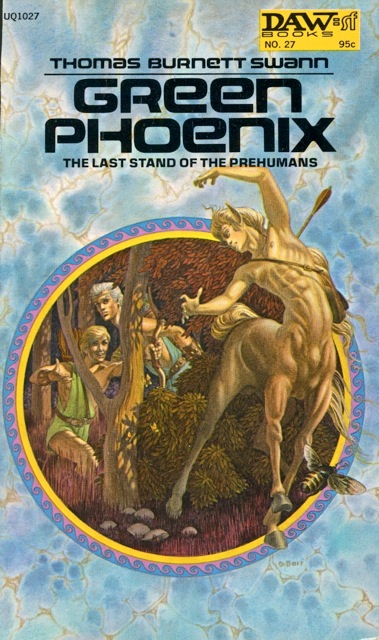
Green Phoenix by Thomas Burnett Swann. DAW Books, 1972. Latium 2.
Content warning: This essay discusses sexual violence.
Table of Contents
Swann, Latium, and DAW
Reading Green Phoenix
The Sacred Oak and the Second Troy
Parting Thoughts
Swann, Latium, and DAW
“Aeneas must die” (7, emphasis in original). Thus spake Volumna, queen of the Dryads, imploring the Oakarian Dryads of Latium to kill the newcomer to Italia’s shores, lest he ravage the women of this land, bringing pain as he brought to his betrayed wife Creusa, abandoned to her fiery death as Troy fell to the Hellenes while he escaped with their son Ascanius, and to the Carthaginian queen Dido, who killed herself rather than face the shame of having been ill-used by her heartless lover—a marauder, a killer, a widowmaker: “Aeneas, Butcher of Troy, betrayer of women” (75). And so opens Thomas Burnett Swann’s sixth novel, Green Phoenix, billed on its front cover—with unfitting, garish, cartoonish art by George Barr—as the story of “The Last Stand of the Prehumans.”
Swann wrote two loose trilogies—or, rather, story cycles featuring related characters and settings—during his short but exceptionally productive career, and both were written out of chronological order. These were his “Latium” trilogy and his “Minotaur” trilogy, named posthumously by his fans. Swann’s loose trilogies were part of his larger “secret” history of the prehumans, the beings of ancient mythology, variously called Beasts, Weir Ones, Wild Ones, and so on, who constituted races of people such as Dryads, Centaurs, Minotaurs, Fauns, Water Sprites, and much much more, and who were slowly driven to extinction or into the abject status of monsters by the rise, growth, and spread of urban human civilizations across the ancient Mediterranean (Swann’s “Great Green Sea”). Most of Swann’s 16 novels were part of his historical fantasy saga of the prehumans, even those set during later time periods, like The Tournament of Thorns (medieval), The Goat Without Horns (Victorian), or Will-O-the-Wisp (seventeenth century), and most of them reference important events, figures, and mythological narratives, weaving the prehumans into the story of humanity and, often, showing the cost to nature of the rise of humanity. Swann’s stories are, importantly, not stories of civilization triumphing over barbarism, but an exploration of the barbarism of civilization, of the violence it takes to wipe out another species, to rend society’s relationship with nature, and to hold power over others.
As of this writing, I’ve read two novels in the Minotaur trilogy, Day of the Minotaur (1966) and The Forest of Forever (1971), and the final (in terms of chronology but the second written) novel of his Latium trilogy, Lady of the Bees (1976). Lady of the Bees retold the myth of how Romulus and Remus founded Rome, with the Dryad Mellonia a major player in this story. The novel was an expansion of Swann’s 1962 novella “Where Is the Bird of Fire?” first published in the British magazine Science Fantasy, then a Hugo finalist for the short fiction category, and later the title story of a 1970 collection of Swann’s short fiction, published by Ace Books. But before he expanded on the story of Mellonia and Remus, he wrote the story of Mellonia and the Trojan hero Aeneas.
Green Phoenix is set several hundred years prior to “Where Is the Bird of Fire?” and in a very different Italia. This is a land where humans are scarce, where the Latins live in small fortified towns, where the Etruscans are a distant idea somewhere to the northwest, where mythic figures like the Amazon Camilla and her Volscians roam—and where forests still teem with Dryads, Centaurs, and Fauns. Like much of Swann’s work that retells well-known mythic stories, Green Phoenix sits at the edge of the myth, barely touching the events of Virgil’s Aeneid, so that Mellonia’s story and that of the prehumans, including the birth of her and Aeneas’s son, Cuckoo, take place in the epic’s interstices, in the shadow of the major events that were stitched from the cloth of even earlier myths and mythistories into a nationalist poem for the Roman Empire. Where Virgil’s story of Aeneas gave Rome’s emperors a lineage beyond the shepherd brothers suckled by the She-Wolf, connecting Rome to an age of heroes and to the ancient Mediterranean’s best known mythic story cycle, Swann gave readers in the early 1970s the story of a tragic figure, plagued by guilt, haunted by the trauma of war and loss, a gentle hero who finds respite in the love of a Dryad, only to have that, too, taken away.
Green Phoenix was also Swann’s first novel with DAW Books. I noted in my essay on Day of the Minotaur that Swann owed a lot to Donald A. Wollheim, who published Swann’s first novel and several more at Ace in the mid-to-late 1960s and who, on founding DAW, continued to publish Swann’s novels until after his death. Of Swann’s 16 novels, Ace published six (plus two story collections) and DAW published another six; the other four were published by Ballantine (two novels), the British publisher Corgi (Will-O-the-Wisp, never released in the US), and a niche hardcover publisher Heritage Press (Swann’s only hardcover novel, Queens Walk in the Dusk, the first Latium novel and prequel-of-sorts to Green Phoenix). Swann may not have been a cash cow for Wollheim, but his unique historical fantasy novels clearly sold well enough—and his reputation was good enough—for Ace and DAW to continue publishing his books. Green Phoenix was an early DAW novel, too, number 27 and published within eight months of the firm’s first novel, Andre Norton’s Spell of the Witch World (April 1972). In addition to being Swann’s first novel with DAW, Green Phoenix was also wholly original and not, like several of his earlier novels, previously serialized in an sff magazine.
Reading Green Phoenix
Like most of Swann’s novels, Green Phoenix is split in two parts. Part One takes place in the space between lines 36 and 37 of book VII of Virgil’s Aeneid, after Aeneas and his surviving Trojans warriors have left Carthage, after Aeneas’s visit to the Underworld, after he receives a prophetic vision of Rome (Virgil’s attempt to canonize a wealth of disparate stories about Latium, Alba Longa, the Roman kings after Romulus, and more), and just at the moment after the Trojans have arrived at the shores of a vast forest through which flows the Tiber river. The coming of the Trojans has set off alarms in the forest, where Dryads, Centaurs, and Fauns live together far from the small human settlements that will eventually be stitched together to form Rome. Though we’ve seen these prehumans in earlier Swann novels, the Dryads of Latium are different. These “Oakarians” are ruthlessly gynocentric and misandrist, they expose all male infants at birth, they are ruled with an oaken fist by queen Volumna, they cultivate a species of large spiders called Jumpers whose venom they use against their enemies, and they believe their god Ruminus (or sometimes “the evil dwarf-god Sylvanus,” 54) impregnates them when they enter a drug-induced sleep in their sacred oak.
When the novel opens, the young Dryad Mellonia is a chaste and devoted believer in everything she has learned about men and their dangers. Men kill, conquer, rape, and hurt women to serve whatever whims they follow. And Aeneas is said to be the worst of them. But when Mellonia, concerned about the Trojans but naturally a little curious, goes looking to confront Aeneas, she finds instead two naked youths—Halcyon and Phoenix—and tentatively befriends them. Later, however, Phoenix kills Mellonia’s Centaur friend, Bounder, mistaking him for a deer, and Mellonia vows to kill both Trojans, especially once she discovers they are actually Aeneas (Halcyon) and his son Ascanius (Phoenix). But the preternaturally young and beautiful Aeneas, son of Aphrodite, is so moved to grief at his son’s killing of a Centaur (whom he views as noble, but his son sees as an animal) and so willing to make amends to the Centaurs and other prehumans—going to far as to bury Bounder himself and to gift his father’s ring from Aphrodite as Bounder’s toll for Charon—that Mellonia realizes the Dryads and the tale-tellers must have gotten something wrong about Aeneas…
Indeed, Aeneas is nothing like the reputation that precedes him. Ascanius understands that when Aeneas weeps for Bounder, “he wept for the world’s lost youth” (43)—not just Bounder’s, not just his own or Ascanius’s youth, but for all those lives torn apart by bloodshed, war, violence. When Aeneas gets a chance to tell his story to Mellonia, it is one of tragedy. He did not abandon his beloved wife Creusa, but was separated by the tumult of the Hellenes’ siege. And while Ascanius scorns Dido, Aeneas defends her: “An unhappy woman who mistook summer for spring and wanted to stop the drip of the water clock, the shadows of the sundial” (59). Aeneas is framed by Swann as the victim of a world of violence; his heroism is, yes, part of his deific ancestry and equally (if not more so) the outcome of his having survived the violent circumstances of his life. Moreover, while Aeneas is prophesied to raise a Second Troy, this promise of the future—which he does not seem to want—pales in comparison to the past that weighs so heavily upon him. Swann’s Aeneas is a man compounded of grief, haunted by the traumas of his past, and he fears that “To the women I love I am death” (59).
Where Aeneas is a god among men, in large part because of the choices he makes, who he decides to be, his son Ascanius is anything but. He is very much everything the Dryads fear. Ascanius sees himself as a warrior, no more or less, and feels no grief in killing; he is not burdened by the traumatic violences of the Fall of Troy nor by the pillaging and conquering the Trojan refugees have done in the intervening 15 years. He enjoys it; he lives for it. And so he has no qualms killing a Centaur. In Swann’s symbolic language, which so greatly values nature and its beauty: “Ascanius was almost indifferent to flowers” (39). He is a certain kind of man who shows up time and again in Swann’s writing, whether the Ajax or Day of the Minotaur or the Romulus of Lady of the Bees: the kind of man whose masculinity is a harbinger of the destruction civilization will bring to the natural world and the prehumans.
Ascanius embraces this masculine ideal to such an extent that women are inimical to his life, only good for sleeping with—by force if necessary (he even suggests multiple times that if Aeneas desires Mellonia, he should just rape her). Outside of their role as sex objects, women are a potential threat to Ascanius: they are dangerous, deceitful, untrustworthy. He labels Mellonia a new Pandora (38). He cannot imagine Aeneas as anything other than a foolish boy (though his father) manipulated by the wily women around him. “You’re such a trial to me with your women,” Ascanius tells Aeneas: “You mistake them for goddesses and then forget that even the Olympians have their failings,” and so he wonders whether “I’ll ever rear you into a safe old age” (50). The context for this infantilization of his father is damning: Aeneas and Ascanius have just discovered from the Faun Mischief that it’s the Fauns, and not the god Ruminus or the evil Sylvanus, who impregnate the Dryads. The Fauns, in essence, rape the Dryads—sometimes as many as three Fauns at once—in their drugged-induced sleep under cover of a religious narrative, posing as gods in order to take what they lust after. To Ascanius, this seems a perfectly reasonable situation: the Dryads want children, Fauns want Dryad lovers, so where’s the problem? But Aeneas names this as rape and means to warn Mellonia. This is the “trial” Aeneas puts Ascanius through: that his father wishes to stop Mellonia from being raped.
After revising her initial fears of Aeneas, “Butcher of Troy,” and seeing how sensitive, genuine, and beautiful a man can be, Mellonia decides she is ready to have a child and, moreover, she hopes to have a boy-child as beautiful as Aeneas—a child she will refuse to expose, defying Volumna’s rules against the raising of sons. The whole experience of meeting Aeneas has shifted her perspective on Volumna, given her a new frame for thinking about what a leader owes her people:
[Volumna] had ruled her people for almost three hundred years, and made them feared and respected in the Wanderwood. She had fulfilled her self-appointed destiny. She walked in the tranquility of her power and achievement.
Aeneas and Volumna, though enemies, had much in common. Both were leaders. Both were ripe with years, even to the silver of their hair, and yet they were somehow young. But there was a difference as great as that between the sea and the forest. Aeneas was not tranquil. Aeneas was still tormented by self-doubts, and in his anguish, it seemed to Mellonia, lay his grandeur. No leader had earned tranquility while those around him suffered pain. Bounder had died; Aeneas, not Volumna, had grieved for him, and not only because his son had shot the fatal arrow. (“All things die,” Volumna had said to her. “And after all, he was only a Centaur—and male at that.”) (52–53)
With the death of Bounder, Mellonia begins to understand how Volumna’s hatred of men has blinded her to the humanity of all. And so, seeking to bear and raise a boy, Mellonia decides to enter the sacred oak. On the way, she is accompanied by Volumna, her aunt Segeta, and a third Dryad, who recount their experiences in the sacred oak. Most have been positive, leaving the Dryads with a feeling of peace and joy, but others—the experiences attributed to the evil god Sylvanus—were painful and violent: “He tortured me in my sleep. I awoke with bruises in a pool of blood,” recounts Levana (54). Segeta echoes this account; importantly, Segeta is withdrawn and melancholy, seeming to live in a fugue state, as though suffering long-term PTSD.
Mellonia is sure, however, that her lover will be Ruminus, not Sylvanus. In the event, she is attacked by three Fauns, but they are routed by Aeneas, who comes to Mellonia’s rescue after learning about the Fauns’ abuse of the sacred oak ritual. And there, in the darkness, in the arms of her savior, who reveals the Fauns’ monstrous deeds, Mellonia gives herself to Aeneas and the two conceive a child. But this is not without consequence—not the least of which is the shattering of Mellonia’s worldview and the reorienting of her relationship to Voluma, to the Dryads, and the gods themselves. Aeneas and Ascanius confront Volumna and threaten to tell the other Dryads the truth if Volumna does not let Mellonia keep her and Aeneas’s boy-child. Ascanius, for his part, also threatens to rape Volumna and have the rest of the Trojans rape the other Dryads; Aeneas says nothing about this.
In the face of this threat, Volumna reveals she was the sole survivor of a massacre by lions who came to the Wanderwood at the end of the Golden Age and the dawn of the Silver Age, some three hundred years ago. As the last Dryad, she was groomed from childhood by a seemingly kindly Faun, who eventually raped her, impregnating Volumna with a daughter. So Volumna came to hate and distrust men, but arranged for the Fauns’ rapes to continue and she raised the girl-children of those assaults into the Oakarian community she now rules (the boy-children were all Fauns, and so were killed). Volumna created the ritual of the sacred oak and drugged the Dryads so they would not have to know that monstrous men had touched them. For centuries, then, Volumna has perpetrated the systematic rape of her people in order to ensure their survival in a grotesquely patriarchal world, and enacted vengeance upon that patriarchy by killing the boy-children, helping the Amazonian Volscians war against humans, and teaching the Oakarians to despise and fear all men. It’s a twisted logic born of trauma and hurt.
Part One ends with Mellonia sharing a final, joyous night in the Trojan camp celebrating her and Aeneas’s union. And when Aeneas drifts off into a blissful sleep, she tells Ascanius that she must leave and Aeneas can never see her again, lest Volumna kill Mellonia and her child. Ascanius, who has come to respect and admire Mellonia, acquiesces and vows to help his father move on. And because Dryads can sometimes glimpse the future, Mellonia tells Ascanius that though Aeneas will not build a Second Troy in his lifetime, she foresees that she will witness that city rise up, centuries from now, built by the descendants of Aeneas’s bloodline. Mellonia’s parting message to Aeneas: “Love is a dragonfly” (76). This is a callback to Aeneas’s own melancholy description of his cursed loves. When he asked Mellonia what she thought he meant by this, she responded, “That [love] comes swiftly and by surprise.” And he continued, “And may leave as swiftly” (61).
Part Two skips forward eleven years and takes place well after Aeneas’s victory over the Rutuli that ends Virgil’s Aeneid, and adapts instead portions of Livy’s History of Rome and Ovid’s Metamorphoses to retell Aeneas’s death and Ascanius’s subsequent assumption of kingship in Lavinium. Aeneas and Mellonia’s child, named Cuckoo by the Dryads and Halcyon by his mother (after his father), is now a gangly youth. He and Mellonia live in internal exile among the Dryads. Cuckoo is despised by the Dryads; his name is a reference to the cuckoo bird that places its eggs in other birds’ nests. Mellonia is not so much despised by her people as feared, for she disobeyed Volumna, and only her aunt Segeta visits her now. She lives in near total isolation and has grown melancholy, bolstered only by the sweet memory of her forbidden love and the presence of the son who is so like him. Cuckoo, however, knows nothing of his father. We also learn that Mellonia never revealed to the other Oakarians the truth about what happens in the sacred oak, or Volumna’s role in it, making her complicit in this truly heinous system of abuse (though perhaps her son’s life is leased in exchange for her silence).
Considering all that takes place in Part One, Part Two’s plot is comparatively thin but pulls together the thematic strands of the narrative into a messy whole. It all begins when the naive Cuckoo encounters his first human—the dead body of a soldier who washes up on the shore of the Numicus river. To Cuckoo, this man is divinely beautiful and the youth surmises that the warrior must be a great hero, so he buries him out of respect. He then meets a living man, the son of the hero looking for his father’s body, and the man mysteriously knows Cuckoo, calls him by his secret name, “Halcyon.” Of course, in the logic of myth and prophecy, the dead man was Cuckoo’s father, Aeneas, and the son he meets is Cuckoo’s half-brother, Ascanius. But Cuckoo does not yet know who these men are to him, only that the dead man was the famed Aeneas, a great king and hero, and that his son Ascanius is equally heroic. So Cuckoo arranges to meet Ascanius the next day and to bring Mellonia with him.
There, on the banks of the Numicus and at the edge of the Wanderwood, Swann pens a scene that is one of his best, a truly beautiful meeting between two whose shared love for Aeneas made them set aside their enmities, two who now grieve the hero’s death:
Yesterday Ascanius had seemed to walk in a dream of sorrow; today there was an aliveness about him; anticipation tempered with wariness. He was watching for enemies but seemed about to smile. It is I, Cuckoo, who have made him glad, thought the boy. There must be something about me which no one except my mother has ever seen. Something more than ugliness and awkwardness, than untidy hair and outsized legs. Something to love, even for one as great as the son of a great king.
He rose from the grass and the warrior smiled to him as to a comrade-in-arms.
“Mother, this is my friend,” he began. She too had risen from her concealment; now she waited; and Cuckoo saw her for the first time as a woman as well as his mother, no longer simple and simply loving him, but with a heart as secret and labyrinthine as the forest; sunlight and shadows, concealment and grassy glades. A woman capable of loving others besides her son, and in ways beyond his comprehension. When had he really looked at her? She had been a presence to be accepted, not examined. Protective and comforting. Yesterday when he had said [to Ascanius] that she looked like spun honey, it was only because he was asked to describe and made to remember and reach for words. Now he saw her reflected in a stranger’s eyes, Ascanius, the golden and godlike, stared at her as if she were a goddess.
Indeed, she was worshipful. Her green tunic was bordered with purple hyacinths. Her necklace was strung with malachite sea gulls. Her sandals were fastened with buckles of ancient green copper. Except for her choice of a sea instead of a forest bird, her dress was much like that of the other Dryads, but there was a difference about her which lay in a pride which was not haughty, in a strength which was not hard, in a sadness which was not self-pity. She was a hyacinth like those embroidered on her tunic. Protected by bees. Petals for her friends. Stingers for her enemies. There was no one like her in all of the Wanderwood.
But her newness was also strangeness, and strangeness threatened to become estrangement. An eloquent stillness seemed to envelop her and Ascanius and exclude Cuckoo. Would they never move or speak or remember that he was with them? They have forgotten me, he thought, and it was I who brought them here to meet at the river. My own mother and my new friend. It was as if he had found a treasure on the beach, a casket of amber and coral from the sea-cover of a Nereid, only to lose it to a sudden wave.
They seemed to yearn toward each other without quite touching, without knowing how or if to touch. At last Ascanius fell to his knees and pressed his head, his cornucopia-golden hair, against Mellonia’s knees, and she drew him to his feet and kissed him on the cheek and Cuckoo knew and wondered how long he had known without quite knowing, without presuming to know, that he, pathetic, ugly Cuckoo was the son of a great warrior and king, and Ascanius was his own half brother.
In the light of such knowledge, it was worse now to be excluded from the embrace. What was the good of a brother who yesterday had hugged him and today ignored him? Of a mother who had loved only him and his nameless, unseen father for eleven years and now forsaken him for a stranger? He thought: If I vanish into the woods, perhaps they will think that a lion has eaten me and be ashamed of their neglect.
But it was he who was ashamed. He had underestimated both himself and them. Almost with the same motion they reached out to him and drew him into the magic of their arms, their intimacy. No circle of Dryad oaks could ever bring such a wonder of warmth even to the Dryads, even to proud, confident Volumna. Thus, in this time of loss, of finding his father only to find him dead, he had found more than he had lost. His brother loved him. His mother had drawn him more richly into her love. (105–106)
In this magnificent passage, Swann masterfully captures the complex of roiling, tumultuous emotions that boil up when Ascanius and Mellonia meet again, told from the vantage of a confused but empathetic son and brother just puzzling out the nature of his identity as Aeneas’s son, reappraising his kinship to his new friend and idol, and understanding the secret truth behind his and his mother’s position as outcasts among the Dryads. The passage, too, showcases Swann’s generation talent, the beautiful simplicity and tasteful poetic flare of his writing, and his careful attention to emotions and their complex manifestations, to how a boy like Cuckoo can shift through a dozen feelings in the span of moment—indignant, resolute, confused, shy, surprised, awed, angry, self-pitying, ashamed, and, at the end, more fully cognizant of the love these two people have for him. For Cuckoo, it’s the experience of all these emotions, and the revelations they bring about his mother’s personhood, that perform the estranging work of the novel’s fantasy and that ultimately give Cuckoo entry into a world of demigods and heroes that to him existed only in the epic poems beloved by his mother.
The meeting between Ascanius, Mellonia, and Cuckoo also underscores that Swann is, perhaps more than anything, a writer whose work theorizes the complexities of that single word: “love.” In Green Phoenix, Swann ranges across permutations of familial love, from the brotherly to the motherly to the fatherly, the love between comrades-in-arms, the love between friends and would-be lovers and (un)requited lovers, and the love between those bound together in duty. In the case of the latter, Swann offers up how Aeneas loved Lavinia purely as “what he needed, a coverlet against the frost,” in comparison to Mellonia’s raging fire (107; this image of love as sustaining warmth recalls the hearth-fire/log fire theme Swann has threaded through his novels since The Weirwoods). Mellonia’s observation that Ascanius has never liked women, merely desired or possessed them as needed, and therefore never known true romantic intimacy (107), forces him to rethink his step-mother Lavinia, seeing her as beautiful for the first time not because of her looks but on account of her devoted love for Aeneas. Reflecting on his father’s different and equally meaningful experiences of loving and being loved by Mellonia and Lavinia, Ascanius’s relationship to women begins to change.
Love and intimacy—but, importantly, not the heteropatriarchal family unit—are central to Green Phoenix, not just to Swann’s artistry but to the novel’s narrative climax and its gender politics. Cuckoo is right when he compares the wonder and warmth of his reunited family’s bond with Volumna’s lack of such intimacies. Volumna, in her fear and hatred of men, in her continued effort to keep the violent secret of the sacred oak ritual, retaliates against Mellonia for her step-motherly intimacy with Ascanius and for revealing to Cuckoo his connection to the “Butcher of Troy.” The Dryads attack, taking Mellonia prisoner, and Cuckoo is forced to flee with Ascanius to Lavinium. Together, the brothers plot to overthrow Volumna. They kidnap her exceptionally horny daughter, Pomona (a reference to the Roman goddess of abundant harvest), when she enters the sacred oak, forcing Volumna to parlay.
With Pomona as collateral (she’s quite happy, actually, because Trojan men are so attractive), Volumna is forced to let Ascanius address the assembled Dryads, to reveal the truth of the sacred oak ritual, and to hold a vote for a new queen of the Dryads. Volumna acquiesces and, in defense of her actions, assures the Dryads: “I spared you the pain of choice” (128). That is, Volumna spared the Dryads the choice of whether to sleep with a man in order to get pregnant, offering instead a myth of divine conception that excised men from the social order and made the Dryads safer. While some of the Dryads are understandably enraged, others back Volumna, who releases the Dryads’ venomous Jumper spiders to kill Ascanius. But quiet Segeta intercedes, calms the spiders, and convinces the Dryads to vote for a new queen. During the vote, Volumna attacks Cuckoo in the woods, reveals that it was she who killed Aeneas to punish him for challenging her control over the Dryads, and Voluma is ultimately eaten rather anticlimactically by a lion.
The novel ends with “this happy time when Trojan and Dryad have learned to live at peace” (133–134). In the final scene, the newly elected queen Mellonia leads the Dryads in a procession out of the forest to the walls of Lavinium. As they proceed to the human settlement—“The Second Troy? A village built by children, it seemed to [Ascanius] now” (59)—“[t]he field was festive with Fauns and Centaurs, who had gathered from the furthest reaches of the Wanderwood to watch the hated Dryads humbled before the Trojans” (136). Yes, the Fauns, who ritually raped the Dryads for three centuries because they “hate” the Dryads for not being sexual partners, come to watch the Oakarians “humbled.” The “humbled” Dryads under Mellonia crown Ascanius “lord of the forest” (138). Ascanius offers a speech to the Dryads, subtly decrying their hostility to the Trojans but offering a path forward:
I have prepared a feast for you and your queen in the city. I ask you to come as my honored guests and greet my men, who have sailed from a distant land. We lost our city to fire and pillage; we lost most of our ships to a hostile sea. We have never felt at home in these strange forests, locked up in our city. It is for you, as well as us, to unbar gates. (138)
Mellonia responds:
We too have felt the burden of bars. All the more cruel because we lived without walls and thought ourselves free. But the truest freedom consists of letting in, not keeping out. It is a time for unbarring gates. (139)
And so, “Mellonia between them, Cuckoo and Ascanius ascended into the city—the queen, the prince, and the king” (139). In the end, the reunited family bring together under their rulership both Wanderwood and Lavinium, forest and city, nature and humanity, offering the promise of a future that sees beyond the differences between the two poles of this binary, that instead seeks a future of hybridity symbolized by the half-Dryad, half-human grandson of Aphrodite: Cuckoo. It’s a rare triumphant ending for a Swann novel, rather than a quietly happy or melancholy one; it’s an ending that celebratorily resolves the opposition between forest and city that motivates so much of Swann’s fiction.
But, as we know from his later novel Lady of the Bees, already partly familiar to readers in 1972 in its un-expanded form as “Where Is the Bird of Fire?” (1962), the triumph of “this happy time when Trojan and Dryad have learned to live at peace” and the unbarring of the gates between city and forest are not to last.
The Sacred Oak and the Second Troy
Though a slight novel at only 139 pages, there’s a lot going on thematically in Green Phoenix, and most of it is really quite messy. In the above section, I’ve tried to outline the narrative shape of the novel as fully as possible along with relevant commentary to prepare the field for a discussion of what the hell is going on with this novel’s gender politics and to hazard some arguments about how gender, especially rape culture and masculinity, might relate to the novel’s secondary theme of forest and city, nature and civilization.
Green Phoenix is a novel expressly concerned with sexual violence and which offers us a compelling narrative of how, essentially, rape culture is ideologically and physically enforced by men, by religious and state institutions, and even by the complicity of other women. The narrative is not, however, unproblematic. The novel is also about the role of sexual violence in romantic life and argues that a “good” man, a demigod of a man, a sensitive man concerned about the rights and choices of other people—that is, a man like Aeneas—loves only those who love back willingly, even if his love mixes lust with romance. Indeed, the novel would seem to argue that lust is what leads to the devoicing and devaluing of, and sexual violence against, women by men like Ascanius and Fauns like Mischief. They lust, but they do not love and they have no problem committing rape. By contrast, Aeneas loves; even Bounder, in his short life, loved. But while Aeneas is a “good” man in this sense, a man who loves and whose love overcomes or outshines lust, he does not seem to be generally concerned about the act of rape, since Ascanius regularly discusses “taking” women from conquered cities and threatens Volumna with rape. Aeneas doesn’t object to Ascanius’s behavior in the least, even proudly compliments him for being a ladies man. Aeneas also has no qualms with his Trojan men keeping women slaves for sex. But he is personally concerned with rape affecting someone he has feelings for.
In the most generous stretch of a reading, this paradox of a man condemning rape but having no issue with others perpetrating it would seem to be a way for Swann to rationalize what was a normalized aspect of ancient Mediterranean cultures—namely the “taking” of women as “spoils of war” (which implies repeated sexual assault) within the context of a deeply, sometimes violently patriarchal culture—with his desire to write the story of a modern hero. His hero, of course, could not perpetrate a culture of rape personally but nor, apparently, can Swann imagine telling the story of Troy’s posthistory and Rome’s prehistory without such a culture. It’s a tricky position for an author who engages with history, especially when that author’s work so often focuses on questions of gender and sexuality. Should Swann do away with the threat of sexual violence against women in his ancient world, especially when such violence was a major theme in Greco-Roman mythology and history? And if Swann does keep sexual violence in his stories, how best should it be handled? There are no clear or definitive answers, of course, but Swann provides provocative if not resonant ones—e.g. the sacred oak ritual, which allows Swann to comment on the systemic force of rape culture—as well as some disappointing ones—e.g. his choice of Ascanius as the novel’s hero and Volumna’s characterization.
Volumna is the classic evil witch figure, so blinded by her own pain and trauma that she transforms it into pure hatred that thrives on maintaining power no matter the cost, even if it means hurting others in the very same way she was. What’s worse, her means of aggrandizing power and securing the supposed safety of the Dryads guarantees they are all violated and sometimes traumatized. And she does all of this in the caricatured guise of a “man-hating” feminist, one whose actions are admittedly motivated by the desire to take other women’s “choice” away. Volumna has done great moral and social injury to her community, but the novel (rightly) condemns her while hailing Ascanius as a hero. I find it nearly impossible, then, to reconcile this storyline, Volumna’s characterization, and Ascanius’s position as the novel’s triumphant hero with a reparative reading. While the novel foregrounds and maps the structural violence of patriarchal rape culture, it also undermines this commentary in multiple ways and comes off as grossly insensitive, to say the least.
Green Phoenix is very clear about its bad woman and punishes her accordingly. But it is much more ambiguous about its men, the values of masculinity they espouse, and how these values inform and trouble Swann’s critique of civilization. Indeed, Ascanius is very clearly a terrible man, and yet he is idolized by Cuckoo and ultimately the hero of the novel, crowned “lord of the forest” by Mellonia. Aeneas is essentially marginal to the story; his soft, emotional masculinity, usually the focus of Swann’s argument about the “right” kind of masculinity, never rubs off on Ascanius and has no chance of influencing Cuckoo, who sees Ascanius as the heroic ideal. This seems to be a reversal of Swann’s usual narrative and thematic structures, which tend to condemn or at least strongly critique the macho men’s macho manness, often tempering their worst qualities through character growth (cf. Arnth in The Weirwood). Swann does this to a limited extent with Ascanius, as I’ve noted, when he confronts his dislike of women and reappraises Lavinia. But this moment is fleeting and subtle, barely an idea and easily missed, overshadowed by the novel’s push to defeat the novel’s villain and then to merge forest and city under Ascanius’s joint rule with Mellonia and Cuckoo.
But while Green Phoenix refuses, ultimately, to condemn Ascanius’s own participation and even pleasure in rape culture, and at most suggests that maybe Ascanius will one day find romantic love and stop seeing women (or at least whatever woman he falls in love with) as more than just sex objects, I do think there’s a way of understanding the ending that fits it into the larger context of Swann’s oeuvre. Perhaps, in the end, this is part of Swann’s larger argument about the rise of human civilization: that it will be driven by men like Ascanius. Men who, even if they can reform their opinions of one or two unique women (Mellonia, Lavinia), retain the barbarity of sexism and the violence it entails. Men like Romulus, who will build Rome—the Second Troy of Aeneas’s Underworld prophecy.
Almost everywhere else in Swann’s fantasies, men like Ascanius are roundly condemned. They represent the doom to nature that is civilization, a prophesied inevitability assured by the retrospective view afforded in historical fantasy. Civilization is a tragedy, but Green Phoenix ends on a triumphant note, with the unity of forest and city, Dryad and human. How can we reconcile this? Well, Green Phoenix may end sweetly, but we already know both historically and from Swann’s own “Where Is the Bird of Fire?” published ten years prior, that Mellonia’s story ends with tragedy: it ends with Romulus and the rise of Rome in his image.
Such a reading might be putting square pegs in round holes, but there are other ways we can understand the cultural and political critiques Swann might be forwarding in Green Phoenix. Given that Swann regularly wrote about the essentially paradisiacal, egalitarian gender and sexual relations that flourished in his fantasy prehuman communities, especially in his earlier novels (e.g. Day of the Minotaur, The Weirwoods, and The Forest of Forever), and given that many of Swann’s other novels juxtapose a culture like the Etruscans or the Minoans against other cultures, like the Romans or the Hellenes, and in doing so emphasize the ostensibly more egalitarian gender relations of the former in comparison to the latter, we can read the situation in Latium’s Wanderwood as a corruption of what Swann understands to be the ideal gender relations that would normally flourish among the prehumans. Here, in the Wanderwood, because of fear and then power, Swann’s ideal gender relations are out of whack—not because the Dryads are gynocentric but because they are misandrist and because their misandry leads to disunity among the Dryads, Fauns, and Centaurs.
Importantly and uniquely in Green Phoenix, this imbalance in egalitarian gender relations is not caused by human civilization explicitly, but by the coming of the lions, who killed all of the Dryads except Volumna centuries before the start of the novel. We might understand the lions’ arrival, however, as caused by the larger geopolitical shifts occurring in Swann’s historical mapping of the prehuman world as human civilizations—the Minoans, Etruscans, Hellenes, Trojans, Romance, Jerichites, and more—rise and fall, with prehumans often the victims of these historical changes. Volumna’s Oakarian regime takes advantage of the world-historical changes afoot in Latium and the wider ancient Mediterranean world, twisting fear of the newly arrived Trojans into further aggrandizement of her power.
We could read the rather overwhelming heterosexuality of this novel (aside from two or three brief references to the queer relationship between Achilles and Patroclus signaling the acceptance of gay relationships among the Hellenes), in comparison to so much of Swann’s other much queerer work, as stemming from this fundamental break in egalitarian gender and sexual relations in the Wanderwood. Bounder is the only semblance of the usual order of relations between Centaurs, Fauns, and Dryads living in communities elsewhere across Swann’s Great Green Sea, but he is killed quickly and his presence was barely tolerated by Volumna, who dismisses the tragedy of his death and in doing so further devalues the ideals of gender egalitarianism. Read this way, Green Phoenix offers something not exactly feminist but certainly more interesting, since this reading ultimately wars with the other themes at work in the novel and seeks to put the novel in context of Swann’s entire oeuvre. Whatever the reading, everything going on with gender, sex, and sexual violence in Green Phoenix is a compelling mess.
Parting Thoughts
And maybe that’s the point? History, after all, is messy. It occasions titanic changes, sometimes shifting in directions we don’t expect, rupturing epistemes and affording new ways of being and thinking—and historical actors respond unevenly and erratically to the circumstances of change. Indeed, the Fall of Troy and the late Bronze Age “collapse” it mythologized testify to this. Volumna’s story, then, could be read as an experiment in Swann’s history of the prehumans, an example of the way historical changes—like the sudden arrival of the lions in the Wanderwood—driven by historical agents—such as the Faun who groomed and violated the lions’ sole survivor, rather than caring for her—can create new, unexpected, even untenable circumstances and beget modes of social organization, of religious belief, and of ideological adherence at odds with what we might expect. Perhaps.
Big words, big ideas, for a little book. But does it work? I don’t think so. Swann, at least, has earned the benefit of the doubt across his many novels—a benefit that suggests a more generous reading of this novel in context of his oeuvre, rather than a dismissal out of hand. But this doesn’t mean we should neglect to hold the novel accountable for its failings. In Green Phoenix, I think Swann tried something new to his writing with regard to gender and sexual violence but he ultimately compromised it in the telling by not attending to the complexities of the gender and sexual politics he took on.
For Swann to tell a story about sexual violence is one thing; for him to tell a story about how rape culture is systematically enforced is another thing; for him to tell a story about how a traumatized woman enforces that system out of fear and to maintain autarchic power is yet another thing entirely. And to tell these stories in the context of a retelling of the myth of Aeneas and Ascanius and the beginnings of that Second Troy is a total transformation of those things. Swann brings these story threads together awkwardly, uncomfortably, and to the novel’s final detriment. These thematic concerns aside, the novel was already uneven in its writing and characterization, in its juxtaposing of melancholy scenes of grief and love, its poetic imagery of the hyacinth and the dragonfly, with its cartoonishly crazed femme fatale villain—a juxtaposition made all the more obvious by George Barr’s garish line illustrations that pepper the second half of the novel.
Green Phoenix is a text that’s too thorny to be easily handled but that is worth finding a way to grasp hold of and wrestle with nonetheless. For it shows an author struggling with the themes that have animated his work across five previous novels, sessing out new narrative possibilities as his career and artistry continue to mature, and bringing his historical fantasies to bear on increasingly weighty social and political concerns.
To get notifications about new essays like this one sent directly to your inbox, consider subscribing to Genre Fantasies for free:

 Genre Fantasies
10 thoughts on “Reading “Green Phoenix” by Thomas Burnett Swann”