The Not-World by Thomas Burnett Swann. DAW Books, 1975.
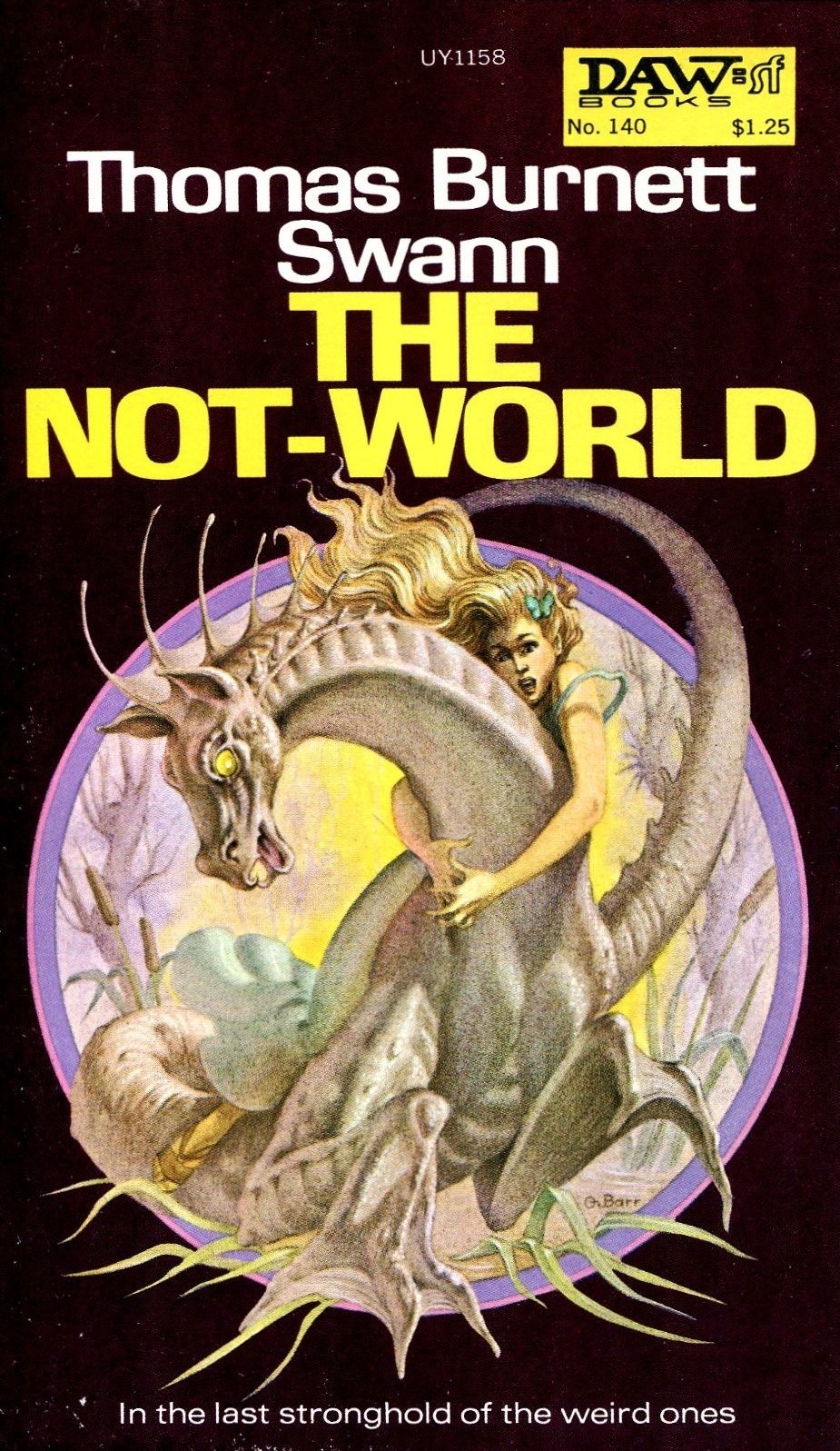
Table of Contents
Of Brits, Prehumans, and Poets
Reading The Not-World
Parting Thoughts
Of Brits, Prehumans, and Poets
Thomas Burnett Swann’s ninth novel, The Not-World, is a slight, curious, and largely forgettable little thing set in and around Bristol toward the end of the eighteenth century. It was his third of six novels published with Donald Wollheim at DAW Books and, once again, was atrociously served by an awful cover painting and interior illustrations by George Barr.
Of the 16 novels published in his too-short career between 1966 and 1977, Swann wrote five chronicling the history of magic, religion, and his “prehuman” peoples—creatures of myth and folklore—in Britain, from the coming of Christianity (The Gods Abide (1976)) to the Crusades (The Tournament of Thorns (1976)) to the English Civil War (Will-O-the-Wisp (1976)) to the dawn of the industrial revolution (in this novel, The Not-World) on down to the Victorian period (The Goat Without Horns (1971), set mostly in the British Caribbean). The Not-World was the first of two loosely related novels, along with Will-O-the-Wisp, connected by the throughline of Devonshire vicar and poet Robert Herrick. And together with The Goat Without Horns, Swann’s three modern(ish) English novels offer a celebration of English literature, especially poetry, while coincidentally also charting the rise and supremacy of the British Empire and the changing social, economic, and political circumstances of modern(ish) England and its people.
Swann’s British novels can be grouped together as a clade in the taxonomy of his “secret history” of the prehumans, which occupied the whole of his literary output as a fantasy novelist working in the very period when fantasy, as a market genre, was just coming into being. The vast majority of his novels were set in the ancient Mediterranean, but Swann’s British novels allowed him to venture to a country and into a literary tradition he very much loved and admired. In addition to his voluminous literary output, Swann was also a literature professor and wrote multiple monographs, mostly on British poets like Christina Rossetti, Charles Sorley, and H.D. And if Swann’s ancient Mediterranean novels explored the destructive effects wrought by the rise of human civilizations on the mythic, prehuman peoples of the past (e.g. Dryads, Fauns, Minotaurs, Centaurs, and the like), then his British novels showed how the prehumans survived into modernity, driven into obscurity and whispered of in legends, sometimes becoming the savage monsters humans had always imagined lurked in the woods—like the cannibalistic Mandrakes of The Tournament of Thorns.
Swann’s British novels developed his favorite theme, shared by virtually all of his books, of civilization versus nature. Swann often articulated this theme as a dialectical opposition between city and forest, or human and nonhuman, and it manifested in Swann’s deep interest in ancient myths and folktales, which he adapted in unique, sometimes wildly inventive ways (cf. the evil telepathic fennecs of Moondust (1968)). Swann’s cycle of stories about the prehumans, then, constituted more than two thousand pages detailing the tragedies caused by human civilization’s rise, lamenting the kinder, gentler, more egalitarian world of the prehumans destroyed by barbarous humanity and its heroes. But like his other novels set in more modern times, the prehumans of The Not-World are hardly recognizable: they have been warped by millennia of human aggression and ostracization. And like The Tournament of Thorns and Will-O-the-Wisp, Swann draws on local folklore, departing from his regular realms of Greco-Roman Dryads and Fauns and Centaurs, and entering instead forests populated by beings vaguely drawn from Celtic myth: the Drusii, whom Swann describes as something like gargoyle-vampires, and Water Horses (or kelpie), which he also calls Night Mares in association with the common Indo-European idea of the mare. Swann also adds layers of Christian mythology, namely the association of black witches with Satan.
The Not-World is also one of Swann’s “poet” novels, a small grouping of his books that feature famous poets as pivotal characters, though often with some of the biographical details changed to better fit the story he wants to tell. These include Wolfwinter’s Sappho, The Goat Without Horns’s Charles Sorley, and Will-O-the-Wisp’s Robert Herrick. The poet of The Not-World is Thomas Chatterton, the tragically short-lived but phenomenally (and precociously) talented poet, antiquarian, political essayist, and forger of medieval Romances by “Thomas Rowley” (he even tricked Horace Walpole!), who died from arsenic poisoning (perhaps purposefully, as a suicide) at the age of 17 in 1770, and whose death was immortalized in an 1856 painting by Pre-Raphaelite artist Henry Wallis. Chatterton was a major influence on the Romantics of the early nineteenth century. His combination of medievalist invention, antiquarian study of medieval texts, and influence on the Romantics makes him an important symbolic figure in the history of pre-genre fantasy, since Chatterton’s works and influences embody the cultural forces that, as Jamie Williamson has shown in The Evolution of Modern Fantasy (2015), informed the literary traditions that would become genre fantasy in the postwar field of popular fiction.
Reading The Not-World
The Not-World tells the story of how a disabled and outrageously successful Gothic novelist, Deirdre, meets a rugged but well-educated sailor, Dylan, and how the two fall in love after a night waylaid by mysterious forces in a massive forest near Bristol, the Not-World of the title. They are protected from the ravenous, vampiric Drusii by a teenage boy who appears as if from nowhere, the youth Thomas Chatterton. Later, when the upper-class Deirdre reaches Bristol to lodge for a spell with her aunt Adeline, she receives word that Thomas has faked his suicide in London (death by arsenic, in our real history) and returned to the Not-World. The bulk of the plot concerns Deirdre and Dylan venturing, with Adeline, into the Not-World—for some reason, by hydrogen balloon—and searching for Thomas, who reappears at the very end, totally unharmed. Over roughly a week in the Not-World, Deirdre, Dylan, and Adeline face Drusii and Water Horses, befriend the Genii Cucullati (this novel’s Latinate term for the Telesphori, who also appear, in rather different form, in Wolfwinter and Lady of the Bees (1976)), and defeat an ancient “black witch,” Arachne, who sold her soul to the devil and put a curse on Dylan in his youth to love only her (Deirdre broke that curse, naturally, through the in-born “white magic” of her Celtic ancestry).
Unlike most Swann novels, which seem to sprawl across complex, internecine plotting in spite of their short lengths (only one of his novels surpasses 200 pages), The Not-World somehow drags and feels baggy inside of its meager 160 pages. Too little happens or, rather, so little of what does happen is interesting, that I found myself sometimes wondering if this was a Swann novel and not some awful prank by DAW. But Swann it is, and it has many of his hallmarks—such as his tragic heroine, his burly but gentle manly man, his kind-hearted prehuman who saves the day by rallying his people to help a human in need, his softboi poet, and his themes of nature and civilization—but they feel like the bare bones of his ideas, a skeleton that elsewhere wears muscle, sinew, and flesh, that thinks and speaks. The Not-World lacks the literary ferocity with which Swann approaches ideas and characters and themes in his best novels.
Deirdre, for example, is meant to be a version of Swann’s tragic heroines. She is modelled after Elizabeth Barrett Browning and her own experience as an invalid. In his acknowledgments, Swann describes Barret Browning as “a great-hearted woman who, like my heroine, suffered a fall from a horse and, later, what modern psychologists would call a psychosomatic lameness, and found her feet in loving an extraordinary man” (159). But Deirdre is also very clearly based on Ann Radcliffe and her magnificently successful career, at the end of the eighteenth century, as a Gothic novelist who wove together adventure, romance, history, and terror (Radcliffe is also referenced in The Goat Without Horns alongside Walpole). A major theme of The Not-World is that Deirdre lives a cloistered life, old at 30, and still a virgin. She is very much the antithesis of her popular novels’ heroines. But by taking on this adventure to find “Tommy” Chatterton, and bolstered by her dawning love for Dylan, Deirdre creates her own adventure, claims her man from a satanic witch, and “overcomes” her disability, ending the novel apparently cured of the near-paralytic back and leg pains she has suffered for two decades (you see, she was holding herself back by not believing fully in her own potential). Yet while Deirdre shares the general outline of the tragic stories of Swann’s typical heroines, she lacks the depth and self-reflexivity that make, say, Mellonia or Erinna or even Swann’s earliest characters, like Thea or Tanaquil, come to aching life. Deirdre is dull, motivated almost exclusively by the plot’s needs; she does not take charge of her story, but moves through it.
And then there’s Adeline. She is quite unaccountable in Swann’s oeuvre. Often, yes, there is a somewhat older, more matronly figure in his stories, usually a Dryad. And, I suppose, Adeline serves that role to some extent. But whereas, say, Zoe is a principal character in The Forest of Forever (1971), Adeline is just sort of… there. She serves a plot-critical point at the very end and is the butt of the novel’s aggressively fatphobic humor. As the tight, third-person narration from both Dierdre’s and Dylan’s perspective reminds us time and again, Adeline is fat. She is one of those fat people who refuses to admit she’s fat and instead calls herself euphemisms like “amplitudinous” or “voluptuous.” She’s the kind of fat that can eat an entire week’s supply of food for a voyage into the Not-World in mere minutes, when no one is looking. She’s the kind of fat that insists on bringing fancy sweet treats on such an adventure, and eats them all. She is the target of every joke in the novel, a cruel pun on womanhood, an example of what not to become.
But don’t worry—the Genii Cucullati adore her, because she is made in the image of the prehistoric Mother Goddess. They worship her amplitude, but both Dylan and Deirdre are so disgusted by the sight of her naked fat body (which Barr depicts in an interior line drawing, probably the best illustration of the five or six in the book!) that they initially make enemies of the Genii by denying them (and Adeline) an orgy, leaning on propriety to “rescue” her and, when that doesn’t work (Adeline doesn’t give a shit about propriety), insulting Adeline for her fatness and shaming her into turning down sexual relations with people who idolize/sexualize/objectify her body. Later, however, Adeline has her moment and saves the day by inviting the Genii to an orgy when Dylan and Deirdre are captured by Arachne. She gives her body—willingly, excitedly—so that the Genii will rally around her to defeat Arache and her Drusii and Water Horse minions. Adeline’s participation in the orgy is very much in line with Swann’s usual celebration of enthusiastic egalitarian sexual relations, but it’s all done off-camera so as not to horrify the reader with Adeline’s fatness. Adeline is thus presented through a kaleidoscope of complicated and problematic ideas about gender, sex(uality), and fatness. And by the end of her week-long venture into the Not-World, Adeline has somehow shed her obesity and is now pleasingly “pulchritudinous” instead of grotesquely, humorously “amplitudinous.”
Dylan, though made in the image of Swann’s manly men, is something of a wet rag. He does precisely nothing in the novel but be admired for his beauty, manliness, and worldliness—as a sailor—by Deirdre and Arachne, who go to war for Dylan’s heart. Arachne, of course, loses, not because she is a black witch (her powers gifted by Satan) but because, under the magic that shrouds her age, she is ugly, withered, and, yes, even fat. Dylan’s primary role, really, seems to be as a cipher for introducing into the novel the global reach and power of the British Empire, and the effects that this has on the way characters raised in this milieu understand the world around them. Because Dylan fled his early trauma in the Puritan community—he was coaxed into sex with Arachne when he was about 15–16, and then she was burned at the stake as a witch (she came back, thanks to Satan)—he spent most of the last decade as a sailor, traveling on merchant ships to British colonies in North America, the Caribbean, Africa, India, and Southeast Asia.
Dylan regularly references his colonial experiences, talking of savage African pygmies, barbarous “Injuns” in Virginia, cannibals and headhunters in Southeast Asia, and the horrible violence of the British enslavement of Africans. Through Dylan, the trio’s adventures in the Not-World become tinged with colonialist rhetoric, and while the language Swann uses, speaking through Dylan, is indeed problematic, the language strives for something like historical realism while also making clear that the “savagery” of the untouched forest of “the last stronghold of the weird ones,” as the cover blurb puts it, is an ideological outgrowth of modernity, a historical frame for understanding the unknown that is shot through with the colonialism, Orientalism, and British cultural chauvinism tacitly learned by characters like Dylan and Deirdre. This reading is pretty explicitly forwarded by the novel but not obviously undermined by any of the characters, who take their worldview as a given and never have reason to question it. This undercurrent of imperial ideology serves as an adjunct to Swann’s regular theme of city versus forest and shows Swann’s ability to adapt the theme to the changing historical circumstances of his many novels.
Set in Britain during the early Industrial Revolution, in the region of one of Britain’s early major industrial centers, and also in the wake of major religious and political upheavals of the last century, The Not-World and its prehumans adapt a great many changes to Swann’s city versus forest theme. The novel not only deals with colonialism (which is also a major but poorly handled theme in The Goat Without Horns), but also Christianity and capitalism. While Swann addressed early Judaic myths in Moondust and How Are the Mighty Fallen (1974), and while he would address Christianity’s invasion of Roman Britain and its displacement of the Celtic gods in The Gods Abide (1976) and the sanctimoniousness of Puritanism in Will-O-the-Wisp, The Not-World is his first novel to deal directly with Christianity. He does so at first distantly, through flashbacks to Dylan’s Puritan boyhood, and later more fully when Arachne reveals her connection to Satan.
Arache has lived dozens of lives over hundreds of years, surviving since the coming of Christianity to Britain, when she decided that serving one side in the war between God and Satan would pay off better than continuing to worship the waning Celtic gods. So she and her Drusii servants struck a deal with Satan, to let them return to the world in new bodies and sow greater sin in the fields of humanity (this is similar to the White Ones’s deal with Hades in Wolfwinter). Interestingly, Arachne and her black magic aren’t condemned for their ties to Satan—no one comments on this in the novel, and there is no suggestion, either, that God is real in the way Satan is—but for the harm they do to the protagonists. Arachne even survives the novel, admitting that she lost Dylan to the “better” woman (Deirdre), and she vows not to do her evil deeds in the Not-World anymore, to find a new place to serve Satan. As we’ve seen elsewhere in Swann’s writing, there are few moral judgements about belief systems, only judgements about actions toward other people, the community, nature, etc. Harming nature, upsetting the balance between city and forest: these are things Swann considers immoral, but Satan and witchery are not, in themselves, immoral, and Christianity in Swann’s novels doesn’t seem to have any greater claim to morality than other belief systems, except insofar as certain characters might believe, in the context of their Weltanschten, that Christianity is the “right” religion.
In addition to colonialism and Christianity (with the latter figured elsewhere in Swann’s writing as a kind of the former), The Not-World also deals explicitly with capitalism as a force of modernity and a structuring logic of the city versus forest dynamic. Indeed, the best parts of this novel are its prologue and epilogue, which served as poetic, descriptive scene-setters. The prologue reads, in full:
Eighteenth century Bristol bestrode the many-masted Avon and faced the Colonies beyond the sea. The Royal George sat in her harbor like a guardian Gorgon, a warning to Frenchmen, pirates, and restive colonists. Merchant ships sailed with the tide to Tripoli and Beirut, to India and the West Indies; returned with camlets and carpets, cinnamon and indigo, tobacco, opium, and sugar; and human cargo en route from Africa to the Americas. Land-sick sailors, accustomed to pitching decks, swayed through the streets as if they had reeled from a tavern. The shrill of the fish vendor muffled the jingle of pony bells. The whir of spinning-jennies anticipated the factories which would soon replace the workshops where women sat at handlooms and patiently fed their wool to revolving spindles. Signs bespoke a multitude of trades: Golden Boy for jeweler; Turkish Bashaw for mercer; Sword and Crown for cutler. The first manned hydrogen balloon bobbed in the sky like a float and led the earthbound Puritans, belatedly diminishing in number, to conjecture that the Devil was fishing for souls. A highroad clattered with horses, manes beribboned, tails enwreathed in silk, and groaned with fat carriages accommodating fat lords on the two-day journey to London.
But anyone who climbed the bell tower of St. Mary-Redcliffe Cathedral could look beyond the piebald streets, the remains of the ancient city wall, and see the hop fields and the hedgerows, as neatly patterned as an old maid’s sampler, abruptly meet the forest.
It was a forest abristle with oak and yew, entangled with ivy and wild grape-vines; the listening trees, they were called, the strangling vines. It was a Celtic forest in the Age of Enlightenment, and the citizens of Bristol, whether the shepherd to find a sheep or the forester to fell an oak, refused to risk its threadless labyrinth, because it did not belong to God, it belonged to the gods. At night the farmers and foresters could hear the wailing of the Drusii or Blood-Suckers and see their eyes glinting like evil stars in a sky of black foliage; hear too the cannibalistic water horses, which swam in the streams and whinnied their dark hungers or wallowed in mud and slime. Were they truly trees and vines, birds and animals, or the old Celtic gods who had metamorphosed themselves with the coming of Christ and kept, deadly and inviolate, this one last stronghold against the angelic hosts?
Bristol was change and challenge, the sun at high noon; Bristol was now.
The forest was of the night; of dreams and especially nightmares. The forest was then. (7–8)
There is more poetry, artistry, and thematic resonance packed into the two pages of the prologue than in the rest of the novel. Swann shows his skill for description and for layering in details that render eighteenth-century Bristol a rich, complex, globalized world, much as his descriptions of ancient Crete and Etruria and Jericho do in earlier books. Swann explicitly frames modernity as structured by the interwoven forces of capitalism and colonialism: a globalized merchant fleet bringing back cinnamon and slaves is made possible by colonial expansion, which was itself fueled by private enterprise as much as by the state. Notably, while Dylan is an adventurer in the tradition of, say, H. Rider Haggard (some of his adventures are even fantastical, as he notes having faced Gorgons in the Mediterranean), and thus firmly rooted in the imperial adventure tradition, Dylan is also staunchly anti-slavery (as all good people in Swann’s novels are; see my essay on The Weirwoods for a discussion of justice, violence, and anti-slavery).
In addition to foregrounding the role of capitalism and colonialism in giving structure to and thus making possible modernity, the prologue also marks out connections and oppositions between different times and spaces, between an emergent modernity and the residual past, Britishness and Celticness, colonizer and colonized, city and forest. Swann renders a set of oppositions that reads as follows:
city : British : colonizer : modernity : : forest : Celtic : colonized : the past
This is one of the more explicit and multi-layered renderings of this theme across Swann’s oeuvre, and it is also modified by the complex relationship of the Puritans and Christianity, as well as his ideas about a pre-British, autochthonous Celtic past, to the Age of Enlightenment that is concurrent with modernity. Swann correctly identifies the Celtic as colonized, but problematically views Celticness as a thing of the past, not as a set of living, breathing cultures that in the eighteenth century were in the midst of national revivals across Scotland, Wales, Ireland, Cornwall, Brittany, and the Isle of Man. Deirdre’s Celtic ancestry is what allows her to triumph over Arachne, for hers is ultimately an older magic that pre-dates Christianity and Satan. At the same time, Christianity is understood as the antithesis to science, as is Celticness and its ancient forests. But Swann’s Puritans are as much opposed to the forest and their Celtic gods as they are to hydrogen balloons and Satan.
Complexities roil beneath the surface of Swann’s seemingly simple oppositions of World and Not-World, city and forest, modernity and the past. And in the end, the complexities remain and are modified by a new notion, what Tolkien thought of as the capacity of “the fairy-story” to affect the recovery of the world:
The old ones shudder and make the sign of the cross.
“Night Mares, wallowing in the slime.”
“And Drusii. Eyes like coals in the dark.”
The young ones nod but smile with secret understanding, and laugh when they leave the house. The old must have their dreams and, yes, even their night mares. The young prefer the truth.
And what is truth to these boys and girls in the lengthening shadow of Bristol, city of steeple, mast, balloon and dragon-factory belching smoke and fire? Truth is to carry a basket—cheese and a slab of tongue and a flask of foaming beer—to the edge of the fields, and study the green secrecies of the world their parents called Not.
Listen!
The twang of an arrow, the blast of a hunting horn, the hush of a tunic among the greennesses.
And a boy will turn to his girl: “Robin has come again.”
“And Marion, swift as a roe.”
“And a lad, their son.” (158)
The prose poem shows us the aftermath of the novel’s resolution, for the forest of the Not-World has been freed from the witch Arachne and her vampiric Drusii, the Night Mares/Water Horses have been calmed and tamed, and the Genii have been made friendly again. But, most importantly, the Celtic god that was the personification of the Not-World, who was long ago banished and forgot himself, has returned. He was, for a brief time, lost in modernity in the form of Thomas Chatterton—but Deirdre, Dylan, and Adeline freed him so that he might return as the forest god, the embodiment of the Not-World.
And as the forest recovered, the epilogue tells us, even as Bristol and Britain beyond grew into a modernity ever more entangled with Christianity (“steeple”), colonialism (“mast”), science (“balloon”), and capitalism (“factory”), a part of the past remained and even thrived. For the remnants of the past can change, too; they can be re-enchanted. That which was corrupted or broken—like, however problematically, Deirdre’s body—can be made whole again. The old prefer their fears and their nightmares, but the young, those who live in the ever-present of the modern, seek re-enchantment. They see in the forest not monsters or nightmares, but fantasy and possibility: Robin Hood and Maid Marion come again, the forest itself made new.
The epilogue reminds me powerfully of the renewal of the world that takes place at the end of Peter Beagle’s The Last Unicorn. There, the unicorn asked if “ours” is a good age for enchanted creatures like unicorns, and the answer, though ambivalent in Beagle’s way, is that any age could be made a good age for unicorns. Arachne in The Not-World suggests that eighteenth-century Britain is not a good age for witches, that it is too modern, too scientific, but also too Christian and superstitious. But Arachne was wrong, it seems, for Swann’s epilogue shows us an emerging world, an alternative to modernity that lives alongside it: one that is a good age for fairy tales and legends, that even in its explanation of modernity cannot help but reach for the language of fantasy to describe a factory, that icon of modern industry, as a dragon belching smoke and fire. A dragon to be slain? Time will tell. But Swann is clear that fantasy—the past, the forest, a space for renewal and possibility—lives on as the truth the young prefer.
Parting Thoughts
Very little about The Not-World is good. The exceptions are Swann’s wonderfully evocative prologue and epilogue, and the final effect, or argument, of the novel, which ties it to the major thematic thrust of Swann’s oeuvre, to his preoccupation with city versus forest, and iterates interestingly on this theme by articulating it to the emergent world of global capitalist and colonialist modernity. In The Not-World, Swann makes explicit the conflict between modernity and the past—a past of overlapping cultural inheritances, of different ways of understanding nature, filtered through the story of a single forest and its changing fortunes from pre-Roman times to the dawn of modernity. And yet, the exploration of this theme is thin and heaped mostly in the final ten or fifteen pages of the novel, when first Arachne and then Thomas give lengthy, multi-page expositions about their own centuries-long histories. These are perhaps the most interesting moments in the novel, aside from the prologue and epilogue.
The Not-World is also marred by awkward, at times confusing leaps in narrative progression (a problem with several of Swann’s early novels), and Swann’s prose lacks the beauty and clarity that makes most of his other novels so worthwhile at the craft level. A poet at heart, Swann quotes widely from poetry in all his novels, but here he mostly uses Robert Herrick’s short poems of ribald horniness (Dylan is said to be a descendent of Herrick’s, giving him and Deirdre excuse to reference him liberally). When he’s not quoting Herrick, Swann includes his own poems, which are equally as light as Herrick’s and equally unfunny. (Swann loves to include his own poetry in his novels, but I think he’s a rather shit poet.) The novel, in short, lacks both the weight and the artistry with which Swann so often—incongruously, but with a deft and convincing hand—treated characters and ideas that might otherwise seem, as many critics suggested, Disneyesque. Thus, Swann was able to make his Fauns and Dryads and Minotaurs and Sirens into tragic, poetic figures, rather than fleeting fancies in humorous, forgettable tales of happily ever afters. But in The Not-World everything appears to be caricature; not satire, as Swann attempted and failed with The Goat Without Horns, but rather a story drawn ridiculously and populated with characters who do, indeed, come across as cartoonish, but not Disneyfied. No, Swann’s The Not-World is more like the raunchy strangeness of Ralph Bakshi’s Wizards (1977): a little off-putting, mildly interesting, lousy with potential, and really quite a bore.
At the same time, The Not-World is, like his previous three novels (Green Phoenix (1972), Wolfwinter, and How Are the Mighty Fallen), a very personal story. Where the previous novels dealt heavily with death and the shortness of a human’s (or Faun’s) life on earth, and the ripples made by great love in the short time given to us to love, The Not-World is more explicitly concerned with the life of an invalid writer whose fantasies—in the form of Gothic romances—seem to express the inner richness of a life that, because of sickness or disability, has been deprived of the adventure and romance afforded to others. Deirdre is both Elizabeth Barrett Browning and Ann Radcliffe, but also quite obviously Swann, just as the invalid Elizabeth Meynell in The Goat Without Horns was a stand-in for Swann. In both The Not-World and The Goat Without Horns, the invalid woman is rescued and quite literally saved from life as an invalid, made whole and freed of her disability, by an educated, poetry-quoting man who does not lack for masculinity. This was, increasingly throughout the 1970s as Swann’s health worsened, as the cancer weakened him more, a fantasy close to Swann’s heart.
If The Not-World were one’s only experience of Swann, it would be off-putting indeed. It is drab, cartoonish, slight, awkwardly paced, fails to develop its characters in interesting ways, does little of interest with its fantasy elements, but admittedly offers some thematic rewards to those familiar with Swann’s wider oeuvre. In short, The Not-World is everything critics decried about Swann’s writing. But given that Swann wrote 16 novels in roughly a decade, it’s no surprise that not every novel was a masterwork.
To get notifications about new essays like this one sent directly to your inbox, consider subscribing to Genre Fantasies for free:

 Genre Fantasies
6 thoughts on “Reading “The Not-World” by Thomas Burnett Swann”