The Minikins of Yam by Thomas Burnett Swann. DAW Books, 1976.
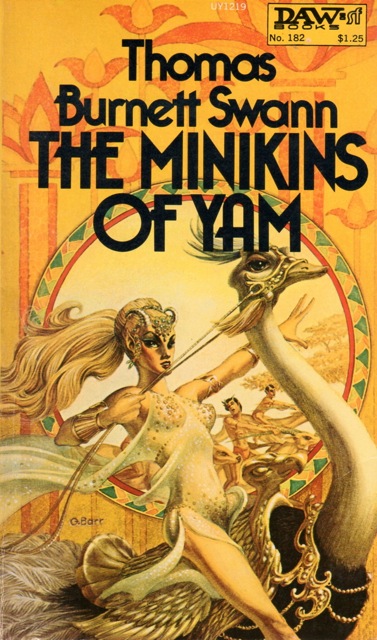
Table of Contents
Swann in Egypt’s Splendor
Reading The Minikins of Yam
Parting Thoughts
Swann in Egypt’s Splendor
The Minikins of Yam was Thomas Burnett Swann’s eleventh of sixteen novels, his second of five novels published in 1976 (his first novel of the year for Americans and Canadians, since Will-O-the-Wisp appeared only in the UK from the British publisher Corgi), and his fourth of six novels published with DAW Books. The Minikins of Yam was also his last novel published in his lifetime: Swann died on May 5, 1976 from a prolonged bout of cancer at age 48. His remaining five novels appeared posthumously, with his masterwork, Lady of the Bees, debuting the month of his death. Swann spent the last half-decade of his life struggling with medical problems (not just cancer, but also nerve damage from persistent urinary tract infections) and left his position as an English professor at Florida Atlantic University in 1970 to focus fulltime on his writing. In this way, Swann published thirteen of his sixteen novels from 1971 until his last posthumous novel, Cry Silver Bells, came out from DAW in December 1977.
Despite the condensed timescale of this later writing, which saw a third of his novels published in just one year (1976) and more than half of his novels published in the three years between 1974 and 1977, Swann’s final novels aren’t necessarily bad. They show the same variance in quality attested in his earlier work: some are incredible, others forgettable, but they are always critically interesting and provocative (and even some of the bad ones are wildly inventive). Indeed, two of his best novels were published in this later period—Lady of the Bees and Will-O-the-Wisp—but both were also fixed up from earlier stories published in 1962 and 1974, respectively. The Minikins of Yam, unfortunately, is not a very good novel, and of the thirteen Swann novels I’ve read so far (with the remaining three, The Gods Abide, Queens Walk in the Dusk, and Cry Silver Bells, coming up next in my readthrough of his work) it may be his second worst after The Not-World (1975). In many ways, and as expected, it rhymes with Swann’s oeuvre and its thematic emphasis on conflict between civilization and nature, and while it is certainly about gender and love, as most Swann novels are, The Minikins of Yam lacks the subtlety, range, and critical depth with which Swann typically handles gender, sex(uality), and love. Like The Not-World, here again is a Swann novel that feels like the bare bones of an idea tumbling around in a baggy, unpacked, and hastily sewn meatsuit—a short story, maybe a novelette, uncomfortably stretched to 156 pages.
Of all Swann’s novels—tied with How Are the Mighty Fallen (1974) (owing to that novel’s explicit, controversial queerness)—I was perhaps most excited about getting to The Minikins of Yam, owing almost entirely to its setting in the Old Kingdom of ancient Egypt some four thousand years ago (and yet, even then, the pyramids at Giza were already hundreds of years old and Egypt’s semi-mythic unifier, Narmer, was as old to the novel’s protagonists as the Norman Invasion is to us). Like most history and mythology nerds, I spent a good deal of my youth speedrunning my own personal course in Egyptomania, and while I studied Classics in college (I was two Greek courses away from a third major in Classics!) it was largely for want of being able to study Egyptology (in high school I even flirted with the idea of applying to the American University in Cairo for their Egyptology program). So, like his stories riffing on ancient Hebrew myths, I was particularly interested in Swann’s take on ancient Egypt.
To be sure, Egypt gets mentioned regularly in Swann’s novels, often as the example of a civilization older and more accomplished than whatever culture his characters belong to, since the legacy of Egypt looms larger in Swann’s ancient Mediterranean world. All of Swann’s novels belong to a meta-narrative that fans and early critics dubbed the “secret history” of the prehumans. Swann’s prehumans are mythological beings like Fauns, Dryads, and Centaurs who are slowly drowned by the rising tide of human civilization, so that by the birth of Rome they are viewed as mostly myth—dead and gone, if they were ever real. The Minikins of Yam is set in the earliest period of this prehuman history, centuries before his novels of Bronze Age Crete or Canaan or Carthage or Italia. And it is here, in this most ancient of Swann’s stories, that we see origins of the coming conflicts between human and prehuman, civilization and nature that develop over his meta-narrative’s several thousand years of fictional history, all the way to the late-nineteenth century of The Goat Without Horns (1971), when prehumans are so rare that they are the stuff of (racist) Gothic nightmares.
Like many of Swann’s historical fantasy novels, The Minikins of Yam draws impressively on real-world archaeological and historical scholarship, and when possible quotes and repurposes ancient literary texts to fit its narrative. The boy pharaoh, Pepy II (c. 2284–2214 BCE), Swann’s protagonist, was a real pharaoh from the Sixth Dynasty, who ostensibly (and very questionably) ruled Egypt for some 90 years. The novel’s plot revolves around a real-life letter he sent as a boy to the governor of Upper Egypt, Harkhuf, requesting that the governor bring Pepy a dancing dwarf “from the land of the spirits, for the dance of the god, and to rejoice and gladden [my] heart” (qtd. in Swann 20). This Harkhuf, too, is a principal character in Swann’s novel, though not yet a governor, and his life, exploits, and expeditions are attested from tomb writings that comprise some of the earliest known examples of autobiography and travel writing, while also recording the text of Pepy’s letter requesting the captive dwarf. Swann also quotes partially from an archaic prayer to Wenis from the Pyramid Texts and repurposes it as an exorcist rite that resulted in Pepy’s father’s catastrophic expulsion of the “demons” from Egypt many years ago, leading to the central conflict of the novel. Swann takes as his source, among other texts, Margaret Murray’s The Splendour that Was Egypt (1949).
Reading The Minikins of Yam
These few historical facts, along with lush descriptions of ancient Egyptian material life drawn from other sources, are reimagined in Swann’s The Minikins of Yam with his usually inventive flair and are woven into a story about the social and environmental consequences of disturbing the balance between civilization and nature, the human and the nonhuman. When the novel opens, Egypt is a land devoid of magic, for Pepy I staged a mass exorcism over a decade ago, some time before his death and Pepy II’s ascendance to the throne, that cast all of the “demons” out of Egypt and pushed them south, into lands like Nubia, Punt, and Yam. But the “demons” were both good and bad, for by labeling all supernatural forces as evil, Pepy I failed to understand that the very beings who bring plague are also those who cure it, and those who bring death bring life, drought and water, sun and moon, for all things are interconnected in the natural as well as the supernatural world. “Demons” are not the enemies of humanity, but a representation of the natural forces which structure human life and its connections to the natural world and to the divine, the worlds of spirits and gods.
The Minikins of Yam is the story of Pepy II, a boy pharaoh of twelve and an orphan; he spends his nights adopting the name Harpocrates and the guise of a commoner, distributing money and gifts to Egypt’s poor, and playing with his friend Tike, an orphan and a bard. In the eyes of his harsh and ugly sister, Henna, this makes Pepy an unworthy ruler of Egypt, for he does not see himself as a god among mortals, but as a person among people. Henna plots with Ayub, a high priest, and uses the dark magic of the god Set to create omens that say the Nile will withhold its floodwaters and cause a famine—an excuse to sacrifice the young pharaoh to appease the god of the river and dispose of the boy they see as a weakling, while usurping power for themselves.
It is also the story of Harkhuf, the son of a farmer who was raised into nobility by Pepy I. Harkhuf is gruff, manly, muscular, and thinks women are pointless except as sex objects, a character type that recurs in several of Swann’s novels, though never so egregiously misogynist as here. Harkhuf has been sent on an expedition to the south, to the jungles of Yam, to recover a dancing dwarf to entertain the boy pharaoh. He finds murderous Black dwarves, alright, but kills them all and in doing so rescues a Golden Minikin named Immortelle, who is—in the manner of Swann’s women characters—the most stunningly sexy woman ever, to Harkhuf’s delight (the novel is dedicated to the Classic Hollywood actress Adele Mara; Swann was a starlet fanboy and dedicated many of his novels to either Mara or Stella Stevens, with the implication often being that his female protagonists are meant to look like one or the other). Harkhuf takes Immortelle back to Egypt, where they together save Pepy from Henna and Ayub’s assassination attempt and whisk Pepy back to Yam, so that he can ask the god of the Nile why he is withholding his floodwaters and how Egypt can be saved from the famine this will bring.
The plot hops around rather disjointedly and involves a few side characters, including the spirit (ka to the Egyptians, jinn to the Minikins) of Harkhuf’s dead wife, Ti, and of Immortelle’s brother, Tutu. The spirits mostly serve to prompt Harkhuf’s character development, since Ti hates Harkhuf, and vice versa, and she serves as a sounding board for the novel’s gender discourse: how to be the best woman for a man, how to please and not goad or nag, how to give pleasure, and so on. Immortelle often chides Ti for her failures as a wife, but Ti and Tutu explain that Harkhuf is a brute who understands sex as taking something (owed to a man) from a woman, but does not see it as mutually pleasurable, and so he treated Ti poorly. There are a great many jokes about Ti’s death, too. She was eaten by crocodiles when she fell in a river while boating with Harkhuf. It’s played as an accident for most of the novel; Ti doesn’t seem all that mad about it, after all, and her disagreeableness hints that her version of events isn’t to be trusted. But toward the end, Pepy is given a vision in which he sees the brutal truth: that Harkhuf planned Ti’s death, that he was always cruel and unkind toward her, and that he gleefully shed himself of the woman who was his proverbial “ball and chain.”
The novel reaches its climax when the god of the Nile reveals that the Green Lotus convinced him not to flood Egypt’s riverbanks. The Green Lotus is the source of the mysterious Green Melancholy, which physically pains and emotionally depresses all who go near it and which has spread throughout the jungles of Yam, driving Black dwarves and Brown Minikins (Immortelle’s rustic cousins, who live in Yam) alike further and further south. Only the boys Pepy and Tike can venture into the Green Lotus without succumbing to the Melancholy. There, Pepy discovers that his mother, long thought dead, is the spirit of Lotus and source of the Melancholy, for she was a succuba (the novel doesn’t explain how this might differ from the succubi of European folklore) who married Pepy I and gave up evil. Pepy did not know her identity and so, when his exorcism of Egypt’s demons succeeded, she was driven from Egypt, too. Her melancholy became the Green Melancholy, her rage at Pepy and at Egypt’s hate for the demons doomed Egypt to the famine she sought to inflict with the Nile god’s help. Pepy’s rejection of the divine order and interrelationship between nature and civilization brought disharmony, but his son restores the balance, calms his mother, and welcomes demons and magic back into Egypt.
The Minikins of Yam is a bit of a mess, but an interesting one. Narratively, the plot moves about haphazardly and time’s passage can be difficult to track. This disjointed feeling of the narrative is common to early Swann novels and I have to wonder if it’s the result of his working on so many novels, back to back, so quickly in his final years. The feeling that the book is underbaked extends to its treatment of the storyworld, too, which is often the saving grace of some of Swann’s weaker novels. The Minikins, for example, are the only prehumans in this novel. Minikins have been referenced throughout Swann’s oeuvre, but often as a way of referring to the physically smaller prehumans (like the Bears of Artemis), but here Swann gives them an identity and a lineage: they are gazelle-people, small, svelte, cute little horns on their heads (Swann’s fantasies often approach the edge of ridiculousness, but balance it with narrative seriousness: see Will-O-the-Wisp’s woodpecker-people and how their self-hatred led to the creation of Puritanism in Swann’s secret history). The Golden Minikins dwell on the island of Sappharine in the Arabian Sea and several words and ideas connected with them suggest they are inspired by Arab cultures. But the Minikins feel awkwardly inserted into this novel, not part of an organic storyworld, and Swann does little to explain the nature of “demons” or of Pepy’s succuba mother—all things that would, in most other Swann novels, have been crucial to the narrative.
Moreover, Swann’s ideas about gender and sex(uality) are usually complex and nuanced. Swann’s fictions are invested in the idea that the prehuman peoples lived more egalitarian lives, not just in class structure but also with regard to gender and sex. They love eagerly and freely, sex is not taboo, and gender hierarchies rarely exist except when prehumans come into contact with beings (humans, evil telepathic fennecs, Cyclopes) who would subjugate them and in doing so disrupt the prelapsarian harmony of prehuman existence. Swann’s prehumans, in a word, offer a queer vision of gender and sexuality—not one that is always liberatory, and certainly not always feminist, but nonetheless provocative and exciting and refreshing for its time period. His fictions do often buy into the idea of a masculine/feminine binary, where each complements the other. More often than not his ideal masculinity is a combination of strength and softness, power and beauty, while his ideal of femininity is a bit more obviously and stereotypically feminine (cf. the Hollywood starlets mentioned above), while at the same time challenging patriarchal ideas about women’s sexuality by writing women who are polyamorous, gleefully sexually active, and who valorize their right to choose sexual partners (which I’ve suggested, in my essay on Wolfwinter (1972), might be a purposeful nod to pro-choice feminism).
The Minikins of Yam offers the blunt hammer version of Swann’s ideas: Harkhuf is manly in the most grotesque way, he actively dislikes women until the last few pages, and he is truly a reprehensible figure who murders his wife with absolutely no consequences; she isn’t even mad! Harkhuf far surpasses Ascanius in Green Phoenix (1972) for absolute patriarchal awfulness. On the feminine side of things, Immortelle represents the apotheosis of Swann’s ideas about sexually active women, for she, like all Golden Minikins, is a whore by trade. She is supremely skilled in the arts of pleasing men and so happily chides women like Ti and Henna who fail to meet feminine ideals (in fact, when Immortelle tells Henna she can help make her pretty, with the right wig and makeup, that’s enough to break Henna’s resolve to usurp her brother’s throne). She is hypersexual in a way that reads almost as exploitative. And, in the end, her sexuality and womanliness are so great that she changes Harkhuf’s opinion of women and what they’re good for—from object to have, to partner to be with—but in doing so she also changes her mind about her own social position, and decides to give up being a whore in order to marry Harkhuf. A potentially radical (or at least interesting) critique shoehorned into heteropatriarchal complacency.
I think I can see where Swann was going with some of this. It’s easy to say, “Written better, XYZ could have worked,” but I think, given the tapestry Swann richly wove from critical threads across his sixteen novels, he does deserve some benefit of the doubt, and I do think that there were elements of this story—even the idea that the Golden Minikins are a culture of professional whores (let’s not get into the fact that Swann uses the Arabic term houri as the Minikins’ own word for themselves; note: houri and whore are not cognate)—that could have created harmony out the dissonance. Certainly, Harkhuf is not an unusual character type in Swann’s novels. No, the man who dislikes women and fears commitment, only to learn that the complementary merging of male and female, masculine and feminine is beautiful and fulfilling, is a staple of Swann’s writing and in some places, for example in The Weirwoods (1967), it is done incredibly, touchingly well. But like Ascanius, whom I puzzled over in my essay on Green Phoenix, Harkhuf is a terrible person and lacks any of the charisma of Swann’s lovable, gruff, manly men.
What’s particularly interesting and totally confounding about Swann’s handling of Harkhuf is that he renders the scene of Ti’s murder so as to be horrifying. It is tragic, with Ti surprised and confused by Harkhuf’s suddenly kindness as he invites her to go boating, only to be gaslit into believing that he means her no harm, that he’s just turning the boat around (ever so slowly) to come get her after she’s fallen out, and, why, no that’s not a crocodile in the water—oh, well, OK, maybe it is, but just be still, and so on. Harkhuf comes across as a psychopath in the vision of this scene given to Pepy by his mother in the Green Lotus, and the events alter Pepy’s view of Harkhuf. The scene also echoes the vision Pepy has of his father’s discovery that he has exorcised his wife out of Egypt. Pepy’s mother asks if Pepy still loves his father, knowing what he did. And he says yes, but that his opinion of the man has changed; love can accommodate acceptance of the truth and loyalty to family. The same is true of Harkhuf, who acted like a second father to Pepy, but whom the pharaoh now knows is capable of horrible crimes. And still, all Pepy does is collude with Immortelle to get Harkhuf to marry her and spend a year honeymooning on Pleasure Island. The novel nearly has teeth, nearly makes for an interesting, even powerful, critique of masculinity and patriarchy, but pulls back for the sake of an unearned, unaccountable happy ending. I guess one could say that Harkhuf is sentenced to his worst nightmare—marriage—for the crime of uxorcide, but if that’s restorative justice, things have gone truly fucking wrong.
Parting Thoughts
The Minikins of Yam is a messy disappointment, an artisan bread with golden brown crust—but a slice to the middle reveals unbaked dough, gloopy and awkward and bad for the belly. I have a feeling that, like some of his stories that baked for a good deal longer (there were fourteen years between the initial novella “Where Is the Bird of Fire?” and its expansion into the novel Lady of the Bees), The Minikins of Yam might have been something special, with more time and, say, thirty more pages. Swann’s best novels, I’ve noticed, are his longer ones, which stretch to just a few dozen pages more than his average of circa 150 pages.
There is, in Pepy’s desire to bridge the gap between poor and rich, between magic and the mundane, and to sacrifice his bodily self for the good of his people by embarking on a treacherous journey to Yam to seek the source of the Nile’s anger with Egypt, to enter the Green Lotus and face the Green Melancholy, and to ultimately confront the horrible truth that both of his father figures caused great harm—there is in Pepy’s story the makings of an excellent narrative about power, justice, and the relationship between nature and humanity at the dawn of human civilization. This is a story ostensibly about how civilization breaks from nature, how a pharaoh convinced of civilization’s self-importance banishes the supernatural and the nonhuman and so purposefully creates disunity, sparking a pattern that rhymes with humanity’s interactions with prehumans across all of Swann’s secret history. And yet Swann fails to make this point with clarity or purpose or weight and he focuses overmuch on a plot that he doesn’t resolve satisfactorily or with any sense of justice.
The Minikins of Yam could have been the story that gave his secret history of the prehumans—the focus of his life’s work as a fantasist who clearly understood the political power and critical potential of this emergent genre—an origin, a frame, a reference point. And maybe, had cancer not taken Swann before he had even turned fifty, we could have read that novel.
But this was not Swann’s final novel and perhaps treasures yet await us.
To get notifications about new essays like this one sent directly to your inbox, consider subscribing to Genre Fantasies for free:

 Genre Fantasies
3 thoughts on “Reading “The Minikins of Yam” by Thomas Burnett Swann”