Cry Silver Bells by Thomas Burnett Swann. DAW Books, 1977. Minotaur 1.
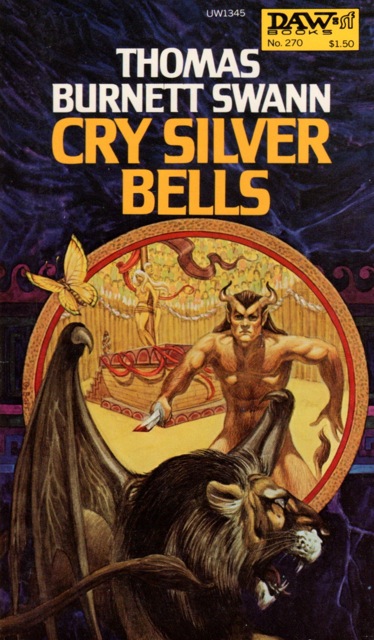
I have to admit that it was a difficult task to finish Cry Silver Bells, Thomas Burnett Swann’s sixteenth and final novel, published at the very end of 1977 well over a year after his death from cancer in May 1976. The difficulty had nothing to do with the novel itself, which is a fine example of Swann’s work, but, rather, it took me over two weeks to finish this short novel (albeit long for Swann’s oeuvre, at 192 pages) because, after reading Swann’s other fifteen novels in the past eleven months, I’ve grown a bit tired of his writing. Not really tired, as in bored or no longer interested, but Swann’s writing—which is very much similar across his novels, even though the quality of his work varies—has become like a familiar food, a favorite even, but one that, if eaten too many times in too short a time span, needs to be taken off the meal rotation for a few months so the palate can grow to crave it again. So I would read a chapter of Cry Silver Bells, a dozen pages or so, and put it down for days at a time before returning and making further headway.
This is an unfortunate side effect of my push to get through all of Swann’s novels before the fiftieth anniversary of his death in May 2026, but I felt it important to try to “know” Swann and his writing as well as I could, because after reading Lady of the Bees (1976) I knew he was an author worth recovering from the “great unread” and putting a spotlight on a half-century after his death. Because Swann’s work, not just the volume of it, not just the quality of his best novels, but the spirit of it—the exuberant romance and queerness and melancholy critique of human history, all wrapped up in the inventive “secret history” of his pre-humans (the Centaurs, Dryads, Fauns, etc. of myth)—should demand our attention as readers, critics, and historians of fantasy. Because Swann was doing, fifty years ago, things that are suddenly popular and “new” today, and his stories were as remarkable then as they are now.
Cry Silver Bells is quintessential Swann. It is a novel of light adventure and deep romance focused on the personal and social peril brought to the pre-humans by their interactions with the human world. It is also a prequel to the prequel of Swann’s first novel, Day of the Minotaur (1966), and as such returns the author, at the very end of his life, with this parting gift, his last novel, to his beginnings: to ancient Crete and the Country of the Beasts, to the Minotaurs and Dryads and Fauns and, in perfect Swann fashion, to the humans who come to love them and so forsake their human lives to dwell in harmony with nature and the noble Beasts.
As with Green Phoenix (1972), Lady of the Bees, and Queens Walk in the Dusk (1977), which were retroactively called the Latium trilogy, Cry Silver Bells was put together with Day of the Minotaur and The Forest of Forever (1971) and labelled by his fans and critics as the Minotaur trilogy. All three do involve the Minotaur Eunostos, who is a central character in the earlier two novels and a side character in Cry Silver Bells, and they all also feature Zoe the Dryad and a few others, including Moschus and Chiron the Centaurs. More so than the Latium novels, the Minotaur novels tell a loosely connected story, that of the threat posed by human civilization to the Country of the Beasts. This narrative arc—which takes us from the distant but threatening Cretans of Cry Silver Bells to, centuries later in Day of the Minotaur, the active invasion of the Country of the Beasts by the Achaeans who have begun to usurp Crete’s sunsetting power in the Mediterranean—captures the spirit of Swann’s “secret history” of the pre-humans and, given that it stretches from the beginning of his writing career to its end, offers a glimpse into how his ideas changed (or didn’t) over his incredibly productive decade as a fantasy novelist.
Cry Silver Bells is chronologically the earliest of the three novels and tells the story of how Eunostos becomes the last of the Minotaurs, giving background to the wider loss of pre-humans across the Mediterranean world. But since it was written the latest, the novel also takes liberties with Swann’s own pre-human storyworld—as he was wont to do in later years without concern for continuity across his oeuvre—and retroactively rewrites key elements of the earlier-written novels, by changing, for example, the characterization of Chiron, making him into a foolish, hubristic tyrant of the Beasts rather than the sage ruler of Day of the Minotaur. Moreover, the Beasts’ relationships to humans would be quite different in the earlier novels given the latter-day perspective of Cry Silver Bells. But the throughline of the inevitable doom of the pre-humans, who leave Crete in Day of the Minotaur (the latest-set and earliest-written in the “trilogy”), is very much the same and is even deepened with new meaning in Cry Silver Bells.
Like Day of the Minotaur, Cry Silver Bells tells the story of two young humans—Lordon the thief and Hora the prostitute (a lauded profession in Swann’s queer, sex-positive version of the ancient world; see The Minikins of Yam (1976) for his fullest commitment to the idea of sex work as liberatory practice)—who enter the Country of the Beasts and are transformed by the experience. Lordon and Hora have fled Egypt after a botched thieving attempt offended a princeling. Prior to leaving Egypt, the cousins lived in the Upper Nile Valley with their parents, merchant immigrants from Achaea, but they were driven into prostitution and thieving after their parents were slaughtered by a Sphinx from the desert. What seems like a tragic backstory returns as one twist and then a second in Swann’s winding narrative. Lordon and Hora wreck on Crete after their ship is torn apart by Harpies and they eventually make their way to the Country of the Beasts, where they meet and befriend the Minotaur Silver Bells and the Dryad Zoe. This being Swann, Hora falls in love with Silver Bells and Lordon with Zoe. Silver Bells, however, is not receptive to romance, having lost his true love, the Naiad Alyssum, to Cretans hunting for Beasts to ritualistically kill in their Bull Games.
Lordon and Hora come to love not only Silver Bells and Zoe, but all of the Beasts of the forest, including Melissa the Bear of Artemis, Phlebas the Faun, and even the raucous Goat Girls (female Fauns trapped forever in pre-pubescence, a totally new take on Fauns and sexuality that rewrites Swann’s earlier presentation of female Fauns). For loving the Beasts and willingly assimilating into their egalitarian culture, Lordon and Hora are renamed Oryx (after the gazelle) and Marguerite (after the daisy, neverminding that the term comes from a French word for daisies that was borrowed from a Greek word for pearls). But the king of the Beasts, Chiron, does not want humans in the Country, and so exiles Oryx and Marguerite, who in the first moments of their exile are captured by Tritons, along with Silver Bells, and sold to Crete’s Bull Games. A convoluted plot follows wherein Zoe attempts to rescue them by traveling to Phaistos with several other Beasts, who all dress in blackface to pass as a Nubian queen and her entourage of pygmies. (Yeah, Swann’s work can be pretty racist; see my essay on The Goat Without Horns (1971).) In these guises, they trick the very dumb prince of Crete, Minos XV, into showing some leniency. In the Games, Oryx and Marguerite are tied to a stake to entice a Sphinx to kill them, and Silver Bells is made to fight the Sphinx and defend his human friends. It is, you might have guessed, the same Sphinx that killed the humans’ parents in Egypt. Silver Bells prevails, Zoe’s trickery is successful, and the Beasts return to the Country with Oryx and Marguerite.
But Cry Silver Bells is a Swann novel. And, with few exceptions, Swann novels do not end without some final, tragic, or at least melancholy, twist. In this case, the death of Silver Bells, leaving his eight-year-old nephew Eunostos the last of the Minotaurs, and ending any hope that Oryx had for a brother, Marguerite for a lover (there was never a chance, but still she hoped), and Zoe for her own true love (there may have been a chance, but she will never know). Tragedy strikes suddenly, at an orgy celebrating the Beasts’ return home, when Silver Bells is poisoned by Deadly Nightshade pollen spread by two golden butterflies on flowers innocently presented to Silver Bells by a friend. In Cry Silver Bells, Swann has added new layers to his ever more complex mythology of the pre-humans and we learn that the souls of dead Sphinxes and their kin, Lamias, live on as golden butterflies. Minotaurs are their ancestral enemies, since Minotaurs drove Sphinxes and Lamias from Crete centuries before in a war that killed off most of the Minotaurs. And the second twist: Alyssum was a Lamia who took the form of a Naiad and was sent by the Sphinxes of Egypt to kill the last of the Minotaurs—and to do so most cruelly, by first capturing his heart. But before Alyssum could enact her plans, she was killed by Cretans and her true, evil purpose was never known to the Beasts. And the Sphinx Silver Bells fought in the arena had come not for Oryx/Lordon and Marguerite/Hora, but for Silver Bells, to finish what Alyssum had started. What the Sphinx and Lamia could not achieve in life, they did in death, as butterflies carrying life-giving, death-dealing pollen to the wrong (or right) flowers.
And so died Silver Bells, leaving Eunotos without a father figure, Zoe without her love. Oryx and Marguerite awkwardly disappear from the story in these final pages, their fate unclear (especially since they are never mentioned in the later-set, earlier-written novels). The last pages of the narrative focus on Zoe’s experience of tremendous grief; she begins to wither away, locked in her oak. But Eunostos, valiant, young Eunostos, last of the Minotaurs, consoles her and shows her a snake, perhaps the soul of Silver Bells living on as this symbol of love and luck for the ancient Greeks and Cretans. This snake is a viper, with horns like a Minotaur’s, and when he opens his mouth, out comes the distant sound of silver bells tinkling, rather than a hiss. This possibility of survival beyond death, a counter to the evil continuance of the Sphinxes’ and Lamias’ souls as the innocuous butterflies, so refreshes Zoe that she is able to carry on. She has the Country to live for, Eunostos to help raise, and Beasts who need her healing arts.
Cry Silver Bells is by no means Swann’s finest novel. It’s one of his better ones, to be sure, and it is certainly a more memorable novel than either Day of the Minotaur or The Forest of Forever. Many of Swann’s negative critics described his tales as “slight” or “Disneyesque,” and his two earlier novels about the Minotaurs of Crete feel to me, of all his novels, the closest in description to those terms. I never found Eunostos or Zoe compelling characters, and what Swann seems to have done with Cry Silver Bells is improve on this weakness by making Eunostos a child too young to really play a key role, instead giving us Silver Bells, a wise but tortured father figure not unlike Swann’s vision of Aeneas in Green Phoenix and Queens Walk in the Dusk. That Silver Bell grieves for one who meant only to harm him, and that he never knew Alyssum’s treachery, is all the more tragic. And yet, Zoe is still as uninteresting as ever. Swann awkwardly rewrites Chiron to be a petty doofus, for reasons that make little sense and feel like the work of a much less talented writer (that is, Chiron’s doofusness serves only to forward a plot point that could have been done elsewise). And Oryx/Lordon and Marguerite/Hora appear to be an attempt to connect some of Swann’s ideas about ancient Egypt from The Minikins of Yam into his stories about Crete, connecting elements of his occasionally disparate “secret history.” This is laudable, but both are rather uninteresting as characters and their trauma is ultimately irrelevant to the plot or to their character development.
In all of this, Swann loses sight in Cry Silver Bells of his earlier project: to tell the tragedy of human civilization’s rise and the consequent loss of the pre-humans’ prelapsarian egalitarian world. Sure, there are some vague critiques of civilization here, with the Cretans in Cry Silver Bells understood as an emergent civilization that inherits from Egypt, and from Babylon and Sumer before Egypt, an obsession with wealth and power, with trade and commerce pushing their growth as much as their naval military power, leading to a cosmopolitan urban culture that does not recognize its own cruelty, especially in its treatment and exploitation of the pre-humans. But this critique is a side concern of Cry Silver Bells, which seems much more interested in the romantic drama, the potential triangle between Marguerite, Zoe, and Silver Bells (or square, if we add Silver Bells’s memory of Alyssum). And where the romance in many of Swann’s earlier novels is inextricable from the critical elements—whether Swann’s commentary on civilization or ecological destruction or gender and sexuality—in Cry Silver Bells Swann has shifted the focus exclusively to the tragic romance and most especially to the question of love in the face of death.
The focus on death in Cry Silver Bells is, of course, understandable. After all, this was Swann’s final published novel, written during a hard year of cancer treatment when Swann was keenly aware of his mortality. (To be clear, I think Cry Silver Bells was written second-to-last, since Queens Walk in the Dusk, though published second-to-last, is a much less polished novel and shows more signs of having been hastily completed, whereas Cry Silver Bells feels totally finished; it’s even one of his longer novels.) Death was always a central part of Swann’s fiction. He especially loved tragic love. I’ve called Swann a theorist of love before; he is perhaps the best fantasist who wrote about love; it was central to his fiction, even if his life, from what little we know, seems to have been romantically loveless or at least never culminated in a long-term relationship. He nearly married a woman, a fellow professor, who herself remained unmarried after Swann called off the engagement, but I suspect that Swann was queer and, if he experienced gay love in his life, he (given the times, understandably) did not write about it openly and it never made it into the scant commentary by friends and colleagues that we have on his life.
Central to Swann’s theorizing of love is the idea that any love, no matter how short the experience, is powerful enough to last a lifetime, and that a person may have many loves of many different kinds throughout their life—each valuable in their own right. Cry Silver Bells pokes at these ideas, referencing the symbols of the firefly (bright but lasting only a flash) and the dragonfly (leaving as quickly as it comes) from earlier novels, but adds to this the idea that the soul lives on beyond death (this is actually first suggested in How Are the Mighty Fallen (1974)). For the Sphinxes and Lamias, who do not love but only hate, their souls become instruments of further death. But for Silver Bells, for the greatest of the Beasts, his soul persists as a symbol of luck and love, a blessing beyond death to his friends and fellow Beasts. Zoe may not have known his love in the way she hoped, and Silver Bells may have misunderstood or been tricked by the “love” he had for Alyssum, but even in death Silver Bells returns to give what love he can.
The 2021 Marvel television miniseries WandaVision originated a phrase about love that circulated like wildfire on social media: “What is grief, if not love persevering?” Swann would have liked that; so many of his novels said essentially the same thing a half-century earlier: love survives death. And at the end of his life, in his final published novel, with the last new words to reach his readers, Swann assured them—fantastically, appropriately, more than a year after his death—that love perseveres. It lives beyond death, it reminds us, heals us, keeps us warm in the depths of winter, refreshes us under the summer sun; it can be a hearthfire, stoked endlessly, or a logfire that burns out in a night; it can alight like a dragonfly and flash like a firefly; it can continue transform us; and it can, like a golden butterfly, hurt us.
Cry Silver Bells is a story about death touching us long after those we love die, for good and for ill, but mostly for good. It’s about memory and the permanence of the soul, transformed and returned to nature. By no means Swann’s finest novel, it nonetheless shows growth, with Swann asking an expanded set of questions and probing at new answers. It shows an author willing to rewrite and rethink his own work, for better or worse, and refreshingly unwilling to hold his own earlier writing as sacrosanct—an author ready to transform and become something new, as he himself was becoming something new, standing on the precipice of death and imagining what might come next, how he would be remembered, what his persistence beyond death might do for others.
Cry Silver Bells is a fitting end to Swann’s career as a fantasy novelist. Though little remembered today, he was a rare talent, and I hope my attention to his novels over this past year has done his work some justice. And forgive me, reader, if I have been short in my treatment of this last of his novels—but these will not be my last words on Swann.
To get notifications about new essays like this one sent directly to your inbox, subscribe to Genre Fantasies for free:

 Genre Fantasies
4 thoughts on “Reading “Cry Silver Bells” by Thomas Burnett Swann”