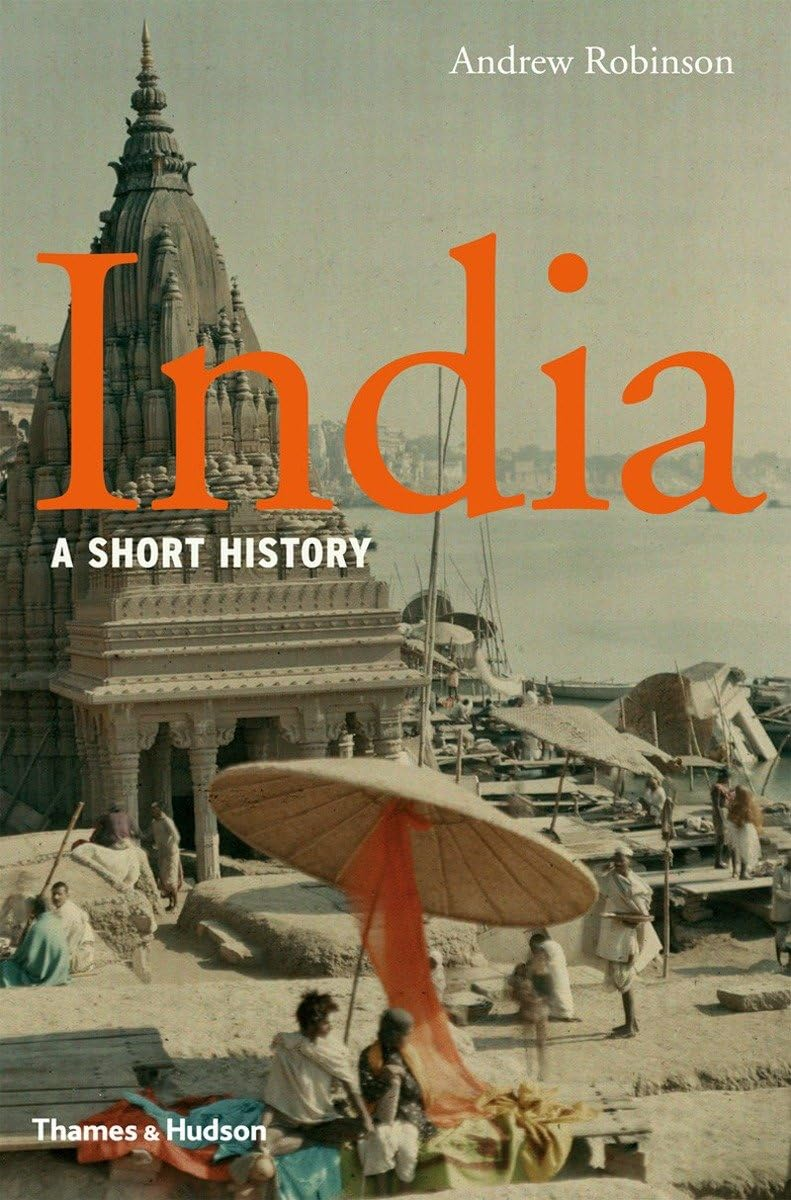
India: A Short History by Andrew Robinson. 2014. Thames & Hudson, 2019.

Short Histories
The genre of the “short history” that seeks to communicate an impossibly complex narrative spanning the entire history of its subject—whether decades, centuries, or millennia—to an audience that many describe as “the educated public” faces a nearly insurmountable challenge. No matter how it’s written, a short history will leave somebody scratching their head, whether it’s that elusive member of “the educated public” who happened to pick up a short history that leans too heavily into the dates and names approach, or the specialist bemoaning why the thing they think defines their subject’s history was given such short shrift, or the college teacher looking for a good intro text to assign in their 100-level course.
The short history is a genre in search of the unachievable balance between generalization and specialization, in the hopes of finding an ideal reader who simply doesn’t exist, and destined to frustrate a great many people while selling more copies than more specialized books could ever hope to. It’s also an absolutely necessary genre, a treasure trove of books, each one of which offers a fascinating, sometimes frustrating dialogue between author, publisher, imagined audiences, and actual audiences. Some short histories manage the difficulties facing them well, whether through strategic balance, insightful thematic focus, clear explanation of the limitations of their book, and so on; others are just bad, either because they fail to do any of the above, or, even worse, because they are poorly written.
Andrew Robinson’s India: A Short History is a categorical example of the short history genre and demonstrates the problems it faces. But it is also a good example of one way the genre can be effective—in this case, by deciding to frame the history of its subject to a particular end. What distinguishes Robinson’s little book (at c. 200 pages) and makes it a valuable short history for the general reader, though perhaps a frustrating one for the specialist in South Asian history, is that he frames his historical narrative of India around the ways in which history (sometimes mythologized, often up for debate) informs Indian politics today. This is a choice decision on Robinson’s part, since many readers of a trade nonfiction book on India will likely be interested in India because of its regional and global role today, and are likely to be familiar with various headlines about the Modi government.
The decision to write his short history in this way does, naturally, preclude other focuses the book could have taken, as do Robinson’s own interests and beliefs about what matters, as I’ll detail below. But that’s OK. His is not the only book on India. If it’s the only book someone did read on India, though, it’s not the worst one to have read precisely because of Robinson’s way of relating the historical narrative to present life and politics in India, though it does leave much to be desired as I detail below.
The ability to stand alone as “the one book” someone might read on a subject, in my view, is one hallmark of a successful short history; the ability to make clear why the history matters today, and not just as the subject of an academic discussion that seems unconnected to people’s lives, is another. That said, if one were to read just one book on the history of India, I have some thoughts about why India: A Short History should probably not be that one book.
Robinson’s India in Perspective
Robinson’s India: A Short History is part of Thames & Hudson’s not-very-robust series of short histories that, to date, only covers France, India, and Turkey, with a volume on Paris forthcoming. Robinson’s was the first of the publisher’s short little volumes (I also have Norman Stone’s Turkey: A Short History, which I will write about in due time); it was published in hardcover in 2014 and in paperback in 2019. The time of original publication coincides roughly with the election of Narendra Modi, from the Hindu nationalist or Hindutva Bharatiya Janata Party (BJP), as Prime Minister of India. The politics of history have always been important in India—as anywhere—and were brought to the fore during the rise of the BJP party and in the decade since. India: A Short History provides useful context for India in the time of BJP, but also offers what might be thought of as a liberal narrative typical of British people who “know” India.
Robinson divides his history of India—or, more specifically, the subcontinent south of the Himalayas, roughly from the region around the Indus river to that near the Ganges—into ten chapters, each roughly 15–18 pages, covering distinctive periods in the cultural and political development of the idea of a place that would become India. The book spans from the Indus Valley civilization that flourished in modern-day Pakistan roughly 5,000 years ago to the Partition and the post-Independence government of Nehru. Curiously, Robinson covers very little of the last 50 years of Indian history. Robinson’s chapters focus on: (1) the Indus Valley civilization, (2) the origins of Hinduism, (3) Buddha, Alexander the Great, and Aśoka (three ancient figures who shaped the early idea of India), (4) the early Hindu dynasties of northern India and the Gangetic plain, (5) the early invasions of Islamic empires into northern India, (6) the Mughal empire, (7) the slow infiltration of India by the British East India Company, (8) the British Raj, (9) the dissolution of the Raj and independence of a new Republic of India (and a separate Pakistan), and (10) India since Independence.
Though he covers 5,000 years of history, and could easily have prioritized more recent history, say, from the Mughal empire or from the British Raj onward, Robinson makes clear in the preface that most other short, introductory texts on India cover only the past 200 years of history, and that he sought instead to demonstrate the cultural continuities across the past 5,000 years in the subcontinent. Doing so means that the better documented history of the past two centuries suffers quite a bit, but the trade off is a longer view of the history that Indians themselves draw on in their own understanding of India and the political battles over that history. In a curious move, Robinson does not detail a linear narrative from chapter to chapter, but tends, instead, to begin each chapter with the bigger picture of how the historical material under consideration is part of Indian cultural and political discourse in later periods, informing the history of India long after the names and dates in the chapter have passed by.
The early chapters that detail the rise of a complex, settled, agricultural civilization with a form of writing (the as-yet-undeciphered Indus Valley script) followed by the introduction of an Indo-European culture in the form of the Aryans, and the subsequent development of Hinduism out of Vedic culture and early Sanskrit literature—these chapters are particularly valuable for the way Robinson explores how the very history of these periods is politicized. For example, the right-wing Hindutva movement has laid claim to the Indus Valley civilization; it has also rejected claims that the Aryans—that is, the group of Indo-Iranians who moved into the Indian subcontinent and, over time, developed into the Indic-speaking peoples who produced the Vedas—were invaders, and argued that they were, instead, autochthonous to India and that the relationship between Sanskrit and the other Indo-European languages is not one of shared heritage, but of descent from Sanskrit.
In these chapters Robinson also makes much of the supposed lack of written and physical evidence of Indian history from the period before the early medieval incursions of Islam. Indeed, he notes in the introduction that it is one of the “mysteries” of Indian civilization that so little is known of it prior to, say, 1000 CE. What he does not do, unfortunately, is explore the reasons for this “lack” of evidence, whether environmental (how and on what surfaces things are recorded) or historical (how conquests, fires, etc. destroy materials; no doubt the British attitude toward India as a land of savages led to the erasure of much evidence of earlier periods). It is instead written off as one the many odd things about India. Moreover, much of the early chapters—the book as a whole, in fact—remains firmly planted in the history of northern India, treating the southern regions inhabited by speakers of Dravidian languages as an afterthought.
As noted above, the decision to cover the breadth of history from the Indus Valley civilization to the present means that the last 200 years of modern Indian history are told in roughly 70 pages. And while I understand and applaud the decision to explore the deep history of India, and to frame that deep history as politically and culturally relevant—sometimes to the detriment of the history itself: half of the chapter on the early Hindu dynasties is actually about the later historical importance of the Ramayana and Mahabharata, rather than about the early Hindu dynasties—the choice does run up against the fundamental problem of the shortness of the short history genre, and leave the later history ironically (given that there’s less of it!) underdeveloped.
This is also partly because of Robinson’s own personal interests. For example, the chapter covering India post-Independence, i.e. since 1947, spends half of its 15 pages discussing his pet theories about why Indian scientific development was not as significant in the post-Independence period as it was before Independence, when great thinkers like Srinivasa Ramanujan flourished (though they were usually educated in the UK). While this discussion raises important points about the odd structure of Indian colleges and universities and their intense oversight by non-specialist government officials, and corruption within that system, it also leads to Robinson decrying the ways the Indian government, thanks to the early influence in Nehru’s government of B.R. Ambedkar, has carved out special treatment of lower castes—in Robinson’s view, this system has only held India back and hasn’t really helped the cause of dalits and adivasis. The remainder of the chapter discusses Nehru’s government; Indira Gandhi is mentioned once.
Another example is Robinson’s handling of what he calls “The End of Empire,” i.e. the march toward the end of the Raj in the early 1900s. This chapter downplays British atrocities—what famine in Bengal?—and instead focuses on how interesting Mahatma Gandhi was; Muhammad Ali Jinnah and the Muslim League are cast as the bad guys in the story. The “end of empire” Robinson narrates is a much more generous vision of Britain’s role in Partition than Gurinder Chadha’s liberal fantasy in Viceroy’s House (2017). Unsurprisingly, the Partition and the harms it caused are hardly discussed, the subject of a brief, final paragraph. No shrift is given to the complexity of the quit India movement, of the anticolonial struggles that flourished throughout the history of the Raj, and the loudness and seriousness of the competing voices that held the conversation of decolonization aloft. Robinson’s sotry is just Gandhi and Tagore against Jinnah.
The book is also, at times, annoyingly Orientalist, offering an understanding of India as “a land of unique, sometimes puzzling and frequently disturbing contradictions” (187). That phrase closes the book, but it is also the theme of Robinson’s introduction and so the idea of an India caught, in his words, between wealth and poverty, violence and stability, rationality (i.e. science) and irrationality (i.e. religion, mythology) structures his whole narrative. It’s a lazy idea, one that emphasizes Robinson’s view of India from a British or Western perspective, because the idea of a nation being characterized by “puzzling and…disturbing contradictions” at once signifies that India is somehow exotic, not easily intelligible, while ignoring the very real fact that all cultures and nations are characterized by contradictions! It’s not an innovative argument for anyone well-versed in the history of any culture or people or nation, but used in this way it frames India as strange, exotic, and not-fully-modern or at least not-modern-in-the-right-way. One only has to look at Brexit and the 2016 US election to put to rest the smug thought that the UK and US are not lands of puzzling and disturbing contradictions.
Useful, Flawed, Not that Book
While I give high praise to Robinson’s accomplishment in summarizing 5,000 years of history in an accessible format, and doing so in a way that prioritizes the meaning of the history today, especially with relation to cultural and political undercurrents at work in the past three decades of Indian history (or, rather, three decades back from the publication date), and while I think India: A Short History is ultimately a good example of a book in the short history genre, I ultimately find Robinson’s book troublesome for his Orientalist attitude toward the nature of Indian history and its sources, his liberal perspective that seems aligned with the Brahmin elites whose circles he seems socially familiar with, and his downplaying of the violence and atrocities of the past two centuries that could more fruitfully have been framed as the story of how Britain underdeveloped India—to borrow Walter Rodney’s phrasing—and how India responded to colonization and in the decades since Independence.
I want to end by asking, if someone were to read just one book about India, what should that book be? Andrew Robinson’s India: A Short History, while a valiant attempt to narrate 5,000 years of rich history that still resonates in the lives of more than a billion people today, is too flawed a book to meet the mark. A worthwhile starting point, yes, but there’s better out there if all you want is that one book. Obviously, no one should read just one book about India, but we have to confront the reality of our lives and the limited time we have. So, what do you recommend?
To get notifications about new essays like this one sent directly to your inbox, consider subscribing to Genre Fantasies for free:

 Genre Fantasies
2 thoughts on “Reading “India: A Short History” by Andrew Robinson”