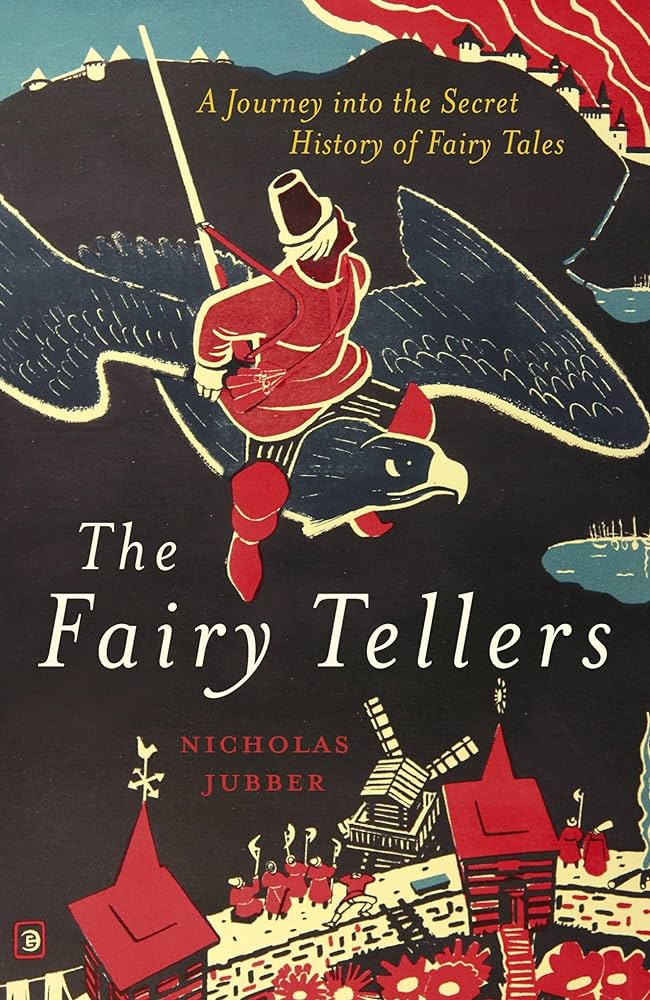
The Fairy Tellers: A Journey into the Secret History of Fairy Tales by Nicholas Jubber. Nicholas Brealey, 2022.
I should say, right off the bat and somewhat like a curmudgeon, that I don’t like fairy tales. I have never read or listened to a fairy tale and felt more than mildly interested in it. Perhaps what I should say is, as a narrative form, I’m bored by fairy tales.
As an academic topic, as a window into cultures and their histories and values, however, fairy tales are deeply interesting. Hence, I have great respect for the field of fairy tale studies—despite its overwhelmingly psychoanalytic approach—and even more so for folklore studies. Scholars in these fields have not only shown how fairy and folktales follow circuitous historical routes across time, space, and language, offering a glimpse into humans’ cross-cultural and cross-linguistic interactions over the millennia, they have also demonstrated the political power of fairy and folktales—whether for radical purposes, such as transgressing heteropatriarchal structures, or for nationalist agendas, like creating a sense of a(n imaginary) German Volk around which a political party could rally.
Nicholas Jubber’s The Fairy Tellers steps into the world of fairy tales that are well-known across the West to recover the stories behind those tales’ tellers. His central claim is that, while most of us know about people like the Brothers Grimm or Hans Christian Andersen, the most famous fairy tales and the details that remain memorable in continued tellings and adaptations were told not by the few people whose names we remember, but by folks obscured by history. Jubber thus narrates the life stories of seven people behind our favorite fairy tales: Giambattista Basile, Hanna Diyab, Gabrielle-Suzanne Barbot de Villeneuve, Henriette Dorothea Wild, Ivan Khudyakov, Somadeva Bhatta, and Hans Christian Andersen.
The Fairy Tellers is structured so that each teller gets three chapters about their biography and historical contexts, each prefaced with a short retelling of one of their most famous tales, many of which are likely familiar to readers. Jubber shows, for example, how the Syrian fairy teller Diyab told stories directly to the French translator of One Thousand and One Nights, Antoine Galland, who added those stories to his translation project—essentially adding Diyab’s versions of Aladdin and Ali Baba to a translation of another text. Or how de Villeneuve’s version of Beauty and the Beast, which retold an already well-known tale, included major new elements that were then exported without recognition into an English edition that became the version we know today. Or how Dorothea Wild, who lived just across from the Brothers Grimm and later married one of them, was the origin of several of their more popular stories and coded them with details of her father’s abuse.
A key argument of Jubber’s book, then, is that fairy tales are not, necessarily, the products of an anonymous, unspoken, ancient folk culture that merely reproduces itself through the mists of time, but instead the actively created work of literary artisans whose lives reflected in the way they told their stories, in the details they added or omitted, and the language they used (for example, Basile’s prevalent use of vulgarities). Jubber sets up this claim so that he can frame the book around recovering the specificity and individuality of the fairy tellers and their stories. He juxtaposes this with a claim from a now well-known 2016 article wherein philologists argued they can trace back some elements of fairy and folktales to the Bronze Age; of course, it was already well-known that facets of Hindu, Greek, and other ancient mythological traditions were shared because of their descent from an older, shared Proto-Indo-European culture. Jubber, however, wants to both embrace the specificity of the artist while always pointing to these stories’ circulation across time, space, and languages, something he doesn’t always juggle well.
In addition to recovering these stories, Jubber turns to his roots as a travel writer with experience across Eurasia to pepper the narrative with personal stories of places and regions. These are often quite evocative and engaging, but they are few and far between, and don’t offer more than cute details—that is, with perhaps the exception of Jubber’s description of listening to Syrian storytellers, the ground-level details add very little. There is no sense of “touring” the world of fairy tellers; to be fair, that is not Jubber’s claim in this book, though he is best-known as a travel writer.
Overall, Jubber’s book offers an interesting set of stories about stories, where they come from, who told them, and perhaps why (with a lot of speculation!) they might have told them in the particular ways they did.
Some Frustrations with Trade Nonfiction
But, as someone vaguely familiar with fairy tale studies, and more so as an editor who thinks quite a lot about the role trade nonfiction plays in relation to academic scholarship, Fairy Tellers left me with a mildly sour taste.
To be sure, Fairy Tellers is the sort of tertiary non-fiction that works really well for a general trade audience, building on the academic work of the past several decades to weave a synthetic tale in journalistic style and thereby bring what, for scholars, is increasingly the status quo of our knowledge to an audience that has no idea who folks like Jack Zipes or Marina Warner are, let alone that “fairy tale studies” is a whole area of scholarship with specialized degrees, journals, and book series.
Because all of the stories about the seven fairy tellers discussed in The Fairy Tellers, and their contributions to fairy tales, were already known to scholarship (sometimes for decades), it’s needs to be said that Jubber relies heavily on scholarly work that he only rarely acknowledges or cites, leading to the easy assumption by readers that he is the one who has discovered which stories Dorothea Wild told the Grimms or how Galland came by his version of Diyab’s Aladdin tale.
I both admire what Jubber is doing by helping to recover these fairy tellers for a trade audience, but his method has the ironic effect of obscuring the very people who spent decades researching these figures so that they could be recovered. Jubber has his own literary flair and brings his own many, well-placed insights into the literary works of these fairy-tellers, but his poor treatment of the scholarship he draws on is notable and lamentable.
Jubber style in providing historical context through the words of fairy tellers’ contemporaries has the flair of literary craft, and no doubt draws the readers into the world of these remarkable figures all the more fully, but it also often skips over key historical details and, for the more historically minded, tends to leave so many more questions than answers by asserting facts that sometimes seem dubious or, in a more scholar-minded book, would at least warrant a citation so that the reader could seek out more information.
But for Jubber it’s only his story of these fairy tellers that seems to matter, and this has, as noted above, the unfortunate effect of seeming as though he is masking the sources of information and the huge wealth of scholarly material that sits behind this book. There are, to be sure, occasional footnotes, but they are rarely useful in obtaining further information and could almost always have been either added to the main text or cut. Jubber also includes a “Sources and Further Reading” section that, although horribly formatted, at least shows that he is directly citing some scholarship.
And here I should vent my usual frustration with any work proffering a “secret history,” since only in very rare cases—such as Philippa Langley’s recent The Princes in the Tower: Solving History’s Greatest Cold Case—is the history actually secret. There is, and all writers should maintain, a key distinction between history that is secret in the sense of truly being unknown before now, and only just recovered, and history that is merely obscured to a broader public by virtue of knowledge regimes, usually because of the level of specialism required to attain that knowledge and more often because of the lack of interest from trade publishers in publishing certain books and believing in the trade audience’s interest. That so many books have to resort to gimmicky “secret history” type titles to tell stories that are known usually to everyone in their academic field, is on the vain end of things supremely annoying and on the practical end of things just wrong. It valorizes the work of the tertiary scholar to an extent that is unfair to the original producers of knowledge and, when written in the style of Jubber so as to obscure the scholars who did a great deal of the work, makes them appear to have done far more work and possess far more expertise than they can lay claim to.
Of course, I don’t want to say that writers—most often journalists—who do this sort of tertiary non-fiction writing that, often beautifully, synthesizes academic advancements in knowledge are not providing something valuable. Jubber most certainly is! And, all the more, I want to say that this sort of work is absolutely necessary for the survival of academia because it communicates the work we do to broader audiences and demonstrates its value, often more readily and more capably than most academics ever can. Moreover, there is skill and art in the accomplishment of a writer like Jubber, not just for having an agent who can place a book well, but for having synthesized work that is rarely put together in so vibrant and compelling a narrative—with a level of familiarity with the scholarship that would be demanded of a PhD student—and having written it so damn well and provided additional insight. Jubber’s achievement is great. But there is a way to write a book like this responsibly and in a way that recognizes the work of those whom the work draws.
One need only look at Annalee Newitz’s Four Lost Cities: A Secret History of the Urban Age to see how a journalist can write a beautiful, powerful book that actively acknowledge all of the scholars it builds on without fear that such acknowledgment diminishes Newitz’s own contributions and her unique vision in weaving these sources together. Of course, Newitz’s book also suffers from the “secret history” style title beloved by trade non-fiction publishers, but reading her book puts to quiet any doubts that Newitz obscures the scholarly work that creates the foundation of her project. She gleefully cites scholars, references them and their publications by name in the text, discusses niche academic arguments in vivid detail, and describes her time interviewing these people. They are the stars of her book, they are the ones revealing the “secret history” through Newitz’s synthesis of their work. It’s exceptionally well done and a model for all others.
Jubber’s The Fairy Tellers is probably not for anyone already very familiar with fairy tale studies, but would be a great intro to thinking about fairy tales critically and historically for everyone else. There is great diversity of fairy tellers here, the insights are interesting, and anyone looking for more can, with a little effort, find the scholarship sitting behind all of these claims. I only wish Jubber had been clearer—for his audience’s sake and for academia’s sake—in giving recognition to the tellers behind The Fairy Tellers.
To get notifications about new essays like this one sent directly to your inbox, consider subscribing to Genre Fantasies for free:


