Dinotopia: A Land Apart from Time by James Gurney. Turner Publishing, 1992. Dinotopia / Dinotopia (Gurney) 1.
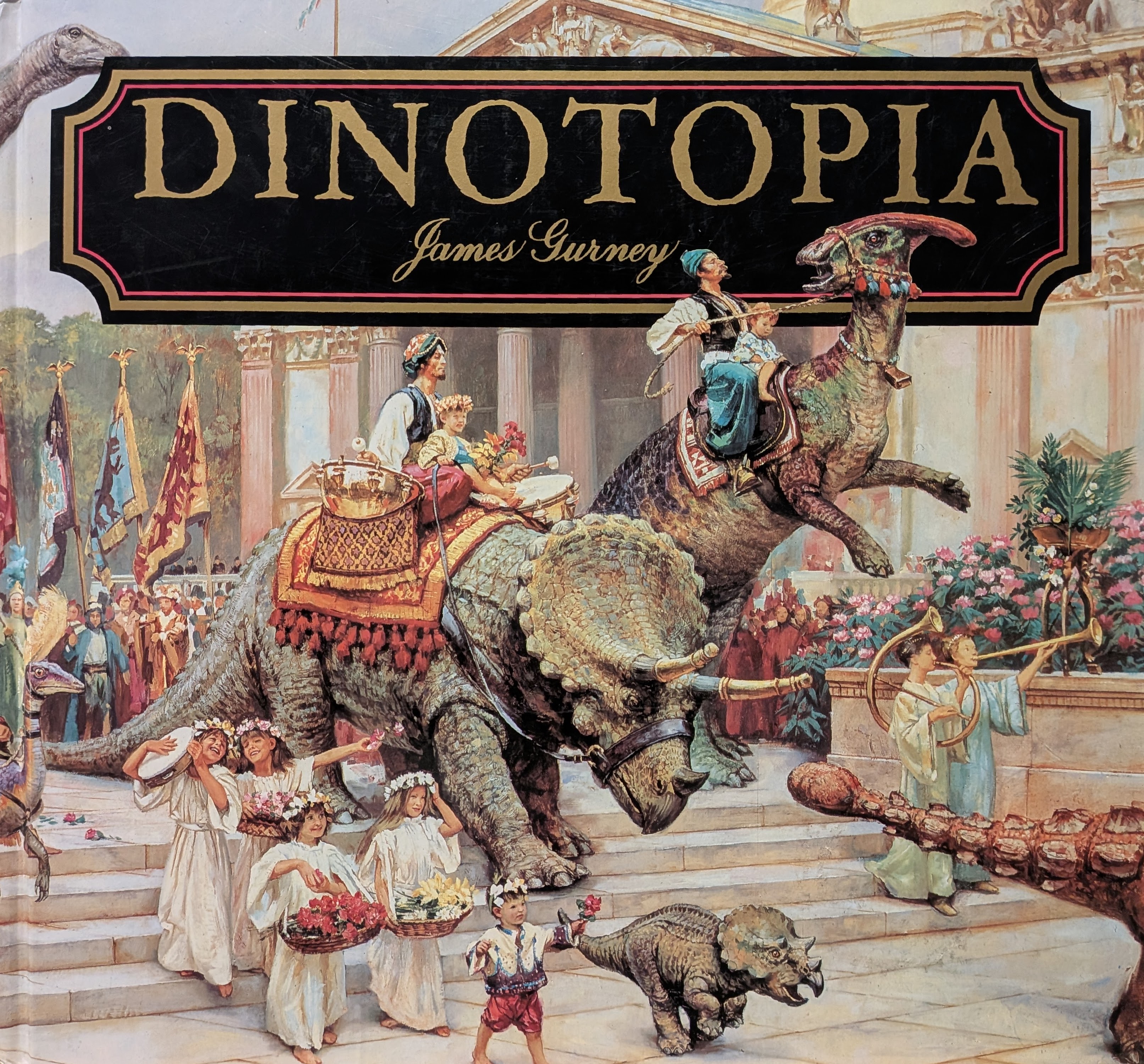
Table of Contents
Gurney and Dinotopia in the Dinosaur Decade
Reading Dinotopia: A Land Apart from Time
Breathe Deep, Seek Peace
Although the social stigma around being an adult fan of sf, fantasy, and even comics has begun to dissipate in the last two decades with the significant rise in their cultural capital, especially in academia, where each has become not only an important part of humanities scholarship but even a trendy area of research and teaching, it remains somewhat strange for an adult at, say, the age of thirty-five to declare themselves a fan of dinosaurs. After all, we treat it as totally normal for a child, even an early teen (though a high schooler might be pushing it), to profess wonder at the idea of giant beasts who roamed the earth for more than 160 million years—a period of time nigh unfathomable to the vast majority of humanity, whose own time on earth was summarized, so evocatively, by Carl Sagan in The Dragons of Eden (1977) as flowering only in the last hour-and-a-half of December 31, if the entirety of time since the Big Bang were metaphorized as taking place in the span of a single calendar year. But for an adult to wonder at those beings that populated this planet for so long, and to do so for reasons other than professional duty, somehow reads to most people as eccentric at best.
It therefore strikes me as somewhat of a vulnerable thing, after a lifetime of unabated love for and wonder at dinosaurs, to confess my deepest admiration for Dinotopia. And not just James Gurney’s first book that started it all, which I’ve just read for the first time, but also for the four-hour 2002 miniseries produced by the Hallmark channel and which was my introduction to Gurney’s world. I checked out that dorky, cheaply CGI’d miniseries from Blockbuster at least once a month throughout middle school and even into my first year of high school. It is corny, sincere, heart-warming, full of moral lessons about living in community with others, talking dinosaurs going on about social harmony and inner emotional peace, and, yes, it’s a bit cutesy—all things that today would be labeled “hopepunk” or maybe “cozy” or maybe the conservative Christians’ version of these terms: “clean” (I’m sorry for making you learn about this, but you had to know this was out there, right?). Even today, the miniseries brings me nostalgic joy. But despite having been obsessed with this incredibly uncool miniseries in my younger years, I somehow never read the thing it was based on: Gurney’s 1992 illustrated novel Dinotopia: A Land Apart from Time.
Gurney and Dinotopia in the Dinosaur Decade
The 1990s was undeniably a decade for dinosaurs. In addition to Michael Crichton’s bestselling “terrible masterpiece” Jurassic Park (1990), its sequel The Lost World (1995), and their film adaptations (1993, 1998), there was the fever-dream, Roseanne-meets-The Flintstones TV show Dinosaurs (1991–1994), the sexed up TV adaptation of Arthur Conan Doyle’s The Lost World (1999–2002), a reboot of the 1970s show Land of the Lost (1991–1992), the 1993 kids-find-dinosaurs film Prehysteria!, the 1994 animated banger We’re Back! (with John Goodman as an intelligent T. rex), half a dozen The Land Before Time sequels, dozens of documentaries, including the game-changing Walking with Dinosaurs (1999), and the shlocky creature feature Carnosaur (1993), not to mention the sff novels and anthologies: Jack Dann and Gardner Dozois’s Dinosaurs! and Dinosaurs II (1990, 1995), Robert J. Sawyer’s Quintaglio Ascension trilogy (1992–1994), Stephen Leigh’s Dinosaur World and its five sequels (1992–1995), paleontologist Robert T. Bakker’s Raptor Red (1995), James F. David’s Footprints of Thunder (1995), and, just after the decade’s end, Michael Swanwick’s Bones of the Earth (2002) (you can peruse ISFDB’s “dinosaur” tag for everything not listed here).
And amidst all the prehistoritastic dinofictions of the 1990s there was James Gurney’s unlikely, but surprisingly successful Dinotopia. Gurney’s first book, a 159-page art-book-style novel featuring over 150 oil paintings, introduced Dinotopia—a “lost” continent, larger than Sri Lanka, where sapient dinosaurs survived the Cretaceous-Paleogene extinction event some 66 million years ago. For the past 5,000 or so years, dinosaurs have lived alongside humans shipwrecked on the island and trapped there by the island’s inescapable coral reefs. Together, humans and dinosaurs have built a harmonious, utopian society that blends human and saurian cultures, languages, and lifeways in a relationship that respects one another’s differences, capacities, and needs. Dinotopia: A Land Apart from Time introduces readers to this world after the fashion of classic utopian fiction, by narrating the story from the perspective of two new arrivals who come ashore in 1862, explore the island and its cultures, must overcome their prejudices, but ultimately embrace their new life as Dinotopians.
What began with Dinotopia: A Land Apart from Time in 1992—coincidentally, the 150th anniversary of the term “dinosaur,” meaning “terrible lizard,” coined by Richard Owen—continued with a sequel illustrated novel, The World Beneath, in 1995. The success of these two books led to a series of fifteen middle-grade chapter novels published by Random House between 1995 and 2002, all written by mainstays of both sff and tie-in fiction, such as Scott Ciencin, John Vornholt, Midori Snyder, and Peter David, among others. In addition to the middle-grade novels, veteran sff novelist and tie-in writer Alan Dean Foster wrote two adult novels, Dinotopia Lost (1996) and The Hand of Dinotopia (1999). While the middle-grade novels mostly featured original characters, Foster’s were about Gurney’s protagonists, father Arthur and son Will Denison. Gurney explored Dinotopia’s deep, mythic, and much less utopian past in another illustrated novel, First Flight, in 1999 and returned to Arthur and Will’s tale in his final illustrated novel to date, Journey to Chandara, in 2007. Dinotopia was also adapted to television (a 2002 miniseries and a 2002–2003 TV show), to a straight-to-video animated film in 2005, and into four video games (1995, 2002, 2002, 2003).
Dinotopia emerged from a confluence of interests that developed over the course of Gurney’s childhood and early career. Gurney grew up in a family of engineers, became infatuated by dinosaurs through museum trips, and spent his nights reading National Geographic issues from the first decades of the twentieth century. He loved the idea of “lost civilizations” and majored in archaeology at UC Berkeley in the late 1970s, where he also took a paleontology course and spent a summer doing paleontology field work, making charcoal sketches of their finds. After graduating, Gurney went to art school with his Berkeley friend, Thomas Kinkade (yes, that Kinkade). Bored by their professors’ ramblings on art theory, they decided to go beatnik and spent a year traveling American backroads and riding in boxcars, painting and sketching the whole time, and produced out of their travels the much lauded The Artist’s Guide to Sketching (1982).
In the 1980s, Gurney split his time between scientific illustration and sff art. After the success of their book on sketching, Gurney and Kinkade painted backgrounds under the direction of Frank Frazetta for Ralph Bakshi’s animated sword and sorcery film Fire and Ice (1983). Kinkade went off to become the “Painter of Light” (a phrase previously associated with J.M.W. Turner, which Kinkade gaudily trademarked), while Gurney turned down an offer from Disney Animation to instead work as a freelancer. He spent the rest of the 1980s doing illustrations for National Geographic and painting covers for sff novels and magazines. At National Geographic, Gurney brought ancient cultures to life based on the newest findings in archaeology, often traveling to archaeological digs sites (see here for his discussion of how he worked on reconstructing the scene of an Etruscan tomb).
In the sff world, he painted more than 70 covers between 1983 and the publication of Dinotopia in 1992, including covers for R.A. Lafftery, C.J. Cherryh, Charles R. Saunders, John Brunner, Joanna Russ, Tim Powers, Alan Dean Foster, and so many more. Gurney’s style brought a sense of realism, detail, and emotion to sf and fantasy worlds. The scenes on his covers often bridged the personal and the grand, fantastical scales of sff storytelling, and he sometimes added a tinge of humor. Gurney’s influences ranged from the Hudson Valley painters to the Pre-Raphaelites, from Norman Rockwell and mid-century paleoartists like Zdeněk Burian or Charles Knight to early-twentieth-century slick and pulp magazine illustration, such as one might see on the covers of All-Story Weekly or Adventure. While Gurney’s paleoart has been the subject of much discussion, I’d love to see more attention paid to his place in the sff art landscape of the 1980s, because Gurney was clearly a generational talent but is barely remembered today as an sff artist (I actually have a ton of books he did covers for and which I bought simply because I loved the art, without knowing he had been the artist!).
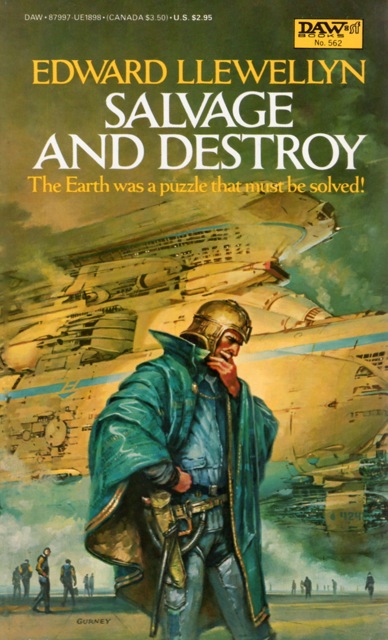
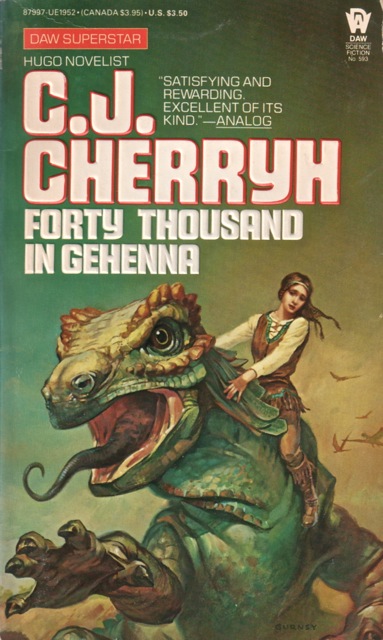
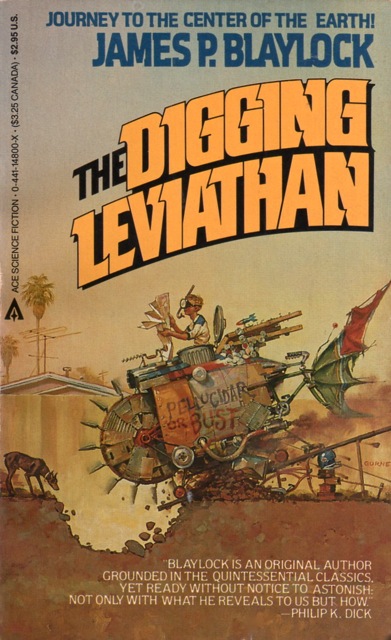
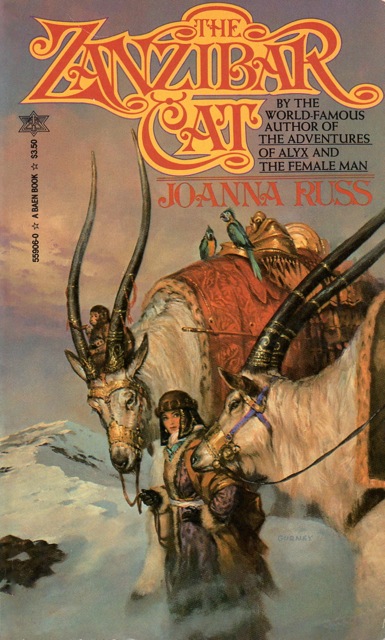
Fig. 1: Some of Gurney’s sff covers from 1984: Llewellyn’s Salvage and Destroy, Cherryh’s Forty Thousand in Gehenna, Blacklock’s The Digging Leviathan, Russ’s The Zanzibar Cat
Gurney began working on Dinotopia in the mid-1980s, in the midst of this highly productive period of sff cover art and archaeological illustration. In his own words,
I came at dinosaurs through a fascination with lost worlds and archaeology. I had been working for National Geographic all through the 1980s painting archaeological reconstructions for them, while also painting paperback covers in the science fiction genre. I combined those interests with my love of Jules Verne by coming up in my spare time with a series of lost world panoramas. One of them was called Dinosaur Parade. The idea was to reimagine dinosaurs not just as monsters or dull sluggards in the swamp, but to pick up on what Bakker and Horner were proposing about caregiving and warm bloodedness. (“Interview with James Gurney,” Archosaur Musings, March 6, 2011)
That painting, Dinosaur Parade (Fig. 2), was the real origin of Dinotopia, though Gurney had done several earlier paintings (including Waterfall City [Fig. 4] and Palace in the Clouds [Fig. 6]) that were later incorporated into his island of dinosaurs. Dinosaur Parade became the cover for the first book and is today the iconic symbol of the series and its central idea: dinosaurs and humans living together in community, with the parade evidence of their shared culture, understanding, and care for one another. And that painting was ultimately turned into a book thanks in large part to the help of Betty and Ian Ballantine, the founders of Ballantine Books.
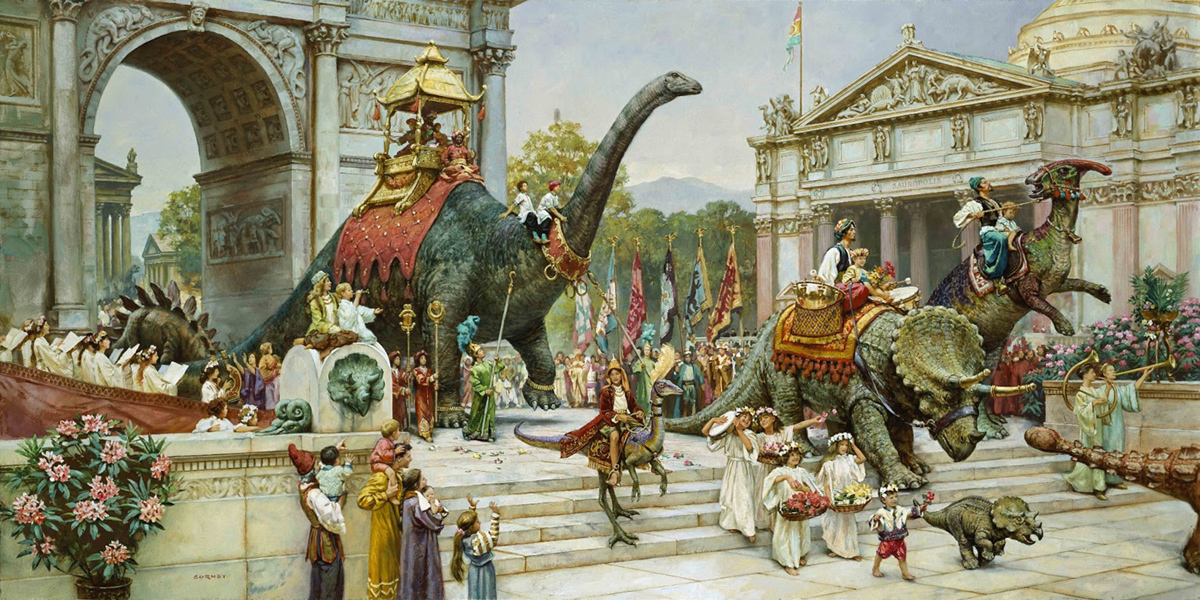
Fig. 2: James Gurney, Dinosaur Parade. Courtesy of the Norman Rockwell Museum.
Gurney initially imagined Dinotopia as a travel guide, Dinotopia: Grand Tour of a Lost World, but soon settled on the “long-form picturebook” in the style of Dutch artist Rien Poortvliet’s Gnomes (1976). Betty Ballantine made introductions to various publishers and Dinotopia: A Land Apart from Time was picked up by Turner Publishing, a now-defunct boutique publisher in Ted Turner’s media empire. Turner gave Dinotopia a huge media push, putting Gurney on talk shows, sending him on a global book tour, and even running television ads on Turner’s own TBS station. No doubt driven by the craze for dinosaurs created by Crichton’s books and their film adaptations (1990, 1993, 1995, 1998—a solid flow of bestselling, blockbusting dinofictions for rabid dinomaniacs like me), and by the totally enthralling, realistic, and much less terrifying world Gurney created, Dinotopia and its sequel were hits, leading to the flowering of the minor franchise outlined above.
Today, Gurney’s Dinotopia books continue to be reprinted, including in multiple anniversary editions; he is a much respected paleoartist; and he has gained even greater admiration as an artist through more than 35 exhibitions of his paintings in the past 20 years and with the release of his two guides to painting—Imaginative Realism: How to Paint What Doesn’t Exist (2009) and Color and Light: A Guide for the Realist Painter (2010)—and the re-release of The Artist’s Guide to Sketching (2025). Gurney is also a prolific blogger at Gurney Journey, where he has written thousands of posts since 2007 about art, archaeology, and dinosaurs.
But now it’s time to venture into Dinotopia ourselves.
Reading Dinotopia: A Land Apart from Time
Dinotopia opens with a frame narrative, “How I Discovered the Sketchbook,” which describes how James Gurney, researching the Chinese spice trade, discovered “a curious old leather-bound sketchbook”: Dinotopia, by Arthur and William Denison, Being the Account of our Adventures and Discoveries on a Lost Island. The sketchbook-cum-diary is what we are about to read and Gurney warns us that it contains the impossible—“drawings showed people and dinosaurs living side by side”—but he leaves it for us, the reader, to decide whether the book is “mere fantasy” or an actual “surviving record of a lost civilization” (9). Such frame narratives are incredibly common to late-nineteenth and early-twentieth century fiction, especially colonial adventure narratives, historical romances, and “lost world,” “lost race,” or “hollow earth” stories, all of which Dinotopia clearly draws inspiration from: not just Arthur Conan Doyle’s The Lost World but also Edgar Rice Burroughs’s Pellucidar novels and to a lesser extent H. Rider Haggard’s King Solomon’s Mines and its sequels. These fictions form one major strand of the genealogy of early science fiction and are, at the same time, wholly appropriate to the temporality of Gurney’s narrative.
The sketchbook diary opens in late 1862, following the shipwreck of father Arthur and son Will Denison’s schooner Venturer, on which they had been traveling the world for the past two years. It was a “voyage of discovery” for Arthur, a professor of science in Boston, and a means to escape the grief of his wife’s and Will’s mother’s recent death (11). They were sailing in “uncharted waters” out of port from Hong Kong when a typhoon struck and, everything lost in the wreck, the pair were rescued by dolphins and deposited on the shores on an unknown land. Here they find strange footprints, eerie animal sounds, and, forced into the position of “[t]wo reluctant Crusoes,” they venture into the forest and discover “living members of the class of vertebrates known as Dinosauria!” (13, 17). Stranger still, the dinosaurs are accompanied by a young human, Sylvia, who soothes the dinosaurs spooked by Arthur’s aggression toward what he perceives as monsters out of time.
Sylvia and the dinosaurs bring the newcomers—whom Dinotopians call “dolphinbacks,” since all people who arrive in Dinotopia are brought by the dolphins—to the nearest settlement, the island’s hatchery for dinosaurs. Here, on the rural periphery of the island continent, Arthur notes “road[s] twice the breadth of those in America” and dinosaurs (“creatures”) “allowed to roam free of fences or harnesses, strutting about like roosters in a farmyard, and accorded the greatest respect by all of the people” (20). Arthur even spots Iguanodontidae, which any well-traveled person of the Victorian period would have recognized from the famous Crystal Palace exhibition of 1854. The dolphinbacks are given a warm welcome, are finally able to communicate with someone who “spoke an archaic form of English,” his ancestors having arrived in the 1400s, and they begin to learn about the lifeways of the Dinotopians, which consist in large part of “all manner of dinosaurs, most of them peaceable, living as equals with the humans” (25).
Gurney’s accompanying paintings show us not just his interpretations of scenes from the narrative (or, rather, as the book wants us to think: Arthur’s sketches of his journeys), but also diagrams, sketches, and studies of Dinotopian culture, architecture, and peoples. These images are sometimes paired with text from Arthur’s diary, but occasionally Gurney interrupts the narrative with multi-page spreads of world-building imagery and notes, such as an early two-page spread showing what a dinosaur chair or “resting-couch” for quadrupeds looks like or how a typical human bed is shaped in the form of a circular nest, reflecting the influence of dinosaur habits on human habitation (23). Gurney even gives us cutaway architectural designs for the hatchery, to demonstrate at this early stage how humans and dinosaurs share a building, and how deeply a multispecies communitas affects the design and layout of a place in order to make life comfortable for all peoples. A great many of Gurney’s illustrations demonstrate this latter point, emphasizing the mutual coexistence of vastly different kinds of beings, and how this creates major infrastructural challenges for Dinotopian life that have to be practically solved. Gurney also shows how deeply intertwined human and dinosaur lives are, with both species playing key roles in one anothers’ “hatching” and rearing.
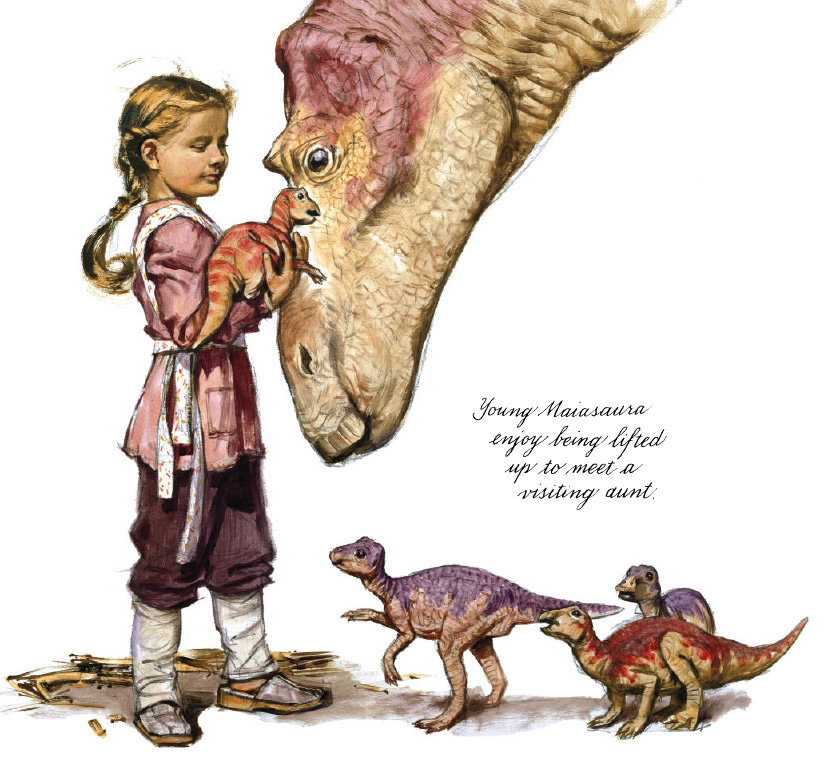
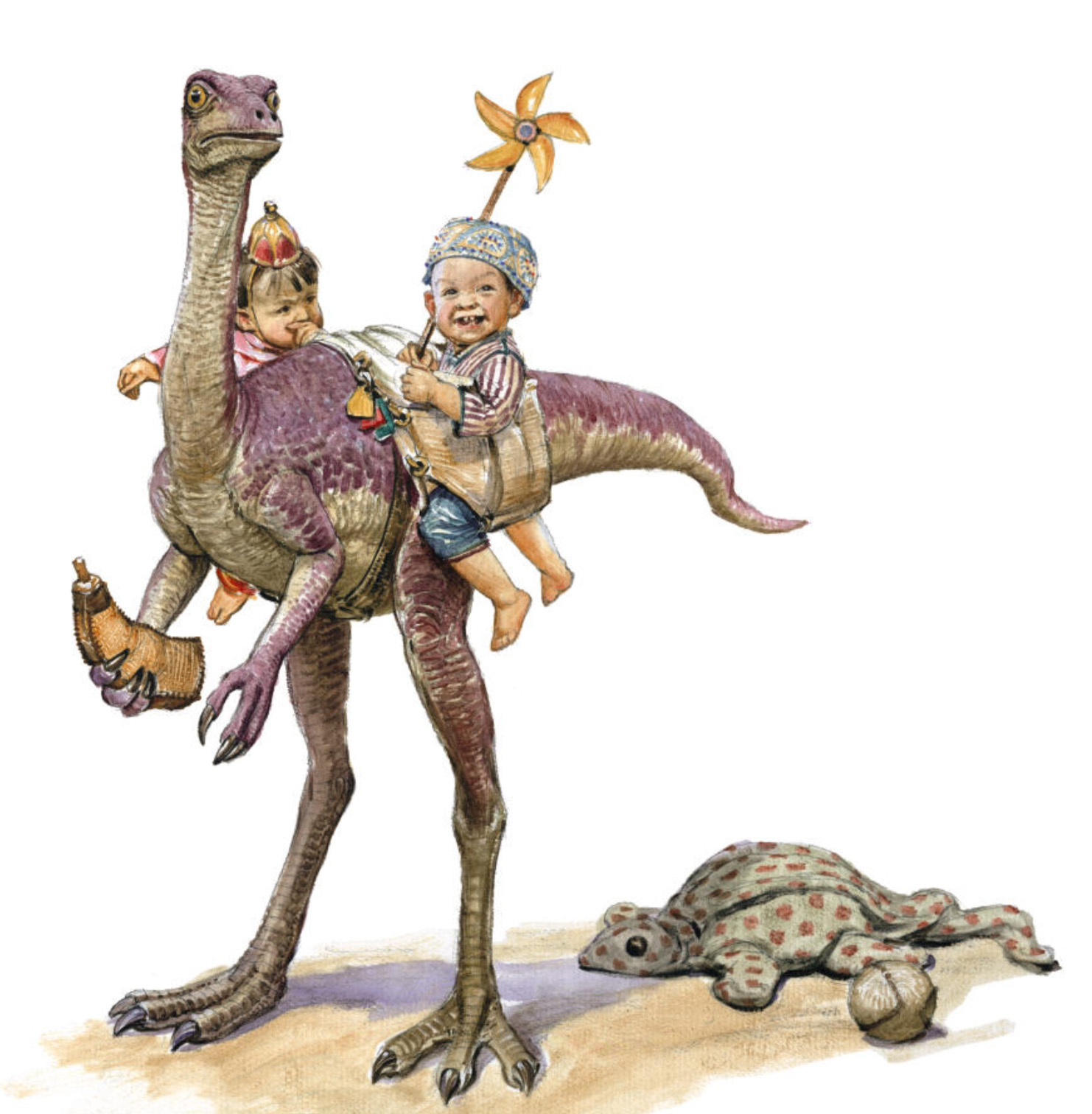
Fig. 3: James Gurney, a Maiasaurus hatchling and a dinosaur nanny (pp. 29, 31)
After some time spent acclimating to Dinotopian lifeways (which includes a vegan diet), Arthur and Will are told to travel to Waterfall City, where they “are expected to register our arrival […] and to supply a list of our skills. This sounds too much like regimentation to me,” Arthur complains, “but I shall, for the time, cooperate” (32). At this point, Arthur is skeptical of the mutuality of Dinotopian life, of cumspiritik in the creole language of Dinotopia, meaning “breathing together,” which is used to describe close friendships, human-dinosaur life partnerships, and marriages, and which expresses a multispecies version of the Marxist dictum “From each according to their ability, to each according to their needs.” For Arthur, this is “regimentation,” unfreedom of a kind, an ideological position that will be challenged over the course of the book. Up to this point, Arthur’s primary experience of Dinotopia is one of scientific awe (“This land is a Mecca for a biologist,” 32), whereas, for Will, Dinotopia is a child’s dream come true. It’s rather interesting, then, that, in a book ostensibly for children (or at least marketed as such), we don’t get the child’s perspective until much later, when Will (probably age 16 at that point) takes over the diary for a short time. Instead, Gurney shows us Dinotopia through the skeptical, scientific mind of an adult, a father who even admits to having a hard time showing his emotions toward his own son. It’s a fascinating choice of narrative perspective, made all the more interesting because Gurney layers it with references—to famous Victorian explorers like Richard Burton, missionaries like David Livingstone, and scientists like Charles Darwin—that a younger reader might have a hard time understanding, but which opens up the possibility of learning more.
After leaving the hatchery, Arthur and Will travel by dung cart (which brings nitrogen-rich dino-droppings to the farmlands) toward Waterfall City, making a few stops along the way in Pooktook—a large city with European-style opulence:
people and dinosaurs crowd the broad avenues, the street markets, the grand open-air theaters. I can only compare the spectacle to a Paris in which the doors of the zoological gardens have been thrown open and hippos lounge in the marble fountains of Versailles while sidewalk cafes cater to amiable rhinos (42)
—and Volcaneum, where they lodge with a master craftsmen four-generations descended from a Yorubu king, Tok Timbu. These stopovers in Pooktook and Volcaneum establish the rhythm of Gurney’s book, which unfolds like a travelogue that slowly introduces us to the intricacies of life in Dinotopia and shows us a thriving multispecies and, among humans, harmoniously multiracial society that lacks class distinctions. At each stage of the journey—not just to Waterfall City, but beyond, to Treetown, Canyon City, the Tentpole in the Sky, and Sauropolis—Arthur and Will encounter new aspects of Dinotopian society, experience new dimensions of its philosophical underpinnings, and meet characters, like Lee Crabb in Pooktook, Tok Timbu in Volcaneum, or Malik in Waterfall City, who shape their orientation to Dinotopian life.
Crabb, for example, offers an interesting early challenge to the idea that Dinotopia is in fact a utopian paradise. He is another dolphinback, in Dinotopia for a decade, but he rejects this life and the equality between (and perhaps among) humans and dinosaurs so celebrated on Dinotopia. But because he cannot leave (no one can, due to the island’s geography—which does raise the question of how the Denisons’ sketchbook left the island…), he sees himself as a victim imprisoned on Dinotopia, supposedly denied the saurians’ alleged secret knowledge of how to escape the island, and he declares to Arthur that “[t]he skinnies are the slaves of the scalies. We’re all slaves: hatching their eggs, hauling their dung” (43). Crabb even quips that “Dinotopia” means “terrible place,” a meta-referential critique of Gurney’s portmanteau combining “dinosaur” and “utopia,” which ignores the etymology of “dinosaur” but is evocative for modern readers. For Crabb, this existence that so many others find meaningful purpose in is an imposed life, a prison sentence. Gurney included Crabb to show that utopia is always an incomplete project: “I wanted Dinotopia to be a flawed utopia in a perpetual state of instability and self-correction. There was a danger in letting it become too sentimental or preachy.” The struggle for utopia is an element of Dinotopian society that its people are cognizant of. People like Crabb are welcomed and accepted—“We try to make him feel needed,” Tok says—and their discomfort with the society is not condemned. Later, we learn that Dinotopia even has a refuge for those who need to be “removed from reminders of all they had lost” in order to eventually integrate into Dinotopian life (138).
The time spent in Pooktook and Volcaneum are minimal but pivotal, but the remaining two-thirds of the narrative is split relatively evenly between Arthur and Will’s travels along with the Protoceratops ambassador Bix to Waterfall City, Treetown, and Canyon City, as well as Will and Sylvia’s spiritual journey into adulthood as they hike the Forbidden Mountains in search of the Tentpole of the Sky—a journey which will earn them the respect of their saurian life-partners, Cirrus and Nimbus (a type of Quetzalcoatlus called Skybax in the Dinotopia storyworld). It is difficult to explain just how much information about Dinotopian life, customs, and philosophy are packed into this short, 159-page novel, and which are conveyed with equal weight by Gurney’s text as by his images. My reading notes for this book run to almost 2.5k words and there’s no moment that feels uninformative or uninteresting, even as Gurney pulls us through a narrative that is at turns adventurous, contemplative, and awe-inspiring.
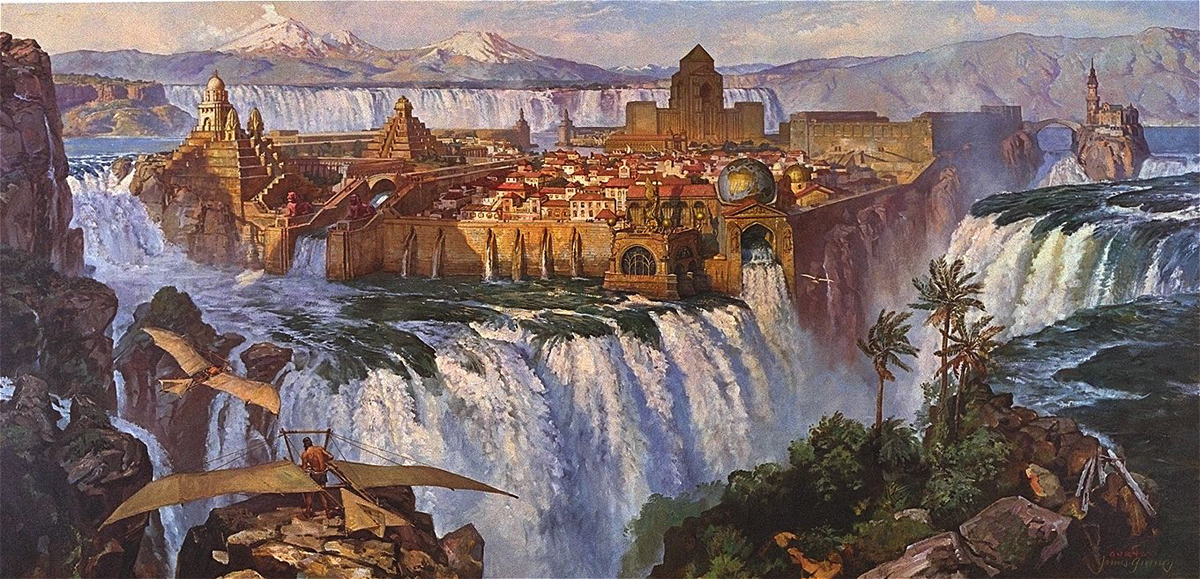
Fig. 4: James Gurney, Waterfall City.
In Waterfall City—depicted in one of several lush, two-page splashes, and perhaps Gurney’s most famous image next to Dinosaur Parade, originally drawn before he conceived of Dinotopia (based on Niagara fall; a later inspiration for The Phantom Menace’s Theed)—, Arthur and Will become full members of Dinotopian society through intensive study of language, writing, history, and ethics. And in the fashion of much utopian fiction, we learn through and alongside them. Gurney creates, for example, a written language for the dinosaurs, inspired by fossilized dinosaur tracks and cuneiform. The “footprint alphabet” is really just a 1:1 substitution cipher for the English alphabet, which of course makes no sense in the storyworld but gives readers a fun challenge throughout, as Gurney includes numerous decipherable texts written in footprint. Details like this draw readers into Dinotopian society, made all the more vivid by the specificity of the details: that Dinotopians write on scrolls so dinosaurs can read using scrolling machines, that three-toed dinosaurs are the preferred scribes because of the clarity of their footprints, that dinosaurs gather around sandboxes to write out temporary gossip, and that dinosaur writing culture dates back “tens of millions of years,” with the library at Waterfall City making the Library of Alexandria seem like “a puny collection cataloguing only a few short millennia of human wisdom” by comparison (74) (As a side note, the librarians in Waterfall City are named Enit and Nallab—Ballantine backwards—and Nallab is modelled on Ian Ballantine.)
In addition to Dinotopia’s writing system and some of its history, including a list of classic works of Dinotopian literature and science, the Waterfall City segment also explores Dinotopian ethics in detail. Gurney introduces the simplistic but effective “Code of Dinotopia,” but more interesting is their philosophy of time and history explained by the Timekeeper Malik:
“You of the West,” Malik said, “think of time moving in a straight line, from past to present to future. Your eastern brothers regard time as a circle, returning endlessly in a cycle of decay and rebirth. Both ideas have a dimension of the truth. If you were to combine geometrically the movement of the circle with the movement of the line, what would you have?”
“The spiral?” I ventured.
“Yes, yes. Or the helix. They are our models of the passage of time,” he said.
“So time moves on, but history repeats itself.” (67)
This idea is an attempt by Gurney to bridge different human understandings of time and it results, too, from the dinosaurs’ additional millions of years of learning. When, just after this lesson, Arthur asks what the time is, Malik lightly admonishes him:
[It’s t]ime for the Kentrosaurus to hatch. Time to plant the millet. Time for the magnolia buds to open. Professor Denison, I’m afraid you persist in thinking of time as numbers. You think of meaningless units of time—weeks, hours, minutes—based on what? Movements of faraway planets? Of what use to us is that? Why not pay attention to the precise 30-year life cycle of the bamboo […] or the exactly repeated mitotic cycle of the paramecium? The whole earth is a heartbeat[. …] And some things happen too slowly for you to notice. If you sit quite still, you can hear the grinding down of mountains, the stretching upward of trees, the pushing forward of continents—indeed the wearing away of this very waterfall. (69)
Malik explains to Arthur that Waterfall City must be partly rebuilt every hundred years due to the natural erosion of the rivers and falls, but that this is part of how Dinotopian society lives in sync with nature: not submitting to it, not seeking to conquering it, but living as needed and as far as possible in the sway of its rhythm, to the beat of earth’s heart. Malik concludes: “You will soon become a Dinotopian. And when you do, you will measure your life in a different way” (69). Malik reveals that the idea of “deep time,” then being worked out by Victorian scientists like Arthur, whose whole worldview was in the process of being reshaped by the emergence of a new temporal paradigm that placed human history in geological scale, is an ethical principle for the Dinotopians—and has been for millions of years.
This, I think, is the essence of Dinotopia for Gurney. Not to insist on a particular economic or political system, but to express the utopianism of Dinotopia as a way of seeking to live differently with and among the beings and people who make the world what it is. Gurney’s utopianism is simple and fantastical in its presentation of an ideal world where humans and many species of dinosaurs live together, bridging their differences, celebrating them, and making a virtue of their togetherness-through-difference. What results is a society that is essentially anarchist, offering a slightly less ambiguous and perhaps even more preferable utopia than the anarcho-syndicalist vision of Ursula K. Le Guin in The Dispossessed (1974), which I’ve written about here, here, and here. Gurney’s novel is much less erudite than The Dispossessed but no less interesting (to me) and, like Le Guin, Gurney embraces the tension of his novel’s generic inheritances.
Dinotopia is in many ways a classic utopian novel, a tour through a “better” world that could (have) be(en), and which focuses on the big and small alike (who scoops the poop, who does the farming, how do so many different kinds of dinosaur communicate, what do they do for fun?). It both dreams of living with dinosaurs and addresses the practicalities of making it so. Dinotopia is also an adventure novel that draws on historical romances, lost world tales, and adventure pulps that served to reproduce the ideology of colonialism, and Dinotopia does its own ideological reproduction in turn by recasting these earlier tropes. Such inheritances—the utopia and the adventure novel—draw from the wellspring of ideas and experiences afforded by early-modern imperial expansion, the “Age of Discovery,” and later violent experiments in settler-colonialism. Despite embracing the fantasy of “lost civilizations,” Gurney also critiques his own frames of reference through his choice of time period and his protagonist, Arthur, a man who wants to explore and discover in the name of science, but who comes to learn that his own knowledge is parochial at best, and his previous way of living was flawed. And Gurney does this without being, in his words, “preachy.”
After almost two years in Waterfall City, Arthur, Will, and Bix travel to Treetown, “where young people and dinosaurs practice living in accord” (54). On the way, they encounter carnivorous dinosaurs, like Tyrannosaurus rex, who is satiated with bribes of eels and fish. Bix explains that carnivores are not evil, they just have different biological needs and some, like T. rex, don’t like the company of others (another reminder in Gurney’s utopia that there are always difficulties to be managed). Gurney’s Treetown seems inspired by Tolkien’s Lothlorien (indeed, there are reports that Gurney would listen to The Lord of the Rings on tape while painting Dinotopia) and is another kind of childhood dream: a city of treehouses. Under the tutelage of the matriarch Norah (modelled after Betty Ballantine), Arthur and Will (and Sylvia, who has joined them) gain a deeper awareness of Dinotopians’ sense of a life intertwined with nature. Will confronts some of his own teenager angst and learns calm and self-reflection from brachiosaurs while Arthur travels through the forests and learns about the “green people,” or plants, from Norah’s niece, Melanie (99). Arthur learns, for example, that human Dinotopians live as old as 250 years because of a longevity herb, drunk in tea form. Will and Sylvia are eventually declared “hatched” into young adulthood. As all Dinotopians, human and saurian alike, they must now pick what Habitat they wish to spend their lives caring for in partnership with a dinosaur life-partner. They choose the sky and Arthur, Will, Sylvia, and Bix travel to Canyon City.
This final portion of the novel concerns Will and Sylvia’s journey to become a Skybax rider, while Arthur goes on a voyage with Bix into the World Beneath, a realm the dinosaurs consider sacred and which, we learn, is the mythic “hollow world” where the dinosaurs of Dinotopia retreated to survive the Cretaceous-Paleogene extinction (132). That story is told in Gurney’s sequel, The World Beneath, and in this novel we only get a glimpse at carvings and historical reliefs in the canyons beneath Canyon City that show early contact between ancient Egyptians and dinosaurs. While Arthur ventures into the World Beneath, Will takes over the narrative, marking a distinct tonal change in the diary (and Will is the more interesting narrator, I think). Will describes his and Sylvia’s climb through the frosty Forbidden Mountains to find the Tentpole of the Sky, a pilgrimage and ritual of self-discovery all Skybax riders undertake in order to win the respect of their Skybax life partners, but also to learn something about themselves and the Habitat they will one day watch over.
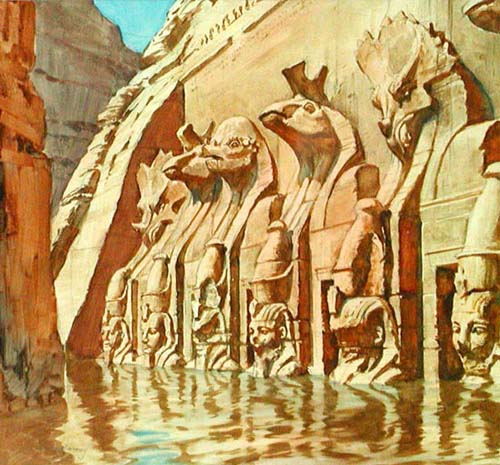
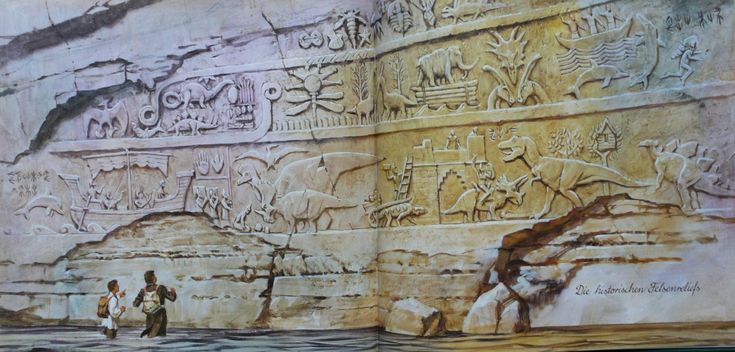
Fig. 5: James Gurney, Egyptian-style monuments and historical reliefs (pp. 127, 128-129).
Will and Sylvia’s journey might be my favorite part of the novel, because it’s so different, visually, from the rest of the narrative. In these colder climes, Will and Sylvia encounter not dinosaurs, but large Pleistocene mammals, such as mammoths, Brontotherium, and giant sloths. Like elsewhere in Dinotopia, the different ecological conditions and partnerships with non-human beings create different cultures and customs; here in the Forbidden Mountains is the only place where Dinotopians work with wool, for example. Eventually, Will and Sylvia make it to the Tentpole in the Sky, a retreat “built by Tibetans” for dolphinbacks when “dinosaurs realized that certain newcomers benefited from being isolated”; it became a place for managing and meditating on the grief of all that was lost of their old lives, preparing them for “a new life” in Dinotopia (138). And, indeed, the Tentpole is still overseen by Tibetans, led by supremely ancient monk Levka Gambo, who reminds Will and Sylvia that “[e]ach person who arrives in Dinotopia become reborn, and the birth is different for each individual” (141) (no doubt there is some reference here to James Hilton’s 1933 novel Lost Horizon). For Will and Sylvia, reaching the Tentpole “was a turning point,” ushering them fully into Dinotopian adulthood.
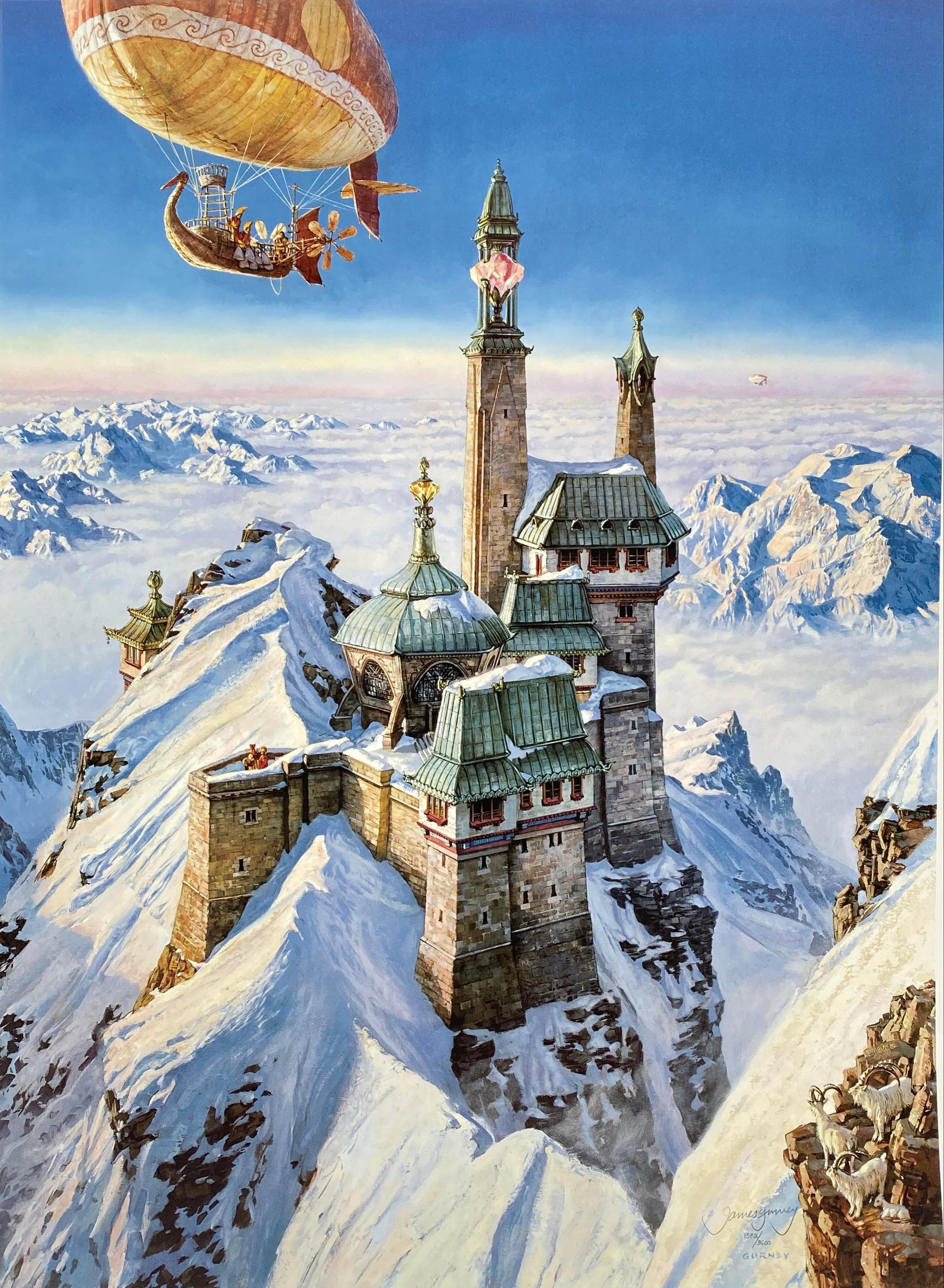
Fig. 6: James Gurney, The Tentpole of the Sky (p. 142).
After departing the Tentpole and returning—via a stopover in Sauropolis, the Dinotopian capital city and site of the painting Dinosaur Parade that started it all—to Waterfall City, where they reunite with Arthur, back from his voyage to the World Beneath, Will and Sylvia are met by their Skybax dinosaur life-partners and there is a suggestion that, though young, the two youths might be ready for cumspiritik. The novel ends with Arthur taking the narrative back over. Because of his own personal growth, he is now able to express how proud he is of his son, now become a man. Arthur reflects on everything he has learned, noting, “Our old life was richly rewarding, and I am grateful to it. But here on Dinotopia my eyes have been opened to the wonders of a new world,” and Arthur promises “a long lifetime” of learning, growth, and future adventures (159).
Dinotopia is, put simply, something of a wonder. It so neatly and productively blends genres, pulling on strings of utopian, adventure, historical, alternate history, and fantasy fiction. Gurney weaves these generic strands together into a narrative that is both compelling and, with the aid of more than 150 paintings (most done in a style that blends charcoal outlines with oil painting, which Gurney had to experiment with to give the look of a diegetic nineteenth-century sketchbook), it is both visually and intellectually stimulating. It’s a book that feels as full and deep in its worldbuilding as Tolkien’s The Lord of the Rings and as ethically engaging as Le Guin’s The Dispossessed. I’m kind of mad I didn’t read it in my childhood, but I have a feeling I wouldn’t have fully appreciated what it was, what it was offering me, and I’m so thankful that a recent rewatch of the 2002 miniseries encouraged me to finally dive into Gurney’s stunning, rich world.
Breathe Deep, Seek Peace
I fucking love this book in a way that, yes, makes it somewhat difficult to engage with as a critic, but I have certainly tried, and I hope the above discussion of Dinotopia: A Land Apart from Time shows my efforts to both embrace this wonderful book for what it is but also to question some of its assumptions and to place it in the larger context of utopian, adventure, and fantasy fiction. I loved and admired Gurney’s first book so much that I’ve committed to myself that, in due time, I will cover not just Gurney’s subsequent three Dinotopia books—The World Beneath, First Flight, and Journey to Chandara—but also the middle grade chapter novels and the adult novels by Alan Dean Foster. My hope is that, with more time and space, I’ll be able to more critically tarry in the world he has created and authorized others to create in.
In Gurney’s own words, offered in a video produced for Dinotopia’s twentieth anniversary:
What I wanted to do with Dinotopia was to create a doorway where the reader’s imagination could become engaged and where we could travel to that point of contact between art and science and imagination, between fact and fantasy. And I think that’s ultimately what fantasy is all about: it brings us together, it takes us to other worlds, and in so doing it brings us to a greater appreciation of the magic of the world around us now.
This tension between fact and fantasy, science and imagination, and their productive but always-unfinished resolution in the singular thing that is Dinotopia, where the two seemingly opposed modalities blend and give greater purpose to one another, recalls for me Roseanna Pendlebury’s recent description of genre as a “threshold.” Science and fantasy, adventure and utopia, dinosaurs and humans, cyclical time and linear time, herbivore and carnivore, “green people” and animals—all of these are thresholds for Gurney. Such differences are invitations, they are opportunities for contact, learning, and transformation. At the threshold, at times of coming and going, Dinotopians say “Breathe deep, seek peace.”
Dinotopia is just as real as it is unreal, just as dinosaurs are both real and unreal, a product not only of how we (and paleoartists like Gurney) imagine them, but also of what we “know” from paleontology, which is itself always a changing field, sometimes radically so. After all, Gurney has said that Dinotopia “grew out of the ideas that were emerging from science in the 1980s: the idea that dinosaurs were more like birds, rather than like reptiles. This revolutionized everything, if I could imagine that dinosaurs were warm-blooded and intelligent and dynamic creatures.” Even within a few short years of Dinotopia’s publication, the science changed again with the revelation in the late 1990s and early 2000s that dinosaurs had feathers. One of my favorite elements of Crichton’s Jurassic Park, which also emerged from the same paleontological revolution of the 1970s–1980s, driven by scientists like Robert Bakker and Jack Horner, is when Henry Wu, the chief geneticist behind Hammond’s de-extinction project, makes clear that they tweaked the dinosaurs to appear more like what we imagine dinosaurs should look like. Even those products of apparent scientific truth—DNA doesn’t lie, eh?—are products of the imagination.
Of course, at this point, I should probably acknowledge some of the most obvious complaints about Gurney’s imaginative project—the obligatory rejoinders from anyone who knows anything about prehistoric creatures or the history of paleontology. For example, how in the hell do so many species from such diverse geological periods, spanning hundreds of millions of years, exist on Dinotopia, seemingly unchanged after so many millions of years? How did they all get there? How was Dinotopia affected by continental drift? How does Arthur know to fear the possibility of carnivorous tyrannosaurs, which he mentions by name, some 60 years before they were even discovered? How do the Dinotopians know about binomial nomenclature and the Latin names for every dinosaur, many of which hadn’t yet been coined? Why did the dinosaurs develop a writing system that is a perfect cipher for the English alphabet, and record English phrases like “Thumbs Come” on their earliest historical reliefs documenting the arrival of Egyptians? Why do the Dinotopians call their island Dinotopia, when “dinosaur” wasn’t coined until 1852 and, in any case, has the awkward meaning of “terrible place,” instead of “dinosaur place”? There are, to be sure, plenty of such factual inconsistencies of the kind pointed out by the same folks who note that most of the dinosaurs in Jurassic Park are from the Cretaceous period. I’ve got no rejoinder, frankly, except to say that Gurney’s world is clearly a fantasy world—a land apart from time—and I feel no need to justify such inaccuracies, as interesting (and sometimes as funny) as they are. A thing can be true, even if it isn’t accurate.
When, early in his time in Waterfall City, Arthur expresses to the librarian Nallab that he has a hard to imagining “how it could be possible for such a small island to support enough artists and stone cutters to build all these wonders[, and] how all these different people and dinosaurs can possibly get along without quarreling,” Nallab answers, very simply: “it is possible […] but only if you do imagine it” (79). This is the challenge not only of utopia, but of all political change (which is the same thing), and indeed of scientific knowledge production itself: to actually imagine it and to realize that the act of imagination, the act of fantasy, is part of the process.
There is no truth, no reality without fantasy.
Breathe deep, seek peace.
To get notifications about new essays like this one sent directly to your inbox, subscribe to Genre Fantasies for free:


I recently gave a copy of this to my nephew. I’m pleased to see from your analysis that I did a good job of gift-giving. Thank you for helping me feel like a decent uncle!
LikeLiked by 1 person
A very very important book to me as a kid — inspired my love of maps and creating imaginary cities and worlds….
LikeLiked by 1 person