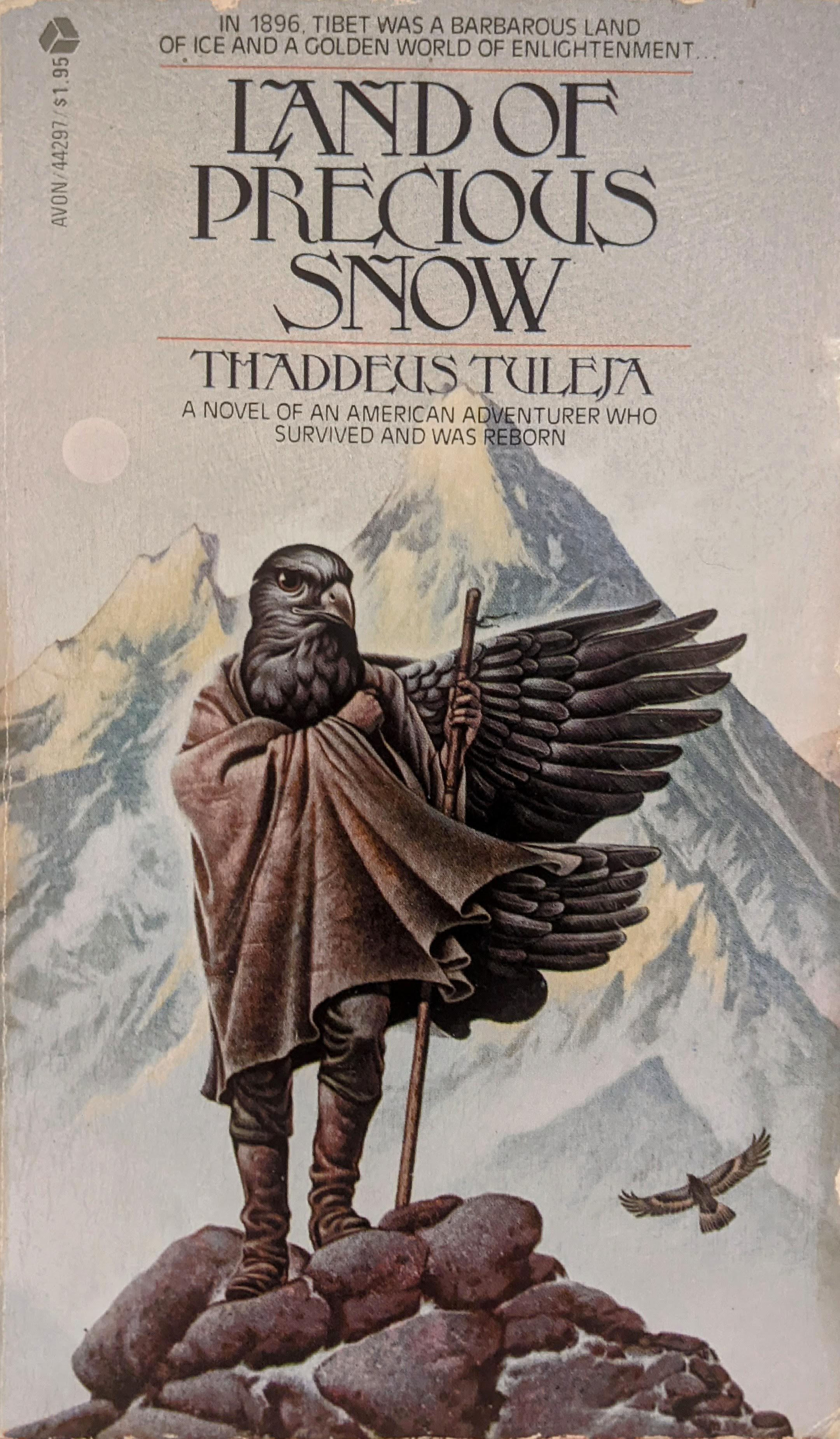
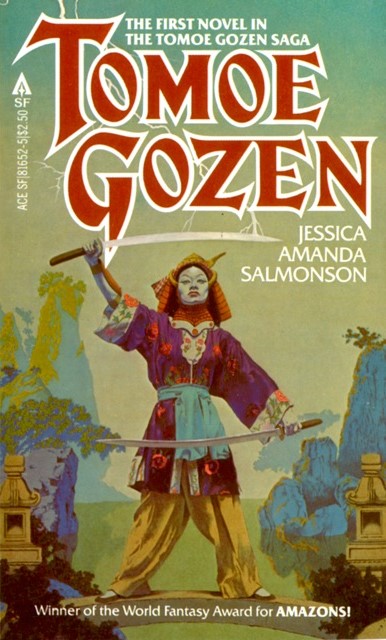
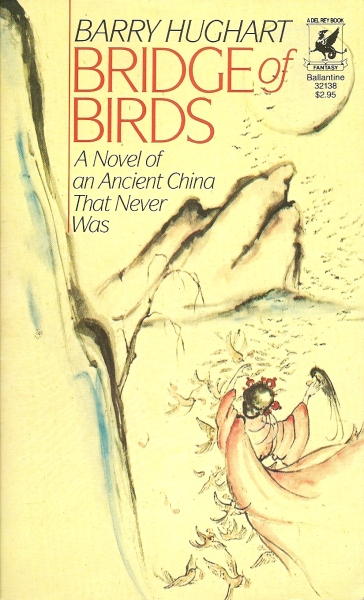

Covers from Avon Books (1978), Ace Books (1981, 1988), and Del Rey (1985) with art by Peter Schaumann, Robert Florczak, Mary Meitzelfeld, and Kang Yi.
Orientalist Fantasy Novels, 1970s–1990s: A Bibliography
After writing about both M. Lucie Chin’s The Fairy of Ku-She (1988) and Thaddeus Tuleja’s Land of Precious Snow (1977) earlier this year, I became quite interested in the extent of fantasy novels written during the postwar twentieth century that drew on Asian culture, languages, folk traditions, and belief systems in their storytelling and worldbuilding. My running list of titles grew and grew, measuring now at over 50 titles published between the 1970s and 1990s. My focus has been on novels published explicitly as fantasy—so, after fantasy became a recognizable mass market genre, hence the temporality of this list—and not texts that might be generally fantastic (say, kung fu novels of the early-to-mid-1970s). I have also not included children’s fantasy, of which there are several that might fit this list, since what I’m interested in is the adult genre market, which is quite distinct from the children’s fiction market, even if there are occasional overlaps. But I have included two TRPG campaign settings—Oriental Adventures (1985) and Legend of the Five Rings (1997)—since they proved influential in the genre fantasy space and later produced spin-off novels that appear on this list.
I call the grouping of titles on this list “orientalist fantasy” for several reasons. First, it recognizes that the vast majority of the authors on this list are white American and British authors who wrote their fantasies inspired by Asian cultures and histories more often than not from an outsider perspective. Thus, even in the most sensitive, respectful, and familiar examples of such work—here I’m thinking of Chin’s novel—there is always a “writing the other” lens, and thus some question of the politics of representation at work in these novels. Second, this name is a nod to the much older “oriental” fantasies that emerged in the late 18th century and were a significant thread in the development of genre fantasy; see Jamie Williamson’s The Evolution of Modern Fantasy for an exceptional genealogy of oriental fantasies alongside the other major influences on the genre. More often than not, though, oriental fantasies were set in the Middle East and about Arab and Islamic cultures (or inspired by them). The orientalist fantasies on this list thus represent a major shift in the non-Western influences on fantasy fiction written by (mostly) white people in the mid-to-late twentieth century, and also recognizes the increasing significance of (especially east) Asia in the postwar global order, not to mention the increasing number and visibility of Asian diasporas in both the US and UK.
The vast majority of the novels on this list are either historical fantasy or secondary-world fantasy; are set nearly entirely in an Asian-inspired world, usually with a specific culture, region, and/or historical moment as the building blocks; and are heavily influenced by (outsider understandings of) China and Japan, with a few drawing on Tibet, India, and Central Asia. Many of these novels are what SFE calls Chinoiserie, borrowing a term from the visual arts, and which we might extend to include a kind of literary Japonisme for those texts heavily influenced by Japanese history and culture. It’s in the implementation of, and creation of knowledge (as telegraphed to readers) about, these cultures and their histories where much of the orientalism of these books arises.
My use of “orientalist” should be taken to denote a relationship between creator, historical and cultural influences, and audience, and not as a blanket claim that these books are necessarily “bad” (morally, politically, or literarily) because they were written by non-Asian (diaspora) writers. Rather, my use of “orientalist” invokes a relationship of appropriation, adaptation, and, yes, occasionally of power, and raises questions about authenticity, knowledge(-making), and who is afforded the right or opportunity to write about certain topics and cultures. There are certainly racists texts on this list that heavily exoticize Asianness and copy-paste racist tropes, stereotypes, and caricatures; there are also texts that are decidedly not racist, that are significantly learned in Asian histories, cultures, and languages, and that are doing politically exciting things. The nuance, of course, lies not in the categorical term for these texts but in the books themselves and in our critical readings of them. I have not read them all but will certainly endeavor to do so in the next few years and I will link my writing about each novel below its entry, as well as any worthwhile writing about these books by other critics and scholars. I imagine the texts on this list will form a chapter of the book I’m working on about postwar fantasy and the mass cultural genre system.
Organization-wise, I’ve listed everything by year and then, within that year, alphabetically by author last name. If a book belongs to a series, I’ve put the series name is parentheses following the book titles, that book’s number in the series, a backslash, and the total number in the series, e.g. Salmonson’s Tomoe Gozen is the first book in the Tomoe Gozen trilogy, so that entry reads: Jessica Amanda Salmonson, Tomoe Gozen (Tomoe Gozen 1/3); the entry for the second book in the series reads: Jessica Amanda Salmonson, The Golden Naginata (Tomoe Gozen 2/3); and so on. In cases where a book belongs to a series but the entire series is not relevant, I simply state that the book is “in the XYZ series,” but I don’t give the number in the series or the total number of books in the series. I’ve also hyperlinked the book titles to each book’s ISFDB page, for easy access to as much info about each novel as possible.
I’ve included a few titles from the “early 2000s” but not made an attempt to be thorough there, and I’ve listed some texts that I either don’t have in my collection or can’t get enough information on to figure out whether they count as orientalist fantasies. Of course, the 2010s saw a massive shift in the landscape of sff publishing, with more authors of color publishing than ever before, writing incredible stuff, winning major awards, and courting huge readerships! As a result, today there are many times more examples of “Asian fantasy” published in the last decade than are represented by this list’s three decades—and, significantly, almost all of these recent novels were written by Asian and Asian diaspora writers. I haven’t put together a list of more recent texts because (1) there are dozens of such lists already available across the internet, especially on Goodreads, (2) more recent texts by Asian and Asian diasporic writers have an obviously vastly different relationship to representation of Asian cultures and histories than the texts by (almost all white) authors on this list, and (3) my list here is more for academic inquiry than to suggest books you should read.
If you know of anything I’m missing or have insights into these texts (especially the maybes!), please let me know! I aim to be as completionist as possible, despite (or perhaps because of) the inherent fuzziness of this set of texts and the problems it raises for thinking about genre, authorship, the politics of representation, and the uses of history.
The Bibliography
— 1976 —
Richard A. Lupoff, Sword of the Demon
— 1977 —
Thaddeus Tuleja, Land of Precious Snow
— 1979 —
E. Hoffmann Price, The Devil Wives of Li Fong
Tim Lukeman, Rajan (Khe’Chin 1/2)
— 1980 —
Grania Davis, The Rainbow Annals
— 1981 —
Jessica Amanda Salmonson, Tomoe Gozen (Tomoe Gozen 1/3)
Tim Lukeman, Koren (Khe’Chin 2/2)
— 1982 —
E. Hoffmann Price, The Jade Enchantress
T.C. Rypel, Deathwind of Vedun (Gonji 1/5)
T.C. Rypel, Samurai Steel (Gonji 2/5)
Jessica Amanda Salmonson, The Golden Naginata (Tomoe Gozen 2/3)
Jessica Amanda Salmonson, The Swordswoman
— 1983 —
R.A. MacAvoy, Tea with Black Dragon (Black Dragon 1/2)
T.C. Rypel, Samurai Combat (Gonji 3/5)
— 1984 —
Peter Dickinson, Tulku [note: originally published in the UK in 1979, but republished under the American mass market YA fantasy imprint Tempo Books in 1984]
Barry Hughart, Bridge of Birds (Chronicles of Master Li and Number Ten Ox 1/3)
Gwyneth Jones, Divine Endurance
Jessica Amanda Salmonson, Thousand Shrine Warrior (Tomoe Gozen 3/3)
Morris Simon, Blade of the Young Samurai (in the D&D Endless Quest series)
— 1985 —
Dungeons & Dragons, Oriental Adventures campaign setting (AD&D)
T.C. Rypel, Fortress of Lost Worlds (Gonji 4/5)
Jessica Amanda Salmonson, Ou Lu Khen and the Beautiful Madwoman
— 1986 —
R.A. MacAvoy, Twisting the Rope (Black Dragon 2/2)
T.C. Rypel, Knights of Wonder (Gonji 5/5)
— 1987 —
Kathryn Grant, The Phoenix Bells (Land of Ten Thousand Willows 1/3)
Raymond E. Feist and Janny Wurts, Daughter of the Empire (Kelewan Empire 1/3)
— 1988 —
C.J. Cherryh, Paladin
M. Lucie Chin, The Fairy of Ku-She
Kara Dalkey, The Nightingale (in Terri Windling’s Fairy Tale series at Ace)
Avram Davidson and Grania Davis, Marco Polo and the Sleeping Beauty
Barry Hughart, The Story of the Stone (Chronicles of Master Li and Number Ten Ox 2/3)
Susan Shwartz, Silk Roads and Shadows
Stephen Marley, Spirit Mirror (Chia Black Dragon 1/3)
— 1989 —
Lillian Stewart Carl, Wings of Power (in the Sabazel series)
Kathryn Grant, The Black Jade Road (Land of Ten Thousand Willows 2/3)
Kathryn Grant, The Willow Garden (Land of Ten Thousand Willows 3/3)
Jeanne Larsen, Silk Road (Avalokiteśvara 1/3)
Andre Norton and Susan Shwartz, Imperial Lady (Central Asia 1/2)
Chelsea Quinn Yarbro, Path of the Eclipse (in the Saint-Germain series)
— 1990 —
David Cook, Horselords (Forgotten Realms’s Empires 1/3)
Troy Denning, Dragonwall (Forgotten Realms’s Empires 2/3)
David Gemmell, Quest for Lost Heroes (Drenai 4/9)
Raymond E. Feist and Janny Wurts, Servant of the Empire (Kelewan Empire 2/3)
— 1991 —
Margaret Ball, Flameweaver (Flameweave 1/2)
Gillian Bradshaw, Horses of Heaven
Barry Hughart, Eight Skilled Gentlemen (Chronicles of Master Li and Number Ten Ox 3/3)
Jeanne Larsen, Bronze Mirror (Avalokiteśvara 2/3)
James Lowder, Crusade (Forgotten Realms’s Empires 3/3)
Stephen Marley, Mortal Mask (Chia Black Dragon 2/3)
Sean Russell, Initiate Brother (Initiate Brother 1/2)
— 1992 —
Phillip Brugalette, The Nine Gates
Raymond E. Feist and Janny Wurts, Mistress of the Empire (Kelewan Empire 3/3)
Sean Russell, Gatherer of Clouds (Initiate Brother 2/2)
— 1993 —
Margaret Ball, Changeweaver (Flameweave 2/2)
Stephen Marley, Shadow Sisters (Chia Black Dragon 3/3)
Andre Norton and Susan Shwartz, Empire of the Eagle (Central Asia 2/2)
— 1994 —
Terry Pratchett, Interesting Times (part of Discworld)
— 1995 —
Eileen Kernaghan, Dance of the Snow Dragon
— 1996 —
Piers Anthony and Alfred Tella, The Willing Spirit
Kara Dalkey, Goa (Blood of the Goddess 1/3)
David Gemmell, The Legend of Deathwalker (Drenai 7/9)
Greg Keyes, The Waterborn (Chosen of the Changeling 1/2)
Jeanne Larsen, Manchu Palaces (Avalokiteśvara 3/3)
Sasha Miller, Ladylord
— 1997 —
Kara Dalkey, Bijapur (Blood of the Goddess 2/3)
Greg Keyes, The Blackgod (Chosen of the Changeling 2/2)
Legend of the Five Rings TRPG and Rokugan campaign setting
— 1998 —
Kara Dalkey, Bhagavati (Blood of the Goddess 3/3)
Troy Denning, Faces of Deception (in Forgotten Realms’s Lost Empires trilogy)
— 1999 —
Mary Brown, Dragonne’s Eg
Early 2000s
Dungeons & Dragons, Oriental Adventures campaign setting (3e)
Kara Dalkey, Genpei (2000)
Kij Johnson, The Fox Woman (2000)
Stephen D. Sullivan, The Scorpion (2000) (Legend of the Five Rings’s Clan War 1/7)
A.L. Lassieur, The Unicorn (2000) (Legend of the Five Rings’s Clan War 2/7)
Ree Soesbee, The Crane (2000) (Legend of the Five Rings’s Clan War 3/7)
Stephen D. Sullivan, The Phoenix (2001) (Legend of the Five Rings’s Clan War 4/7)
Stan Brown, The Crab (2001) (Legend of the Five Rings’s Clan War 5/7)
Ree Soesbee, The Dragon (2001) (Legend of the Five Rings’s Clan War 6/7)
Stephen D. Sullivan, The Lion (2001) (Legend of the Five Rings’s Clan War 7/7)
Curt Benjamin, The Prince of Shadows (2001) (Seven Brothers 1/3)
Curt Benjamin, The Prince of Dreams (2002) (Seven Brothers 2/3)
Lian Hearn, Across the Nightingale Floor (2002) (Tales of the Otori 1/5)
Edward Bolme, The Steel Throne (2002) (Legend of the Five Rings’s Four Winds Saga 0/4)
Ree Soesbee, Wind of Honor (2002) (Legend of the Five Rings’s Four Winds Saga 1/4)
Jess Lebow, Wind of War (2002) (Legend of the Five Rings’s Four Winds Saga 2/4)
Rich Wulf, Wind of Justice (2003) (Legend of the Five Rings’s Four Winds Saga 3/4)
Ree Soesbee, Wind of Truth (2003) (Legend of the Five Rings’s Four Winds Saga 4/4)
Curt Benjamin, The Gates of Heaven (2003) (Seven Brothers 3/3)
Lian Hearn, Grass for His Pillow (2003) (Tales of the Otori 2/5)
Kij Johnson, Fudoki (2003)
Don Bassingthwaite, The Yellow Silk (2004) (in Forgotten Realms’s Rogues series)
Scott McGough, Outlaw: Champions of Kamigawa (2004) (Magic: The Gathering / Kamigawa 1/3)
Scott McGough, Heretic: Betrayers of Kamigawa (2005) (Magic: The Gathering / Kamigawa 2/3)
Scott McGough, Guardian: Saviors of Kamigawa (2005) (Magic: The Gathering / Kamigawa 3/3)
Lian Hearn, Brilliance of the Moon (2004) (Tales of the Otori 3/5)
Curt Benjamin, Lords of Grass and Thunder (2005)
Lian Hearn, The Harsh Cry of the Heron (2006) (Tales of the Otori 4/5)
Lian Hearn, Heaven’s Net Is Wide (2007) (Tales of the Otori 5/5)
Maybe?
M.A.R. Barker, Tékumel TRPG and novel series (1974–2003)
Piers Anthony, Wielding a Red Sword (1986) (in the Incarnations of Immortality series)
Elizabeth Ann Scarborough, The Healer’s War (1988)
Glen Cook, The Glittering Stone series (1996–2000)
Elizabeth A. Lynn, Dragon’s Winter (1998) and Dragon’s Treasure (2003) duology
Ardath Mayhar, Tales of the Triple Moons series (1979–1983)
Robert E. Vardeman, The Jade Demons series (1985–1986)
Paul Edwin Zimmer, The Dark Border series (1982–1989)
Sara Zettel, The Isavalta series (2002–2007)
Acknowledgments
My (alphabetically ordered) thanks go to Brian Attebery, Bobby Derie, Nat Harrington, Rich Horton, Murray Leeder, Peat Long, Tim Walters, and Dennis Wilson Wise for additional titles added to this list after its initial publication.
Jess Nevins pointed out a useful list of “Orientalia” put together in the 1990s/2000s by Jessica Amanda Salmonson for the antiquarian bookseller Violet Books. Most of those texts pre-date the period of the present bibliography, but the collection of texts points to a range of popular fiction genealogies that no doubt informed many of the authors included on this list (esp. the fiction of Sax Rohmer) and which speak to a different but equally important period of in the development of the orientalist imaginary in Anglophone popular fiction.
To get notifications about new projects like this one sent directly to your inbox, consider subscribing to Genre Fantasies for free:


Geoff Ryman’s The Unconquered Country (1986) might not be quite fantasy enough–the Encyclopedia of Fantasy calls it “SF partaking of fabulation,” which seems about right–but it might be an interesting edge case. (It’s also outstanding.)
LikeLiked by 1 person
Thanks for that! It’s actually on my list to read in the next two months, so I’ll make a decision then about whether to include it here. I’m really excited to read it. I quite enjoyed Air a few years ago.
LikeLike
I strongly recommend Jeanne Larsen’s theee China-based fantasies. The first one, Silk Road (1989) won the Crawford Award. They’re not really Orientalist so much as being about the way we construct the past and the other.
LikeLiked by 1 person
Wow, those look great! Thanks so much for the recommendation, Brian! Adding those now.
LikeLike
I’d suggest Peter Morwood’s Book of Years series that starts with The Horse Lord (1983) for the list. Very heavily Japanese coded, although not entirely. I always really enjoyed the first one for some gripping adventure and cost of adventure.
Also depending on how Asian-esque the cast needs to be, I think some of David Gemmell’s books would make the list. I am presume you’re looking for more than a few chapters in the Asian-esque culture (or there’d be a lot more Eddings and Feist on the list) but I’d make an argument for two books from his Drenai cycle
The Legend of Deathwalker – Two Drenai seeking magic jewels get tangled up in a Gothir attempt to exterminate the Nadir (not-Mongol) and end up fighting alongside them, which means a large number of Nadir characters with different insights into the culture (and also a few not-Chinese characters too)
A Quest for Lost Heroes – A similar tale of white foreigners getting tangled up in Nadir/Chiatze politics with insights into their societies – less certain than the above, but also one of the few books from this period that I know that goes into the idea of culture clash between Asian-esque races.
Hmm, what else? John Dalmas’ The Yngling in Yamato looks like it’s too sci-fi rather than fantasy; I know little about it other than I saw it in a bookstore and went “wtf”.
LikeLiked by 1 person
Thanks for all of this! I’ve added the two Gemmells, but I’ve kept off the Horse Lords books for now, since (as I’ve said to a few others) I’m trying to avoid books that have general background influence from Asian cultures, e.g. a number of Cherryh’s early novels or Jordan’s Wheel of Time novels. I always appreciate these suggestions and I’ve added you to the list of folks who have contributed!
LikeLiked by 1 person
An interesting non-genre fantasy case is David Mitchell’s The Thousand Autumns of Jacob de Zoet, which starts off as what seems like a Shōgun-esque historical fantasy, and veers off into a much more fantastic direction halfway (and IMHO rather offensively orientialist direction – although I seem to be very much in a minority position here, judging by the reviews and awards). Mention of Shōgun also makes me wonder whether this qualifies too. It is set in what amounts to an alternative version of the historical Japan of the period. Again, certainly non-genre fantasy…
LikeLiked by 1 person
It’s interesting you mention Shōgun and I agree that it’s certainly relevant, especially insofar as it proved there was widespread public interest in the 1979s–1980s in east Asian period pieces (both the novel and the miniseries adaptation were massive hits!), and which no doubt inspired quite a lot of imitators and compounded with others factors that helped increase American interest in Asia and its history (however thin or imaginary that understanding of Asia was), but I’ve refrained from listing novels not explicitly and purposefully published as fantasy, since what I’m most interested in is fantasy as a genre within the mass market system.
But I will actually be writing about Shōgun either later this year or next year because I have a long-standing interest in historical fiction and specifically in the formal, rhetorical, and aesthetic similarities between fantasy and historical fiction set in, let’s just say, “pre-modern” time periods. Of course, some historical fiction is more and less historical than others, but I hesitate to label the less “accurate” historical fiction as “fantasy” insofar as I want to keep separate the historical, sociological, and literary uniqueness of fantasy as a market genre. But what is always interesting about historical fiction—whether Shōgun or Pillars of Eternity or Roots—is how the “historical imaginary” functions, who it is written for, and what it tells us about an author’s (and readers’) understandings of the past.
Thanks, also, for the Mitchell rec. I’ll be interesting to take a look at that!
LikeLike