The Dolphin and the Deep by Thomas Burnett Swann. Ace Books, 1968.
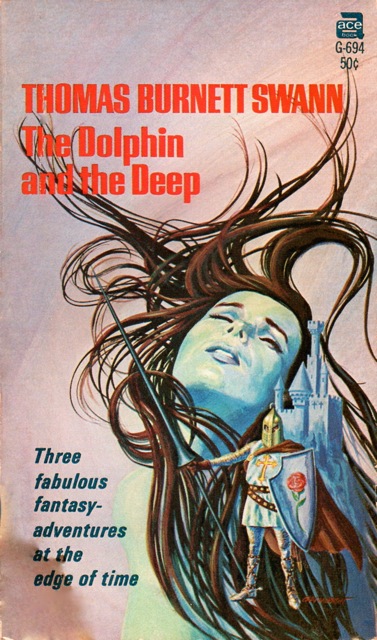
Table of Contents
Swann’s First Story Collection
Reading “The Dolphin and the Deep” (1963)
Reading “The Manor of Roses” (1966)
Reading “The Murex” (1964)
Parting Thoughts
I don’t enjoy short fiction.
I used to keep up with the major sff magazines and their short fiction as they came out; I also read multiple “year’s best” anthologies each year. But after about half-a-decade of that, I realized I couldn’t remember a single work of short fiction from that period. This is my own failing, if failing it is, and no fault of the short fiction or its writers. But of the hundreds of short stories, novelettes, and novellas I’ve read in the 15 or so years since I started seriously paying attention to sff, the only three that have stayed with me and which I can remember in any detail, are Arthur C. Clarke’s “The Nine Billion Names of God” (1953), Ursula K. Le Guin’s “The Day before the Revolution” (1974), and Octavia E. Butler’s “Bloodchild” (1984). I am also forced to reflect on Le Guin’s “The Ones Who Walk Away from Omelas” (1973) every few years when some writer figures they should “solve” her story and puts out some pastiche that does the rounds on social media and predictably gets an award nomination or two.
So, I can say quite confidently that I don’t enjoy short fiction. Or, perhaps I should say: I don’t enjoy short fiction for the most part.
Any defense I have of this position amounts to a personal preference that cannot, really, be critically defended. It’s like those people who say, in all seriousness, as though it’s any sort of meaningful rule about the form, that ninety minutes is the “ideal” length of a film. Of course, there is no “ideal” form of a form—Plato, be damned.. Critically, that’s nonsense: prescription and preference masquerading as description and fact. I want to avoid the critical misstep of pretending that my merely personal dislike of short fiction is an actual critical evaluation of a form that, if driven to vouch for it, I most certainly could. But I want to be upfront about my prejudice because, as an sff critic and historian, my dislike and ignorance of short fiction creates a major blindspot. And it’s one that I want to begin to correct, albeit slowly, in the coming years by looking more intently at sff—and most especially fantasy—short fiction.
I’ll start, then, with an author whose work I’m an expert in: Thomas Burnett Swann.
Swann’s First Story Collection
In the past year, I’ve read all sixteen of his novels—each of them a further entry in his complex, millennia-spanning story cycle narrating the “secret history” of the prehumans, the mythic beings like Centaurs, Dryads, and Fauns who were driven into extinction and legend by the rise and spread of human civilization, from the banks of the Nile to the edges of the British empire. Like many professional sff writers of the 1960s and 1970s, Swann tried to maximize the (minimal) profits from his writing by publishing his fiction first in sff magazines and then later fixing them up into novels. About a third of his novels—Day of the Minotaur (1966), The Weirwoods (1967), The Goat Without Horns (1971), Will-O-the-Wisp (1976), Lady of the Bees (1976), and The Tournament of Thorns (1976)—originally appeared originally in magazines, some as serializations and others as separate stories later fixed-up or expanded into a novel.
While Swann is best remembered in the sff world for his many novels, some of which are among the best fantasy novels of the late-twentieth century, he also published two story collections, both with his first publisher, Ace Books: The Dolphin and the Deep (1968) and Where Is the Bird of Fire? (1970). They include some pieces that were later fixed-up into novels—like “The Manor of Roses” (1966), which was combined with “The Stalking Trees” (1973) to form The Tournament of Thorns—but for the most part they collect stories that Swann never expanded (though he might have intended to, in some cases, had he lived longer). Because these stories also hail from early in his career, all published before he turned more fully to novel writing and before he had cemented some of his key themes and character types, the stories in these two collections offer a fascinating glimpse at how Swann’s fiction changed over the short span of his too-short career.
Swann’s first story collection was The Dolphin and the Deep, published by Ace in 1968 after the success of Day of the Minotaur (a Hugo finalist for Best Novel) and The Weirwoods. The Dolphin and the Deep was Swann’s third book-length publication, all three of which appeared at Ace while his patron editor, Donald A. Wollheim, was still there. And, like the two novels before it, Swann’s first story collection was given a (not very good) cover painting by Gray Morrow. Curiously, The Dolphin and the Deep does not include Swann’s most famous story, “Where Is the Bird of Fire?” (1962), which raised Swann’s profile early in his career as a Hugo finalist for what was then called the short fiction award, just four years after his first professional sff publication (“Winged Victory” [1958]). “Where is the Bird of Fire?” became the title story of his second collection (before being expanded into his best novel, Lady of the Bees).
The Dolphin and the Deep collects two novellas (“The Dolphin and the Deep” and “The Manor of Roses”) and one novelette (“The Murex”) set in Swann’s ever-expanding prehuman storyworld. In these tales, Swann explores the coast of West Africa in search of Circe, experiments with horror and probes the ideology of Crusade in medieval England, and asks what happens when an Amazon warrior falls in love with one of the mysterious Myrmidon ant-boys. They are stories of gender and sexual identity, of transformation, of bridging differences, and of the many forms love can take. They are classic Swann and prefigure important ideas that shape his later—and mostly better—work.
Reading “The Dolphin and the Deep” (1963)
The first and title story of the collection, “The Dolphin and the Deep,” was published in Science Fantasy, the British sister magazine of New Worlds, in August 1963 (an issue that also featured Terry Pratchett’s first published sff work and a surprisingly late story by Mervyn Peake). Swann first found traction and appreciation as an sff writer in the pages of Science Fantasy, which not only published his Hugo-nominated novella “Where Is the Bird of Fire?” but also the serialized installments of what later became his first two novels, Day of the Minotaur and The Weirwoods. “The Dolphin and the Deep” is the earliest story in this collection and was also the first featured cover story Swann received from a magazine (although the cover image illustrated Michael Moorcock’s essay “Mervyn Peake: An Appreciation,” a tribute to his friend, then suffering from a debilitating neurodegenerative disease; Swann’s first feature-plus-cover story was “The Murex,” his next story in Science Fantasy and the third story in this collection).
“The Dolphin and the Deep” is typical of Swann’s prehuman stories. It’s the story of a rich Etruscan named Arnth, known to everyone as Bear, who defies his society’s expectations by eschewing marriage and instead uses his (parents’) wealth to travel the Mediterranean, from Greece to Babylon to the Pillars of Hercules (Gibraltar). Far from being the story of an adventurer seeking manly renown, Bear is travelling the cosmopolitan ancient world in search of love—someone worth stopping for. One day, the merchant ship he’s booked passage on is stranded near an island that turns out to be Aeaea, the ancient home of Circe. There, Bear meets the orphaned Triton Astyanax and an albino dolphin, Atthis, and—after some hijinx, including almost being sold at a slave market—the three of them hire another ship, take on board two “Scandian” brothers (Balder and Frey), and go in search of Circe, whom legend says left Aeaea for a new home somewhere on the coast of West Africa.
In their travels along the western coast of Africa, the misfit crew of adventurers encounter vicious Harpies who turn femininity into grotesquery, African “pygmy” women who are the very image of racist nineteenth-century colonial ideas, and Sirens who nearly devour Astyanax. Eventually, they discover Circe’s new home on the Island of Oleanders. Bear undertook this voyage in search of the final, true love he had been seeking, the one to end his rambling ways, and Circe plays the part, offering herself as the too-good-to-be-true fulfillment of his wanderings. Swann’s prose is magnetic as he describes Circe’s wooing of Bear:
I held her in my arms and her maiden’s slenderness stabbed me with sweet bewilderment, and her hands, like searching swallows, fluttered at my face. I held her, and in my heart summer trembled into spring, but a spring without wandering or need to wander, where boughs of quince put forth their quivering leaves. I buried my face in her tumbled hyacinths and sobbed that beauty and brevity must be inseparable.
Laughing, she drew me into the palace, under the high lintel, from room to courtyard, garden to corridor, from shadows to shadow, fragrance…tapestries blue as waves, and the smell of salt and dunes…sunbirds wheeling in roofless chambers and rushes under our feet…the orange embers of a phoenix throbbing in green dusk—or did I dream, remembering cedar woods? She held my hand, but always she seemed immeasurably far ahead of me, elusive, irrecoverable. She moved to a deep-toned music, neither lyres nor flutes, but drums like a giant heartbeat and the sighing of many waters. It seemed to have no source; it welled from the throats of beasts. I fell among cushions sweet with spikenard and palm-oil, marjoram and essence of thyme. I lay on my back, and her face, like a distant moon, laughed in the sky.
“You have bewitched me,” I said. (55, ellipses in original)
And Circe, of course, is bewitching Bear. She says he must give up his friends—the multispecies family of men, Triton, and dolphin he’s made on his journey—in order to have her love. But he refuses this, saying he cannot leave behind that other kind of love in favor of this new one, no matter how long he had searched for it. This is the right answer; Circe reveals that she intended to kill Bear if he abandoned his friends. For Swann’s Circe is not a recapitulation of sexist ideas about a witchy temptress. Rather, Swann rewrites Circe’s myth into an almost Gravesian interpretation of history, one in which of an earlier matriarchal culture was supplanted by the patriarchy of northern invaders:
I will tell you why I came here. Before your people sailed to Hesperia, when Egypt straddled the Nile like a golden sphinx, I lived, a queen, in Knossos. It was a time for queens, and for the goddess they served, the Great Mother. On Crete itself and in her far-flung colonies, it was the king who died to make the fields grow fertile, the queen who raised the sacrificial knife. Then came the men from the north, the yellow-haired conquerors, scornful of women, scorning the Goddess, bringing gods of their own, Zeus and Poseidon, Hades and haughty Apollo. Knossos itself fell to their ragged fleet. With the women of my court, I fled to Aeaea. Years passed. Tranquil years. Then they began to find us—lusting captains and swinish mariners, warriors and wanderers—and each in turn, except Odysseus, I met and charmed and enchanted as he deserved. Still they came, and once again I fled—this time to Libya. I lost one ship in a storm […] and built another and sailed at last to the Island of Oleanders. Men have tried to follow me. No man has found me—till now. My friends saw to that, the Harpies, the Sirens, the pygmies. Cruel and misshapen, yes, but loyal to me, loyal to the Goddess. Then you came. (56–57)
The story ends with Bear leaving the Island of Oleanders, choosing his friends, with Circe’s blessing. And Circe, for her part, changes the dolphin Atthis into a beautiful woman for Bear to love, and the fish-tailed Triton Astyanax into a human boy, so they can all share in future adventures without the water dividing them. Circe describes Bear’s choice as picking the dolphin over the deep.
I have complicated feelings about this novella. I’ve struggled, for example, to figure out what Circe’s metaphor of “the dolphin and the deep” means. Obviously, the once-dolphin Atthis is now Bear’s lover, but does that imply that Circe was the deeper love, even though she meant to kill him for choosing her? Are dolphins and the deep (water? emotional connection? love?) in some way distinct? The story doesn’t parse this idea very carefully, but that’s the least of its problems. Obvious, this is an incredibly and casually racist story in its treatment of African peoples, even if it is referencing ancient Greek writers’ own ideas about Africa (pygmies appear in Homer, Aristotle, Hesiod, and others, who generally associate them with Africa and the upper Nile river, and nineteenth-century writers used this idea to name certain African peoples “pygmies”). Swann even tosses in a reference to the Homeric pygmies’ hereditary war with the cranes.
Moreover, Swann associates the defenders of Circe—who is, essentially, a refugee from misogynist violence—with grotesque versions of femininity in the form of the Harpies and Sirens, and even perhaps in the pygmies (though Swann doesn’t describe them in any detail, except to say that they are Black). At the same time, though, Circe offers a powerful account of misogyny as a world-historical force and explains how patriarchal violence drove the repression of the Goddess cult and of women’s power in an earlier history of the Mediterranean (echoing later theories forwarded by Marija Gimbutas and embraced by the feminist spirituality movement). Ultimately, Swann’s story is sympathetic to Circe. Indeed, Circe’s origin story of misogynist oppression in the ancient Mediterranean is the backbone of much of Swann’s later fiction, which takes up the idea of the Mother Goddess or, more often, just the Goddess as a truer, older, and more just symbol of love and equality. We can see, then, in Circe’s story the origin of a major motivating idea for Swann, but the whole of it is so awkwardly and clumsily done.
“The Dolphin and the Deep” plays with other ideas that are central to Swann’s oeuvre, such as the avowal that there are many different and equally meaningful kinds of love (and that is one possible, though not very convincing, reading of the title’s metaphor) or that found family brings deep, life-affirming meaning to those who feel restlessly alone in the world, perhaps above and beyond romantic love. In Circe’s story and those of her defenders, the Harpies and Sirens, we see glimpses of the idea explored throughout Swann’s fiction that the violence of oppression—whether of the prehumans by humans, or women by men—transforms its victims, sometimes making them into monsters (a point taken up in the other stories in this collection).
A number of smaller elements in “The Dolphin and the Deep” are also recycled and reimagined in later work by Swann. The Etruscan protagonist named Arnth, nicknamed Bear, appears in a slightly different form as the half-Etruscan, half-Gaulish Arnth—with a one-eyed bear for his sidekick—in The Weirwoods, where he rescues a Water Sprite (basically, a Triton with human legs instead of a fish tail) from slavery. The Tritons and Sirens appear in later Swann novels, too, like How Are the Mighty Fallen (1974) and The Gods Abide, but their later characterization is radically different. Such changes within the texture of his prehuman storyworld were common in Swann’s writing and didn’t seem to bother him; see, for example, how drastically the Fauns change between The Forest of Forever (1971) or Green Phoenix (1972) and Wolfwinter (1972). And Swann’s insistence that love bridges multispecies differences is a hallmark of his fiction, which makes it all the more surprising that Circe transforms Astyanax and Atthis into humans (without their consent).
In general, “The Dolphin and the Deep” is fine. Most of it is pretty uninteresting until it swells to the heights of Swann’s finest prose in the collection, and to Circe’s pointed critique of misogyny and violence, in the final four or five pages of the novella. But the story does presage a number of elements that would recur again and again in Swann’s writing and which he was, even in 1963, deeply concerned with—even if he doesn’t yet do those ideas justice.
Reading “The Manor of Roses” (1966)
The collection’s second story, “The Manor of Roses” was originally published in The Magazine of Fantasy and Science Fiction in November 1966. As noted above, it was fixed-up with “The Stalking Trees” (1973) into the novel The Tournament of Thorns, one of Swann’s five novels published in 1976 and the first of his posthumous novels (he died in May, the novel was released in July). The story has been reprinted in several anthologies—including The Best Fantasy Stories from the Magazine of Fantasy & Science Fiction (1985), Great Tales of Fantasy and Science Fiction (1991), Faeries (1991), and Modern Classics of Fantasy (1997)—in large part because it’s really fucking good.
The novella is set in early-thirteenth-century England and tells the story of three youths—John, the “gentle” son of a cruel Baron; Stephen, a strong boy whose family was killed by Mandrakes; and Ruth, a beautiful, shy girl who shows up out of nowhere and whom Stephen believes is an angel—fleeing the emotional scars of home for the promise of God and glory in the Crusades. On their journey, they encounter the “evil” Mandrakes, prehumans peoples of Britain reduced to monstrous barbarity by the influx of human civilization and Christianity centuries earlier (ideas echoed in Swann’s other novels set in Britain, namely The Not-World [1975], Will-O-the-Wisp, and The Gods Abide [1976]). The youths escape the Mandrakes and are sheltered by Lady Mary, a widow whose husband and son died in an earlier crusade, in her fabulous Manor of Roses. The sojourn threatens to tear the trio apart, as John sees in Mary the mother he so desperately wants and Mary suspects Ruth of being one of the changeling children of the Mandrakes and of plotting to lure John and Stephen to their deaths. In the end, Ruth proves she is neither angel not changeling, but a girl fleeing family sexual abuse. A further twist reveals that Mary herself (and unbeknownst to her) is a changeling—a plant-person, child of the Mandrakes, raised by humans.
I’ve already thoroughly discussed “The Manor of Roses” in my essay on The Tournament of Thorns, and especially the powerful reveal at the end. “The Manor of Roses” is a story about the ideologies of masculinity and crusade, which implicates Christianity in the rhetoric of violence that stems from the intersection of religion, gender, and the racialized hatred/fear of the “Saracens” as much as the Mandrakes. It is also a story about belonging and found family, about the need to make human connections in a cruel world. And its twist ending reveals that “barbarity” and “evil”—descriptors used by the youths to classify the Mandrakes, and by extension the Saracens they wish to travel across the world to kill, in order to glorify God and gain worldly riches—are not natural truths but social constructions. Their seeming naturalness is reified by the material circumstances wrought by systems of oppression (humans over prehumans, Christians over Muslims, men over women) that render them abject, other, enemy.
Beyond this, “The Manor of Roses” is also an early story demonstrating the queer gender dynamics at work in so much of Swann’s fiction. I discuss the unrequited queer affection of the younger Jonathan for the older Stephen in my essay on The Tournament of Thorns, but it’s worth noting that the triad of (1) a somewhat younger, more feminine, and more intellectual male youth, (2) a somewhat older, more masculine, but also gentle male youth, and (3) a supremely beautiful and intelligent female youth or woman (who can serve as love interest, mother figure, and sometimes both) is a regular feature of Swann’s writing from the beginning of his career to the end. With this triad, Swann’s fictions explore queer and heterosexual desires, familial bonds of mother, sister, and brother, and the different kinds of love that emerge from such a complex of relationships.
In a 2020 essay for Foundation, author Geoff Ryman wrote about his own encounter with “The Manor of Roses” in 1966, which helped him understand his own homosexuality by recognizing the queer desires expressed by John and, he believed, the novella’s author:
I knew something […] in my bones—the author was a homosexual. It was much more than the love between John and Stephen. The story is one long unrequited ache of love, most especially in the voice of Mary, the mistress of the Manor of Roses where the three teenagers take shelter. Mary has lost her only child to the Crusades and now yearns to protect and keep with her these three beautiful children. Nearly everyone in the story is motivated by love or the lack of it.
In the idiot, self-oppressing way we humans sometimes have of imprisoning ourselves, I remember feeling I had one up on the author. I felt that I’d pierced his mask and that I’d been very perceptive.
Reading it now, with all of scholarly John’s yearning glances at Stephen and all the professions of love between them, it’s perfectly clear that there was nothing to be perceived. The story was as open as it could have been in 1966. Any science fiction magazine had to remember that some of its readership was underage. This slightly veiled story was as far as the magazine could go. I’m sure the editors saw it as a plea for open-heartedness towards all. (102–103)
“The Manor of Roses” is, on its own, a much more effective piece of fiction than The Tournament of Thorns as a whole. Standing alone, “The Manor of Roses” is a wonderfully evocative and complex novella. It’s beautifully textured with moments of aching longing and quiet intimacy, it showcases Swann’s talent (so rarely employed) for horror scenes, and it demonstrates his use of fantasy as a tool for social critique. It’s easily the best story in The Dolphin and the Deep, and even Ace seemed to know that, since Gray Morrow’s cover is an attempt to impressionistically evoke the imagery and feel of the novella. Why it’s not the title story, beats me!
Reading “The Murex” (1964)
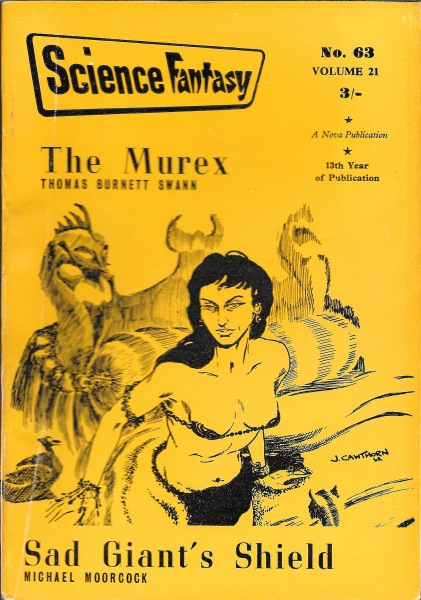
The third and final story in the collection, “The Murex,” was published in the February 1964 issue of Science Fantasy, just a few months after “The Dolphin and the Deep” appeared there. It was Swann’s first story in a magazine to receive a cover illustration (and, unfortunately, a really bad one). “The Murex” appeared alongside a J.G. Ballard story and an early Elric story by Michael Moorcock. After the medieval interlude of “The Manor of Roses,” “The Murex” returns us to Swann’s more typical haunt: the ancient Mediterranean.
On the island of Aegina we are introduced to Daphne, one of a small cohort of Amazon warrior women. These are not the Scythian Amazons of Homer, but a group of women who fled the abuses of ancient Greek patriarchy, whether they are survivors of domestic violence, child marriage, or, like Daphne, infant exposure. They are led by Gorgo, who rescued many of these women and who reads at times like a caricature of a misandrist, though her and the other Amazons’ feelings toward men are, for the most part, presented sympathetically. The Amazons live in the woods separate from the people of Aegina, devote themselves to outclassing men in the art of war, and have sworn to remain celibate like their goddess Artemis. They also keep a one-eyed bear chained up so they can sacrifice (male) victims to him for their goddess’s favor. Under Gorgo, the women strictly police one another to erase any sign of femininity from their lives and persons by shaving their heads, rejecting feminine clothing, eschewing jewelry, and condemning sexuality (hetero or queer). By embracing masculinity and men’s activities, the Amazons reject their prior status as women subject to men’s authority (and thereby reduplicate the disciplinary function of masculinity within a patriarchal society).
The crux of the story is the Amazon’s antagonism toward the Myrmidons. These are also not Homer’s Myrmidons, but ant-boys: prehumans who look human, except for their small wings and antennae (like Swann’s other instectoid prehumans, such as the bee-like Thriae, they are more human than insect), and who live in underground nests, where they milk giant, cow-like aphids and sculpt clay figurines to trade for food. In so describing his Myrmidon, Swann plays on Ovid’s later interpretation of Greek myths, which explained that the Myrmidons had once been worker ants on Aegina, but were transformed into men by Zeus. By pitting the Amazons against the Myrmidons in this story, Swann also nods to the Homeric conflict between the two groups during the Trojan War, when the Myrmidons’ leader Achilles slew the Amazon queen Penthesileia. Swann recasts that conflict in “The Murex” by pitting the Amazons, in all their rejection of femininity in favor of masculinity, against the ant-boys, whom the Amazons consider abjectly effeminate on account of their slight builds and lack of interest in warfare. The Amazons seem more disgusted by the ant-boys’ pathetic failure at being men than they are by human men themselves.
One day at the market, Daphne spies some ant-boys returning home to their maze-like mounds. She gathers her sisters and they launch a cruel attack on the ant-boys, whom they expect will cower and give up their treasures, but instead the Amazons are routed, defeated, and ousted—all without being harmed by the shockingly powerful ant-boys and their underground traps. In the battle, Daphne meets one of the ant-boys, Tychon, who seems amused by the Amazons’ efforts and chides Daphne for having earlier crushed a (small, actual) ant nest out of sheer spite: “They help the farmers by turning over the soil,” he says. “They destroy the termites that nibble the columns of the great megarons [in the city]. They work hard and bother no one. Can you say the same?” (129). The Amazons’ defeat, paired with Tychon’s observation of her behavior, create a crisis of identity for Daphne, who begins to understand that violence, power, and cruelty might not be the most just response to a harsh and unjust world. Through small observations of the ways Gorgo disciplines the Amazons for purportedly being too feminine, vain, or wanton—all misogynist claims made by men (and women) to discipline women under patriarchy—Daphne comes to question her allegiances and the righteousness of the Amazons’ cause.
And, of course, because this is Swann, Daphne falls in love with Tychon after just a few encounters—and he with her. But this is too great a betrayal for Gorgo, who tries to make of Tychon a sacrifice to Artemis. Things go awry, the ant-boys intervene to free their brother, and Daphne goes to live with the ant-boys. But Daphne still has to contend with her deeply ingrained fear of love, desire, and intimacy, inculcated through years of social discipline. As a courtship present, Daphne is gifted the ant-boys’ treasure: the gown, jewelry, and makeup of a long-dead Egyptian queen, once worn by the ant-boys’ mother (who was captured and killed by human raiders, perhaps like those who sacked Circe’s Knossos in “The Dolphin and the Deep”). After seeing herself as beautiful for the first time in her life, Daphne embraces her femininity, puts on the raiments of the long-dead queen, and gives in to her desire to love Tychon. But, in a final (and humorous) twist, she learns that because the ant-boys are, well, ants, she is marrying not just Tychon, but all of them; she will be their gyne, their queen ant. In this moment, she sees that the ant-boys do not lust for her—that being the only emotion she was taught men had toward women—but, rather, they express the pure love that can only come from the Goddess. The story ends with her embracing her “beloved husbands” (160).
Like “The Dolphin and the Deep,” “The Murex” is a story that really wants to say smart things about gender. Although it more clearly addresses issues of gender identity, oppression, and violence than the collection’s title story, it is also, in its attempt to be so direct, a much more bumbling and yet more ambitious take on femininity, masculinity, and responses to misogynist violence. With the hindsight of having read almost every work of fiction he wrote, barring a handful of short stories, I do get what Swann is going for in “The Murex.” Swann is deeply committed to the idea that people have (or express) both biological sex (i.e. men and women) and social gender (i.e. masculinity and femininity), and that these two categories do not need to align (i.e. men and masculinity vs. women and femininity). For the most part. Men can be feminine and masculine. Men can be gay or bisexual. Hell, even women can be gay or bisexual. But in Swann’s fiction women shouldn’t be masculine (and are after punished or mocked for being so). In his view, because women represent the Goddess, they therefore embody the Goddess’s “natural” affiliation with femininity, and therefore a feminine woman is the embodiment of the greatest good there is and is an avatar of love. This complex but questionable formula for gender and sexuality derives, I think, from Swann’s own obviously complicated feelings about men, masculinity, and men’s sexuality. He clearly admires men and masculinity, is even attracted to them, but all of his fiction points to the idea that women and femininity are, in some serious way, superior.
To read the novella in this slightly convoluted context, then, “The Murex” is about what happens when men distort what Swann articulates as the originary, “natural” egalitarian harmony of gender relations, oppressing women to such a degree that—like the Mandrakes, who have become barbarous after centuries of oppression—some women resort to the unnatural (i.e. masculinity, in Swann’s formula) in order to regain their power. But the gender non-conformity of the ant-boys, whose embrace of femininity is perfectly fine within Swann’s schema, defies the Amazons’ rigid association of masculinity with power and therefore social value, and ultimately demonstrates to Daphne that she does not have to sacrifice what is the greatest good and, in Swann’s view, her natural prerogative—femininity—in order to have value or to be powerful. Indeed, femininity is, as much for Swann as for the ant-boys, the greater power. In this understanding, the Amazons of “The Murex” are the ultimate expression of heteropatriarchy, for they express a rejection of the greater good (femininity) in favor of the unnatural, oppressive force of masculinity, and they only do this because they have learned to devalue femininity because of the violence of misogyny. But Swann’s presentation of the Amazons comes across, ultimately, as misogynist—even if his critique of them is in service of a larger critique of misogyny itself.
Simply put, Swann’s gender politics are peculiar, vaguely but not exactly feminist, certainly queer, and, in their worst and clumsiest expression (as here), they can be obtusely difficult to parse. “The Murex” is a bumbling story, for all its critical aspirations, even if it does reveal an early attempt by Swann to express some of his more interesting ideas about masculinity and femininity under conditions of heteropatriarchy.
Parting Thoughts
The Dolphin and the Deep is a strange and uneven collection showcasing some of Swann’s earliest sff work. Its greatest value is in reprinting “The Manor of Roses” in its best form, before it was awkwardly shoehorned into The Tournament of Thorns to the detriment of the story. “The Dolphin and the Deep” is memorable only for its final, poetic pages, and “The Murex” is an ambitious story that shows how Swann’s unique vision of gender and sexuality can so easily be undermined by weak execution (this is something we see in some of his worst novels, most clearly in Green Phoenix, which also rather nonsensically pairs an almost radical feminist critique with a misogynist frame).
The Dolphin and the Deep is held together thematically by each story’s exploration of gender and sexual identity and the bridging of (often multispecies) differences through love. That said, “The Manor of Roses” feels like the most awkward fit here, but perhaps that’s because I’d prefer the collection had either featured stories all set in the ancient Mediterranean or that it had collected stories from vastly different times and places. In any case, The Dolphin and the Deep is a decent trove of Swann’s early work. The stories show him experimenting with the major themes, ideas, narrative strategies, and character types that would animate the rest of his career. But, of course, that means that what shines in these stories—with the exception of “The Manor of Roses”—can be seen shining brighter elsewhere in Swann’s oeuvre.
To get notifications about new essays like this one sent directly to your inbox, subscribe to Genre Fantasies for free:

 Genre Fantasies