Where Is the Bird of Fire? by Thomas Burnett Swann. Ace Books, 1970.
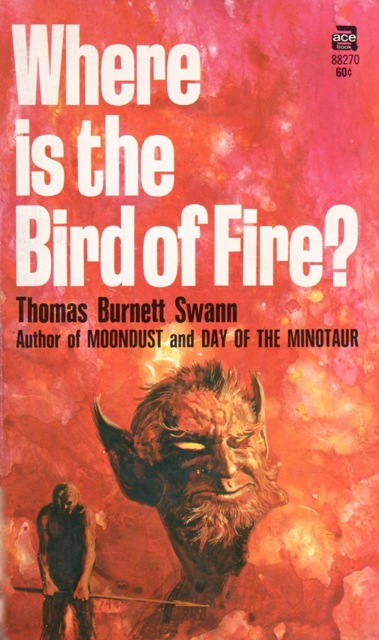
Table of Contents
Swann’s Second Story Collection
Reading “Where Is the Bird of Fire?” (1962)
Reading “Vashti” (1965)
Reading “Bear” (1970)
Parting Thoughts
Swann’s Second Story Collection
Although Swann is best known for his 16 novels—especially Day of the Minotaur (1966), How Are the Mighty Fallen (1974), and Lady of the Bees (1976), the last of which is among his best novels, and, along with Swann’s lesser-known Wolfwinter (1972), is also among the best fantasy novels of the 1970s—he also wrote about a dozen pieces of short fiction, mostly novelettes and novellas published in the 1960s, and he collected half of those in two collections published early in his career: The Dolphin and the Deep (1968) and Where Is the Bird of Fire? (1970).
Swann’s first collection was uneven and mostly forgettable, with the exception of the second story, “The Manor of Roses,” which is easily one of Swann’s strongest pieces. Where Is the Bird of Fire? is similarly uneven but on the whole a stronger collection, with (in order of their appearance in the book) one incredible story, one very good one, and one fine but altogether forgettable one. Where Is the Bird of Fire? is a good showcase of Swann’s writerly skill and his thematic preoccupations. The collection is named after Swann’s story of the same name, a novella published in the April 1962 issue of Science Fantasy. In many ways, the novella “Where Is the Bird of Fire?” put Swann on the map: it garnered his first Hugo nomination and probably paved the way for the editors at Science Fantasy to take chances on longer works, such as the 1964–1965 serialization of “The Blue Monkeys,” which was fixed-up a year later into Swann’s first novel, Day of the Minotaur.
Where Is the Bird of Fire? is, then, something of a celebration of Swann’s early, shorter writing at a time when his work was increasingly moving toward novels. Swann only published four stories after this collection appeared in 1970, and one of those was a prequel to “The Manor of Roses,” with which it was later fixed-up to create the rather mediocre novel The Tournament of Thorns (1976). That Swann turned more fully to novels is unsurprising, given that they made him more money and, frankly, his stories were better as novels. Swann’s best novels were his longer ones (even if he rarely wrote more than 200 pages); the extra pages gave him the space to unfold the deep emotional connections and interpersonal dynamics that made Swann stand out among his cohort of early genre fantasy writers, and novels proved a far better fit for his complex, sometimes ridiculous worldbuilding.
The seeds of Swann’s strengths as a writer are seen sprouting in Where Is the Bird of Fire? These are stories of love and death, of meeting and parting, of demigods and witches, of Rome’s founding and Xerxes’s empire. It’s a fine collection for anyone who wants to dip into Swann’s writing, worlds, and themes without committing to a single novel. And it also has one of Swann’s best covers—a moody, fire-colored painting by John Schoenherr that shows the eerie visage of Sylvan the Faun and, abstracted to his left, a dejected Romulus, referencing the climactic events of the collection’s title story.
Reading “Where Is the Bird of Fire?” (1962)
Published in April 1962, “Where Is the Bird of Fire?” was Swann’s third work of short fiction published in the British magazine Science Fantasy under the editorship of John Carnell (an important precursor to Michael Moorcock’s influence on British sff). It was nominated for the 1963 Hugo award for short fiction (as the category was then known). Just four years into his career as an sff writer, after the 1958 publication of his first story, “Winged Victory,” the Hugo nomination put Swann in the company of Jack Vance (the winner), Fritz Leiber, and Theodore Sturgeon—it got him noticed.
Had I not started my journey with Swann with Lady of the Bees, his finest novel, a subtle critique of imperialism brimming with unrequited queer desire, expressing so elegantly Swann’s ideas about “gentle” masculinity and the enduring power of love beyond death—had I not started, propitiously, there, I probably would react more strongly to the original novella that was the kernel for that incredible novel. But as it stands, it is nigh impossible for me to read “Where Is the Bird of Fire?” without the larger context; it feels too short, like it’s missing some key ingredient, and is neither as impressive nor as deep a work as that later novel. But despite my personal hang ups, it is still an incredible novella.
“Where Is the Bird of Fire?” is Swann’s retelling of the mythic founding of Rome by the she-wolf-suckled twins Romulus and Remus, grandchildren of the deposed king Numitor of Alba Longa, one of the settlements of early Latium founded by Ascanius, son and heir of Aeneas (both men feature in later Swann novels, which act as prequels to Lady of the Bees: Green Phoenix [1972] and Queens Walk in the Dusk [1977]). This story is told from the perspective of Sylvan, a Faun rescued by Remus from his violent twin. It is a story that juxtaposes the gentle masculinity of Remus—which embodies qualities of justice, fairness, ecological balance, love, and friendship—with the hard-edged masculinity of Romulus—which embodies, with brutal simplicity, the adage that might makes right. Like the later novel it was expanded into, “Where Is the Bird of Fire?” ends in tragedy: in a moment of rage over his lover’s rape and murder by one of Romulus’s cronies, and angered by Romulus’s lies, Remus calls for justice but is accidentally killed when Romulus, pissed that his brother would challenge him and threaten the ritual that blesses the building of their new city’s walls, hits Remus with a shovel a little too hard. Rome is born in blood, Swann’s story tells us, its gentleness snuffed out with the very tools used to lay its foundation.
The key difference between “Where Is the Bird of Fire?” and Lady of the Bees is that the former is told only from Sylvan’s perspective, while the novel fills out the story with the alternating perspective of Mellonia, one of the last Dryads, once the lover of Aeneas, now the lover of his descendent Remus. Mellonia is here in “Where Is the Bird of Fire?” but her perspective is gone, and this makes for a much poorer story, for Swann writes brilliantly (and tragically) when he writes from Mellonia’s perspective, and the story thus lacks a clear sense of a natural relationship between Remus and Mellonia. In “Where Is the Bird of Fire?,” their relationship, Mellonia’s offer of aid in the battle for Alba Longa, and even her death, are all rushed, mostly related between scenes, and the narrative occasionally jilts awkwardly forward in time with little explanation of what has developed between Mellonia and Remus. For the extra time Lady of the Bees gives us in this world, the novel is therefore, unsurprisingly, a better, fuller, and more tragic glimpse into the doomed love of Mellonia and Remus, and the conflict between Remus and Romulus; it also includes weird elements as well, such as Mellonia’s voyage to the land of the Telchines; and it provides an explanation of how the twins were saved by the wolf Luperca (and Mellonia herself).
But, as it stands, “Where Is the Bird of Fire?” provides a pointed critique of violence, power, and masculinity, and, when it appeared in 1962, it was no doubt a revelation: here was a writer who could do what Mary Renault was doing, but without losing the magic of the ancient myths.
Reading “Vashti” (1965)
The second story in the collection, “Vashti,” continues to show Swann’s uncanny ability to infuse ancient myths and stories with new ideas, to essentially reinvent them in the endlessly expanding mythology of his prehuman storyworld. “Vashti” was originally published in Science Fantasy in May 1965, after Kyril Bonfiglioli took over the magazine’s editorship from Carnell; it was also Swann’s final piece in Science Fantasy, as his short fiction from 1966 onward was generally published by the American magazine Fantasy and Science Fiction.
“Vashti” is a story that I really wish Swann had returned to and expanded, like he did with “Where Is the Bird of Fire?” (though, who knows, it could have gone the way of “The Manor of Roses” and its fix-up, The Tournament of Thorns!). It is, in the loosest sense possible, a retelling of the Judaic Book of Esther—a retelling in which Esther never appears, Vashti is the main character, and Haman hasn’t begun to plot genocide. Most of Swann’s fiction drew on Greco-Roman myth and history, and to a lesser extent Celtic, Hebraic, and ancient Egyptian sources as well. “Vashti” takes its title character and its interpretation of events from a Hebrew text, but everything else is pulled from Zoroastrianism and Swann’s own spin on the Zoroastrian sacred text, the Zend Avesta, while the protagonist, Ianiskos, references a Greek demigod, the child of the healing god Asklepios. It is a rich text for source criticism and one of Swann’s most interesting uses of non-Greco-Roman narratives.
The story is told from the perspective of Ianiskos, a man of intellect and a respected healer “trapped” in the body of a six-year-old child; he calls himself a dwarf and much is made of how he is treated like a child for his stature. But Swann’s language is careful and he repeatedly refers to Ianiskos as having a child’s body, even if Ianiskos thinks of himself as a dwarf simply because he has no better explanation for what he is. He has no memory of life before he woke up in the captivity of a Greek slave trader, was bought by a Greek philosopher, earned his freedom, and then traveled to Persia to become the court healer of the empire’s kindly ruler, Xerxes. But Xerxes is not so kindly as to suffer a Jinn to share his bed, and he is driven to suspect that his wife, Queen Vashti, is a Jinn when his majordomo Haman asks if Xerxes has ever seen Vashti fully nude (he hasn’t). Xerxes demands Vashti appear naked before his dinner party and she refuses. Vashti is exiled and flees back to her home at Petra, among the Nabataeans. Ianiskos follows her, feeling some kinship with her strangeness, and some draw to the Red Lands she calls home. After several mishaps, including an encounter with a half-dozen lonely Jinn children, Ianiskos finds Vashti, who promptly sacrifices him to a sacred tree, which in Swann’s telling is the size of a ship, shaped like an anemone, and has a devouring mouth that gobbles up the man-boy. But Ianiskos is reborn from the Tree as a man, its final fruit, and he is reminded by Vashti (also born from the Tree) of his real name—Tishtar (the Zoroastrian star-god)—and his purpose on earth: to fight Ahriman, the eternal enemy of the one true god, Ahura Mazda.
“Vashti” is a whirlwind of a story that mixes Zoroastrian, Judaic, and Greek myth with Swann’s own wild (re)imaginings of these stories. Vashti, for example, only appears in the Judaic Book of Esther, which is believed not to be historical but almost entirely fictional; there, the Persian king is named Ahasuerus, a name thought to be the Hebrew transliteration of either Xerxes or Artaxerxes; the story of Vashti being asked to appear before Xerxes/Ahasuerus nude is taken from Midrash interpretations of the Book of Esther, which provide an explanation for why Ahasuerus needed a new wife. But what’s most impressive and interesting is Swann’s weaving of Zoroastrian myths into this Judaic story, with characters discoursing at length of Zoroastrian beliefs and philosophy. The Tree that gives birth to Ianiskos is Swann’s spin on a later Zoroastrian folk belief that the sacred haoma plant was involved in the (perhaps miraculous) conception of Zoroaster; but in Swann’s telling the Tree is the method through which the star-gods are (re)born onto the mortal plane in order to fight in Ahura Mazda’s war against evil. The fruit Ianiskos had initially grown in was plucked by the agents of Ahriman before he was fully ripe, and then lost in the desert, rendering him a child with the knowledge of a god; he had to be fed back to the Tree so he could ripen.
“Vashti” is a strange, compelling story. For most of it, it’s unclear what is happening, but this is the experience of many of Swann’s better tales, which come together in a final moment of revelation. “Vashti” is hard to forget.
Reading “Bear” (1970)
The final story is “Bear,” which is also original to Where Is the Bird of Fire? It is, frankly, a bit of a letdown after the heights of the previous two stories.
The novella is set in 409 CE in what is now (and also, in the story, inexplicably) called Lydney in the final days of the Roman occupation of Britain. The story is related through the diary entries of a Celtic druidess, Deirdre, and her “minion,” Andreas, and narrates Deirdre’s efforts to woo the Roman merchant Marcus with her magic—but she needs a familiar to complete her love spell so that Marcus will marry her and cart her off to Rome (Britain has gotten too dangerous, what with all the Saxons pillaging and burning), and so she goes in search of a beaver. But she finds, instead, a Bearon. This prehuman is new to Swann’s storyworld and never seen again, but Swann describes Bearons as what happens when a human lives an immoral life and so is reincarnated, as a punishment, in a body that has some features of an animal: this Bearon, inventively nicknamed Bear, has a tail and bear paws. His immoral act? He was a timid poet.
The story is mostly a domestic farce that alternates between Deirdre’s bombastic, self-aggrandizing view of herself, the world, and her position in the world, and Andreas’s to-the-point statements that reveal just how out of touch Deirdre is. In the end, after a tour of a beaver’s cozy den and a battle with otter-like Shellycoats, Deirdre casts her spell and gets her proposal from Marcus, but not without having deviously tricked Bear into believing she can magic away his bear paws and tail, so he can run off with Andreas to join the Roman legions (yes, there’s a good deal of queer insinuation throughout! Swann imagined a lot of muscular, gentle, bear-like men…). But Deirdre lied, of course, and her innocent sleeping draught ends up killing Bear. But, distraught by her actions, she sacrifices what little true magic—the Ultimate Amulet—she has and abandons the promise of her life in Rome with Marcus to cast a spell that will bring Bear back, this time as a human and not a Bearon. And the novella ends with the revelation that the spell from her Ultimate Amulet stored Bear’s soul in a fetus now growing in Deirdre’s pregnant belly.
That’s two stories in a row that end with the rebirth of a righteous soul in a new, “better” body, and three stories in a row that promise the fulfillment of life’s dreams and desires beyond death. Swann was nothing if not deeply personal in his stories. Still, “Bear” is not a great story, not even a good one, but it is weird and occasionally funny, a wacky mix of the domestic, the mythic, and the ribald—but in uneven quantities that show the negative effects of what can happen when Swann gets the balance of his elements wrong.
Parting Thoughts
Where Is the Bird of Fire? is a much more impressive story collection than its predecessor, The Dolphin and the Deep; it shows greater range, imagination, and play, and even the worst story of the bunch is better than both “The Dolphin and the Deep” and “The Murex.” What holds Where Is the Bird of Fire? together is each story’s insistence that love transcends time, space, and even death, and that love comes in many forms: that between lovers, brothers, and friends (with acknowledgement that the boundaries between those categories is obviously fluid), between leaders and their subjects, and between (surrogate) mother and her (surrogate) children. Perhaps if Swann had switched out “Bear” for “The Manor of Thorns,” this might have been a collection of stories to rival some of his best novels. But for what it is, Where Is the Bird of Fire? is an impressive, adventurous, and inventive story collection that shows the range of this truly incredible author.
After more than a year reading Swann, this is the last of his books I will ever read anew. I have now read all of Swann excepting a few uncollected short stories. It has been a journey—and I’ve been so very glad to have been on it. Someday, I expect, I’ll return to Swann again. But for now, I hope the collection of essays I’ve written here, on Genre Fantasies, and over at Los Angeles Review of Books, will be a fitting testament to a writer in need of greater attention and rediscovery.
To get notifications about new essays like this one sent directly to your inbox, subscribe to Genre Fantasies for free:

 Genre Fantasies
With regards to Swann, you mention “a few uncollected short stories.” Any thoughts towards collecting them?
LikeLike
The uncollected stories of his that I have read are not very good with the exception of “The Night of the Unicorn” (1975), which is probably one of the best things he ever wrote and worth tracking down. It’s collected in a number of anthologies from 1970s and 1980s. But I don’t think anyone will collected Swann’s uncollected stories because they’re so uneven and mostly pretty blah. I’d rather see a publisher brings some of his better novels back into print!
LikeLiked by 1 person