The Wood Beyond the World by William Morris. 1894. Ballantine Books, July 1969.
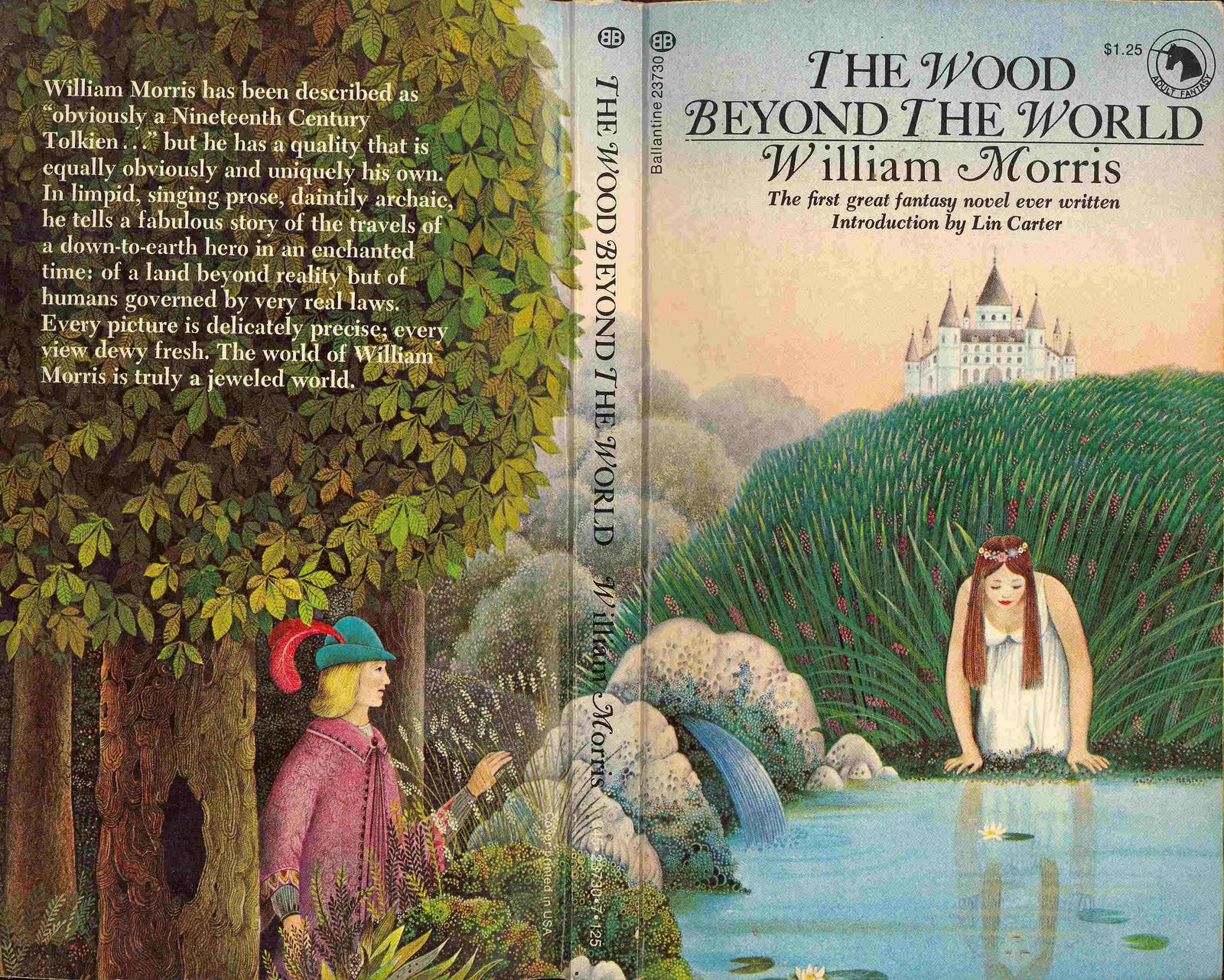
This essay is part of Ballantine Adult Fantasy: A Reading Series.
Read Lin Carter’s introductory essay here.
Table of Contents
William Morris and His Times
On the Messiness of Literary History
Reading The Wood Beyond the World
An Invented World?
Gender, Power, and the Wood
Of Bears and Kings
Parting Thoughts
William Morris and His Times
The English writer, poet, architect, designer, artist, printer, antiquarian, translator, and socialist William Morris (1834–1896) is one of the Big Names of early, pre-Tolkien fantasy alongside Lord Dunsany, E.R. Eddison, George MacDonald, and to a lesser extent James Branch Cabell. Like the others, Morris was canonized in the annals of fantasy by early fan historians and editors, notably Lin Carter and L. Sprague de Camp (in large part based on what they most valued in fantasy fiction, rather than on the breadth of actually existing fantasy), and four of his books appeared in the Ballantine Adult Fantasy series: The Wood Beyond the World (1894; BAF 3, Jul 1969), The Well at the World’s End (1896; published in two volumes as BAF 20–21, Aug–Sep 1970), The Water of the Wondrous Isles (1897; BAF 38, Nov 1971), and The Sundering Flood (1897; BAF 57, May 1973). For BAF’s consulting editor Carter, Morris was unequivocally “the man who invented fantasy” (xv) and The Wood Beyond the World, republished as the third BAF volume, was “the first great fantasy novel ever written: the first of them all” (ix). I’ll return to those exceptional claims later, but Morris’s significance cannot be understated: he not only influenced Dunsany and Eddison, but also J.R.R. Tolkien, C.S. Lewis, H.P. Lovecraft, Clark Ashton Smith, and Fletcher Pratt, all of whom played a major part in defining the shape of genre fantasy in the first half of the twentieth century.
Morris is also widely cited beyond fantasy, where he is a familiar name among scholars of utopian fiction, science fiction, and Victorian art, as well as historians of socialism, anarchism, the book, medieval literature (especially Chaucer and the Icelandic sagas), the arts and crafts movement, and much more. That Morris is well-known among so many fields of study is the result of a rather astounding life lived at the heyday of the Victorian period, during which time Morris proved himself capable as an artist, intellectual, businessman, political theorist, orator, and writer of modestly popular poetry and prose romances. Of all the early writers of pre-genre fantasy aside from Tolkien, has perhaps the long bibliography of critical literature devoted to his life, writing, and art. His biography is easily accessible in multiple volumes offering different approaches to Morris and his legacy from socialist, anarchist, feminist, and other perspectives. But a few highlights of his biography will put The Wood Beyond the World and the other BAF volumes by Morris into useful perspective.
Morris’s life coincided almost exactly with the timespan of the Victorian period (c. 1837–1901). He was born into a wealthy family in 1834; his father a financier who owned major stock in a Devonshire copper mine, which sustained the family and Morris’s education after his father’s death in the 1840s. Morris became interested in British history and myth at an early age through the writing of Walter Scott and was attracted to Romanticism in his teen years. He attended Exeter College at Oxford in the 1850s, studying Classics, architecture, and medieval history, culture, literature, and art. Medievalism remained a dominant force in Morris’s life, influencing his paintings, interior design, architecture, handcrafts, writing, and politics. He was influenced by Christian socialism, grew disdainful of Victorian industrial capitalist modernity, and desired a return to (what he and others imagined as) the utopian labor practices of the Middle Ages. In literature and art, he took his cues from John Ruskin, John Keats, the Romantics, and the Pre-Raphaelites and by the end of the 1850s he was an accomplished architect, producing neo-Gothic buildings through his London firm, and he also befriended and painted alongside Dante Gabriel Rossetti. The two remained close and Rossetti carried on a well-known, prolonged affair with Morris’s wife, Jane Burden.
Throughout the 1860s and 1870s, Morris designed and built multiple buildings, including the famous Red House, painted, produced volumes of poetry and prose, designed and printed wallpaper, learned Norse and co-translated Icelandic sagas into English, experimented with hand-made textile production, and much more. His creative output was exuberantly diverse. Over the course of the late 1870s, Morris became deeply involved in the radical wing of British liberalism but, by 1881, he rejected liberalism in favor of socialism, joined the working-class group the Radical Union, and by 1883 was a member of Britain’s first socialist party, the Democratic Federation (later Social Democratic Federation). Morris and others ultimately broke with the SDF over the group’s increasingly reformist and pro-imperialist direction, founding the Socialist League in 1884 in an effort to establish a more revolutionary, anti-capitalist, and anti-imperial basis for socialist activism in Britain. Among his activities in this period, Morris famously delivered a speech entitled “How We Live and How We Might Live” up and down Britain throughout 1884–1887; the speech was later serialized in the Socialist League’s weekly newspaper, Commonweal, which Morris oversaw production of (and financially backed) from 1885 until his prolonged break from the League c. 1888–1890. That break was occasioned by the growing discord between Morris’s anti-parliamentary socialist faction and the radical anarchist faction, the latter of whom eventually won out.
In the wake of his split with the Socialist League, Morris continued to be politically involved with groups like the Hammersmith Socialist Society and he financially supported leftists prosecuted by the state, but the bulk of his activities in the 1890s until his death in 1896 were literary. He founded Kelmscott Press in 1891 as an outfit for artistic, intricately designed, hand-printed small-run books, including editions of Chaucer and Beowulf. He was offered the position of Britain’s Poet Laureate following Tennyson’s death in 1892, but turned it down for political reasons. And, most importantly for our purposes, he published the books that are often called his “late prose romances,” eight novels that are historical, fantastical, and medievalist to varying degrees but which collectively played a significant role in defining Morris’s relationship to the modern fantasy genre that would develop in the decades after his death: The House of the Wolfings (1888), The Roots of the Mountains (1889), The Story of the Glittering Plain (1890), The Wood Beyond the World (1894), Child Christopher and Goldilind the Fair (1895), The Well at the World’s End (1896), The Water of the Wondrous Isles (1897) and The Sundering Flood (1898) (the latter two were published posthumously by his daughter and literary executor, May Morris). During this period, Morris also published what is likely his most famous work, the utopian novel News from Nowhere (1890).
This gloss of Morris’s life and career offers just a glimpse at how much Morris did and achieved, but should provide necessary and useful context for understanding Morris’s significance to several spheres of influence, including and especially fantasy and socialism. It should also make clear the profound interrelation between his literature, his politics, and his medievalist or antiquarian perspective. Unfortunately, fan-critics like Carter and de Camp largely overlook his politics in their analysis (such as it is) of his work, whereas Marxist scholars of utopia and science fiction tend to focus on News from Nowhere but wind up confused by his romances, which they tend to read as reactionary (insofar as most such scholars tend to read all of fantasy, rather wrongheadedly, as a conservative literary form; for some context and background to my comments here, see the “No Gods, No Masters” section of my essay on Mervyn Peake’s Gormenghast). In general, it’s the Victorianist and the scholars of socialism and anarchism who produce the strongest and most thought-provoking work on Morris, who grapple best with the rich complexities and contradictions of his life and literature.
For those who want to read more about Morris, I would suggest the work of E.P. Thompson, Ruth Kinna, Phillippa Bennett, Lori Campbell, and James Gifford. In my own reading below, I will largely respond to James Gifford’s critique of The Wood Beyond the World in A Modernist Fantasy (2018), which helpfully draws on and condenses the work of these other scholars. The interrelation among genre, politics, and medievalism in The Wood Beyond the World will be central to how I think about this novel, its place in fantasy’s history, and the critical responses to it by other scholars. To be totally transparent, though, I find myself in an odd situation where I don’t like this novel very much and I don’t like most of the critical writing about it, either. Such ambivalence is, hopefully, productive!
But first, a necessary aside on Morris and the “invention” of fantasy.
On the Messiness of Literary History
In Carter’s influential but rather misguided view, fantasy—which he sometimes named more specifically as “heroic fantasy,” depending on which term best suits his argument—stemmed from Morris and everyone worth considering a Father of Fantasy was influenced by him. Carter’s narrative of the history of fantasy, which he first expounded in Tolkien: A Look Behind The Lord of the Rings (1969) and repeated in both his introduction to The Wood Beyond the World and his later study, Imaginary Worlds (1973; BAF 58), told of a developing tradition that grew up from ancient epics, was transformed by medieval romance, and was ultimately ended by the dual death strokes struck by the “failure” of Edmund Spenser’s The Faerie Queen (1590–1596) and the “bravura lampoon[ing]” of the medieval romance by Miguel de Cervantes in Don Quixote (1605–1615) (Carter’s introduction, xi). After that, in Carter’s telling, for nearly 300 years the fields of fantasy lay fallow until Morris appeared and, “almost as an afterthought, he invented the fantasy novel” (xii).
This is, of course, simultaneously a gross oversimplification of literary history, an overstatement and decontextualization of Morris’s writing of prose romances (both within his own oeuvre and his larger literary contexts), and an incredibly silly—if vivid and rhetorically effective—way to tell the history of any cultural phenomenon. But Carter’s narrative of fantasy bursting out of nowhere from the singular genius mind of William Morris, which was echoed by L. Sprague de Camp in his own history of fantasy, Literary Swordsmen and Sorcerers: The Makers of Heroic Fantasy (Arkham House, 1976; the book was based on essays published between 1961 and 1976), proved highly influential and today most histories of fantasy take Morris, understandably, as a jumping off point for discussing the “modern” history of the genre. There is some good sense in this, as Morris’s romances were undoubtedly influential and they were certainly unique, though they were not so singular as to be without precedent or context.
Part of the popularity of Morris’s position in most histories of fantasy is due to the simple need for a starting point, a place to begin telling the history of fantasy, locating it in modernity, and bridging the distance between, on the one hand, all those ancient, medieval, and early modern things that seem to be vaguely relevant to fantasy and, on the other hand, fantasy proper as we came to know it in the twentieth century. Further, Morris’s own disavowal of industrial capitalist modernity, his embrace of medievalism as a solution to the problems of modernity, and his ethical orientation toward art made in the mode of medieval craftsmen all help to tell a clear story of fantasy emerging out of the dissatisfaction with a modernity that we find familiar (that is, the London of the 1890s was infinitely more intelligible to the modern reader of the 1960s, whose grandparents would have been Victorians, than the London of the Romantics in the earlier half of the same century). Morris thus emerges as an obvious and useful example for the argument that fantasy as a modern genre (as opposed to an ahistorical one stretching back to the beginning of human storytelling) is a critical response to modernity, a practice of reenchantment, and so on.
Another reason for Morris’s centrality to this narrative is that Carter, de Camp, and others have argued that Morris was the “first” to write a heroic fantasy narrative set in an invented imaginary world—importantly, not a dreamland or an alternate dimension—where magic works. For Carter, The Wood Beyond the World is the first such story ever, although his colleague, friend, and occasional co-writer de Camp reads Morris’s 1891 novel The Glittering Plain as the first. But, as I’ll try to make clear in my reading of the novel in the section titled “An Invented World?”, echoing Jamie Williamson in The Evolution of Modern Fantasy, the world of Morris’s The Wood Beyond the World is a bit too ambiguously drawn to simply say it is, in the Tolkienian vein, a truly separate invented fantasy world—and certainly it doesn’t seem that Morris had in mind any such thing, for even his earlier historical romances, The House of the Wolfings (1888) and The Roots of the Mountains (1890), both ostensibly about the ancient Germanic past, have as tenuous a relationship to actual history as The Wood Beyond the World does.
The point here is that the search for a first, and specifically for the first invented world fantasy, is an ultimately futile endeavor and Carter’s efforts in this vein seem to come from a place wholly unfamiliar with the breadth of Morris’s own writing or that of his peers, let alone the diversity of the literary landscape of the Victorian period. Williamson even points out that some of Morris’s earlier short prose romances of the mid-nineteenth century are laid more clearly in invented worlds than The Wood Beyond the World is. More to the point, Williamson only gets to Morris on page 117 out of 199 pages of argument in which he shows the deep roots of fantasy in disparate strands of literary genealogy and antiquarian scholarship dating back to the eighteenth century. Carter’s search for a “first,” for an inventor of fantasy, works only from the limited perspective of looking backwards from Tolkien and asking “how did we get XYZ specific things?” and even then, by selecting Morris as the supposed origin of everything Tolkienian or heroic fantasy, the answers don’t totally fit—like Cinderella’s slippers on her stepsister’s feet.
As Williamson concludes:
To question [Morris’s] status as “the man who invented fantasy” is to question something he did not claim; the suggestion behind this study is that modern fantasy in the BAFS mode developed incrementally and that it was not created in a blinding flash by anyone. Though Morris’s romances ran in the face of conventional Victorian expectations for prose fiction, they were tied to Victorian (and earlier) literary phenomena nonetheless. (124)
Instead of “inventing” fantasy wholecloth after the death of an earlier, inchoate tradition some vague centuries before, Williamson suggests that we understand that what Morris did was “advance, rather than break with” the literary traditions that preceded him, especially those of the Romantics, the poetic fantasies of the early Victorian period (some of which he wrote), and of course the antiquarian traditions that revived medieval literature in the nineteenth century and which Morris contributed to, namely through his co-translations of Icelandic sagas (123). Morris’s Kelmscott Press demonstrates that he valued medieval literature as much as that of his literary compatriots, as he printed editions and translations of Chaucer, French romances, and Beowulf alongside work by Coleridge, Keats, Swinburne, and Tennyson, among others. It was in this milieu, nourished by the literary traditions of the distant past as well as by those of his (near) contemporaries, that Morris wrote his late prose romances. These were clearly anything but “an afterthought,” as Carter would have it, but instead a dynamic outgrowth of Morris’s ideas about literature (including his earlier work), his antiquarian scholarship, and his political beliefs.
Morris should be understood, then, as an important threshold in the history of fantasy and not, by any means, as fantasy’s inventor. No one can wear that mantle since there are too many strands informing what fantasy is, and fantasy itself is so capacious a genre, that no single text or person could fill that role. Fantasy developed incrementally, accruing disparate elements that were brought together in a process of genrefication by a set of actors (writers, editors, readers, critics) and market forces (publishers, advertisers, book sellers) and transformed over the course of the first half of the twentieth century, culminating in the critical years c. 1965–1977, into what we now know as genre fantasy.
BAF was obviously crucial to the process of fantasy’s emergence, as were Carter’s efforts to establish a canon and a history, going so far as to pinpoint an inventor of that history. Carter is right about Morris’s key role in fantasy’s development, given his clear influence on later writers, and he is right to see Morris’s novels as very much like fantasy works that came later, even if anyone reading Morris today will likely feel a gulf of difference between Morris and Tolkien. But Carter goes too far in claiming Morris as the genre’s inventor and in trying to locate that invention in a particular text. Despite the powerful rhetoric that Carter uses to establish Morris as the inventor of fantasy, which has clearly proved influential (as well as useful to the process of genrefication, to the story fantasy tells about itself), Carter’s claims elide everything messy and true and interesting about literary history, about Morris’s own oeuvre, and about the contexts he wrote in.
For a relevant example of the messiness of literary history, one need look no further than the history of the novel, a particularly apt example because it, too, is often claimed to have been “invented” by one person and one text, almost as if out of nowhere. Usually that person and text are given as Cervantes and his Don Quixote, but other names and texts are occasionally bandied about (e.g. Chariton’s first-century Callirhoe, Murasaki Shikibu’s eleventh-century The Tale of Genji, or Madame de La Fayette’s seventeenth-century La Princesse de Clèves) depending on what criteria for defining the novel—another thorny question—most concerns the person making such claims. As you can probably guess, both what the novel is and when it emerged don’t have easy answers, if they even have satisfying ones; but they might be some of the most fascinating questions in literary history, since they have everything to do with form, narrative, genre, and so on. To emphasize just how complicated the question of the history of the novel is, Margaret Anne Doody has surveyed the landscape in her cheekily titled The True Story of the Novel (1997)—a book that extends to over 600 pages. Notably, as in Williamson’s The Evolution of Modern Fantasy, Doody replaces simple narratives of invention by singular geniuses with a narrative that details the winding, complicated story of the emergence of a literary form from a collective of traditions, ideas, and practitioners.
Why settle for the dull simplicity of “invention” when we can revel in the complexity of tracing all that constitutes a literary form’s emergence? Of course, one can’t deal with all of literary history all of the time. After all, Doody’s book is 600+ pages. Sometimes historical narratives need to be simplified for rhetorical purposes or because of limited time/space, and that is totally understandable. Doing so can be argumentatively useful, too, especially when such simplification is bracketed as a temporary thought experiment (see James Gifford’s productive argument about taking Morris as a beginning of fantasy for the purposes of his study in A Modernist Fantasy), but one gets the sense that Carter deeply believed that Morris invented fantasy. I’ve hopefully shown why that might be a suspect claim (beyond the numerous inaccuracies and distortions of truth Carter so confidently crammed into his introduction). Carter’s claim about Morris and the invention of fantasy is not entirely wrong—in the sense that Morris is a convenient and useful marker of a shift from earlier work to something more like modern genre fantasy—but at best it’s a shallow interpretation of fantasy’s history (we know how boats fare in shallow waters!) and at worst it’s a misleading one (Williamson spends seven pages exploring the rhetoric of Carter’s argument about Morris’s place in fantasy’s history through careful readings of his novels, and one gets the sense that the preceding 100+ pages of Williamson’s book are, in some ways, context for those seven pages on Morris [117–124]).
My project with Ballantine Adult Fantasy: A Reading Series is essentially an extended, years-long exercise in producing a Doodyesque response to Carter and the wonderful project he spearheaded. Untethered by the limits of scholarly forms like the academic monograph, the journal article, or the public intellectual think piece, I strive to make this project one that takes the time and space it needs and that recognizes that literary history, like all literature and like all history, is messy. And even so, these essays and this blog are just one cog in the machinery of collective efforts to produce a more robust history of fantasy.
So let’s embrace the mess and turn to the novel that got us here, the novel Lin Carter believed started it all: The Wood Beyond the World. As a heads up, the structure of this essay is a little different than that of others, in large part because I wanted to do a section-by-section analysis of the novel, but that grew in the writing so that putting it all under the heading of the “Reading The Wood Beyond the World” section seemed a bit overwhelming. So I’ve broken the analysis up into three separate sections that follow my general introduction to the novel in the following section.
Reading The Wood Beyond the World
The Wood Beyond the World was the fourth of Morris’s late prose romances. Published just two years before his death, it appeared in a lavishly illustrated edition from Kelmscott Press in a small print run of c. 300 copies finished in late 1894. The edition included a frontispiece woodblock illustration of the Maid from a pivotal scene late in the novel; she is depicted as a willowy woman embodying the innocence, beauty, and grace of nature (as well as of an idealized form of the feminine), her body girt about by vines and flowers. The two-page spread that opens the book features woodblock designs of leaves and flowers surrounding the illustration of the Maid and the textblock of the first page. Red text in the style of medieval manuscripts’ incipits marks the chapter title, followed by two red flowers (repeated throughout after each chapter title/incipit). The first letter of the chapter’s text is presented as a large woodcut letter, like the illuminated initial of a medieval manuscript, with the shape of Morris’s “A” appearing as vegetal as the leaves that spring from it:
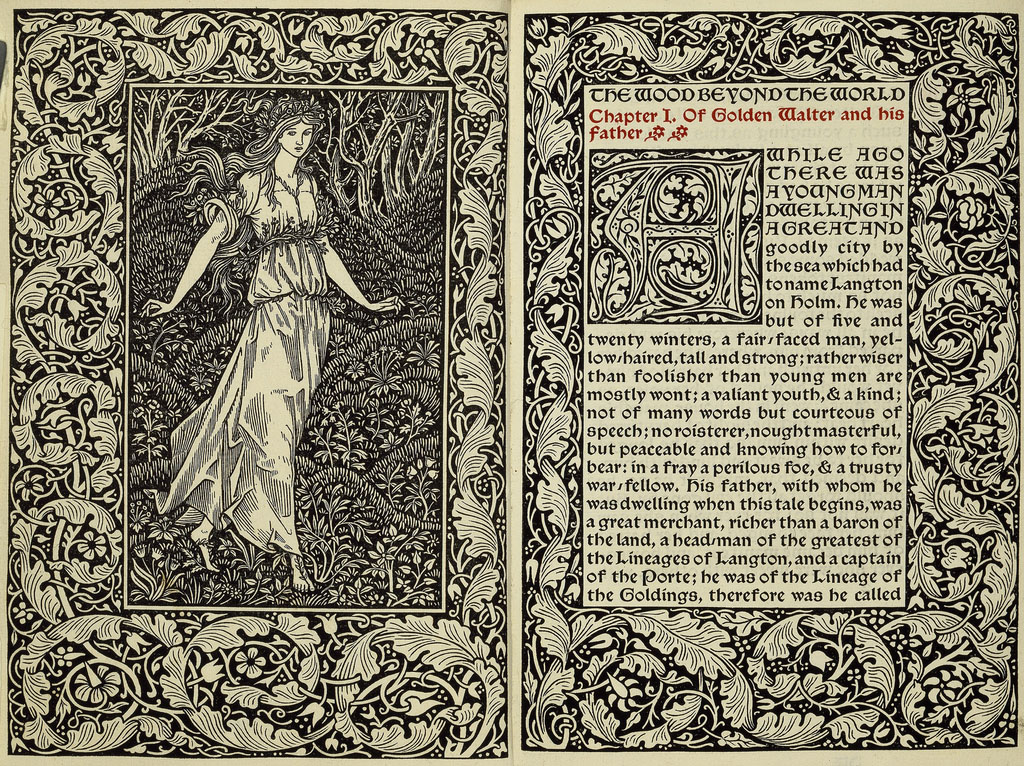
As one leafs through the book, the imagery of nature punctuates the reading experience. Each sentence is followed by a leaf, which acts as a punctuation mark in place of a period. Each new chapter is opened with a leafy illuminated initial and each paragraph with a smaller version. And the text block of each page on which a new chapter begins is surrounded by one of several repeating designs featuring vines, bushes, fruit, flowers, leaves, and more of nature’s bounty. The text flows on and on, winding its way through the metaphorical forest of Morris’s designs and symbolic intertexts, the Wood Beyond the World reaching its leafy textures onto the page, itself a material product of nature.
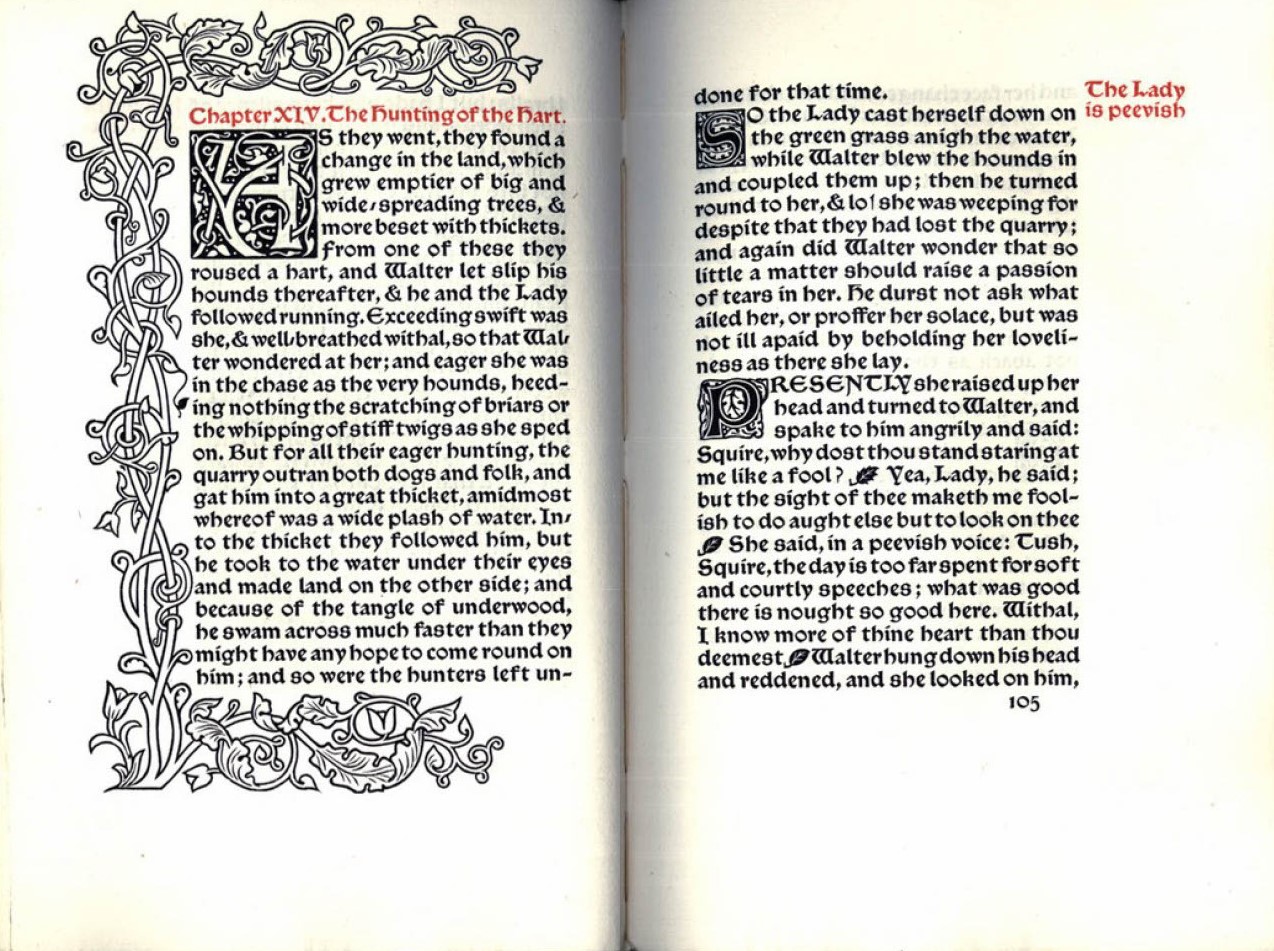
Visually, the book is clearly inspired by medieval manuscripts, with their illuminated initials, doodles, and marginalia reflected in Morris’s design elements. At the same time, Morris’s book is very clearly modern, using moveable type and woodblock printing. The design elements are handcrafted and carved for printing, yes, but each element is not individual, unique unto itself, but repeated through the book, and each is employed in a printing process that itself represents an epistemic shift or break between the medieval and modern. It is a wholly modern and industrial production, even if made in a way that, by the 1890s, seemed exceptionally old, slow, and laborious. But the labor is partly the point for Morris: the physical making of the object recovers it from the anonymous industrial production processes of the Victorian period, even if the process by which Morris created the book had more in common with mass print production of his day than with the hand-written manuscripts he was imitating. Morris’s book, like the archaic language through which he brought the story alive, is medievalizing rather than medieval. This is a distinction I borrow from Timothy S. Miller to mark the difference between the actual medieval and its imitations, but also to emphasize that Morris’s and others’ medievalisms are intended to produce an effect of the medieval, rather than being faithful recreations of the medieval. In this way, Morris’s The Wood the World and his other romances—in fact, most of his creative practice—was both decidedly anti-modern and at the same time, in the particulars of its anti-modernity, wholly modern.
Ballantine’s edition of The Wood Beyond the World is a less impressive material object than the original printing. Like most reprintings of the novel, it eliminates the design elements of the Kelmscott edition, including the frontispiece illustration of the Maid. Surprisingly, though, it does keep Morris’s marginalia headers, something absent from most other reprintings. These headers originally appeared at the top of each page in red text and gave a helpful gloss of events. This is an adaptation of a medieval manuscript element known as the rubric (because it appears in red, which ink in medieval Latin was called rubrica). But because the Ballantine edition doesn’t follow Morris’s page breaks, his original rubrics lose their purpose as page-specific markers and instead appear almost randomly throughout the book, where they are inserted as line breaks rather than marginalia. What’s more, the rubrics’ locations in the Ballantine edition often don’t match their location in Morris’s, and someone—probably Carter—has invented a number of rubrics not present in Morris’s edition (though it’s possible these appeared in later editions edited by May Morris). The supreme upshot of the Ballantine edition, as a material object, is of course Gervasio Gallardo’s cover painting, which is as beautiful as any of his work (though the surrealist bent that was his wont is tamed here) and paired with a lilac text that matches the subtler tones of Gallardo’s landscape. As a material object, then, Ballantine’s edition of The Wood Beyond the World is just as much an attempt at the imitation of an earlier material form as Morris’s was; and, at the same time, it is just as contemporary to its moment, a wonderfully weird meshing of the Victorian neo-medieval romance and some of its anachronisms (like the rubrics) with the mass market paperback form that would come to define genre fantasy.
The Wood Beyond the World is the story of Golden Walter, a merchant’s son from the seaside city of Langton on Holm, and his life-changing encounters with the mysterious trio of the Monster, the Mistress, and the Maid(en). The novel has essentially three narrative movements of unequal length: the first concerns Walter leaving Langton to escape his cuckolding wife; the second his journey into the Wood Beyond the World in search of the Monster, Mistress, and Maid whom he has seen in waking visions; and the third his escape from the Golden House of the Mistress with the Maid, whereafter they pass into the land of the Bears (actually very tall humans who take the bear as their totem) and into the kingdom of Stark-wall, where Walter is crowned king and he and the Maid-turned-queen live happily ever after. It’s a strange tale that wanders and meanders, that doesn’t shy away from sexuality, that renders interesting distortions of Victorian gender expectations, and that feels quite distant from the genre fantasy tradition that emerged in the 1960s–1970s (to say nothing of the fact that it feels distant even from Dunsany or Eddison, writing just a few decades later in the 1920s).
The novel is written in archaized language, described by Carter in his introduction as “lyric, limpid, singing prose,” adding further adjectives like “quaint,” “antique,” “curious,” and “magical” (xv); the back-cover copy qualifies it as “daintily archaic.” Here is a telling example, quoting from the speech of the old carle (peasant) met by Walter when his ship blows off course to a new land:
Said the old man: All that I have is yours, so that ye do but leave me enough till my next ingathering: of wine and cyder, such as it is, I have plenty for your service; ye may drink it till it is all gone, if ye will: a little corn and meal I have, but not much; yet are ye welcome thereto, since the standing corn in my garth is done blossoming, and I have other meat. Cheeses have I and dried fish; take what ye will thereof. But as to my neat and sheep, if ye have sore need of any, and will have them, I may not say you nay: but I pray you if ye may do without them, not to take my milch-beasts or their engenderers; for, as ye have heard me say, the Bear-folk have been here but of late, and they have had of me all I might spare: but now let me tell you, if ye long after flesh-meat, that there is venison of hart and hind, yea, and of buck and doe, to be had on this plain, and about the little woods at the feet of the rock-wall yonder: neither are they exceeding wild; for since I may not take them, I scare them not, and no other man do they see to hurt them; for the Bear-folk come straight to my house, and fare straight home thence. But I will lead you the nighest way to where the venison is easiest to be gotten. As to the wares in your ship, if ye will give me aught I will take it with a good will; and chiefly if ye have a fair knife or two and a roll of linen cloth, that were a good refreshment to me. But in any case what I have to give is free to you and welcome. (28–29)
This passage gives a good sense of Morris’s style, which structurally makes no distinction between dialogue and narrative and which relies heavily on archaic verbal and pronominal forms alongside vocabulary that had long since passed out of use in modern English (the novel abounds with words like foumart, rede, hansel, hight, sithence, wroth, glister, wot, clomb, drave, wanhope, bewray, and much more—these are just the most interesting I noted down!).
Such language is not unique to BAF titles, as we’ve seen, and results from the long history that intertwined antiquarianism and pre-genre fantasy writing, as Jamie Williamson has shown. The effect of such language choices was a nod to earlier influences but also had a defamiliarizing and estranging effect, unique to each text and each author’s approach to style and the fantastic. Morris’s prose style is really of a different kind to some of the writers I’ve covered so far. Morris seems most influenced by the Middle English diction and word choices of writers like Chaucer, with whom Morris was eminently familiar, while Dunsany drew on the King James Bible and Eddison on sixteenth- and seventeenth-century drama. More so even than Dunsany, Morris’s style is most reminiscent of the fairy tale and the Arthurian romance, with the novel having an almost abstracted sense of narrative progression wholly unfamiliar and awkward to a modern reader; this, too, is no doubt parcel to the (ir)reality effects created by Morris’s novel. While most critics seem to praise Morris’s prose, I can’t say I found anything impressive about it. It did not “sing” to me and I much prefer the archaized language of both Dunsany and, even more so, Eddison to Morris.
At the same time that the novel is stylistically unique, its narrative structure invokes a lively diversity of generic, political, and allegorical readings, so that the novel’s form and politics grow and evolve, sometimes breaking off and entering new territory altogether as the pages turn. The first section exhibits, as Richard Matthews puts it, a kind of “realism” that attends carefully to the early modern social milieu Morris sets the novel in but which gives way, increasingly, to the fantastical and the hallucinatory, as Walter sees dreamlike apparitions of the Monster, Mistress, and Maid (and later shares such visions with his clerk) and questions his sanity while embracing the desire to know more of them. The second section mixes the Arthurian romance with the fairy tale, opening the novel to a wealth of allegorical readings—Marxist, feminist, queer, psychoanalytic—that underscore themes of desire and political economy. The third section, then, offers the most clearly fairy tale portion of the novel but also seems to draw on medieval and early modern travelogues and tales of distant lands; here, too, allegories abound, with critics noting especially Walter and the Maid’s passage through what might be read as different “stages” of cultural or political development, as Victorian intellectuals understood it, from the tribal Bears to the monarchical Stark-wall.
As I go through the The Wood Beyond the World’s sections in more detail below, I’ll highlight some of these common readings and ways of interpreting this novel. But on the whole I defer to the Victorianists and the scholars of Morris, because I am not an expert on this period and when pressed to read outside of the twentieth century I feel quite out of my depth. Dunsany and Eddison are about as early as my expertise stretches—and even that’s quite the stretch! But my reading of The Wood Beyond the World should suffice for an in-depth discussion that helpfully frames why this novel is important in the history of fantasy, what questions it raises for fantasy scholars, and how we might approach it today.
An Invented World?
The Wood Beyond the World begins with a section of roughly forty pages, or one-sixth of the novel, that serves as an extended bridge between the threatening, erotic world of possibility, the fantasy world of the eponymous Wood Beyond the World, and—to borrow Dunsany’s borrowing from Tennyson—the fields we know, represented by the familiar, mundane world of an early-modern British-sounding coastal city, Langton on Holm, with its merchant fleets and the social melodrama of marriage, cuckolding, and conflict between wealthy families. In Langton we meet Golden Walter, the son of a wealthy merchant family. He is described as the very picture of Victorian masculinity, intelligence, and genteel restraint:
a fair-faced man, yellow-haired, tall and strong; rather wiser than foolisher than young men are mostly wont; a valiant youth and a kind; not of many words but courteous a speech; no roisterer, naught masterful, but peaceable and knowing how to forbear; in a fray a perilous foe, and a trusty war-fellow. (1)
But for all his perfectness, Walter’s wife prefers to “seek the foulness of one worser than he in all ways” (2) and so, torn between hatred of this nameless woman who doesn’t love him and lust for her beauty, he flees Langton with his father’s blessing and travels aboard the family’s merchant vessels, putting in at various unnamed ports until one day a clerk brings news that Walter’s father was slain in a battle with the family of Walter’s wife, on account of the slight done them by Walter’s leaving her. Walter sets out with all haste to return to Langton, where he plans to make war on the Reddings family, only for his ship to be waylaid by a storm and driven to the coast of an unknown land.
But the discovery of this foreign land and the wonders it hides is not wholly surprising—to the reader or to Walter. Ever since his decision to leave Langton, Walter has seen waking visions of an enchanting trio—a hideous troll-dwarf thing (the Monster), an exceedingly beautiful woman (the Mistress or the Lady), and an innocent, enslaved maiden (the Maid)—walking through the streets of Langton and the cities of his voyage. In one instance, the vision is even shared by his clerk, making it increasingly unclear whether they are material or phantasmic, a real presence in the world or a creation of Walter’s psyche. The mysterious land Walter and his comrades chance upon would seem to be related to this trinity: it is a wasteland with only one inhabitant, an old carle clad in skins, as if from an earlier era in history, who warns the newcomers of the tribe of “Bears” who dwell beyond the nearby cliff wall and of their lady-god. When Walter inquires what lies beyond the wall, the man warns him away from the Wood that grows there, for he escaped the Lady of that Wood once upon a time and would rather kill Walter than let him become her prisoner. Curiosity and desire prove too enticing for Walter, who abandons his comrades in the night and sneaks through a cleft in the wall—this novel’s version of a portal into faerie, a realm of romance and danger—to seek the Lady and her Wood.
Morris’s style throughout is detached, seemingly a bit random in what it chooses to emphasize in how the narrative progresses; it reads almost like a stageplay and it has an overall dreamlike quality. Importantly, none of this changes when the narrative moves from the supposedly familiar world of Langton to that of the Wood. Morris’s style in the first section continues throughout the book and is crucial to thinking about the text’s production of its internal world, especially since the world of the text is central to how Carter, de Camp, and others following them have thought about what makes Morris unique—a breaking point in the history of fantasy between older traditions and the modern one that came to be called fantasy.
The narrative texture creates a sense of unreality within the ostensibly familiar, a key quality of what Kevin Pask identifies as the tradition of the “fairy way of writing” that follows from Shakespeare and the melding of high literariness and fantastical elements in the following centuries (a tradition he sees as culminating in the fantasy fiction of the twentieth century, offering an important alternative genealogy for modern genre fantasy). This quality of detachment, which distances the reader from the narrative styles they might be more familiar with, would have been as strange in the 1890s as it is to us today. The sense of distance created by Morris’s narrative style is exacerbated by the novel’s lack of psychological interiority and the medievalizing language of his prose (not to mention, in the original edition, the materiality of the book itself). The Wood Beyond the World uses these elements to produce the anachronistic effect of a text and a narrative that is seemingly not-modern, an imitation of medieval romance without being exactly the same, and with the added effect of creating something that reads almost like a fairy tale.
For all of these reasons, and locating Morris’s influence in the medieval romances he took inspiration from, it seems a stretch to claim as Carter and de Camp do that Morris’s The Wood Beyond the World takes place in an invented secondary world, that is, the kind of world Tolkien creates with Middle-earth (which, in any case, is intended to be an earlier age of our world, so that the supposed Urtext of secondary world fantasy also has an ambiguous relationship to our world). Rather, it seems less to me that Morris’s “world” is an invented land existing outside of our time and space, as a separate “sub-creation,” than that this is a story mimicking medieval and early modern narratives of faraway places, which verge between the real and the invented, the familiar and the fantastic, and which is therefore of a wholly different kind of narrative than a story set in an explicitly invented world whereby the text itself (and the author and the reader) is conscious of this act. When reading The Wood Beyond the World I am reminded of the Norse sagas of Vinland (as equally real as it is unreal) or the Irish Voyage of St. Brendan with its mythic isles in the Atlantic or Shakespeare’s island in The Tempest (or even his inexplicably sea-girt Bohemia of A Winter’s Tale) or early travel narratives of monstrous men in distant lands or legends of the kingdom of Prester John (and I could go on: Cockaigne, Avalon, Camelot, Lyonesse, Hy-Brasil, Ys, etc.).
One thing that strikes me about not only The Wood Beyond the World but also many of the other early fantasy texts published in the BAF series, is that the relationship between “our” world and the novel’s storyworld is often incredibly ambiguous—and the ambiguity runs in both directions. Dunsany’s Vale of Erl in The King of Elfland’s Daughter is stated specifically to be in England, but that makes little sense within the narrative itself, so that it feels totally estranged from any historical relationship to actually existing England. In the opposite direction, other than Morris not explicitly stating that Langton is in England, nothing in the narrative suggests otherwise: either that it is not an imaginary city in England or that it is not relevant whether it is in England. But what certainly doesn’t seem relevant to Morris’s novel is whether it is in our world or a fantasy world, and the same is true of Dunsany’s Erl: the ambiguity is the point—and productively so. Their settings are indecisively like and unlike our world, playing with the boundaries of familiarity and difference so as to create an otherwhere, a world like ours, but also a world other than ours, in a tension that is never resolved in either text.
So what, then, would constitute the break between what Morris does and what Tolkien and later writers do (if we accept the proposition that Middle-earth is a secondary world, which Tolkien seemed to disagree with)? One thing that might demarcate an invented world is the purposeful sense of historicity that, for Robert Tally (writing in his critical companion to The Hobbit), makes Tolkien’s fantasy very much akin to a historical novel. This sense of historicity—which we could also call worldbuilding—informs the richness of secondary worlds in the Tolkienian tradition so that they appear to be their own thing separate from our world (and this would account for why Middle-earth is retroactively read as a beginning of invented-world fantasy). This probably isn’t a wholly satisfying answer, and there are so many caveats and what-abouts to consider, but hopefully this is a useful placeholder claim about secondary-world fantasy.
All of this is a long way around to saying that what a secondary-world fantasy is is largely irrelevant to Morris’s The Wood Beyond the World because that novel is clearly doing something else, even if later critics’ efforts to find the origin of a literary form has encouraged them and others to (unconvincingly) claim Morris as the form’s inventor (for what it’s worth, Williamson suggests that in pursuing the dubious search for firsts, one could more productively start with Sara Coleridge’s Phantasmion [1837], 86–87). (A related concern orthogonal to this discussion, which I won’t get into here but want to at least surface, is why we are so concerned about the relationship between our world and the world of the text when it comes to fantasy, but not science fiction.)
Gender, Power, and the Wood
The second section of the novel takes us into a world of nature and fantasy, a psycho-spatial realm of trial, desire, danger, fulfilment, and transformation: the Wood Beyond the World—stalked by the Monster, ruled over by the Mistress, and imprisoning the Maid. In succession, Walter meets each of the trio in the Wood. He first encounters the Monster, a hideous dwarf-troll creature in gaudy yellow raiment who speaks with riddles, rhymes, and jests—“How now! What art thou? Whence comest? What wantest?” (50)—and despises the vestiges of civilization (“loathsome bread […] such as ye aliens must needs eat,” 51), but nonetheless he serves the Lady and assures Walter that the young man is expected at the Golden House of his Mistress. The Monster reveals, too, that the Lady “made” him, as well as the Bears, and he refers to the Maid, symbol of purity and thrall of the Mistress, as “It” and “Wretch,” hinting at the possibility of some greater, antagonistic power belonging to the Maid.
As Walter makes his way deeper into the Wood he meets the Maid in a truly strange scene that underscores the fairy-tale-like quality of the narrative, for she falls instantly in love with him, the two promise themselves to each other, and she makes Walter swear to pretend not to know her, for if their love is found out, Walter is doomed. The Maid reveals that the Mistress has arranged Walter’s coming, that she called out to him from the Wood with her apparitions and has grown tired with her present consort, the King’s Son, and desires Walter for her next victim. But the Maid will rescue him, but he must do as the Lady commands (including bedding her, if need be), and swear to forgive any deeds—sexual liaisons with another man are implied—the Maid might undertake to win their freedom. Walter swears this and proceeds to the Golden House.
Walter meets the Mistress enthroned in her country estate deep in the midst of the Wood Beyond the World, attended by the vain King’s Son, Otto (which king? of what land? the text offers no answers!). For all the build up, though, the Mistress shows no interest in Walter but welcomes him placidly to the House, whereafter Walter spends his days traversing the Wood, lying in bushes, overhearing the Mistress and Otto’s conversations (the latter increasingly jealous of Walter’s presence), pretending not to know the Maid, hunting deer—y’know, normal medieval romance stuff! Until the Mistress ditches Otto, attaches herself to Walter, and alternately expresses her sexual desire for Walter and becomes unaccountably vexed with him. Meanwhile, Otto rapaciously pursues the Maid. And the Maid comes to Walter with a plan for their escape, which involves a great deal of subterfuge on the Maid’s part to manipulate everyone else into being in the right place at the right time. The hapless Walter follows the Maid’s lead and they escape the Golden House with its overwhelming sensuousness and emotional confusions. They are pursued by the crazed Monster, whom Walter slays in the only heroic act he performs throughout the novel (some fairy tale logic about burying heads follows).
Now freed of the Monster and the Mistress, the Maid reveals that while the Mistress was a great and powerful sorceress, the Maid has her own considerable powers. She learned magic from an old lady some unimaginably long time ago, and out of jealousy for this magic the Mistress stole the Maid from her land and enslaved her. The Maid has no sense of her history, no idea where or when she came from (“there are […] shards and gaps in my life,” 154), nor how long she had been the Mistress’s thrall—only that she had been abused for years by the Mistress and the Monster, that she had been vilely pursued by foul men who came to court the Mistress, and that Walter’s coming provided the opportunity for her escape. So she played on Otto’s desire for the Maid “to yield him my body” (161), on the Mistress’s jealousy and hate for the Maid, and on Walter’s kindliness (for which she truly loves him), and used illusions to trick the Mistress into killing Otto by disguising him as Walter and intimating that Walter had slept with the Maid. Driven to rage by this betrayal, having been one-uped in womanliness by the younger Maid, the Lady stabbed and killed Otto-as-Walter, but was so struck by the “Out, damned spot!” of it all that she took her own life. The Maid also reveals that her magical powers will disappear when she loses her virginity, but even so she promises to marry Walter when they escape the Wood and find a new home far away, and so they venture forth into the land of the Bears.
This second section of The Wood Beyond the World is probably the most engaging sequence of the novel, since it is gleefully melodramatic, surprisingly risque, and so utterly bizarre. These chapters occupy more than half of the narrative and operate almost as a coherent whole unto themselves. They are also the most indebted to the medieval romance tradition, with traces of Arthurian romance (the Gawain poet, Chrétien de Troyes, Wolfram von Eschenbach) and of Chaucer, especially in how the novel engages sex and sexuality openly. There is also something of the Gothic in the intricate plotting, the dangerous, threatening allure of sexuality, the murders, and the looming House in the Wood (in fact, now that I’ve read The Wood Beyond the World, I see more than a little of it traced in the Gothic satire attempted by Thomas Burnett Swann in The Goat Without Horns: the trio of Curk, Elizabeth, and Jill map surprisingly well to the Monster, Mistress, and Maid, with Charlie cast in the role of Walter—and the house in Swann’s Caribbean novel is an exact replica of Morris’s Red House).
What I find to be most compelling about this section of the novel is the way Morris plays with gender and sexuality, especially his presentation of masculinity and his association of wisdom with power and power with femininity and womanhood. Particularly striking is Morris’s portrayal of Walter, who is presented as a sort of ideal Victorian man, technically capable of heroism when need be, but also appropriately restrained, intelligent, genteel. And yet from the beginning this stated description of him is consistently undermined by the plot: he is cuckolded (the details are incredibly sparse, but Morris suggests that she married him “naught unwilling as she seemed,” i.e. she was pretty resistant to the idea, 2), he is in emotional turmoil, he flees his home rather than deal with his problems, he sees fantastical visions of “the wondrous three” (36), and when confronted with the opportunity to escape his life entirely by venturing into the Wood that he knows (from the old carle’s experience) is dangerous, he seizes it. One might read Walter, as some have (Carter and de Camp especially), as some sort of hero-adventurer, but he seems rather to be driven by his inability to confront his emotions and the desperation caused by his supposed emasculation by his wife.
What’s more, when Walter becomes entangled in the affairs of the Wood, he is presented melodramatically as teetering on the emotional edge in every interaction with the Maid and the Mistress. Walter is easily wooed by the Maid and brought into her plans, he is ultimately a powerless pawn victimized by the sorcerous will of the Mistress (the Maid uses the term “victim” for him and the other men before him), and he is described in feminine terms as trembling with desire at the sight of the Mistress or feeling faint after kissing her hand. His one heroic deed, the slaying of a lion, is in fact illusory, a set-up by the Maid to make Walter seem heroic (to be fair, he does later slay the Monster out of necessity). Walter is cast in the role of the woman insofar as narratives of heroes and danger and faraway places—romances—have traditionally been written, and especially insofar as romances serve an ideology function to describe ideal gendered behavior, relations, and social roles.
By contrast to Walter’s seeming lack of power and agency in the narrative, all of the power in The Wood Beyond the World, or at least as far as we’ve gotten, is held by the Mistress and the Maid. That power is what the Maid refers to as “wisdom,” or the ability to perform magic, but which is also clearly a genuine social intelligence that allows them to scheme so impressively against one another. Moreover, their use of magic reflects their moral status in the narrative. The wicked Mistress uses magic to hold power over men, to manipulate and victimize them, and also to control entire populations, as she does the Bears. But the Maid sees magic as a tool of self-preservation and anti-authoritarianism; she knows her power is tied to her sexual “innocence” and is willing to give up both so long as she no longer needs to fear enslavement. The central conflict of the novel’s climax is about women’s power and Morris locates this power in wisdom and describes it as an individual attribute of these women, not sanctioned by social structures, indeed anathema to community. Such power allows them a shocking amount of independence in this late Victorian novel but is at the same time dangerous and aberrant, even if awe-inspiring.
It’s tempting to suggest that there is something truly feminist about Morris’s Maid, since she is after all the real hero of the novel. Yet not only do the Maid and Mistress remain nameless figures, symbolic ciphers for a whole range of inputs about gender and sexuality, but the novel’s central conflict is also about an older woman’s jealousy for a younger woman. Yes, it’s technically about the Mistress’s fear of the Maid’s “wisdom,” but wisdom here is clearly a stand-in for something amorphously feminine, perhaps for womanhood itself. After all, the Mistress kills Otto-as-Walter because she imagines Walter has slept with the Maid, and if this were really a conflict about power, then she would be thrilled, for the Maid’s capacity for magic—the ostensible threat to the Mistress—is tied to the Maid’s virginity. Moreover, the very fact that wisdom is tied to sexual status makes clear that in the psycho-sexual drama of the Wood, sex is power (as well as the thing that undoes it). This is some absolutely wonderful fairy-tale logic. While Morris’s Maid is a fantastic and compelling character (and the only interesting one in the novel), and while she solves all of Walter’s problems, she is nonetheless willing to give up her independence, her power, what has made her who she is, for the sake of a heterosexual happily ever after with Walter.
Read most generously, the Maid’s story is a cautionary tale about how women under patriarchy discipline one another’s sexuality and womanhood, seeing other women as threats because of their wisdom or power, rather than as allies in a struggle against oppression. That might be pushing it a bit, and it’s also such a high-level gloss of the narrative, ignoring the useful specifics, that I’m not sure it’s a particularly valuable reading. But there is, unsurprisingly, a great deal of writing about Morris’s relationship to late-Victorian feminism and the role of the “woman question” in his politics, art, and literature. A particularly germane reading is Lori Campbell’s “Where Medieval Romance Meets Victorian Reality,” a chapter in Beyond Arthurian Romances: The Reach of Victorian Medievalism (2005), which focuses on The Wood Beyond the World but considers all of his romances as “irretrievably preoccupied with the challenges he witnessed in late Victorian society, especially regarding gender,” such that his romances might be read as “efforts to come to terms with the myriad emotions evoked by feminist challenges to masculine dominance” (171, 172).
With Campbell’s intervention in mind, we could read The Wood Beyond the World as trying to resolve the tension between early feminism and Morris’s own ideas about the centrality of gender to the domestic sphere and his conviction that women should be free sexual beings. Such a framing might make sense of the Maid’s ideas about city life with Walter as safe enough that she could forgo her powers, her independence (for more on this, see the end of the next section). This reading would figure the gendered domestic sphere as an ideal domain of safety and freedom, which it so often is not under patriarchy. Still, women’s sexuality and independence remain at odds in this reading, an almost irresolvable tension for Morris—and Campbell suggests that this just might be the case, that Morris and some of his contemporaries didn’t have a solution, or at least not one that would please us (or even Morris’s feminist contemporaries). Campbell’s is an impressive study of the conflicting gender politics of The Wood Beyond the World and her bibliography is a boon to anyone interested in Morris, gender, sexuality, medievalism, Victorian culture, and feminism.
Of Bears and Kings
The closing section of the novel certainly doesn’t resolve the tensions around gender that I’ve highlighted in my reading of Walter’s adventure in the Wood. Instead, the final few chapters of the novel, which take the Maid and Walter into the land of the Bears and end with their crowning as the monarchs of Stark-wall, introduces greater complexity and offers the novel’s first serious engagement with questions of authority, governance, and the state. The final sixty or so pages of the novel are truly strange to read and underscore, alongside the other two sections, just how odd the composition of the novel is, so that each section is wholly different from the other, making the novel read like a weird amalgam of disparate parts rather than a coherent whole. But the section has proved incredibly productive for scholars of Morris’s politics.
The first few chapters of this section deal with the Maid and Walter’s journey among the Bears. It reads like a travelogue exploring the customs, material culture, and character of the Bears, and how the Maid and Walter survive their encounter thanks to the Maid’s magic and her willingness to manipulate these “primitive” peoples into believing she is their new goddess. To ensure her and Walter’s safety, she gathers the Bear tribes and reveals that she killed their goddess; with a flourish, she uses her magic to conjure a glorious living raiment of flowers, as pictured in the original frontispiece in the Kelmscott Press edition of The Wood Beyond the World, and so is accounted by the Bears as their new goddess. Walter, playing as her adoring servant, is saved from a gruesome death, and the Bears help the Maid pass beyond their borders, for she promises to cast a spell that will bring rain to the drought-stricken land. When they are beyond the pass, the Maid and Walter leave the Bears behind and voyage to the city of Stark-wall.
The Bears are a strange addition to the story, but thematically purposive. They are described as giants, though really they stand only a bit taller than Walter, and are reminiscent of Morris’s ancient Germanic peoples in his earlier prose romances, The House of the Wolfings (1888) and The Roots of the Mountains (1890). They have a simple material and social culture like that of Iron Age peoples and are organized into tribes governed by a chief. To make major decisions, the tribes gather at a great stone circle and their chieftains make collective decisions. The allusions to prehistoric Germanic and Celtic cultures, as well as to Norse traditions such as the thing or folkmoot, are clear, and anchor the Bears in an ancient past. Contrasted to the early modern, mercantile society from which Walter hails, the Bears represent an earlier period in sociocultural development according to Victorian models of cultural change, like Lewis Morgan’s in Ancient Society (1877), that saw human societies progressing on a linear path from savagery to barbarism to civilization. Another obvious influence on Morris—especially since Morris was personally acquainted with the Engels family—would be Friedrich Engels’s discussion of barbarism and civilization in The Origin of the Family, Private Property, and the State (1884), which understands societies like the Bears’ as incapable of maintaining class divisions (and which was also indebted to Morgan).
Leaving behind the “barbaric” Bears, the Maid and Walter traverse metaphorical time, wandering and losing themselves briefly in the mountains, before they progress physically and culturally into “civilization”: the city of Stark-wall. Stark-wall is a kingdom and a budding maritime empire, but its king has died without an heir. In situations like this, they look to the mountain pass and select the first man from the mountains—from which their ancient, valiant ancestors first came to Stark-wall—and they put him to two trials: first, that the elders of the city should look on his naked form and see that he is “well-fashioned of his body,” proving that he is no “craven” (222); and second, that he choose between two raiments laid before him: the fine, rich, bejeweled clothes of a nobleman or the battered armor and weapons of a warrior. Should he choose “the war-gear” (222), he is declared king immediately, for he has thus proved his valiancy equal to that of the men of Stark-wall. But if he chooses the fine clothes (“the raiment of peace,” 222), he must make a wise, spirited defense of the choice to the elders; if they like not his answer, he is enslaved and the elders turn back to the mountain pass to await another would-be king. Walter just so happens to be well-fashioned of body (as we know from the first page of the novel) and he fancies himself and the Goldings family as men of battle and action, so he chooses the war-gear and is declared king. His first act as king is to take the Maid as his wife and to make her queen. Banquets are held and the people of Stark-wall rejoice at seeing their new king, but more so their new queen: they praise the “beauty,” “meekness,” and “high heart of her” (225), and one man swears that twenty generations hence the people “shall [still] bless and praise the memory of her, and hallow her name little less than they hallow the name of the Mother of God” (231).
In the final chapter of the novel, the novel pulls together several thematic threads. The Maid gives her virginity to Walter and loses her magic power, having come into the safety of “civilization” and her new-found sociopolitical status as monarch of a great kingdom (in other words, she trades one form of power and security for another). Then, feeling guilt over having tricked the Bears, the Maid returns to them with men from Stark-wall to bring them carts, horses, crop seed, and iron farming tools. She teaches them how to till fields and sow crops, and she bids them adopt into their tribes the men she has brought from Stark-wall, so that they might further impart the knowledge of civilization to these barbarous folks. All of this is done to the delight of the Bears and the Maid returns to her kingdom. In the final two paragraphs, Morris enters a lofty tone that captures generations in its scope, speaking of the eventual cultural development of the Bears, their wars with Stark-wall, and of how Walter and the Maid’s lineage was so strong and plentiful that “by then it had died out, folk had clean forgotten their ancient custom of king-making” (237).
Thus ends the fairy tale-cum-romance of Walter and the Maid. It’s a journey that begins with Walter’s inability to confront his wife about their relationship, that passes through psycho-sexual realms of desire and danger in the Wood Beyond the World and from there traverses a literalized mapping of the linear progress from savagery to civilization, and that ends like a Disney fairy-tale, with a matured Walter founding a great dynasty of kings of Stark-wall with the Maid who saved him so many times and who gave up her powers to dwell in domestic safety as Walter’s wife and the mother of the kingdom.
The end of The Wood Beyond the World is obviously replete with allegorical and political meaning, and to understand what might be happening here I want to reflect briefly on James Gifford’s reading of Morris’s novel in A Modernist Fantasy (for relevant background on Gifford’s project—and especially the argument he’s making about modernism, anarchism, and the historiography of fantasy scholarship—I again point you to this section of my Gormenghast essay). Gifford chooses to frame Morris as one possible beginning of the anarchist genealogy of fantasy his book historicizes in large part because of several decades of scholarship that have emphasized Morris’s affinity with anarchist anti-authoritarian, anti-statist politics, despite Morris’s stated objection to the sort of radical, bomb-throwing anarchism he (rightly or wrongly) associated with the folks who ousted him from Socialist League. Gifford refers to Morris as “an anti-statist social anarchist” and, drawing on historians of anarchist theory, he notes that “between Kropotkin and Morris the extent of agreement is remarkable” (97).
Gifford’s positioning of Morris not just at the (possible, temporary) beginning of modern fantasy but at the (possible, temporary) beginning of his genealogy of anarchist fantasy is important because it reminds us in the face of the popular critical tradition (i.e. Carter and de Camp) that Morris’s romances, his fantasies, were not “afterthought” but instead a deeply purposive outgrowth of everything else he was doing: “The Wood Beyond the World is no reactionary turn after Morris’s radicalism [of the 1870s–1880s], and its archaisms embody a politics as much as his Arts and Crafts Movement” (98). In Gifford’s reading of Morris’s romances, “power and the state precede capital, in which capital is insufficient when not seen as a child of statist social organization with individuality resisting yet suppressed by both” (99). Put another way, Morris’s romances articulate how power inheres within social systems prior to the development of states and capitalism, and that the individual becomes a site of politicization for anti-authoritarian power struggle.
Gifford suggests that the world(s) of The Wood Beyond the World “is not a reactionary scenario of nostalgia for the safeties and trappings of aristocratic rule in a bucolic world of imagined class climbing. Instead, Morris’s tale shows Walter and the Maiden working against those in this premodern scenario and against those who would abridge their independence” (99). To that end, “[t]he quest narrative [from the Wood to the Bears to Stark-wall] follows the social stages of development across progressively more free social forms, which [the Maid] finds in solidarity with Walter” (100; I would disagree with the rhetoric that the Maid and Walter are in solidarity in the sense of genuine political struggle, given that, at least in Morris’s writing, there seems to be little mutual political recognition between the two; Walter sympathizes with the abuse she suffered and loves her, but there’s no reason to think that Walter’s acquiescence to their mutual survival is something like a political struggle among comrades). For Gifford, it’s important that each stage (really just two: barbarism and civilization), as Morris and other social historians at the time imagined them, is represented not as a system of “economic forces” but rather of “rule over others” in which power, authority, and relations of dominance are structured in (supposedly) increasingly freer ways.
To effect this argument, Gifford claims that Walter, the Maid, and the people of Stark-wall accept “the mutual maintenance of relations of domination.” (102). This reading—that there is some mutual sense of domination whereby the elders control Walter through their rituals and he in turn controls them through his new status as king, and the people hold both accountable—relies heavily on two things: first, a passage in which Walter gives a very typical “heavy is the head that wears the crown” complaint; and, second, a reading of the final paragraph of the novel, which Gifford interprets as Morris’s intimation of “the end of kingship and the rupture into some new form of equitable non-state organization without domination and gesturing beyond the state” (102). The line in question from Morris is: “after Walter of Langton there was never another king that came down to them poor and lonely out of the Mountains” (237). I don’t agree with Gifford’s reading, since the text makes clear that Walter’s lineage ruled for so long that it was the ritual of king-making that was forgotten (as quoted above), but this does not imply that kings or kingship were in any way abandoned as a governing structure of the state. The text is ambiguous on this matter but, for Gifford, Morris’s ending presents “the mutual captivity of the ruled and ruler as expressing an anarchist ethos” (103). And to Gifford’s credit he claims that this is a “gesture to a limitation on the possibility for rule through the eventual forgetting of king-making,” one that perhaps echoed Morris’s own sense of gradual, non-violent social change (102, emphasis mine).
I remain partly unconvinced by this anarchist reading of The Wood Beyond the World, though I admire that Gifford emphasizes how in this novel and his other romances Morris is consistently dedicated to anti-authoritarianism and anti-statism, and that because his romances—as opposed to News from Nowhere—filtered its politics through the forms invoked by his medievalism, it has been all too easy for Marxist critics of fantasy to write off Morris’s important pre-genre fantasy novels as reactionary claptrap. One thing that does convince me at least partly of Gifford’s argument, and that certainly highlights the centrality of social community to Morris’s political vision, is the Maid’s assertion that the wilderness, and the total independence it affords from the teeming mass of humanity, is a threat to actual human thriving. In her mind, the city, with its gossipping neighbors and ritual-obsessed elders and banquets and kings, offers a measure of human companionship and the potential for solidarity that is simply not afforded by a person’s singular relationship with nature alone. For this reason, the most abject figure in Morris’s novel is not the Monster or the Mistress, but the old carle, a former victim of the Mistress who lives alone in perpetual liminality, trapped between the coast that promises return to the world and the cliff wall that bars entrance to the Wood Beyond.
Parting Thoughts
Writing about William Morris’s The Wood Beyond the World in Literary Swordsmen and Sorcerers, L. Sprague de Camp had little praise for the plot of the novel, focused as he was on a very specific idea of how a “well-wrought tale” should look:
This plot has three glaring defects. First is the change in direction of the story, already mentioned [i.e. Walter not returning to Langton to kill the Reddings who slew his father]. Second is that the most exciting part, the escape from the enchanted castle, is in the middle of the book instead of just before the end as in a well-wrought tale. Finally, the coronation of Walter and his maiden is perhaps the longest reach of the arm of coincidence on record. It badly exposes Morris’s tendency to “legislate himself out of trouble.” (43)
De Camp’s is a fascinating response and makes clear that he did not particularly like Morris as a writer (indeed, two pages earlier he decries Morris’s “Victorian optimism,” which led to stories that are “too mild and safe,” with “too much sweetness and light and not enough conflict, 41). There is nothing technically wrong with de Camp’s critique of Morris’s novel, except that it misses the point of Morris’s novel. Certainly, as a novel, The Wood Beyond the World is not my cup of tea and de Camp is right that, for a modern reader, it is a narratively strange thing compared to the usually tight, action-oriented plotting of mainstream popular fiction in the twentieth century. De Camp is especially bothered by the seeming randomness of plot elements and he is generally unable to recognize the allegory or symbolism at work in Morris’s novels (something he shared in common with his colleague Lin Cater). The novel’s plot movement is jarring, but it is all purposeful, even the too-good-to-be-true happily ever after that sees the bumbling Walter made the king of a great city.
What de Camp has done is read The Wood Beyond the World as a “heroic fantasy” novel, in the vein of Howard and Pratt and Tolkien—the tradition of fantasy he is most interested in and which he and Carter consequently used to retroactively define fantasy (which, as we know, proved highly influential). But Morris wasn’t writing heroic fantasy, he was writing a Victorian neo-medieval prose romance with elements borrowed from fairy tales and early modern travel narratives, perhaps even the Gothic. The sheer oddness of the novel to modern readers should give one pause to think about it in its own contexts, and I hope that is what I have done here.
While I can’t say that The Wood Beyond the World was, for me, a wonderful or particularly exciting novel, it was damn interesting and made all the more interesting when read on its own terms, on Morris’s terms, and in terms of its historical, social, and political contexts. And is that not what Ballantine would have wanted in presenting Morris— this “Renaissance man,” a key figure in the arts and crafts movements, a socialist thinker who wrote about revolution and nature and labor and capitalism, and so much more—to a new generation of readers? After all, if, as Rachel Rubin has argued, the Renaissance faire “invented” the 1960s as we know it, who better to read at the end of the decade than the (pre-genre) fantasy writer who embodied so many of the anti-capitalist, anti-authoritarian, anti-modern values that energized the era? Morris, Kelmscott Press, and The Wood Beyond the World would all have been at home in the 1960s.
I hope this (perhaps overly long) response to Morris’s The Wood Beyond the World demonstrates the continued relevance and richness of this novel for fantasy scholarship. It won’t be the last time we meet Morris, but next on the list is another important name to introduce to our BAF vocabulary: James Branch Cabell. Starting with his 1926 novel The Silver Stallion.
To get notifications about new essays like this one sent directly to your inbox, subscribe to Genre Fantasies for free:


3 thoughts on “Ballantine Adult Fantasy: Reading “The Wood Beyond the World” by William Morris”