The King of Elfland’s Daughter by Lord Dunsany. 1924. Ballantine Books, June 1969.
This essay is part of Ballantine Adult Fantasy: A Reading Series.
Read Lin Carter’s introductory essay here.
Table of Contents
Lord Dunsany and His Times
Reading The King of Elfland’s Daughter
Parting Thoughts
Lord Dunsany and His Times
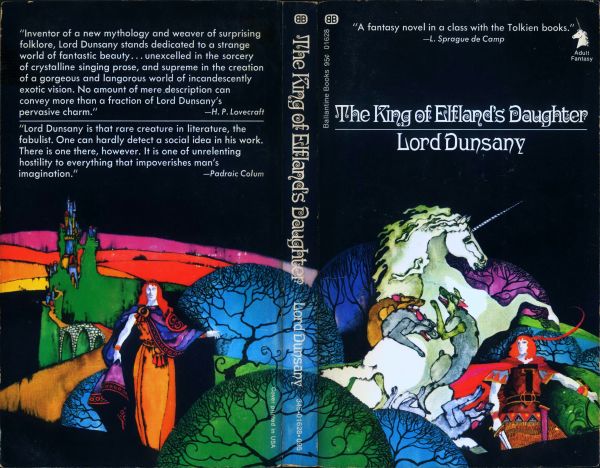
Edward John Moreton Drax Plunkett (1878–1957), 18th Baron Dunsany, publishing under his title Lord Dunsany, was the ostentatious name of an Anglo-Irish writer whose impact on the development of fantasy fiction has been tremendous, even if he’s not a household name like Tolkien. But, like William Morris, though his name is little known today outside of those who delve into fantasy’s deepcuts, Dunsany’s influence on fantasy’s forms, styles, tropes, and ideas is inverse to his name recognition. Indeed, of the 65 books BAF (re)published as the main part of the series between 1969 and 1974, probably none has remained as influential for fantasy writers and readers as Lord Dunsany’s 1924 novel The King of Elfland’s Daughter, republished as the second BAF novel in June 1969 with an appropriately enigmatic, even haunting cover by Bob Pepper (who provided the covers for Ballantine’s earlier republication of Mervyn Peake’s Gormenghast novels).
Originally published in hardcover in the UK by G.P. Putnam’s Sons in 1924, The King of Elfland’s Daughter was out of print for decades before Ballantine Books brought it back into print under the sign of the unicorn. Since then, it has been republished in a new edition at least once per decade, including a 1999 Del Rey edition with an introduction by Neil Gaiman (acknowledgement). When it was republished in the BAF series, it had blurbs pulled from L. Sprague de Camp, H.P. Lovecraft, and Irish writer Padraic Colum, demonstrating the range of Dunsany’s appreciation across literary circles but also his specific impact on fantasy writers, and Arthur C. Clarke considered Dunsany one of the finest writers of the twentieth century. He was and remains a writer’s writer, with The King of Elfland’s Daughter one of those texts that seemingly retains its charm and artistry for each new generation that reads it.
A conservative, Unionist peer, Dunsany inherited his barony at 20. He was a poet, novelist, and playwright, a confrere of Irish and British writers alike, among them W.B. Yeats, Oliver St. John Gogarty, George Bernard Shaw, even H.G. Wells. He was a renowned marksman, a champion chess player, and he served in three wars: the Second Boer War, WWI, and WWII (the latter on the homefront), and was injured by bullet shrapnel to the face during the 1916 Easter Rising (by Irish nationalists, since he had gone into Dublin to help the British army). He published dozens of books and plays in his lifetime and was a minor hit among those with an interest in the peculiar pre-genre fantasies he published, which were written in lush prose very much at odds with the literary modernism he so despised. In Lovecraft’s words, excerpted from his essay “Supernatural Horror in Literature” and used as a blurb on the back of the BAF edition of The King of Elfland’s Daughter, Dunsany was “Unexcelled in the sorcery of crystalline singing prose, and supreme in the creation of a gorgeous and languorous world of iridescently exotic vision.”
When people write about Dunsany, they tend to do so in awed and reverent tones. They speak of a lean, imposing man who stood over six feet tall (de Camp, in his chapter on Dunsany in Literary Swordsmen and Sorcerers, oddly notes the size of Dunsany’s hands and feet, which he assures us were quite big), lived a cosmopolitan life, fought in multiple wars, led hunting expeditions across India and Africa, and even escaped the Nazis when they invaded Athens in 1941. Of course, many are also impressed that he was a baron of all things—from one of the oldest and most distinguished baronies in Ireland, no less! The legend of Dunsany-the-man, and the sometimes fawning admiration (seen most egregiously in Hazel Littlefield’s Lord Dunsany: King of Dreams) with which so many critics wrote about Dunsany, seems to have had as much to do with his living a colorful, accomplished life afforded by the happenstance of his nobility, his consequent wealth, and the elite social circles he ran in, as it does with his voluminous literary output and the quality thereof.
For his part as editorial consultant to the BAF series, Lin Carter places Dunsany (“an astounding man”) in similarly high esteem in his introduction to The King of Elfland’s Daughter. He drapes Dunsany’s birthplace—the Castle Dunsany, County Meath, built in the twelfth century—in the language of Celtic fantasy:
among the hills that were already rich in song and fable a thousand years before his Norman ancestors came a-conquering by the right hand of Duke William the Bastard. These lands were the age-old demesne of the Ard-ri, the emperors of the ancient Celts. In Meath was Tara of the Kings, so sacred and venerable that the king who held it became High King of all Ireland. Thus the hills and fields of Dunsany’s childhood were steeped in golden legend, and some of the enchantment and music of antique Tara entered into his wonderful stories. (vi)
No doubt Dunsany’s seemingly fantastical upbringing—albeit tinged in this telling with Carter’s, and many Americans’, view of Ireland and all things Celtic as enticingly exotic—in Ireland, and his family’s deep roots in Irish history, had something to do with his vision of fantasy. Unsurprisingly, critics have placed Dunsany in the context of the transnational turn-of-the-century Celtic Revival; Jamie Williamson, for example, in The Evolution of Modern Fantasy (134–143), reads Dunsany alongside other “Celtic Twilight” authors of similar fantasies, namely James Stephens and Kenneth Morris, though only Dunsany was recovered by BAF. Carter, writing in 1969, understands Dunsany as one of the most important writers of fantasy to date and follows de Camp in considering him the second author (after William Morris) to write what could be considered “heroic fantasy,” i.e. the type of “adult fantasy” Carter intended the BAF series to canonize. Carter praises The King of Elfland’s Daughter for “passages of amazing power and unearthly beauty […that] scintillate with a brilliant surface of exotic names and fabulous imagery,” even if he felt the novel was “somewhat flawed in conception,” probably for reasons of narrative flow and underdevelopment of character (ix, viii).
The King of Elfland’s Daughter was Dunsany’s second novel. It followed the minor success of his first, the Cervantean Spanish fantasy The Chronicles of Rodriguez (1922), retitled Don Rodriguez: Chronicles of Shadow Valley for the American market. But Dunsany began his literary career in 1905 with the mythopoeic story collection The Gods of Pegāna. He wrote nine more story collections and four plays before Don Rodriguez. Critics generally mark a distinction between his pre- and post-WWI fiction. Like most writers who fought in WWI—and Dunsany was on the front for most of 1917, as Edward James details in his entry on Dunsany for the Science Fiction and Fantasy Writers in the Great War project—Dunsany’s writing was influenced by his experiences. While his early fictions tended toward the short, strange, and mythopoeic, often inflected with a strong Orientalist sensibility, all elements that made a decisive impact on the early writing of Lovecraft and on others, like Clark Ashton Smith, Dunsany’s novels of the 1920s—not just Don Rodriguez and The King of Elfland’s Daughter, but also The Charwoman’s Shadow (1926) and The Blessings of Pan (1927)—show the effects of WWI on the now much matured writer and together offer a sustained reflection on the role of magic, memory, and history in the mundane (and allegorically “modern”) world of “the fields we know.”
Dunsany’s fantasies were not unique to the literature of the 1920s. Indeed, the 1920s saw a flowering of pre-genre fantasy that greatly influenced the later market formation of the genre. A number of writers from this period—including Dunsany, but also E.R. Eddison, David Lindsay, Hope Mirrlees, James Branch Cabell, H.P. Lovecraft, Clark Ashton Smith, Frank Belknap Long, Ernest Bramah, Eden Phillpotts, among others (some of these only appeared in collections edited by Carter)—were republished in the BAF series. Some of the historical changes that accounted for the unique moment of fantasy (and its allied genre, the weird) in the 1920s included the social, political, and psychological aftermath of WWI (see Adam Roberts’s Fantasy: A Short History, 65–85), the rise of Celtic nationalisms in the wake of Ireland’s successful war of independence (again, see Williamson, 134–143), and, by the decade’s end, the spread of new “pulp” magazines for the distribution of popular fiction, especially in the US.
So strong was the pull of fantasy in the 1920s that it made an impact on the mainstream of literary fiction production in the UK, and even on British literary modernism. Fantasy became a powerful form of literary engagement with and critique of the social and political dimensions of the post-WWI world. Nick Hubble has argued convincingly in “Fairy Fruit and Creative Auto-Intoxication: The 1920s as a Decade of Fantastic Romance” (in The 1920s: A Decade of Modern British Fiction) that the techno-utopian scientific romances of H.G. Wells and Jules Verne steadily gave ground to the fantastic romance across modernist, middlebrow, and popular fiction alike. For Hubble, fantastic romance of the 1920s differed
from the narrower category of scientific romance in its focus on the immediate transformation of society as opposed to subordinating and deferring immediate concerns in favour of achieving a greater transformation in the future. The liberated landscapes of fantasy and the imaginary offered by such romantic fantasies offered writers such as those discussed here—Hope Mirrlees, Virginia Woolf, [Naomi] Mitchison[,] and [Ethel] Mannin—unprecedented opportunities for self-expression beyond conventional norms of gender and sexuality. (21).
While Hubble’s authors are specific to their project, focused as it is on the queer and feminist dimensions of British modernist and middlebrow fiction, at least one of those (Mirrlees) was included in the BAF series. And although Dunsany was a writer of a wholly different sort, as a conservative distinctly opposed to literary modernism, The King of Elfland’s Daughter folds neatly into Hubble’s argument about the function of fantastic romance in 1920s, since it presents an immediate, irrevocable, and ultimately emotional transformation of a society by magical means—though in Dunsany’s fantasy, it’s unclear if the transformation is for the better.
Reading The King of Elfland’s Daughter
The King of Elfland’s Daughter is undoubtedly a fantastical romance of the sort identified by Hubble. And it is also deeply indebted to an earlier generation of pre-genre fantasy writers whom Dunsany, born in the late 1870s, would have grown up reading (see Williamson, 91–126, for a concise discussion of Victorian fantasy and its influences). Dunsany’s novel adapts the sense of “faerie” from Victorian fairy tales to the narrative form of the heroic romance, also popular in the Victorian period among antiquarian literary types, most notably William Morris. Stitching together the modern and the antiquarian, and marrying them in a poetic prose style heavily influenced by the King James Bible, The King of Elfland’s Daughter is both decidedly of the 1920s while also being indebted to earlier strains of pre-genre fantasy.
I noted in my essay on the first book in the BAF series, Fletcher Pratt’s The Blue Star, that Pratt’s novel was “an excellent choice to launch a series that intended to demonstrate the literary virtue of ‘adult fantasy’—or, rather, to demonstrate that fantasy was not merely a category of children’s fiction.” Dunsany’s The King of Elfland’s Daughter, then, is an ideal second book, differing as it does in so many ways from Pratt’s novel, but at the same time demonstrating, in very different fashion, exactly the same thing: the literary value of “adult fantasy.” The stark differences in tone, style, topic, source material influences, and disposition to and use of the fantastic in these two novels testifies to just how diverse were the inheritances of the emergent genre of fantasy as canonized by Carter and Ballantine books in the BAF series. Indeed, it’s a diversity of genre that continues throughout fantasy’s history after BAF, even if many folks who criticize fantasy do so by reference only to a particular type of fantasy: the medievalist Tolkienian epic fantasy novel. Like Pratt’s The Blue Star, Dunsany’s The King of Elfland’s Daughter is decidedly not that.
The King of Elfland’s Daughter takes the overall shape of a fairy tale, introduces a heroic romance, splices in a good deal of hunting, and returns again the fairy tale form for its ambiguous ending. It is an inventive novel, to be sure, and one which Lin Carter praised by noting that, “to Dunsany’s lasting credit goes the honor of having written a fairy tale that dares to tell you ‘what happened afterward’” (ix). For Carter, and many readers, the fact that Dunsany brings together the fairy tale and the heroic romance so effortlessly set a watermark for fantasy fiction:
This is the essence of Lord Dunsany’s power and importance both as a literary craftsman and as a fantasy writer—that he combines the style and settings of the classical fairy tale with an adult and sophisticated viewpoint, welding the two diverse elements into one matchless whole through his lyric, singing prose. (x)
I’m not Dunsany-pilled like Carter was, nor do I think Dunsany is nearly as good a writer as Carter, Lovecraft, Clarke, or any of his other acolytes claim, but I do find Dunsany’s virtuosity in pulling together so many elements from earlier fantasy, especially the fairy tale, excitingly original, all the more impressive because the fantastic elements of Dunsany’s novel—whether a witch growing lightning in her cabbage patch, a half-elf prince hunting unicorns with dogs and trolls, or a company of mad men searching for an ever-receding portal of twilight to bring them into Elfland—feel somehow familiar, yet come from Dunsany’s own imagination (indeed, this quality seems to be why people liked his early work in the first place, especially his creation of a wholly new mythic pantheon in The Gods of Pegāna).
Dunsany opens his novel with a preface:
I hope that no suggestion of any strange land that may be conveyed by the title will scare readers away from this book; for, though some chapters do indeed tell of Elfland, in the greater part of them there is no more to be shown than the face of the fields we know, and ordinary English woods and a common village and valley, a good twenty or twenty-five miles from the border of Elfland. (xi)
With this preface, Dunsany knowingly winks at the apparent strangeness of writing a fairy tale-cum-heroic romance for an adult audience. Already, in this short paragraph, before the story has even begun, Dunsany offers some suggestions about how The King of Elfland’s Daughter positions the relationship between magic and the mundane, fantasy and the “normal,” by assuring readers that England (he clarifies later that the novel is ostensibly set in England’s past, a bold claim for an Anglo-Irish author writing just a few years after the establishment of the Irish Free State) is safely removed from any “strange land,” but also just 20–25 miles from the border of it. Of course, this points to the sense in so many British fairy tales that the land of “faerie” and magic is a threatening one, but I also read in Dunsany’s novel something else—a suggestion, perhaps, that the strange lands could be read elsewise, as the threat that hangs at the periphery of England, that looms over and ultimately transforms it. The British colonies? The Celtic past? Ireland itself? Things to ponder.
The preface also introduces a phrase—“the fields we know”—that is repeated at least a hundred times in the novel, a lyrical refrain that serves to both emphasize (or inculcate a sense of) the audience’s supposed familiarity with the mundane world of the novel, of that which is not Elfland, but which, Dunsany assures us, is very much like whatever we the readers are familiar with. Perhaps, too, the phrase warns against becoming familiar with Elfland, with magic, with faerie. At the same time, the phrase might be understood as an arbiter of semantic satiation, working to defamiliarize the very thing it insists we know. This phrase is borrowed in part from Tennyson’s poem “In Memoriam” (1850)—“My paths are in the fields I know, / And thine in undiscovered lands”—and we see more borrowings from Tennyson in The King of Elfland’s Daughter, not just in the melancholy air of a lost English past that hangs all about the novel, but also in specific imagery that motivates Dunsany’s novel, such as the calling of the horns of Elfland, heard each dusk by Orion, and captured in Tennyson’s “The Splendor Falls” (1848)[1]:
O, hark, O, hear! how thin and clear,
And thinner, clearer, farther going!
O, sweet and far from cliff and scar
The horns of Elfland faintly blowing!
Blow, let us hear the purple glens replying,
Blow, bugles; answer, echoes, dying, dying, dying.
The horns of Elfland blow, clear yet far away and echoing farther away the closer we come, harkening to its call: this is the story of The King of Elfland’s Daughter.
The King of Elfland’s Daughter is a cautionary tale of what happens when humanity brings magic into its midst. The story takes place in the Vale of Erl, somewhere and sometime in England’s premodern past.[2] The lord of Erl asks his son, Alveric, to travel to the east, cross over into Elfland, and fetch back the king of Elfland’s daughter to be Alveric’s bride. Before departing, Alveric visits the aged, ageless witch Ziroonderel and requests a magic sword, which Ziroonderel fashions from seventeen thunderbolts gathered from beneath the leaves of her cabbages. Sword in hand, Alveric travels to the eastern edge of Erl and the border of Elfland, a veil of shimmering light made of “the massing of twilights from the ending of thousands of days” (141), and crosses into timeless Elfland, where he is attacked by trees and elf-knights alike. His presence shocks the eternal calm of Elfland and entices the elf-princess Lirazel, who willingly, excitedly flees back to Earth with Alveric and becomes his bride.
On returning to earth, they discover that a decade or more has passed in the mere afternoon Alveric spent in Elfland. His father dead, Alveric takes the mantle of the lord of Erl, his elf-wife its lady; the people of Erl rejoice and a baby is born: Orion. But in Elfland, the king despairs of his daughter’s disappearance and the broken calm of his placid, exquisite kingdom, and so—mere minutes after she has left—casts a rune that will return her to Elfland. In the time it takes the Elfking to cast his rune, years go by on Earth and Lirazel and Alveric drift apart. Lirazel in her elfin ways has trouble adapting to the human world; even the lessons of Erl’s “Christom” Freer (friar) mean little to her. Alveric wants Lirazel to “be guided by custom, and do what others did, and forsake wild whims and fancies that came over the border from Elfland” (54). He wants her to be all too human and she tries for a time, but her awe at the stars—so unlike anything in Elfland’s sunny forever-afternoon that she wishes to worship them—breaks her interest in Christom and Erl ways. Dunsany (or, rather, the narrator) intervenes in one of his many asides to the reader:
We may understand [Alveric’s] feelings easily: the strangeness of [Lirazel], her contrariness to all established things, her scorn for custom, her wayward ignorance, jarred on some treasured tradition every day. The more romantic she had been far away over the frontier, as told of by legend and song, the more difficult it was for her to fill any place once held by the ladies of that castle who were versed in all the lore of the fields we know. (57)
Again Dunsany associates Elfland with, yes, the magical, the romantic, the strange, but also underlying his (perhaps tongue-in-cheek) empathy for Alveric’s position is a strong sense of the foreignness of Lirazel that, I think, fits my reading that Elfland allegorizes that which is unfamiliar to the British, and which warns that brooking such unfamiliarity will cause problems: the foreign hold their own customs, the people of the colonies have their own ways, the Irish their own traditions. They are ultimately “not like us” in some fundamental way, not reared in the fields we know—though it’s unclear whether Dunsany means this negatively, or simply as a matter of fact, and, as we’ll see, Dunsany never resolves that tension.
Lirazel is unable to reconcile her strangeness to Erl, to set aside its strangeness to her, and when the Elfking’s rune finally reaches her, she blows away on the wind like a fallen leaf, yellowed by time, caught in a chill autumn gale, and she floats back to Elfland, where her presence restores the perpetual calm of Elfland and its king, the contentment that “all our troubled world with all its changes seeks, and finds so rarely and at once must cast it away” (104). To keep content, the Elfking pulls the border of Elfland back from Erl, leaving in its twilight-veiled wake a sad, desolate land of grey wastes and forgotten memories that occasionally turns up lost toys and mislaid trinkets; a haunted, ruined land where the notes of ancient songs linger with the faintest echoes of bygone ages. This land, “dreary with lost romance” (68), calls to mind the Western Front of WWI, which Dunsany described in his autobiography thus:
I saw […] more ruin than any traveller would see in the whole of Egypt; and indeed the cathedral of Arras and the streets of Bapaume gave rise in my mind to a comparison with Egypt and Pompeii, so that Ruin seemed to have come out of History, and with a long stride through the ages, appeared in our own day […] That plain with regular rows of shell-holes where there had been village streets, through which Disaster had gone with even strides, and where wreckage of peace and war were mingled in one desolation (qtd. in Vaninskaya, Fantasies of Time and Death, 29)
As for Tolkien, Dunsany’s experience of WWI was one of total ruin brought about by machinery, rendering an unreal world where “tanks were lying like monstrous beasts of the Miocene, slain in the cataclysm that had overthrown their era” (qtd. in Vaninskaya, Fantasies of Time and Death, 29). Elfland’s desertion of Erl, though not presaged by violence (except, perhaps, that of Alveric and his magic sword against the trees and knights of Elfland, and his stealing away of the Elfking’s daughter—whatever her agency in the decision), leaves behind a landscape not nearly as dramatic as Dunsany’s blasted land that recalled Egypt, Pompeii, and even the Miocene, but one equally desolate and forlorn, a place out of time, devoid of purpose, ignored by the farmers who dwell nearby, fallow and stale in the aftermath of its enchantment—a raw metaphor for the post-WWI world as much as for adulthood shorn of childhood’s imagination.
At Lirazel’s departure, Alveric forgets his hesitation over Lirazel’s strange, foreign ways and devotes his life to seeking Elfland again. His quest is like the Arthurian quest, only no one but the mad and insane and the outcast believe in it and go questing with him; it is not a Christian quest, like that for the Holy Grail, but is decidedly un-Christian in that it seeks to bring back that which people refuse to believe exists. The people who dwell in the borderland adjacent the twilight veil of Elfland never turn eastward (notably, the direction British soldiers in WWI would have looked to see their German enemies) and they pretend to know nothing of Elfland’s existence (one old man, a recurring character, begrudgingly refers to it as “the past” when pressed for information by Alveric). For theirs are lives of hardship: “barely at the end of each year they won their fight against Winter” and in their toil “they knew well that if they let a thought of theirs turn but for a moment toward Elfland, its glory would grip them soon and take all their leisure away, and there would be no time left to mend thatch or hedge or to plough the field we know” (122). So Alveric and his company of questers stalk the edges of the desolate land where Elfland once had its border, keeping always close to the farms of Erl for supplies, passing like phantoms into the legends of those who dwell in the east and refused to see the wonder that was once at their doorstep. And for years Alveric wanders with his company, to no avail, wasting away while Orion comes of age in Erl.
With his description of Alveric’s quest—which takes place over more than a hundred pages of the novel, though we only see it in intermittent chapters—and especially with his description of peasants’ responses to Elfland and to Alveric’s quest, Dunsany offers us a partial theory of fantasy. He suggests, rather empathetically, a materialist argument for why so many turn away from fantasy, faerie, and the imagination. Dunsany characterizes fantasy not as mere entertainment, a simple wonder for the toilers in the field to take brief leisure from, but instead Dunsany understands fantasy as a powerful threat to our psyche in a world of hard labor. Because fantasy is escape and because that escape is so deeply necessary, so eminently enticing when thatch needs mending and fields ploughing, when the passage of time and the seasons themselves are existential threats. Instead of embracing the cruel optimism of fantasy-as-escape under capitalist modernity, Dunsany’s peasants embrace a pitiable pessimism, reconciling themselves to the world they (we) live in, the world as it is, and from which they (we) feel no escape is truly possible: because to do otherwise would be too painful, perhaps even deadly. Of course, as defeatist as such a pitiable pessimism might be, since it locks us into the world-as-it-is and rejects the alternative possibilities that follow from engaging with the fantasy of Elfland, this is not the end of the story.
Alveric’s quest is ultimately a failure. His magic sword alerts the Elfking to Alveric’s presence any time he ventures near the twilight border, and so Elfland remains ever beyond Alveric’s reach until the witch Ziroonderel meets him upon the heath and disenchants his sword. But when Alveric would gain Elfland again, his mad companions—who worship the moon and follow their own insane logics—fear the actual magic of Elfland and so prevent Alveric’s return. At the last, dragged away by his companions from Elfland’s border, Alveric blows his horn and Lirzael hears it. The sense-memory of Alveric and their brief love, so long denied by “the deep deep calm in which ages slept, unhurried by time” in Elfland, breaks like a wave. Love disrupts, for a moment, the timeless magic of Elfland and the Elfking’s attempts to reason with his daughter over the tragedy inherent in a relationship between a human and an elf (echoed later in Tolkien’s Legendarium) come to nought. So the Elfking unleashes his final rune, using up the last of his great magics that brought Elfland into being in some distant past.
Meanwhile, in the years Alveric has been on his quest for Elfland, and in the eternal afternoon of Lizarel’s contentment there, Orion has grown up in Erl and become its lord. Where the stories of Alveric and Lirazel borrow heavily from the forms of fairy tale and heroic romance, Dunsany tells Orion’s story primarily through the frame of the hunting tale. Through Orion’s story Dunsany bleeds magic into Erl, as the son of the elf-princess draws the magic of Elfland slowly back to Earth, unbeknownst to the Elfking, and Dunsany at the same time asks whether magic is the unique preserve of Elfland. Orion’s childhood is spent exploring the forests of Erl with two hunters, Oth and Threl, who teach Orion with folktales and hunter’s lore how to “read” Earth’s magic—that of the woods, of the animals, of nature itself, and most importantly of the reciprocal relationship between nature and the human afforded by the hunter’s intimacy with the land. Indeed, Dunsany’s own prose style lingers on land and nature, brings it to life, gives even the passing wind a sense of agency, an actor in a large and living cosmos, and through Orion especially we come to see that nature has enchantments of its own—“glamour” and “mystery” (92)—separate from those of Elfland. The realm of the Elfking may compose its border with Earth from all the captured twilights of the past, but a single twilight at dusk—indeed, the very passing of time itself—has magic, too: Earth’s magic is phenomenological, reflecting back and amplifying our experience of the world.
As a son of the elf-princess, Orion is predisposed to magic and he hears the horns of Elfland blowing each evening. In the absence of his father, Orion devotes himself to hunting and the magic of the woods. One evening, he hearkens to the call of Elfland’s horns, finds the twilight border of faerie, and spots a unicorn, which appears to him “like an inspiration, like a new dynasty to a custom-weary land, like news of a happier continent found far off by suddenly returned sea-faring men” (122). Since Orion’s chief relationship to nature, and therefore to magic, is that of a hunter, his impulse is to hunt the unicorn with his hounds. Dunsany records this in a harrowing, almost disturbing sequence—immortalized by artist Bob Pepper on the BAF edition’s cover—that ends with Orion’s triumphant slaying of the unicorn, his hounds’ tearing at the carcass:
Awful groans came from the unicorn, such sounds as are not heard in the fields we know; and then there was no sound but the deep growl of the hounds that roared over the wonderful carcase as they wallowed in fabulous blood. (131)
From this moment, Orion becomes obsessed with the hunting of unicorns. On one hunt he comes across Lurulu, a troll from Elfland playing back and forth on the border between worlds. Orion invites Lurulu to live in Erl and “whip” his hounds, and asks Lurulu to invite other trolls from Elfland to do the same, in order to better hunt the unicorns. Thus Elfland and its creatures begin to saturate the mundane land of Erl—first the trolls, then will-o-the-wisps, then other, unnamed creatures of myth and legend—until Erl is soon overflowing with magical beings.
Lurulu is Dunsany’s most endearing, and the only truly interesting, character in this otherwise quite dry and emotionless novel. When Carter calls The King of Elfland’s Daughter “somewhat flawed in conception” (viii), I suspect he had in mind how, like many a fairy tale, Dunsany’s gives no thought to characterization, emotion, or motivation—his characters are not people, but bit players in a rapidly unfolding plot. Lurulu becomes the emotional heart of the novel in large part because Dunsany spends so much effort expounding Lurulu’s reaction to the wonder and, to the troll, magic of time. In one particularly memorable chapter, “Lurulu Watches the Restless,” Lurulu observes time and its effects on the world from the pigeon-filled attic of the castle Erl (153–160). Dunsany’s capacity for stunningly poetic observation of the mundane is on full display in this chapter and here, more than anywhere else, one gets a sense of my claim above that magic in The King of Elfland’s Daughter is a fundamentally phenomenological thing: it is not only what we experience but how we experience it. For Lurulu, from a timeless land of ever-calm, the rising and setting of the sun, the aging and splintering of the castle’s wooden beams, the bustle of the city of Erl, the rising of smoke from its chimneys—all of these are exciting, alluring, breath-taking. They are the stuff of legend and adventure. When Lurulu returns to Elfland to persuade the trolls to hunt unicorns with Orion, he explains the appeal of Earth by describing the passing of time as though he is recounting folktales. And so the trolls come to Elfland, seeking the magic of time’s passing.
Through Orion’s efforts to better hunt unicorns, Elfland comes to Erl. At the same time, the Elfking has cast his final rune to reunite his daughter with Alveric and their son, for she refuses to remain in Elfland without them. The Elfking’s final rune expands the borders of Elfland so they engulf the entire kingdom of Erl, not only reuniting the family that bridged the twilight divide between Elfland and Earth, but also bringing into Elfland’s fold all of the men and women, trolls and will-o-the-wisps, unicorns and foxes, and so on who previously lived apart. Those toilers in the field who once turned away from Elfland now live there, as if in some glowing, near-utopian dream, bound to the timelessness of the place for all the good and ill that entails. Erl disappears from Earth; Dunsany’s novel recounts the story of a land ensorceled out of time, once part of the mundane, once a part of England, now gone into myth and legend beyond the veil of twilight. But is that a good thing?
There is one more crucial element of The King of Elfland’s Daughter to consider before trying to parse what exactly the novel might be doing with its ambiguous ending—and that element is the frame narrative of Dunsany’s fairy tale-cum-heroic romance. The novel begins, ends, and is punctuated with the meeting of a parliament, a group of twelve elders from Erl who (ostensibly) represent the peoples’ interests to the lord. The opening of the first chapter details the parliament’s request to the lord of Erl, touching off the events of the novel: “For seven hundred years the chiefs of your race have ruled us well […]. And yet the generations stream away, and there is no new thing,” says the spokesman of the parliament. When asked “What would you?” the elders respond, “ We would be ruled by a magic lord,” and their lord acquiesces: “It is five hundred years since my people have spoken thus in parliament, and it shall always be as your parliament saith. You have spoken. So be it” (1). It is to fulfill the parliament’s demand that the lord of Erl sends Alveric to Elfland for the Elfking’s daughter, hoping that the child of their union will be the magic lord the people of Erl desire.
At first, Orion seems not to be that magic lord and the parliament worries that their desire will not be fulfilled, until one night Orion brings back the head of the first unicorn he hunted and they begin to see that magic is indeed coming to Erl. The “Christom” Freer, though, chides the parliament of Erl for their love of magic, but in their joy at seeing their plans begin to bear fruit the elders chant “Magic!” But the magic becomes too much as trolls and will-o-the-wisps and other fey beings overrun Erl: “The elders had desired magic […] but the actual touch of it, or the mere thought of it, perturbed the folk in their cottages” (146) and soon the parliament regrets their desire. In bringing magic to Erl, the parliament had sought to prevent Erl going “unnoticed in history” (198). Magic, they believed, would bring renown to their obscure, backwater kingdom, but now, as one of the elders declares, “there is overmuch magic […] and the folk that should tarry in Elfland are all over the border” in Erl (212). They ask the witch Ziroonderel to say a “charm against magic, so that there be no more of it in the valley,” but Ziroonderel refuses, not because she cannot do such a thing—indeed, she lets slip that the Elfking fears her powers—but because magic is “the spice and essence of life, its ornament and splendor” (212).
Ziroonderel explains to the parliament that nature and magic are one, that their separation—between Earth and Elfland—by the Elfking is itself an aberration:
Would you rob Earth of her heirloom that has come from the olden time? Would you take her treasure and leave her bare to the scorn of her comrade planets? Poor indeed we are without magic, whereof we are well stored to the envy of darkness and Space. […] I would sooner […] give you a spell against water, that all the world should thirst, than give you a spell against the song of streams that evening hears faintly over the ridge of a hill, too dim for wakeful ears, a song threading through dreams, whereby we learn of old wars and lost loves of the spirits of rivers. I would sooner give you a spell against bread, that all the world should starve, than give you a spell against the magic of wheat that haunts the golden hollows in moonlight in July, through which in the warm short nights wander how many of whom man knows nothing. I would make you spells against comfort and clothing, food, shelter and warmth, aye and will do it, sooner than tear from these poor fields of Earth that magic that is to them an ample cloak against the chill of Space, and a gay raiment against the sneers of nothingness. (213)
Throughout The King of Elfland’s Daughter, Dunsany is attuned to the relationship of Earth to a larger, scientific, cosmic universe, one in which the magic of Earth is a unique “heirloom” or “treasure” of its existence in the “chill of Space,” the thing that distinguishes earth from its “comrade planets.” There is, as Orion’s story shows, magic aplenty in nature, but the Elfking has concentrated it with his powers—“his world-disturbing runes” (241)—and built for himself and his daughter a realm outside of nature, beyond Earth and the planets and Space, where magic accumulates unnaturally like “the massing of twilights from the ending of thousands of days.” Ziroonderel sees the returning of magic to Erl, to Earth, as a return to equilibrium.
And so the novel ends with “Erl dream[ing] too with all the rest of Elfland and so passed out of all remembrance of men,” the very opposite of what the parliament had wanted when they sought to make a name for Erl by bringing magic to it. Erl is no more in the memory of men; it is not only “unnoticed in history,” but wholly outside of history, beyond time and space—except insofar as Dunsany tells us the story of Erl, perhaps passed down to us by Ziroonderel herself, whom Dunsany assures us was not caught up in the Elfking’s magic but could pass as she liked between the two realms. The final line of the novel returns us to the parliament of elders, sitting in deliberation after Ziroonderel’s refusal to turn back magic, after Elfland has swallowed up Erl, “and, gazing over their familiar lands, [they] perceived that they were no longer the fields we know” (242). It’s a classic fairy tale ending. A warning. Be careful what you wish for. Play with magic and there will be consequences. Fuck around and find out.
The ending of The King of Elfland’s Daughter is a productive one insofar as it gives us absolutely no hint at how to read it. Lirazel and Alveric and Orion are reunited, the Elfking presumably is content again, even the old man who refused to acknowledge the border of Elfland just a few meters from his door has been reunited, through Elfland’s magic, with his long-dead wife. Elfland’s magic was too much for the people of Erl who were “perturbed” by the trolls and mythic beings brought into their lives by the overzealous elders who sought to make a name for Erl by demanding a magic lord rule them—and how do they fare now, in Elfland, where they no longer need to mend thatch or plough the fields?
The ending would seem, for all, a happy one. Yet we know that Earth is itself a wonder because it exists in time, because it is not Elfland. Earth is restless, things age and die, suns set and moons rise, and stars—so beautiful they inspire Lirazel to religious devotion—are nowhere to be found in Elfland, in that no-place where time does not bring the light of distant suns hurtling across the chill black of Space. Yes, there is something tongue-in-cheek about the parliament getting what they wished for, and overmuch, in the logic of fairy tales, but I think, too, that the ending masks ambiguity. It is no utopian end, nor is it an end brought about by the will of the people: it was instead imposed. Like the killing of the unicorn, I read the ending of The King of Elfland’s Daughter as the snuffing out of something bright and beautiful. An impossible choice is made between the fey beauty of Elfland’s timelessness and the natural beauty of Earth’s temporality—a choice made by some for all, for selfish reasons, and with a seeming finality.
Elfland, of course, has been the topic of much discussion among scholars of Dunsany. Anna Vaninskaya, who I’ve discussed previously in my essays on E.R. Eddison’s novels, offers some suggestions of how to read Elfland in Fantasies of Time and Death: Dunsany, Eddison, and Tolkien, including that it could represent “all things insubstantial, ideal, intangible, and illusory”: imagination, memory, childhood, even death, “those artefacts of the human [experience] that, having no physical substance, are not subject to the ‘way’ of time,” and which are all tightly bound together in our interpretation of fairy tales (48). And she also argues convincingly that Elfland symbolizes the past. When Elfland engulfs Erl, for example, “It restores the past to Erl, but seemingly at the cost of a living future” (46). It is only in passing out of time that the people of Erl can reconnect with the past: “human beings cannot attain Elfland, cannot go back to the past, but the past can come to them” (51). I disagree in part with Vaninskaya’s argument, since, after all, Alveric went to Elfland (even if he couldn’t get back, though that had nothing to do with Elfland itself); foxes go to Elfland (it’s what makes them special among the animals); and the people of Erl all know of Elfland, even if they do not acknowledge it—the parliament wishes to plunder Elfland for magic in order to win renown for Erl! Elfland is accessible in a material way that the past is not, and timelessness is a wholly different thing to pastness. But her argument is very compelling and I wanted to highlight through her brilliant work just how productive, slippery, and ambiguous Dunsany’s symbolism is.
To these interpretations I’d add my own—possibly unlikely—one, which I admit is inspired entirely by the knowledge that Dunsany was a conservative Unionist who disagreed with Irish independence. And so I have to wonder if, written just two years after the establishment of the Irish Free State by the will of the Irish people who fought an anti-colonial war of independence against the British, The King of Elfland’s Daughter in any way maps its “be careful what you wish for” fairy-tale moral to the situation of Ireland. After all, the novel is about the consequences of the actions of a small group of leaders who bring about a dramatic, world-altering change that tears their kingdom out of the world it belonged to. It’s not a stretch to imagine a reading where Erl is a stand-in for Ireland, Earth for the British Empire, and Elfland for the state of Irish independence. In this reading, the trolls and will-o-the-wisps who invade Erl, upsetting the workaday people who want to get on with their lives, are not unlike how one imagines a conservative, Unionist Anglo-Irish peer might have felt about the Irish nationalist groups “perturbing” the centuries old order of Ireland under British rule. Independence, in this reading, is an ambiguous ending of the sort I’ve suggested in my interpretation of Erl’s fate.
Of course, not everything about the novel maps neatly to such an interpretation—nor should it! I don’t believe the symbolism or meaning of any novel is reducible to any one interpretation; the polysemy and slipperiness of texts is what makes literary criticism and interpretation such a lively and worthwhile practice. And no doubt the indeterminacy of what the ending of The King of Elfland’s Daughter means is part of what has made it such a beloved classic of fantasy.
Parting Thoughts
The King of Elfland’s Daughter was the first of six books by Dunsany republished in the BAF series. It was followed by At the Edge of the World (Mar. 1970), Don Rodriguez: Chronicles of Shadow Valley (May 1971), Beyond the Fields We Know (May 1972), The Charwoman’s Shadow (Feb. 1973), and, the final BAF book, Over the Hills and Far Away (Apr. 1974) (three of those were collections of Dunsany’s stories edited by Carter). This level of representation in the series speaks to both Carter’s perception of Dunsany’s significance in the history of pre-genre fantasy as much as Ballantine’s success getting the paperback rights to his novels, most of which had not appeared in the US in any form before their BAF republications (he was more renowned in the US as a playwright). In the BAF annals, Dunsany measured alongside James Branch Cabell, who also had six books in the series, as the most published BAF authors, and together they surpassed William Morris and his five books (despite Morris being arguably the more historically significant author; those five books only covered four novels, since one, The Well at the World’s End was published in two volumes).
Since starting Ballantine Adult Fantasy: A Reading Series last year, I had been looking forward to reading The King of Elfland’s Daughter, as Dunsany has such high regard among writer colleagues and such an important place in fantasy’s history. I can’t say I was wowed by this Dunsany novel, though, but I found myself intrigued. I’ve said before that I’m less interested in whether I “like” a novel or a writer than I am in whether their work is productive: Do they make me think in new ways about fantasy or science fiction or whatever the genre or medium is? Do they make me think in new ways about the contexts of their production, their time period, their politics, and so on? And for Dunsany, for The King of Elfland’s Daughter, I can confidently answer “yes” to both. This is a dry, characterless novel and I don’t enjoy Dunsany’s prose all that much (even if he occasionally turns a nice phrase, although I do admire his ability to extend the observation of minutiae to paragraphs and pages), but the novel is never a slog and the core of his work, the direction of his interests, and the ambiguity of the novel’s ending—these are all incredibly compelling.
Next in the BAF reading series, following on the heels of Dunsany’s The King of Elfland’s Daughter, comes yet another luminary of pre-genre fantasy and one of the genre’s masterworks: William Morris’s The Wood Beyond the World (1894).
To get notifications about new essays like this one sent directly to your inbox, subscribe to Genre Fantasies for free:
Footnotes
[1] Dunsany explicitly references Tennyson and this poem in a personal aside in the novel, where he claims the poem gives evidence of the poetic, if not scientific, validity that Elfland’s horns do indeed blow for man to hear (93).
[2] Dunsany’s unplaceable human kingdom of “Erl” has both an Old English meaning, akin to that of Norse jarl (king or chieftain), but also a cognate with German Erl, which means literally “alder tree.” But in the late eighteenth century, German Erl was adapted as a (false) cognate for the Danish figure of the elle or elver—that is, elf—in Johann Gottfried von Herder’s 1778 version of a Danish folktale. Von Herber titled his tale “Erlkönigs Tochter” or “The Elfking’s Daughter” and this usage of Erl as “elf” was immortalized in Goethe’s famous 1782 Romantic ballad “Erlkönig” (“Elfking”). So while there is a real English-language etymology for Erl, and one that indexes an early medieval version of English that we could expect Dunsany’s characters might have spoken, if indeed Erl is meant to be some lost valley ensorceled out of history and time by the Elfking’s final rune, Dunsany also ties his human world to another tradition, that of the figure of the elf-king itself, and its circulation in German romance since the 1770s.


Dunsany wrote a novel specifically dealing with the Irish revolution and its aftermath, Up in the Hills (1935). That’s about how the revolution ended a certain romantic vision of Ireland and created a normal, mundane state with more similarities to the English state than some people would like to admit.
LikeLiked by 1 person
Thanks for the reminder! De Camp writes about that in his chapter on Dunsany, and if I recall Dunsany wrote it in part to prove to Yeats and his circle that he could, in fact, write about Ireland. Sounds like a fascinating novel, and I’d be curious to read how critics interpret its politics, but it’s one I will probably pass on reading myself.
LikeLike
I have not read any of Dunsany’s novels, though I’ve had a copy of The King of Elfland’s Daughter for decades. But I love many of his early short stories — not those in The Gods of Pegana but those in the following collections. I also enjoy his Jorkens stories. I do mean to get to The King of Elfland’s Daughter.
Speaking of his connections to the literary world, his niece, Violet Pakenham, whose brother was the notorious Lord Longford, married Anthony Powell (one my my favorite writers.) Lady Violet’s memoirs include a short description of summers spent in Lord Dunsany’s drafty old castle. As I recall, she didn’t find it very pleasant, and thought Lord Dunsany himself rather eccentric.
LikeLiked by 1 person
While we’re etymologizing Erl, may as well do the same for Alveric, a close cognate of the Alberich of the Nibelungenlied and Wagner’s operas, the magical dwarf who forges the Ring. The name is also tied to elfdom through some false cognates (Alv – Alp -elf, though the actual Alb root means “power”) and some sideways etymology (Oberon is the French translation of Alberich). Like the kingdom, the hero from the start is tied by nominative determinism to his fate.
LikeLiked by 1 person
Absolutely great points!
LikeLike