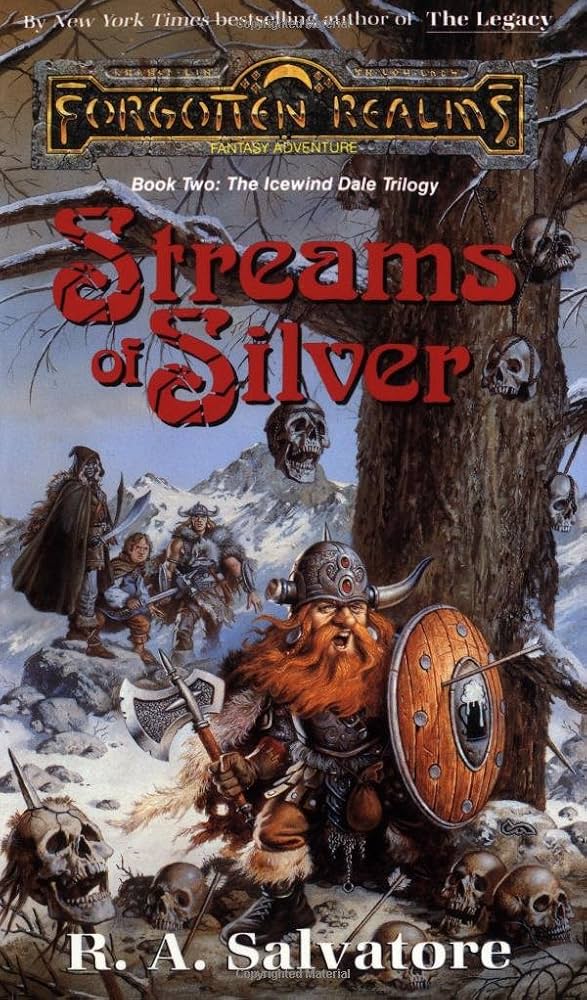
Streams of Silver by R.A. Salvatore. TSR, 1989. Forgotten Realms / Legend of Drizzt / Icewind Dale 2.
This essay is part of Dungeons & Dragons: A Reading Series.
Returning to it after more than twenty years, R.A. Salvatore’s The Crystal Shard was an incredible surprise: it is charming, deeply aware of the emotional lifeworlds of its characters, oddly structured, written in crisp prose that never feels plodding or awkward, and it has an impressively complex plot that turns, ultimately, on some rather intriguing propositions about how to be a good D&D player and what kind of player not to be. It’s ultimately a story about power, responsibility, and friendship. It was refreshing, especially in light of the denigrated status of D&D franchise novels in fantasy criticism, to discover that The Crystal Shard was not only good, it kind of rocked! And all the more surprising because it was written in just a few short months by a debut writer.
Streams of Silver, Salvatore’s second novel and the direct sequel The Crystal Shard, is in every way a worse book. And the fact that I remembered nothing about it—not the journey, not the resolution of the quest, not the Big Bad at the end, not the generous helping of Tolkien inspiration, not even Clyde Caldwell’s dorky rendition of Bruenor in his cover painting—except the supremely annoying antagonist, Artemis Entreri, says a lot about how well this novel holds up in comparison to its much better, and infinitely more memorable, predecessor (and several of its successors in Salvatore’s lengthy Legend of Drizzt series). But that doesn’t mean Streams of Silver is a “bad” novel, it’s just not a particularly memorable one. It’s a waystation on the way to developing a larger storyline for his characters from Icewind Dale and it acts, structurally, more like the first novel in a duology with the following novel, The Halfling’s Gem. Together, these second and third novels of the Icewind Dale trilogy traverse the newly introduced Forgotten Realms storyworld and showcase the diversity of environments, polities, peoples, and kinds of stories that could take place in this D&D campaign setting.
At the same time, Streams of Silver is a novel that clearly shows Salvatore working some things out. He bottled lightning with The Crystal Shard, despite having to pivot mid-draft from his initial idea to focus on Wulfgar and instead make it more about Drizzt. And then he wrote Streams of Silver almost immediately thereafter, launching a shockingly productive career (he wrote 27 novels in the first decade alone, between 1988 and 1998, and another 22 in the following decade!) in which he had just a few short months to write each novel. In the shadow of such writerly productivity, there are bound to be some duds—especially early in one’s career, when an author is figuring out not only what to write, but how to write.
To that end, Streams of Silver feels like a reaction to the awkward but refreshing narrative structure of The Crystal Shard, in that it follows a very clear quest plot structure: the heroes of Icewind Dale go in search of the dwarf Bruenor’s lost homeland, Mithril Hall, and the story follows their meandering adventures, their search for answers, and the inevitable encounters with various foes along the way. The story of Streams of Silver is also much more playable, in the sense that it is difficult to imagine the grand scale of The Crystal Shard’s story translating easily to a D&D campaign. But Streams of Silver is almost written to be played. It’s a novel that says: here’s how you could structure an adventure campaign across the northwest corner of the Forgotten Realms. At the same time that Salvatore is reacting to possible structural and adaptation critiques, Streams of Silver also moves away from the depth of interiority offered in The Crystal Shard, where characters spend a great deal of time not interacting with one another but off on their own thinking about things: what they want, who they are, and their responsibilities to the people who depend on them. There is very little of that in Streams of Silver, which instead gives primacy to action and mediocre dialogue. And, after The Crystal Shard, Salvatore clearly got the message that a fantasy novel shouldn’t be just dudes.
Salvatore is also trying to figure out his themes. Or, rather, how to extend, deepen, and reflect on the themes of friendship, of being an outcast, of prejudice, and of the nature of evil that animated The Crystal Shard. Streams of Silver is also about all of these things, but it’s much less acutely interested in developing them than it is interested in stating that these are things characters are thinking about. The key exception is probably the theme of prejudice, which is much more explicit in Streams of Silver. Even the back cover copy suggests that Drizzt’s main conflict in the novel is that he is “[f]aced with racism” and, indeed, the reactions he receives on account of his race (or “heritage,” as the novel prefers) form a serious challenge to Drizzt and his sense of self. Salvatore also surfaces a few others themes, which can be grouped into two major categories—one around memory and trauma, another around facing the darkness (or weakness) within ourselves—that ultimately show Salvatore’s interest in character psychology, in why they do what they do, and which attempts to lend psychological realism to characters living in an otherwise barely believable TRPG fantasy world. Salvatore isn’t always successful, and most of these thematic elements are either underdeveloped or poorly handled, but it’s clear that Streams of Silver is trying to cook.
Like The Crystal Shard, Streams of Silver is divided into three “books”—“Searches, “Allies,” and “Trails Anew”—but these book divisions are almost entirely perfunctory and serve little purpose as structural markers in the narrative. One can say, at best, that each section is ostensibly “about” searching, allies, and new paths, but not in any interesting or meaningful way, and certainly they are not themes so exclusively central to each book that their titles are warranted. Rather, the “books” are at best attempts to iterate on Tolkien’s structure for each book of The Lord of the Rings—with the difference that Tolkien’s novels have two “books” each and each is decidedly significant, a narrative and thematic unit unto itself. Salvatore’s efforts at structural iteration on Tolkien verge on awkward imitation in this case, though elsewhere in the novel he iterates on Tolkien, especially the Fellowship’s voyage into Moria, to greater effect.
Streams of Silver begins with threats. In the “Prelude,” Salvatore follows the pattern that worked so well in The Crystal Shard and he mysteriously teases a great enemy-to-come, Shimmergloom, juxtaposing this threat that lies in wait at the end of the questers’ journey with the Companions of the Hall—Bruenor, Wulfgar, Drizzt, and Regis—starting on the road out of Icewind Dale, each hero burdened with “the solitude of his own perspectives and fears” (12). The first chapter then introduces a second, more immediate threat: not lying in wait at the end of the heroes’ journey, but doggedly chasing their trail. It is the assassin Artemis Entreri, sent by Pasha Pook of Calimport to retrieve the stolen magical ruby wielded by Regis (and used to such great effect in the battle for Icewind Dale in The Crystal Shard) and to bring the halfling back south to pay the price for his slight against the Calimshan thieves guild. Entreri kills a few dwarves with goofy names (Grollo and Fender), threatens Bruenor’s adopted human daughter Catti-Brie for sport, to show how evil he is, and then heads off to track down Regis and his companions on the road south to Luskan.
Already, with the first chapter, Salvatore is doing things a bit differently. He has shifted the perspective from the Companions to this new character, an antagonist who takes on something of an anti-hero role, the dark and evil to Drizzt’s light and goodness, and he has given Catti-Brie more lines and personality in eleven pages than she has in the 300+ pages of The Crystal Shard. Streams of Silver gives almost equal attention to Entreri and his eventual companions as it does to Drizzt and his, intertwining the quests of both parties to create conflict, expand the storyworld, and—you probably guessed it—set up a sequel (or, really, the third book in the trilogy). Of course, Entreri was introduced in the final chapter of The Crystal Shard, but Salvatore goes to great lengths to, in a word, make him “happen” in this book, even if we never learn anything about Entreri: he just does “cool” stuff like… have a knife? Be menacing? Have a vibe? Match blades with Drizzt? We’ll get to this later…
The main narrative thrust of the novel is Bruenor’s search for the lost underground dwarven city and mine, Mithril Hall, where his family, Clan Battlehammer, ruled for centuries before being driven out—and most of them killed—some two hundred years ago. Bruenor and his dwarven kin who took refuge in Icewind Dale are scant on the details. Not one of the dwarves who fled Mithril Hall knows where it lies, only that it was somewhere between the Sword Coast and the Anauroch desert, and probably near mountains. Moreover, as the Companions learn at various stops on their quest, Mithril Hall is only briefly mentioned in the thousands of volumes held by the north’s largest libraries. Dwarves are a secretive people, everyone reminds the questing heroes. Apparently they are so secretive that the dwarves who lived there can’t remember where it is. None, apparently, know the path they took across hundreds of miles to eventually settle in Icewind Dale.
This plot point really beggars too much suspension of disbelief, but Salvatore tries to suggest later in the novel that trauma from the pain of Mithril Hall’s fall to some great enemy, and the death of his father and grandfather, clouded Bruenor’s memory. (And, we have to surmise, every other dwarf’s, too.) But while it’s an awkwardly forced plot point, Bruenor’s memory loss does suggest the rather interesting idea that the long-lived peoples of genre fantasy might have memories as fallible and warpable as humans’. Long life, in Salvatore’s version of the Forgotten Realms doesn’t mean a perfect archival remembrance of things past—and that is a fascinating and novel idea, rarely seen in fantasy fiction, where elves and dwarves, especially, seem to operate like uneditable chronicles revealing nothing but facts and truth (and leaving little of a fantasy world’s “history” open to interpretation).
Until he can clear the fog of memory, Bruenor and his friends must search for answers first in the city of Luskan, where they acquire a detailed map of the north, and from there traverse inland across northern Faerûn, finding few answers but gaining some friends—like the eccentric Harpell wizard family of Longsaddle and the Lady Alustriel of Silverymoon—along the way. Their travels follow a narrative structure familiar to readers of The Lord of the Rings, whereby the heroes get into danger while on the road, in the “wilds” of the north, and then find themselves at a “homely house,” where they receive aid, recuperate, and learn important information that determines the next step in their quest.
Their stopover in Luskan is less a “homely house” than it is a waypoint into the wild, and it serves as an opportunity for Salvatore to establish the greater stakes of the narrative and bring together antagonists who will later challenge the heroes. After a battle with orcs, barbarians, and an evil pegasus, they next find themselves at the home of the Harpells, who offer a great deal of comic relief and point the heroes toward Silverymoon, known as the Welcoming City, as well as horses and supplies in exchange for informational interviews with Drizzt—so they can learn about the rarely-seen drow. On the way to Silverymoon, the heroes are turned back from Nesmé on account of their fear of (and racism toward) Drizzt’s dark elf heritage, so they must cross the troll-infested Evermoors, and nearly die in their effort to reach Silverymoon. Interestingly, Silverymoon, the bastion of a notion of almost radical liberalism and multicultural tolerance in the Forgotten Realms, turns them away for the same reason Nesmé did. But Lady Alustriel visits the dejected Drizzt as a starlight apparition later that night to explain her choice (more later), to send them on to the next homely house and provide a memory potion to aid Bruenor. The next homely house of Herald’s Holdfast, with its timeless wizard guarding the greatest library in the north, provides all of the answers the questers seek and from there they reach Mithril Hall and discover its fate: the shadow dragon Shimmergloom and his duergar (dark dwarf) minions conquered Mithril Hall and slew Bruenor’s clan.
While the heroes, or “friends,” as the novel repeatedly refers to them, are venturing toward Mithril Hall, they are pursued not just by Entreri, who takes Catti-Brie captive to terrorize and use as a bargaining chip with Bruenor, but also by the servants of a wizard from Luskan, the ill-named Dendybar the Mottled. Dendybar had a part to play in the events of The Crystal Shard, since it was at his urging that Akar Kessel killed his master, and it was Dendybar who left Kessel to die in the Spine of the World mountains, where the incel-mage then discovered the Crystal Shard. But while Entreri is after Regis, Dendybar seeks Drizzt, believing that the drow has the Shard (he doesn’t; it’s buried under an avalanche on Kelvin’s Cairn). Entreri and Dendybar make for awkward allies, but Entreri acquiesces because Dendybar’s magic gives him an inarguable advantage: he not only sends Entreri with his wizard apprentice Sydney and a soldier, Jierdan, but also with an unstoppable flesh golem, Bok. Salvatore interweaves the heroes’ quest with chapters charting the antagonists’ journey, using the time to build tension between the members of the party, especially between Jierdan and Entreri, and to show Catti-Brie fighting an internal, psychological battle to shed her fear of Entreri. Catti-Brie also stokes tensions among her captors so that, by the time the antagonists catch up with the heroes, she is able to maneuver Jierdan to attack Entreri, leading to the soldier’s death.
The novel ends in a blaze, with the heroes discovering that Mithril Hall is still inhabited by Shimmergloom and its mines actively smelting away with duergar laborers. Entreri, Sydney, and Bok show up and a fight breaks out, with Drizzt and Entreri splitting off to do some beautiful sword fighting (surprisingly, Salvatore has very little to say about what it would be like for two expert swordsmen to battle, despite otherwise being so carefully attuned to the physical realities of battle throughout his fiction) while Bruenor and Wulfgar “kill” Bok and Catti-Brie kills Sydney. To top off her psychological journey, Catti-Brie is shown wrestling with the ethics of having killed a human (this is, to say the least, telling in a novel wherein dozens of non-human “monsters” die and it suggests very clearly the ontological and ethical categories that structure the storyworld). Eventually, Shimmergloom joins the battle and—in a scene drawn straight from Tolkien: in an underground chasm, in a dwarven mine, on a thin bridge across the chasm—is defeated, bringing Bruenor crashing, like Gandalf after the Balrog, into the shadows of the deep. At the same time, Regis is captured by Entreri, setting up the plot of the third novel in the trilogy, The Halfling’s Gem, which will follow Wulfgar and Drizzt’s search for Regis, Catti-Brie’s attempt to recapture Mithril Hall, and Bruenor’s inevitable return.
Streams of Silver is, on the whole, a worse novel but also one that shows Salvatore stretching his writerly muscles in new directions. It is especially refreshing that the novel isn’t a singular quest story, but rather, and unbeknownst to its protagonists, is a multilayered story wherein the heroes are pursued by different enemies for different reasons—and the antagonists get plenty of time on the page, probably a third of the novel, to deepen the stakes of the narrative. Salvatore gave us similar chapters in The Crystal Shard that explored Kessel’s progress toward the invasion of Icewind Dale and the growing tensions between him and the demon Errtu. The antagonist chapters in Streams of Silver have the same structural purpose, ensuring us that, no matter how well things seem to be going for the heroes, a bigger threat—and one whose scope they cannot possibly know—is just over the horizon.
But Salvatore tosses Catti-Brie into the mix, too, giving us another hero and a more “natural” viewpoint onto the antagonist, a reason for us to know what’s going on. While Catti-Brie’s presence (and Sydney’s) dilutes the sausagefest of The Crystal Shard just a little, Catti-Brie isn’t yet a particularly interesting character; like most of Salvatore’s character work in Streams of Silver, he does very little to give us a sense of who she is, aside from bare facts: she’s a human raised by a dwarf, and therefore a smart, hardy lass—with a confounding Scottish accent that is just as grating and annoying and borderline offensive as Bruenor’s is. But Catti-Brie’s main purpose in Streams of Silver is to explain just how evil and bad and scary Entreri is, while also allowing Salvatore to emphasize a theme he returns to time and again: that of the emotional, psychological journey that brings inner peace and, ultimately, the power to defeat one’s enemies. From the beginning of her captivity, Salvatore emphasizes that Catti-Brie is terrified of Entreri but he also describes how she looks inward to calm herself, shed her fear, and prepare herself for an eventual confrontation with him. It’s… interesting. I don’t think it works very well since none of her actions are those of a terrified person, but Salvatore certainly says Catti-Brie is afraid of Entreri often enough. It’s the internality of her journey, the turning inward, really, that seems important to Salvatore, who peppers his writing with a New Agey, vaguely Taoist or Buddhist idea about balance, peace, and personal control over the psychic self.
And, really, Catti-Brie’s constant refrain of how horrifying Entreri is is mostly to get across to the reader that we’re meant to see him as the ultimate badass bad guy, the yin to Drizzt’s yang. If Drizzt spends The Crystal Shard and Streams of Silver helping those who still shun him because of his heritage, doing selfless acts to make the world safer or better, Entreri does the opposite: he is selfish, he kills people who insult him, and he scares Catti-Brie. It’s unclear, though, why Entreri should be a compelling antagonist, but Salvatore very much wants him to be—and he succeeded, apparently, because Entreri is a fan favorite for some inexplicable reason and Salvatore wrote him into well over a dozen novels. But there’s nothing to Entreri in Streams of Silver: most of his dialogue makes him seem like a petty, two-bit criminal; he has nothing deep or interesting to say about what motivates him, i.e. even his selfishness is boring; the two scenes when he kills someone who doesn’t expect it are, to say the least, not very compelling as dramatic set pieces; and the rest of the evidence for his evilness is that, as Salvatore repeats multiple times in the novel, he laughs in an evil way. It’s all so incredibly silly!
Entreri is meant to be the badass assassin, the inverse of Drizzt, but he comes across as the literary embodiment of the “I studied the blade” meme. Even his final confrontation with Drizzt is unimpressive; Salvatore merely states that the two characters match blades so perfectly that neither could win. Salvatore wants so very badly for Entreri to be interesting, mysterious, and compelling that, at the end of Streams of Silver, the assassin kidnaps Regis despite striking a bargain with Drizzt to leave the halfling and take just the ruby back to Pasha Pook. Of course, the dishonest baddie that he is, Entreri takes advantage of the drow’s willingness to believe the best of everyone, and kidnaps Regis. But Entreri clarifies that he’s kidnapping Regis in the hope that Drizzt will pursue him, so they can fight again. Entreri, having spent a lifetime hunting down easy prey for rich criminals wants to be chased, he wants the tables turned on him so that he can finally test his mettle, to meet an equal in battle. Gods, it’s trite and uninteresting. Entreri suffers from what I like to call “Thrawn Syndrome,” named after the equally inexplicably popular “cool” bad guy in Timothy Zahn’s Heir to the Empire (1991) and its sequels.
That Entreri is intended by Salvatore to be Drizzt’s equal and opposite is made clear when the two finally come to blows in the depths of Mithril Hall and the conflict sparks a revelation for Drizzt that has been building to a resolve throughout the novel. Perfectly matched in swordsmanship, Drizzt quickly realizes that Entreri is in some ways more like a drow than he is. For in the totalizing racial logic of D&D in the late 1980s, drow were—like orcs and goblins and trolls and giants—evil as a race. The problems inherent in the racial politics of such ethical-ontological worldbuilding are evident and have been widely discussed, not just with regard to Salvatore’s Drizzt novels or D&D more generally, but in fantasy fiction as a whole, though I do think that Salvatore tries to make clear, especially in the Dark Elf trilogy, that the drow’s evil is an issue of social construction: they are evil because they are raised in a culture that is evil. (Of course, why is it the dark elves, sometimes called the “black elves” in Salvatore’s novels, that are the culturally evil ones? And why is it that more drow don’t decide, like Drizzt did, that such evil was wrong? There’s a lot to say here and I’ll explore this in more detail in a future essay.)
But for Drizzt, it is cruelty—to act on the desire to hurt others, for no other reason than to hurt them—that makes someone evil and the cruelty of the drow that led him into exile. And he quickly learns that Entreri is just such a person: cruel for cruelty’s sake. On recognizing this, Drizzt believes
Killing Entreri would mean killing the darker side of himself […] for he could have been as this man. This was the test of his worth, a confrontation against what he might have become. If he had remained among his kin, and often were the times that he considered his decision to leave their ways and their dark city a feeble attempt to distort the very order of nature, his own dagger would have found Mucknuggle’s eye (305).
The last line refers to Entreri’s killing of a duergar guard after the drow had convinced him they were no threat. In this moment, Drizzt understands that he himself is fundamentally not evil, that his decision to turn against his heritage was the right one, the just one. It’s a decision Drizzt has wrestled with throughout Streams of Silver, since his travels beyond Icewind Dale have made clear that no matter how much good he does, his dark skin marks him as a drow and slots him into the ontological category of the “evil races,” a danger to the good races of the world who populate Luskan, Nesmé, and Silverymoon. And where he is accepted, it is because he is an oddity, an exotic thing: a good drow. This is what he is to the Harpells, for example, who want to know everything he can teach them about drow—which is more uncomfortable to Drizzt than the open racism of Nesmé’s knights (here, Salvatore might even look like a canny reader of American racial dynamics).
Racism is such a clear theme of Streams of Silver that, as I noted, it is explicitly stated on the back cover of the novel. Racism proves an unexpected barrier to the heroes’ quest at several turns, pushing them in the nastiest instance into the troll-infested Evermoors. I do think Salvatore has to be admired for writing a mass market fantasy novel explicitly concerned with racism in 1989. Of course, he inherits the problematic racial logic of D&D and while the racism faced by Drizzt offers a level of social critique that is somewhat surprising for a mass market fantasy novel, it also hinges on the idea that the racism is, in essence, justified: because drow are, in this storyworld, evil. This is a problem, though, with D&D’s mapping of ontological categories to a clear-cut ethical system of good vs. evil. It is why the trolls are irrefutably evil, why orcs can be slaughtered en masse, and why Catti-Brie has a bit of a breakdown when she kills a human. The uncomfortable conclusion of such logic hovers just below the surface of the novel, never addressed, even as Streams of Silver returns again and again to the racism Drizzt faces and how unfair it is to him. But he is different, Salvatore wants to say, not realizing (at least at this point in his writing career) that the need to mark the difference, thereby reifying that the rest of the drow (and all the other non-“good” races) are evil, is the actual problem.
But what is perhaps most compelling about the admittedly messy racial politics in Streams of Silver is that the novel acknowledges that even a bastion of tolerance has its limits. After the friends discover that answers to the location of Mithril Hall might lie in Silverymoon’s library, Drizzt’s internal monologue confirms that he has long dreaded visiting Silverymoon, for the city is known throughout the north as “a place where no one held claim over another” and “[p]eople of all good races walked freely […] and without fear” (173). The liberal multiculturalism of Silverymoon is reflected in its architecture:
No single architectural style dominated Silverymoon, unless it was the freedom of a builder to exercise his or her personal creativity without fear of judgement or scorn. The result was a city of endless splendors, not rich in counted treasures, as were Waterdeep and Mirabar, its two mightiest neighbors, but unrivaled in aesthetic beauty. A throwback to the earliest days of the Realms, when elves and dwarves and humans had enough room to roam under the sun and stars without fear of crossing some invisible borderline of a hostile kingdom. Silverymoon existed in open defiance of the conquerors and tyrants of the world (173).
Drizzt fears that, if he is turned away by the most liberal, tolerant city in the Realms, it will be confirmation that he will never know peace as a drow living on the surface world. And his worst fear is, indeed, confirmed when the heroes are turned away from Silverymoon. But Alustriel visits him to explain that even a place as tolerant and accepting as Silverymoon has to contend with geopolitical realities: “There are elements at work in the north that make perceptions vital at this time, sometimes even overruling what is just,” she tells Drizzt. “A sacrifice has been forced upon you” (210). Such a sacrifice—i.e. accepting prejudice while his friends receive praise from those they’ve helped—is “all too familiar” to Drizzt (210). And Alustriel acknowledges the injustice of the racist structures she abets by refusing Drizzt entry, and points to the dangers posed to Silverymoon by other cities and kingdom, laying the blame especially on the merchant class: “They fear our ideas and ideals as a threat to their structures of power,” she proclaims, and suggests that in time Drizzt will find welcome in Silverymoon (211).
The Silverymoon incident is fascinating, because Salvatore uses the city, Alustriel’s decision, and the treatment of Drizzt to argue that a progressive, multicultural society places limitations on its tolerance and liberalness. And that it does so pragmatically, making what “sacrifices” it can bear in order to maintain the greater good, even if doing so is unjust to a minority. It could be read as a critique of liberalism and an acknowledgement that a liberal society is not exactly a utopian society. But I think it’s more likely that Salvatore believes, sincerely, that this is the “reality” of liberalism: sacrifices sometimes have to be made and compromise is inevitable. Drizzt seems to understand this; his meeting with Alustriel totally wipes away his fear that he will find no place willing to accept him outside of the Underdark, despite the fact that Alustriel turns him away just like everyone else. Of course, who is considered tolerable in a multiracial society is entirely taken for granted in the novel: Silverymoon is a home only to the “good races.” Liberalism and pluralism have clear limits and the naming of some races as “good,” others as “evil,” is never questioned. In the words of the Game Studies Study Buddies catchphrase: Streams of Silver offers a clear example that the social is predicated on its exclusions.
But what’s more interesting about Drizzt’s encounter with Alustriel and her description of Silverymoon’s geopolitical situation is that Salvatore explicitly aligns the merchant class, as agents of something like an emergent capitalism, against the values of liberty and tolerance. Salvatore’s critique here is an important one, especially at the end of a decade of Reaganism that wrought a clear political and economic victory for neoliberalism: knowledge, liberty, and a multiracial society are a threat to capitalism and traditional forms of power. In acknowledging this, Salvatore offers the hint of something a bit more interesting than baseline liberalism, while at the same time indexing FDR’s New Deal, Kennedy’s Camelot, or Johnson’s Great Society as shining historical beacons of American liberalism, pluralism, and possibility—the more just, “earliest days of the Realms” in Streams of Silver. Salvatore’s racial politics are messy and his liberalism is laudable, and his critiques are sincere if limited, harboring the possibility of a more interesting revelation about the intertwining of wealth, power, race, and oppression. But all of this remains, like so much in the novel, underdeveloped.
Streams of Silver is not a bad novel, it’s just not a very good one. The action and adventure are, to be clear, top-notch stuff. As a D&D novel, the narrative would adapt well to the TRPG. If The Crystal Shard is, in some ways, about how to be a good D&D player, then Streams of Silver is about how a good D&D campaign might look. It does an excellent job modeling how a quest adventure could be structured, how to balance action and rest, how to make periods of rest narratively interesting, what types of encounters could be expected, and how those encounters can differ quite radically from one another. For example, Salvatore shows how a battle against orcs could lead to potential allies intervening, only to create another conflict wherein the potential allies become captors. And the journey through the Evermoors is a great example of how to write a compelling, thrilling series of conflicts in which the characters are stretched to their limits, where the atmosphere is claustrophobic and the environment offers additional challenges.
But Salvatore trades the depth of character development and psychological interiority found in The Crystal Shard for near-constant action set pieces that leave Streams of Silver feeling hollow, flat, and ultimately unmemorable. Entreri is the perfect symptom of this: again and again Salvatore tells us what to think about Entreri, but gives us no evidence of any of Entreri’s qualities. The Forgotten Realms wiki entry on Entreri describes him as “A cunning and tactical assassin, Entreri lived an empty life, devoid of any kind of pleasure, existing only to kill,” and that bare statement of fact offers more depth of character than all of Streams of Silver. So much of this novel is woefully surface-level, a major and unfortunate contrast to its predecessor. But, as I’ve suggested in looking at the novel’s treatment of race, prejudice, and tolerance, Streams of Silver is rather interesting and a curious artifact of the late 1980s, offering a commendable liberal critique of injustice, intolerance, and Reaganite America in a D&D fantasy novel.
I find myself almost anxious, then, to (re)read the next novel in the Icewind Dale trilogy and see how Salvatore’s writing continues to develop. The Crystal Shard was a surprise and Streams of Silver was underwhelming, but how will The Halfling’s Gem fare?
To get notifications about new essays like this one sent directly to your inbox, subscribe to Genre Fantasies for free:


4 thoughts on “Dungeons & Dragons: Reading “Streams of Silver” by R.A. Salvatore (Icewind Dale 2)”