Queen’s Shadow by E.K. Johnston. Disney Lucasfilm Press, 2019. Star Wars / Disney Canon /Queen Trilogy 1.
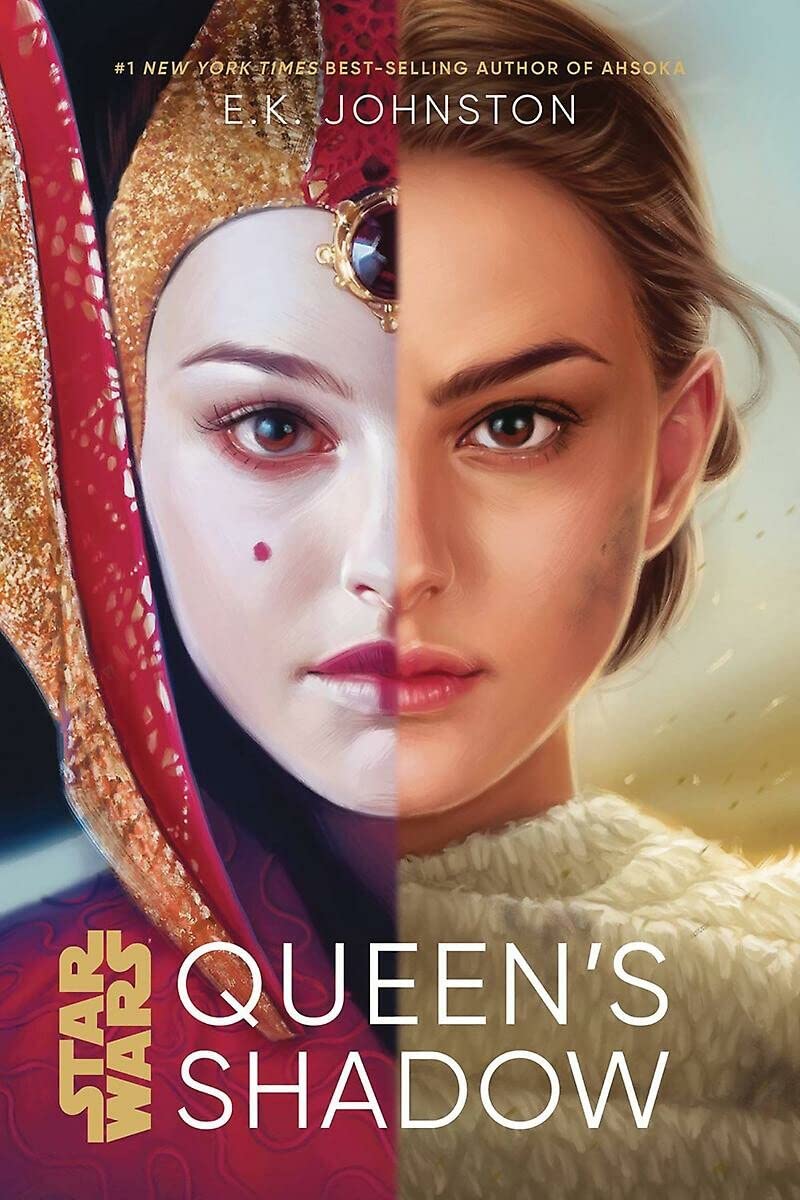
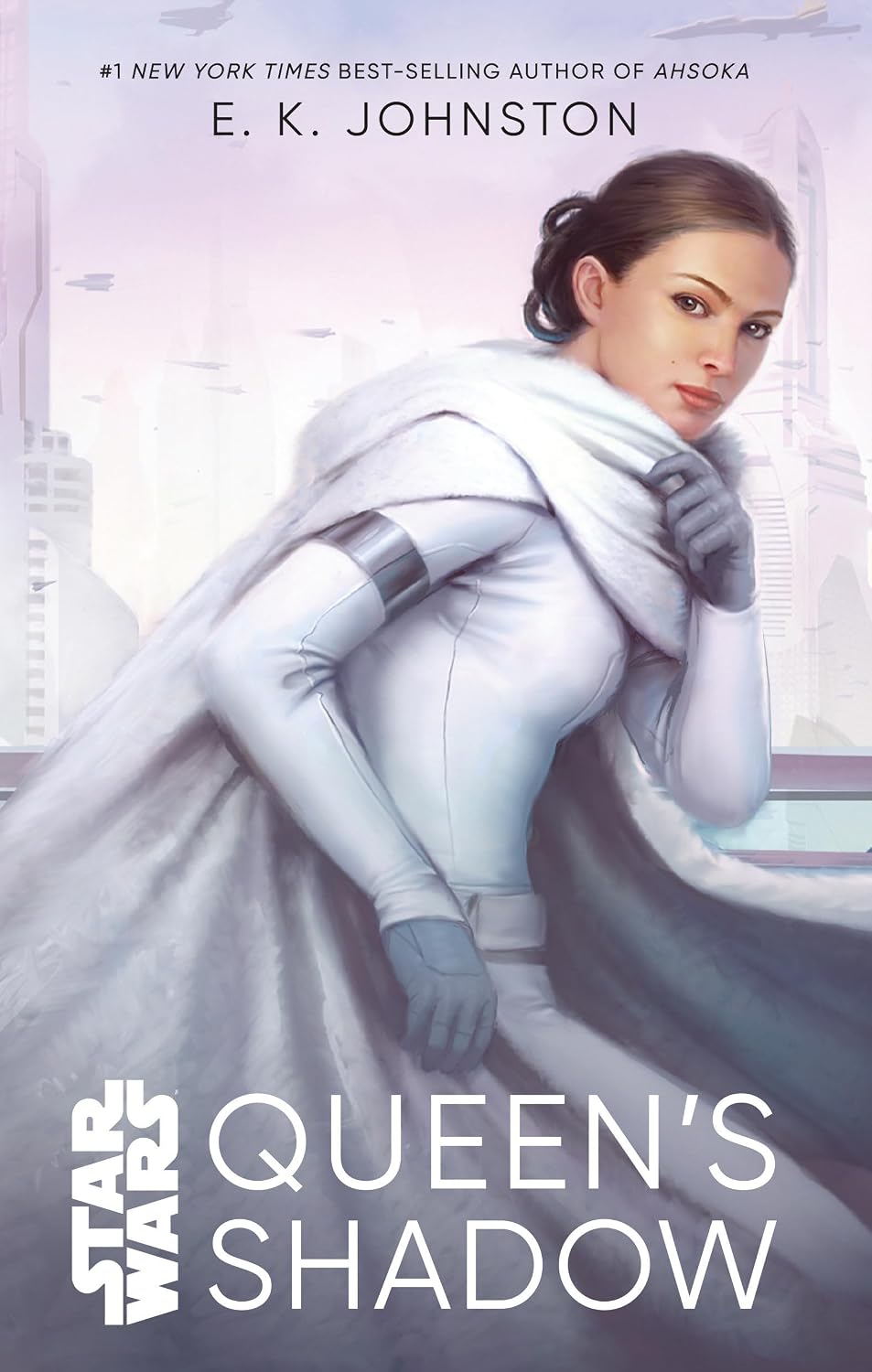
Left: 2019 hardcover with art by Tara Phillips. Right: 2020 paperback with art by Tony Foti.
Table of Contents
On Franchise Fiction, Again
On Padmé and the Queen Trilogy
Reading Queen’s Shadow
Parting Thoughts
On Franchise Fiction, Again
Franchise fiction—tie-in novels, story collections, and comics based on corporate-owned media properties—has been a crucial strategy for transmedia storytelling for nearly a century, but the last two decades have seen a gutting of the franchise fiction landscape. In the 1970s–1990s, it was virtually guaranteed that, if you liked a film, especially an sf, fantasy, or action-adventure film, there was probably a novelization of that movie, and if you liked a TV show, there was probably at least a novelization of the pilot in addition to several original novels. Despite running for only a single season in 1978–1979, with a half-season revival in 1980, Battlestar Galactica had 14 tie-in novels (half of which were novelizations, but the rest original) and a later series of eight novels, co-written by Apollo actor Richard Hatch, that told his version of what happened after the show’s narrative ended. Even a show that very few people remember today, like the one-season Alien Nation (1989–1990), an extension of the 1988 film of the same name, had a series of 8 original franchise novels, which began publishing in 1993 years after the show’s cancellation.
Franchise novels keep media franchises alive for fans—and IP holders—in between the more expensive, less frequent television, film, and video game entries that otherwise define franchises for most of the public. And one of their key functions, especially for a major franchise like Star Wars or Star Trek, is to fill in the gaps—to show to readers one way things might have happened between films or episodes, not necessarily to explain something that didn’t make a lot of sense (though that happens, too), but often, for better or worse, to lend a semblance of realism to the otherwise sometimes unrealistic narrative progression in a given storyworld. One might wonder, for example, what Captain Kirk or Mr. Spock did before their five-year mission on the Enterprise, or one might want some background on Qui-Gon Jinn’s rocky relationship with the Jedi Council in The Phantom Menace, or one might want to know what the other SG teams get up to in Stargate SG-1, while SG-1 is getting all the attention. And franchise novels and comics have expanded all of these stories, and told many more.
Whether that’s “good,” whether it renders films and television subject to the tyranny of realism, whether it’s a symptom of the increasing “otaku-ization” of media culture, or whether it’s the sign of a certain capitalist logic that needs to proscribe every minute detail of a franchise’s storyworld for potential monetization—these questions are always orbiting franchise fiction. But it’s also clear that franchise fiction is incredibly significant to readers, authors, and fans, to whom such fictions go beyond just offering “more details,” and the ways of engaging and making meaning with franchise fiction are as myriad as its authors and readers. Moreover, franchise fictions can teach us quite a lot about the changing strategies of transmedia storytelling, the state of media industries, and publishing’s position in a conglomerated multi-media environment. Not to mention all the other things fiction does by being a reflection of and critique of the social, political, and economic worlds readers and authors inhabit. What’s more, because franchise fictions so often contradict one another, as well as other texts in a transmedia franchise, and because franchise fictions so often offer new and/or alternative accounts of narratives that are told in other texts, franchise fiction exuberantly and rather productively makes clear how uneven, imperfect, and in flux are the storyworlds, narratives, and canons of transmedia franchises. To that end, I’ve argued several times (most recently here) for the need to take franchise fiction seriously, that every franchise novel is an opportunity to learn something.
On Padmé and the Queen Trilogy
E.K. Johnston’s Queen’s Shadow, the first in a trilogy—followed by Queen’s Peril (2020) and Queen’s Hope (2022), and variously called the Queen or Padmé trilogy, but I’ve opted for the former since all the books start with that word—about Star Wars’s Padmé Amidala Naberrie, is a great example of why franchise fiction should be taken seriously. Franchise fiction in major transmedia franchises like Star Wars and Star Trek usually takes one of several forms: it can fill in gaps to explain what happened between X and Y events, often between two films or episodes after there has been a significant narrative time jump; it can tell addition narratives not mentioned or even hinted at in a franchise’s main narrative texts (this is especially common for franchises whose main textual form is TV, such that new novels often essentially function like additional standalone episodes); it can tell completely new stories using new characters, places, and events not referenced elsewhere; and it can offer an “alternative perspective” on the events of another text. Of course, some franchise fictions do all of these and these are by no means the limit of what’s possible, just the most common forms of franchise fiction.
Queen’s Shadow is a “fill in the gaps” kind of story that also gives subtle new perspectives on the events of The Phantom Menace (1999) by telling us about Padmé’s life in the aftermath of the invasion of Naboo, most importantly how she became Naboo’s representative to the Galactic Senate and how she so quickly rose to prominence in the senate, so that by the opening of Attack of the Clones (2002), some 10 years later in the storyworld, she was considered one of the leaders of the Loyalist faction. Franchise fictions that fill in the gaps between the events in other texts help us understand how and why things change, but as Johnston makes clear with Queen’s Shadow, they can also do important political work—in this case, feminist recovery that recenters Padmé in the Star Wars narrative and gives her a life beyond the stilted dialogue and the awkward, unbelievable progression of her romance with Anakin in Attack of the Clones or the absolutely abysmal character assassination she dies of in Revenge of the Sith.
Such recovery is necessary because Padmé has been comparatively overlooked by the franchise, even during the prequel era (1999–2005) when it would have made sense to elaborate her story. But, instead, the focus was almost exclusively on Anakin, Obi-Wan, the Jedi Order, and the battles of the Clone Wars, which would become the focus of an entire animated television series, The Clones Wars (2008–2013, 2014, 2020; not to be confused with an earlier series of animated shorts, Clones Wars [2003–2005]). Padmé plays second string in the otherwise quite expansive The Clone Wars series, with only a few key exceptions out of 133 episodes. Outside of select episodes of The Clone Wars and a handful of Star Wars comics, we have to go all the way back to 1999 and the publication tie-ins to The Phantom Menace to find any sustained treatment of Padmé as a character unto herself, and not a side character in Anakin’s narrative, notably in the middle grade novel, Star Wars Journal: Queen Amidala, that novelized the film from her perspective. There was also an obscure 16-page book, The Queen’s Amulet, released by Chronicle Books along with a keepsake jewelry box and a plastic replica of the titular amulet. To my delight, Johnston references this little-known, beautifully illustrated short story in Queen’s Shadow by making the amulet an important touchstone in the relationship between Padmé and her handmaiden/bodyguard/double Sabé—to whom she gives the amulet as a (romantic?) keepsake. The full list of Padmé’s appearances across all Star Wars media, most of which offer only marginal narrative and character development, can be seen here and here.
What’s clear from this brief summary of Padmé’s presence in Star Wars generally and franchise fictions more specifically is that Padmé has often been an afterthought in large part because, at least in the prequel era and during the storyworld events of the Clone Wars, most of the action focused on the Jedi, with Padmé often as a plot device or character development driver for others, notably Anakin. Even Ahsoka Tano (about whom Johnston has also written a novel), gets more story time and greater depth of character in most Star Wars media. And it’s clear, too, from so much of the marketing around especially The Phantom Menace that Padmé was framed as the character who would appeal to girls and young women, that she was imagined as their self-identifier in the story, their way “in” to caring about Star Wars. Of course, many boys and young men also loved Padmé, myself included—in fact, I still lament never having gotten the luxe Hasbro doll of Padmé as Queen Amidala in her Senate gown.
And while there is nothing wrong with leaning into the visuals of high, historically informed, and often eccentric fashion as a way of making her stand out, and thus emphasizing her girl(i)ness, Padmé’s highly feminine gendered presentation coincided with her general dismissal as “the girl character” of the prequel era and that reflected in the development of her story arc across the three films and the relative lack of interest in the publication of Padmé stories that could have helped to make her more than just a vehicle for others’ stories and development. In her book on women in Star Wars, Valerie Estelle Frankel glosses Padmé’s representation in the prequel era: “Nineties-style, she’s strong but not too strong” (45). For context, she quotes Anita Harris’s Future Girl: Young Women in the Twenty-First Century, on the social, economic, and political formations of girl power consumerism and third-wave feminism that informed Padmé’s story (and her young women fans’ lives) c. 1999–2005: “This kind of girl power constructs the current generation of young women as a unique category of girls who are self-assured, living lives lightly inflected but by no means driven by feminism, influenced by the philosophy of DIY, and assuming they can have (or at least buy) it all” (qtd. 45). Padmé can, seemingly, indeed have it all, even and especially the forbidden romance that causes her to lose all of the sensibilities and fierceness that made her interesting in the first place, so that she ultimately dies at the hands of her lover as the tragic consequence of his fall to the Dark Side.
Johnston’s Queen trilogy, then, is a wonderfully important—and, for some fans, a long awaited—effort at telling Padmé’s story and those of her handmaidens, particularly Sabé (played by Kiera Knightley in The Phantom Menace) and Dormé (played by Rose Byrne in Attack of the Clones), on their own terms—with Padmé front and center, revealing a character of significant depth who earns her role as queen and then senator in meaningful ways before being tragically betrayed by the man she trusted and loved. In doing so, Johnston’s trilogy smooths over a lot of the awkwardness of Padmé’s relationship with Anakin as presented in the films and goes some way toward making sense of why Padmé is as important as she is in the gargantuan scale of galactic politics. Notably, the trilogy launched with Queen’s Shadow during the 20th anniversary of The Phantom Menace, five years into the Disney Era (counting from the 2014 publication of the first Disney Era Star Wars novel, A New Dawn), and it was explicitly a Young Adult novel. All three of these contextual elements are important for understanding Queen’s Shadow.
The significance of Queen’s Shadow as a marker of the 20th anniversary of The Phantom Menace is perhaps obvious, since it serves as both an expansion of Padmé’s story for older fans who grew up with the prequels (and were clearly underserved by the initial wave of franchise fiction, at least where Padmé was concerned), as well as a potential entry into the story of Padmé for younger fans who came to Star Wars because of the sequel trilogy. In other words, Queen’s Shadow helps to make the sliver of an interesting character we glimpse in The Phantom Menace—arguably the film’s protagonist until the arrival of Anakin—into someone more fleshed out, more relatable, more to the standards of contemporary mainstream storytelling about women by women. And Johnston accomplishes this in the late 2010s publishing contexts of the Disney Era of Star Wars franchise fiction and the cultural dominance of YA fiction.
One of the interesting facets of Disney Star Wars’s engagement with franchise fiction is its embrace of YA fiction, a highly gendered publishing category ostensibly for teens but whose audience includes a preponderance of adults and is a leading driver of fiction sales in the twenty-first century. Prior to the Disney purchase, of course, the Star Wars franchise had publishing deals with Scholastic to release children’s and middle grade books (e.g. the Jedi Apprentice [18 books, 1999–2002] and Jedi Quest [11 books, 2001–2004] series) and with Berkley to release young adult novels (prior to the genrefication of YA as we now know it), most notably the Young Jedi Knights series (14 books, 1995–1998). But Disney explicitly embraced the readership and culture of YA in the mid-2010s in an effort to appeal to girls and women, to diversify the Star Wars audience—especially important since Rey was the star of the sequel trilogy.
Disney’s courtship of the YA world began with 2015’s Lost Stars by Claudia Gray, released in anticipation of The Force Awakens. Disney continued to publish novels by known YA talents, including Beth Revis and E.K. Johnston, who made her Star Wars debut with the YA novel Ahsoka (2016). Notably, most of the YA Star Wars novels have focused on the stories of the franchise’s women characters—Leia, Ahsoka, Rey, Jyn Erso, and Qi’ra, to name the most obvious—and on thematic mainstays of YA fiction, especially personal growth, romance, and a mild confrontation with patriarchy (though rarely stated as such). YA fictions have been a prominent part of Disney’s franchise fiction strategy, allowing them to court new audiences and tap into that sweet, sweet YA money, so it was only a matter of time before Disney revisited the story of Star Wars’s fashion icon, rabble-rousing senator, secret wife of Anakin, and mother of the Skywalker twins with a trilogy of novels by an author who had already proved herself a successful YA author for the brand before.
And all of this took place within the larger contexts of Disney’s purposeful push to commodify feminism in the brief window of the 2010s when that was still an appealing corporate strategy. Which does not, of course, invalidate Queen’s Shadow’s feminist sensibilities, but it does mean that, whatever its feminist politics, the novel is at the same time a corporate product, like all franchise fiction, and thus its politics are in some way bound by the limits of what Disney (and the Lucasfilm Story Group) will allow. Franchise fiction is a potent reminder that the text and the means of its production—which in this case includes an extensive system of corporate IP management and oversight—are forever in (productive) tension.
Reading Queen’s Shadow
Johnston’s novel takes place in the first four years after The Phantom Menace. The blockade and invasion of Naboo by the Trade Federation took place during Amidala’s first two-year term as elected queen of Naboo. The novel picks up right at the end of Padmé’s second term, on the day of the election of a new queen, Réillata, who served a previous, single term several years prior to Amidala’s. Padmé believes it’s bad form for a ruler to return to office later in life—because, you see, Réillata is a whole 23 years old! But, when meeting during the royal changeover, Réillata points out that at 15, when she started her first term, she was still figuring out who she was; at 23, she believes she’ll be a better, more attentive queen. Of course, none of this explains the weird fascination Naboo has with electing teenage girls as monarchs, but I think we can extrapolate from the idea that Naboo is a supremely wealthy, peaceful, and almost post-scarcity society that, on account of the freedoms and rounded education they are afforded, their youth are much more intelligent, independent, and self-sure than most youth in our society. Padmé herself had participated in the Galactic Senate’s Youth Legislative Program as young as twelve and her father, Ruwee, a politician of some sort, took her on aid missions throughout her childhood.
The beginning of the novel establishes that Padmé hasn’t yet decided what her next move will be. She might do aid relief work to combat slavery, as she was deeply affected by discovering slavery still thriving in the Outer Rim during her stopover on Tatooine. But she’s dreading figuring out what to do next, especially as she sees her handmaidens, who also served as her bodyguards, body-doubles, confidants, and friends over the past four years, each have a vocation and future life awaiting them. All except Sabé, her closest friend. But Padmé worries that she doesn’t really know how to be a person, that she is only politics—and this is a major undercurrent throughout the novel, as Padmé struggles to figure out who she is and to marry her political alter-ego, so carefully crafted as the ruler of Naboo under the assumed name Amidala, with whoever it is she wants to become.
Johnston’s narrative reveals, too, that political tensions have remained high in the wake of the Trade Federation occupation, which was just one symptom of the social, economic, and political tensions roiling beneath the surface of galactic politics, especially in the Mid Rim. Johnston also hints that the Federation’s occupation was much more brutal than The Phantom Menace let on, including prison camps and the torture of political targets, like Padmé’s handmaiden Saché. A political rift has also formed on Naboo in the aftermath of the traumatic invasion, with a faction pushing the traditionally peaceful planet to militarize and build planetary defense weapons, while Amidala has stressed pacifism, interplanetary cooperation within Naboo’s Chommell sector, and working through the democratic institutions of the Republic. This rift mirrors the larger conflict playing out in the Galactic Senate, which Padmé becomes directly involved in over the course of the novel. The rift on Naboo, though, is personal to Padmé, pitting her against the chief of her own royal security service, Panaka, who eventually becomes governor of Naboo and a Moff under the Empire, thanks to his close friendship with Sheev Palpatine (Johnston notes this in the novel’s epilogue and borrows it from the YA novel Leia, Princess of Alderaan [2017] by Claudia Gray).
Queen’s Shadow is primarily about how Padmé becomes the Naboo senator and how she rises to galactic prominence. Padmé’s future is decided for her, and she accepts with a sigh of relief, when Réillata asks her to fill the vacant senatorial seat. While Padmé heads to Coruscant to begin the lengthy orientation of a Galactic senator—accompanied by Panaka’s estranged wife Mariek, as her new captain of the guard; Mariek’s nephew, Typho, as her other guard; Mariek’s niece, Versaat, as pilot; and two new handmaidens, Dormé and Cordé—and is thrown to the wolves of galactic politics, complete with the attention of a nonstop Coruscanti news cycle fixated on the queen-turned-senator who took down the last Supreme Chancellor with a single speech, Sabé goes with Tonra, a Naboo former royal security officer, to Tatooine to pursue a more direct approach to freeing slaves and to track down and free Shmi Skywalker, if she can. Unfortunately, Sabé plays it all wrong: she’s too goody-goody to successfully infiltrate slaver traders and she overlooks the fact that there was already a anti-slavery resistance movement on Tatooine (which the novel hints might include a young Beru, later Luke’s adoptive aunt). Of course, the resistance movement doesn’t trust her after seeing Sabé try to get in with the slavers, so Sabé settles for purchasing twenty-five slaves and freeing them. This side plot winds down rather quickly, though, as Sabé is called to Coruscant to help Padmé deal with the complexities of senate politics and the plots against her reputation—and her life.
The first half of the novel focuses on Padmé learning how to play at politics in the gargantuan arena of the Galactic Senate. After all, tens of thousands of systems—and corporations—are represented in the Senate and Naboo is only one minor world from the Mid Rim. But Naboo is wealthy, artistic, cultured, and made all the more important because of Palpatine’s decades of service to the Senate and his leadership of it now, thanks to Padmé. But Padmé finds that her efforts to save Naboo from the Trade Federation’s illegal occupation by circumventing the processes of representative democracy to oust Vallorum and invest her own planet’s senator with the chancellery ruffled feathers among those who consider themselves “loyal” to the Republic itself. Hence, the Loyalist faction: Bail Organa of Alderaan, Mon Mothma of Chandrila, and Onaconda Farr of Rodia, to name the most prominent figures, who are all rather suspicious of Palpatine. At the same time, Padmé deals with constant negative news stories about her inexperience and even an assassination attempt, all of which her team traces back to the Trade Federation and Nute Gunray, who continue to be found not guilty in the Republic courts.
Johnston does an excellent job honing in on Padmé’s search for personal identity, meaning, and experience—something to grab on to, to define herself as for or against in the context of the suddenly expanded political arena she finds herself in. Padmé notices time and again that politics at the Senate seems to mean thinking in abstract terms about policies, rather than about the people and lives affected by those policies. She sees multiple motions to protect people’s rights fail in favor of corporations or more powerful planetary systems that want to exploit their weaker, poorer galactic confreres. Piracy and slavery proliferate as the Senate does nothing, deferring motions, voting them down, and sending them back to committee, where bills get watered down so that, for example, the only way to talk about slavery in the Senate is to discuss restrictions on shipping.
Johnston wonderfully and painfully captures what Lucas was after in the prequel films, as so many complained, with all that talk about trade and taxation. Lucas wanted to highlight the way that systems of representative democracy can be ground to a halt, manipulated by, yes, a dark force behind the scene, but also out in the open by the sway of unchecked capital and political chicanery. In the end, the best Padmé can do is slowly gain the trust of the Loyalists, whom she believes to be more on the side of right than wrong, though she laments their lack of focus on the people. Palpatine has purposefully kept her off the committee on slavery and she doesn’t seem to notice that he hampers her efforts at every turn…
After a short vacation home to Naboo, during which Padmé nearly gives up on the idea of being Senator, after seeing her friends and former handmaidens thriving in their personal lives—Saché as a politician on Naboo, Rabé as a musician, Eirtaé as an artist, and Yané as an aid worker—and her sister starting a family, while all she has managed to do is join the committee on permacrete transportation policy, a crisis strikes. And it provides just the opportunity Padmé needs to begin pulling the levers of power to make some changes in the galaxy. Massive earthquakes have unexpectedly hit the Mid Rim planet Bromlarch and destroyed the planetary aqueduct system the population relies on to irrigate crops. Classic international aid crisis! Padmé joins Senators Rush Clovis of Scipio and Mina Bonteri of Onderon (both future Separatists and characters introduced in The Clone Wars) on a mission to assess the damage on Bromlarch and the likely cost of recovery. But when they return and present a motion to aid Bromlarch, the motion is swiftly defeated and the Trade Federation approaches the planet’s senator with an exploitative offer that would put Bromlarch in significant debt.
The climax of the novel is not an action piece—though there is a brief encounter with space pirates—but Padmé’s efforts to write and pass the Mid Rim Cooperation Motion. The bill would incorporate multiple worlds, including Kashyyyk and Malastare, by ensuring free trade of needed goods and labor between the cooperating planets of the always overlooked Mid Rim worlds. No planet would be in debt to another and the Motion would also establish a way to protect Mid Rim trade routes from pirates while also addressing underlying socioeconomic issues that lead to piracy. Bromlarch could rebuild without becoming a vassal of the Trade Federation. Of course, Johnston is rather sparse on the details of how all of this would work, as she is (to my dismay) with much of the practical matters of galactic politics, but what Padmé creates is a kind of Mid Rim New Deal that recognizes the need for reform in the Republic to address intersecting and interplanetary socioeconomic issues at a time when democracy has been weakened by bureaucracy and capitalist interest, when the Core worlds sit comfortable while the rest of the galaxy is left to its own devices, while piracy proliferates and slaves are passed from seller to buyer.
It’s worth quoting at length Padmé’s speech to the Senate introducing her motion, which I’ve cut together to excise the descriptive text and dialogue tags, since I think it demonstrates how well Johnston captures Padmé’s voice and mirrors Amidala pleading unsuccessfully for the Senate’s aid just a few years before:
“Senators of the Galactic Republic, […] the last time I spoke to you, it was to ask for aid to be given to my planet. I stand before you now with a similar request, but for systems that are not my own. Our service here is done in the name of our homeworlds, but we represent all the citizens of the Republic, and it is by virtue of this coalition that we are able to undertake greater tasks than we would as individuals.
The planets of the Mid Rim have been under siege by pirates and we have not acted against them[. …] I understand your hesitancy, for it is mine, too: I am reluctant to arm the galaxy any more than it needs. But my friends, we do have some need. Our shipments are being taken, and the pirates who take them are only looking for security and enough food to feed their own. We must act swiftly.
Appearing on your screens now is the Mid Rim Cooperation motion[. …] You will note that a number of systems benefit from the proposed trades and acquisitions.
Not only are we able to send necessary resources to Bromlarch, [… but] Bromlarch will be able to pay for the supplies without going into debt, and the whole of the Mid Rim will benefit.
But we cannot continue to send such valuable resources to star systems without adequate protection[. …] Since this is a Republic exercise, it must be guarded by Republic ships. Only then can we guarantee the safe passage of the Wookiee laborers to Bromlarch. Only then can we guarantee the safe trade of credits for fuel between Malastare and Sivad. Only then can we guarantee that the ships carrying food from Thiafeña and Naboo to Bromlarch will arrive intact.
And perhaps, in working to maintain this guarantee, we will turn those who have fallen to piracy to better paths[. …] I know they have called me idealistic and naive, and you, my friends, have agreed with them. I do not hold it against you, and I do not apologize for my faith in democracy and what this body can achieve when it acts together. Let us act together now. For Bromlarch. For the Mid Rim. For the continued safety of the Galactic Republic.” (314–316)
And Padmé is successful: the Motion passes and Bromlarch is saved. It’s a win for Padmé’s belief that the good of the people should drive policy. The success also cements her reputation as one of the foremost senators in the galaxy, a staunch advocate for Loyalism, a close ally to Bail Organa and Mon Mothma, and someone who gets things done—definitely not the lapdog of Palpatine, who is very much dismayed by the Motion’s success. Behind the scenes, his plotting has failed, his secret servitor Senator Bonteri is chastised, and, yet again, the hidden Sith Lord has been outmaneuvered by Padmé without her knowing she’s fighting a clandestine political war for the life of the Republic.
The speech captures the powerful, if admittedly thin, political critique of capitalism and the failures of institutions of governance expressed by Lucas in the prequel films and no less germane in 2019 or, now, in 2026. In just a few short paragraphs, Johnston expresses Padmé’s seething frustration with the malaise of the Republic, with its or its representatives’ failure to protect the people they purport to serve. Of course, contradictions abound: Padmé herself was not elected, merely appointed because she was already powerful and well-known. All of the Loyalists Padmé works with are nice people, sure, but they don’t seem to hold any real interest in political change. They believe wholly in the system and Organa suggests to Padmé that if democracy isn’t working, it must be made to work (to which she points out that trying to make democracy work for Naboo… well, it didn’t work!) Yet while Johnston has to write within the canonical bounds of Padmé’s actions—by the time she dies in Revenge of the Sith she is still a Loyalist; it is Padmé who makes that most chilling observation of the prequel films: “So this is how liberty dies: with thunderous applause.”—she also pushes at those boundaries, showing that Padmé is hardly pleased with the limitations of the Senate.
By the end of Queen’s Shadow, Padmé has come to learn, essentially, that her frustration with the limitations of the Republic will forever be in dialectical tension with her belief in the Republic and democracy as the drivers of good in the galaxy. Queen’s Shadow suggests a sort of baseline liberal ideology—a belief in the good of democracy, even when that democracy continues to fail the people—that butts up against the fact that, in the Star Wars storyworld, the Republic is not actually a democracy. It’s not even, really, a representative one, since senators seem to be appointed by whatever government rules on a given planet, whether that’s a hereditary monarchy like Alderaan or an elected one like Naboo or even a corporation, which have representation in the Senate. This leads to a Senate that is totally disconnected from people, as Padmé rightly recognizes and laments, but at the same time she never seems to wonder what the people of Naboo want from her. She leads on the basis of her own moral compass and what she wants to achieve, how she wants to define herself in relation to the Senate and the other senators. Which is almost precisely the predicament of establishment Democrats in the US who have absolutely no loyalty to their constituents but continue to rule, more often than not, by virtue of having gotten in at one point and being proportionally better than the Republican alternative.
That’s the fascinating, sometimes frustrating tension at the heart of Queen’s Shadow’s vision of politics, which inherits the system of governance handed down by The Phantom Menace and everything that followed, and which ultimately points to one reason for the ability of elites and conspirators to capture, maintain, and exploit power. What Queen’s Shadow suggests, perhaps, through Padmé’s continued questioning of her relationship to her role as Senator—what that means, how she can actually help people without abstracting everything into faceless policies, whether she can overcome everyone else’s cynicism and malaise about political change—is that everything that happens in the prequel film era, everyone’s good faith efforts at maintaining democracy and defending the Republic, are essentially a series of tragic failures caused by working within institutions that were always bound to be captured, corrupted, and remade to work against the people.
Parting Thoughts
There’s a particularly powerful moment in Queen’s Shadow when Padmé explains to Senator Clovis why she is fighting so hard to aid a planet that isn’t even hers. She recounts being taken by her father on an aid mission to Shadda-Bi-Boran when she was seven, an experience described in scenes cut from Attack of the Clones and included in R.A. Salvatore’s novelization, and recast by Johnston here:
“The sun was dying and we managed to relocate the entire populace, but we couldn’t replicate the environment properly. Whatever nutrients they got from their sun, they couldn’t get anywhere else.”
“What happened?” Clovis asked.
“They died,” Padmé said. “All of them. I have a few pictures, and there was a monument built afterward, but that’s all that’s left.”
Clovis searched her face, looking for something, though she wasn’t sure what.
“You would do it again,” he said.
“Of course I would,” Padmé said. “Maybe next time, one of our scientists would figure it out soon enough to save someone. Maybe next time, there would be survivors. I would try a thousand times, Clovis, even if I only ever saved one being. I would try ten thousand times.”
I’ve always found Padmé to be a compelling character: the girl queen who stood up to the Trade Federation, risked her own life, united the two species of her planet (the ostracization of the Gungans, the indigenous people of Naboo, is never really dealt with, although the novel makes clear that Padmé changes the laws to allow Gungans to vote in elections for the first time and that she includes Jar Jar among her delegates to boost their representation), and grew up to lead the campaign for pacifism while trying to limit the Supreme Chancellor’s grab for power during the Clone Wars. Johnston gets all of this, she gets what makes Padmé worth writing a trilogy about. I also loved Padmé’s fashion, and her costumes throughout the prequel trilogy were a sight to behold—something Johnston also understands to be part of Padmé’s appeal and which she liberally indulges, describing Padmé’s costumes, their fabrics and designs, and their secret defenses in minute detail throughout the novel. Johnston knows her audience. She joys in the femininity of Padmé, her dresses, her desire for romance and a family, just as equally as she celebrates her tenacity, fierceness, and bravery.
Queen’s Shadow is a simple novel, yes, but it is one that—within the strictures of YA as a literary form—nonetheless sincerely explores Padmé’s emotions, motivations, worries, ambitions, friendships, and political ideals. As the above passage about the horrors of Shadda-Bi-Boran and what it taught the future queen and senator makes clear, Johnston’s vision of Padmé is a woman who, knowing that the Republic doesn’t work very well for its people, but believing that it should, fights tirelessly for those ideals. Of course, Padmé’s own husband betrays her and helps bring about the destruction of democracy. And while the presentation of her romance with Anakin will never not be cringe-inducing in Lucas’s films (The Clone Wars does a much better job establishing their relationship), especially because it does not at all match the intelligent political actor Padmé is elsewhere in the films, Johnston recovers and draws out as much of that intelligent, strong Padmé as she can in Queen’s Shadow. She also protests the confounding, offensive idea that Padmé “lost the will to live”—for who could believe something so ridiculous, Lucas?!—and gives us an epilogue in which Sabé and Tonra commit to finding out how and why she really died (a reference to a storyline that played out in the Vader comics series).
Queen’s Shadow is an excellent beginning to a trilogy of novels that promises to give readers unsatisfied with Padmé’s treatment in the prequel films a version of the character’s story that shows she was more than a vehicle for Anakin’s narrative arc. And isn’t that what all franchise fiction is for, really? To play within the hyperdiegesis of the storyworld, to expand what we “know” about characters and narratives, while at the same time exploring through those expansions the implications of how other texts in the franchise tell their stories? Franchise fiction could be dismissed as merely wanting more of the thing you like, but I think just as often franchise fiction—like fanfiction—is an outgrowth of our dissatisfaction of how a story was told. Johnston has stepped up to say there was more to Padmé, to express her dissatisfaction with the films’ dismissal of Padmé as “the girl” of the prequel era: “strong, but not too strong.” And Johnston has given us in Queen’s Shadow a novel that, through Padmé, also wrestles with the contradictions of the films’ critique of democracy.
Queen’s Shadow is a productive, fun, engaging novel, if a bit slight with its simple, straightforward plot that somehow stretches to 350+ pages (this isn’t all that surprising, really, since I find a lot of the Disney Era novels have incredibly simple, confined plots that allow only the barest expansion of the storyworld, almost as if Disney is afraid of letting authors explore and do truly new things, especially with major characters—but that’s a larger conversation!). It’s also worth noting that there’s some quite interesting bisexual tension between Padmé and Sabé (at least as I read it) and even a steamy moment between Sabé and Tonra as their romance unfolds, though their relationship is otherwise downplayed in the novel, I think to the novel’s detriment, since Sabé’s story often reads as an afterthought despite the fact that Johnston seems to want to make this novel as much about Sabé as Padmé. Ever the handmaiden, I guess! Still, Queen’s Shadow is an excellent start to a promising trilogy that also happens to show why Disney Star Wars’s embrace of YA was a smart move.
To get notifications about new essays like this one sent directly to your inbox, subscribe to Genre Fantasies for free:


2 thoughts on “Star Wars: Reading “Queen’s Shadow” by E.K. Johnston (Queen Trilogy 1)”