The Great Hunt by Robert Jordan. Tor, 1990. Wheel of Time 2.
I have to admit, rather unfortunately, that Robert Jordan’s The Great Hunt, the second in his Wheel of Time series, was a difficult book to finish. It took me almost six weeks to finish this novel. That’s the longest it has taken me to read a book in at least two years, and certainly the longest I’ve spent reading a novel since I began to focus pretty seriously on the Genre Fantasies blog project. I’m surprised, and a little frustrated, because I really quite liked The Eye of the World. Yes, I found it to be on the whole a rather mediocre book, but it was nothing like I expected and it was certainly not the thoughtless “extruded fantasy product” I had come to expect based on the series’s reputation among fantasy critics. I concluded with the observation that The Eye of the World “is by no means a masterwork, but it is interesting and Jordan is iterating on the medievalist epic fantasy tradition in unique ways.” And I stand by that.
Some responses to my essay on The Eye of the World, however, questioned whether a novel having some interesting elements or unique iterations was enough to rationalize deep engagement of the sort I strive for here. I take the point! I’m certainly sympathetic to the question of whether critics need to engage with what they think of as “bad” novels simply because the “bad” novel might, here or there, do something not wholly derivative. To be clear, not every critic has to care about The Eye of the World or the next Brandon Sanderson novel or the newest romantasy bestseller, nor does every critic have to like or enjoy such fiction. But my approach to criticism goes beyond reviewing—i.e. deciding how good a book is and whether it’s worth reading—and is wedded to the sensibilities of the literary historian.
We critics each mark out our own terrain—what we do as critics, why we do it, why (we think) what we do matters—but it’s there, in the realm of literary history, that I live. And any critic in my neighborhood should strive to understand how and why genre fiction, and especially very popular genre fiction, resonates with so many readers in the ways that it does (even if, in some cases, the answer might seem self-obvious). I have absolutely zero interest in Sanderson, for example, but were I writing about 2010s epic fantasy—if that were my particular scholarly, critical, literary historical interest—it would be shameful of me to write his work off as drivel, to not ask “but why do people like it?” and seek the value, and the meaning of that value, that hundreds of thousands if not millions of readers find in Sanderson’s work.
The same goes with Jordan, who wrote one of the bestselling fantasy series of all time, possibly the third bestselling adult fantasy series after Tolkien’s The Lord of the Rings and Martin’s A Song of Ice and Fire. Jordan’s writing, then, needs to be taken for what it was: extremely important, deeply influential, and critical to understanding the shifting landscape of epic fantasy in the 1990s. I will tell you what I think about Jordan’s writing, about his characters, and especially about his shitty politics, but whether I think his books are “good” or not is essentially anecdotal. I want to understand Wheel of Time as part of the texture of literary history and I approach almost everything I write about here, on Genre Fantasies, from that perspective.
And, truthfully, despite not exactly enjoying The Great Hunt—with a few exceptions, that I’ll detail below—I don’t think it would be in the service of a better understanding of the history of fantasy fiction for me to sit here and, in a tone of dismissive smugness, tell you that I thought it was, for the most part, dreadfully boring. As entertaining as that might be, who cares? What would that add? Doing so would also obscure the fact that there’s actually quite a lot that’s interesting in The Great Hunt, whatever the reading experience was like for me, however much I think Rand is a drab, dull, uninteresting wet rag of a character. What I concluded about The Eye of the World could easily be reduplicated and expanded here: The Great Hunt is not a literary masterpiece, and is even less aesthetically and structurally impressive than The Eye of the World, but it is thematically and politically quite a productive text, it iterates uniquely on important ideas from the history of fantasy fiction, and it is also wildly inventive. I’d find it hard to say that the book is uninteresting, even if long stretches of it failed to engage me. In fact, I think of it more fondly after having read it than while I was in the midst of its nearly 700 pages.
Since I already provided a detailed framing of Jordan’s place in fantasy scholarship to date and a background for his biography in my essay on The Eye of the World, I’ll skip doing that here and dive straight into The Great Hunt. The one thing I will reiterate is that, according to his biographer Michael Livingston in Origins of the Wheel of Time (2022), Jordan spent years working on Wheel of Time, developing the storyworld and the general shape of the series’s narrative arc after receiving a six-book contract for the series in 1984, before drafting the first novel c. 1987–1989. The Eye of the World debuted in February 1990 and was followed by The Great Hunt in November 1990. The next four books were released in roughly twelve month intervals, but Jordan began to slow down with book seven, A Crown of Swords, which came out about 18 months after the sixth book. From there, the books came more slowly, closer to every two years. Jordan’s productivity in the early nineties, especially given the length of his novels, is frankly astounding and, interestingly, it’s the period of slowed productivity after book six that resulted in what many fans call the “slog” (i.e. books seven through ten, 1996–2004).
I wanted to preface my discussion of The Great Hunt with this idea of writing productivity to both marvel at both how quickly—and how much—Jordan wrote, but also to seed the ground of the discussion, because The Great Hunt reads like an immediate, breathless continuation of The Eye of the World, with seemingly no caesura between the two narratives. It reflects, I think, Jordan’s workmanlike, Kingian approach to writing: sit down, get it done, keep going. As a result, for better or worse, The Great Hunt feels very much like middle, or rather like more of The Eye of the World, rather than like its own separate book. In fact, the two books together read like one very, very long novel, or maybe a duology within the larger series. In that framing, the duology is about the revelation of the Dragon Reborn. The first half, The Eye of the World, surfaces the question: who among these three youths—Mat, Perrin, Rand—is the Dragon Reborn, the reborn soul of Lews Therin, destined to fight the Dark One in the Last Battle? The Dragon, by the end, is revealed to be Rand. The second half, The Great Hunt, then, is about Rand coming to terms with that revelation, accepting it as truth, and integrating it into his identity. From there, by the end of this duology and/or mega-novel, the series can proceed toward the Last Battle, twelve books later, in A Memory of Light (2013).
The Great Hunt shares The Eye of the World’s meandering plot structure, which is to say that it shares its predecessors awkward pacing, narrative breaks, and wonky distribution of perspectives. Where the first book spends over a hundred pages introducing its character, their relationships, and the immediate storyworld of the Two Rivers before disrupting it with Moiraine’s appearance and the revelation that one of the boys might be very special, and that both of the girls—Egwene and Nynaeve—could be trained as Aes Sedai, The Great Hunt treads similar structural ground. It sits with Rand and company in the fortress city of Fal Dara for more than a hundred pages as they each process the fallout of their journey to the Blight. Top of mind, of course, is the discovery that Rand is the Dragon Reborn. Which, apparently, the Emond’s Fielders seem to think means that he will go mad and either die or be killed by the Aes Sedai. Rand, stubborn and dull as a rock, doesn’t believe Moiraine, doesn’t believe the evidence of his own experience, namely his fight with Ba’alzamon and his use of the untainted saidin (the “male” half of the One Power). He (still) doesn’t trust Moiraine—none of the Emond’s Fielders do, except Egwene—and he certainly doesn’t trust that the Aes Sedai will leave him free to pursue his own path, as the Amyrlin Seat (the head of the Aes Sedai) claims when she arrives in Fal Dara.
Jordan is right to drag out this opening, because there are so many threads to this tapestry. Moiraine and the Amyrlin have been plotting to find the Dragon Reborn because they know that he is the only path to defeating the Dark One. Moiraine and other Aes Sedai, like Verin, have been tracking the prophecies about the Dragon Reborn and the coming Last Battle, and have noted that a great many of the prophecies are being fulfilled. There are rumors of the long-dead king and uniter of the world, Artur Hawkwing, returning with his armies from the continent of Seanchan to cleanse the world. The desert Aiel people are stirring. False Dragons are rising all over. Seals on the Dark One’s prison have been broken. The southern kingdom of Illian has called a hunt for the Horn of Valere (which is secretly in the heroes’ possession). Egwene and Nynaeve are to be trained as Aes Sedai and both of them are magnificently powerful, perhaps more than the Amyrlin herself. There is conflict within the White Tower and among the Ajahs (orders) of the Aes Sedai. There is a secret Black Ajah that serves the Dark One and Darkfriends are everywhere, even among our heroes. The Children of the Light are also on the move, crusading on the prophecy-laden peninsula of Toman Head. And if things couldn’t get worse, Darkfriends and Trollocs storm Fal Dara, steal the Horn of Valere, and break Padan Fain out of prison.
In among all of this narrative and storyworld chaos, throughout the novel the Emond’s Fielders each deal with a personal change. Egwene is finding her place among the Aes Sedai, making friends with fellow novice Elayne (princess of Andor) and with the seeress Min. Nynaeve is also training to be Aes Sedai, but she’s skipped a step and is given the rank of an accepted sister on account of her outsized powers, while also dealing with her inconsummatable romance with Lan, Moraine’s warder. Mat is still magically connected to the dagger he took from Shadar Logoth, and with it now stolen—along with the Horn—he is slowly wasting away. Perrin is wrestling with what it means to be a wolfbrother, though sadly in The Great Hunt we don’t get much of Perrin’s perspective and when I say he’s “wrestling” with his new identity I really just mean that Jordan states this is the case; there’s very little actual character development there. And, finally, as the group splits up—the women going to Tar Valon and the men chasing the Horn—Rand worries over his fate. Will he go mad? Will the Aes Sedai “use” him? Does he have any agency anymore? He most certainly does not believe he is the Dragon Reborn. That, he believes, is a trick by Moiraine, and he thinks he must instead be a False Dragon, just another man who can wield the One Power, who will go mad and hurt those around him. And as the narrative progresses, he learns increasingly how to safely channel that Power, to touch saidin and shape it to his advantage.
This is the state of things after the first 120–150 pages or so of The Great Hunt. The remainder of the book is divided into three more vague narrative movements. In the second part of the book, while Egwene, Nynaeve, Elayne, and Min study at Tar Valon—as told in only a tiny handful of chapters, unfortunately, despite being the more interesting storyline—Rand and the others pursue Padan Fain and the Horn of Valere, along with a complement of knights from Shienar. Jordan introduces several new concepts, like trackers, men who can smell badness (murder, ill-intention, violence, rage, etc.), as well as mirror worlds: other possible, alternative realities, which can be reached via portal stones activated by the One Power. Portal stones can also take users to Tel’aran’rhiod, the world of all possibilities, of which each reality is but a reflection. At one point in their search for the Horn, Rand, Loial, and the tracker Hurin wind up in Tel’aran’rhiod, where they meet a mysterious, supremely beautiful, and not at all suspicious (she is, in fact, incredibly, stupidly suspicious) woman named Selene, who poses as a damsel in distress but also seems to know everything and has a major hard-on for Rand. She is, we later learn, the Forsaken servant of the Dark One named Lanfear, a woman from the Age of Legends who was a lover of Lews Therin (aka Rand’s earlier incarnation) before he wedded Ilyena. Selene is a foil for Rand, consistently pushing him to do “great” things, to blow the Horn when they find it, or to wield the One Power. But Rand handily resists these temptations, despite Selene’s allure.
The third section of The Great Hunt takes place almost exclusively in the troubled kingdom of Cairhien, with a few chapters switching perspectives to the women in Tar Valon or to Toman Head and the Seanchan invasion. Having recovered the Horn of Valere, Rand, Hurin, and Loial wait for their Shienaran compatriots at an inn in Ciarhien. Here, Jordan delves temporarily into the local politics, exploring a kingdom in decline, ruled by the totalitarian king Galldrian who buys his subjects’ loyalties by paying entertainers to perform nearly constantly at various taverns and public stages. Parades are thrown every few hours and fireworks are set off every night. Galldrian has taken the Roman idea of blood and circuses and Disneyfied it, a fittingly reactionary argument in the twilight of the Reagan years for art’s ability to paper over social woes and appease the masses. Masses who are so appeased that they can’t tell the difference between Trolloc puppets on parade and the many actual Trollocs that Darkfriends have secreted into the city—and who threaten Rand and company, even stealing back the Horn.
While Rand is facing down Trollocs, losing the Horn (again), and discovering that his former mentor, the gleeman Thom Merrilin, survived the Fade in Whitebridge, Rand also tangles with the realpolitik of life in Cairhien, where everything is daes dae’mar: the Great Game, the Game of Houses, a constant maneuvering for status between Cairhienin families. It’s George R.R. Martin’s Game of Thrones years before A Game of Thrones (1996), only it’s not really described, just a vague idea that everything one does matters and has political and social consequences. (Having interesting concepts, but not really showing how they work in his storyworld, is starting to seem like one of Jordan’s calling cards.) Rand, for example, looks lordly, he’s foreign, he has the hair of an Aiel, bears a heron-marked blade, and travels with an Ogier, so naturally the houses of Cairhien take him for an important noble who is definitely playing the Game. So Rand gets invitation after invitation, but turns them all done. What a power move, they all think. This guy’s got game! He must be a real big shot. And eventually he gets invitations from Barthanes Damodred, the second-most powerful noble, and the king himself. When the Shienarans finally catch up to Rand, they quickly discover that it was Barthanes who stole the Horn of Valere and that he is likely a Darkfriend, so they accept his invitation and—after a great deal of deadly shenanigans that result in Padan Fain escaping through the Ways with the Horn and Barthanes dead—Rand, et al. must travel to the peninsula of Toman Head and the city of Falme.
While Rand has been cycling through finding and losing the Horn, and worrying incessantly over whether he should wield the One Power, Egwene, Nynaeve, and Elayne have been studying to be Aes Sedai in Tar Valon, along with Min, whom the Amyrlin has been using to divine possible outcomes of the chaotic events across the land that portend the coming of the Last Battle. (Moiraine is, very unfortunately, almost entirely absent from this novel.) Jordan gives us way too little of the women’s story, which is infinitely more engaging because Egwene and Nynaeve are actually interesting and Jordan writes these two young women with way more sensitivity, depth, and personality than he ever does Rand. Their story heats up when Liandrin of the Red Ajah takes them on a secret quest through the Waygates to Falme, ostensibly to protect them from the clandestine Black Ajah of Aes Sedai who have become Darkfriends. But really it’s to sell them to the Seanchan as damane or “collared ones.” Because Liandrin is herself a Black Ajah and the Dark One wants Egwyene and Nynaeve far, far away from events in the Westlands, far away from the Dragon Reborn.
And who are the Seanchan? Autocratic fantasy Japanese people who live on a continent to the west across the Aryth Ocean. Their soldiers dress like samurai, they ride monstrous beasts called grolms, they are ruled by an Empress, and their Aes Sedai are slaves known as damane, who are both more numerous and seemingly more powerful than the Aes Sedai of the Westlands. Centuries ago, Artur Hawkwing (aka Wheel of Time’s King Arthur) united all of the Westlands and sent his son, Luthair Paendrag Mondwin, to conquer Seanchan, too. Luthair never returned, but across the ocean he created an autocratic empire from the ashes of his conquests. Now, the “armies of Artur” have returned to the Westlands, invaded Toman Head, and set about integrating the locals into the Seanchan empire. The Seanchan are questionable worldbuilding at best, and at worst they’re a racist caricature of Eastern despotism. While the Seanchan let the conquered people go about their lives so long as they swear an oath of loyalty to the “Returned” (i.e. the Empress, who, by descent through Luthair, claims the Westlands as her rightful inheritance), Jordan goes to great lengths to describe the horror of Seanchan brutality and especially the degradations of their slaving practices when Egwene is temporarily enslaved, tortured, and brutalized by the Seanchan before being saved by Nynaeve, Elayne, and Min. I’ll put off further discussion of just how ridiculous I think the Seanchan are for a future book, since Seanchan plays a major role in the series.
In the climax of The Great Hunt, the many strings of Jordan’s tapestry—skillfully but ploddingly woven across what often feels like too many pages—come together in an impressive, explosive battle at Falme. Nynaeve starts shit in the midst of the town when she frees Egwene, demonstrating just how far her control of the One Power has come in the course of the novel, and just how intense her power is. Meanwhile, the Children of the Light have been advancing on Falme to face off against the Seanchan, whom they believe are Darkfriends. And Rand takes back the Horn of Valere, which Padan Fain had gifted to the general of the Seanchan. All hell breaks loose as these narrative threads come together and, in the heat of the moment, Rand directs Mat to blow the Horn. From the mists of legend ride Artur Hawkwing and the spirits of a hundred heroes and, like Aragorn leading the Dead Men of Dunharrow, Rand takes them to war. The army of legends drives back the Seanchan and the Children of Light alike, while Rand battles Ba’alzamon one on one. During the battle—which is, epically, projected into the sky so that the two look like storm giants clashing—Rand accepts that he is indeed the Dragon Reborn (on page 666, no less!) and that it is his destiny to fight the Dark One, yet again, as he has done many times throughout the cycles of the ages. But this time, he wants to win.
Rand’s major conflict in The Great Hunt, his whole reason for rejecting the earlier revelation that he is the Dragon Reborn, is that he doesn’t want to be “used.” He wants to carve his own destiny, to express his own agency, and so he insists, constantly, to the point of nauseum, that he is “just” a shepherd, he’s not special, he’s not going to touch the One Power, he’s not different to anyone, and he certainly doesn’t want to lead. Rand, like his namesake, is the ultimate individualist, a libertarian fantasy. He neither wants the responsibility of others depending on him nor does he want to be wedded to the destiny of prophecies that Moiraine, the Amyrlin, Selene, and many more ascribe to him. But over the course of his hunt for the Horn, Rand embraces the role of a leader and, in this climactic battle, accepts that he is the Dragon Reborn. The great symbol of this is the banner of the Dragon, which Moiraine had made for him in Fal Dara and snuck into his saddlebags. He is haunted by its presence throughout the novel, but by the end it flies behind him, held aloft by Perrin, as Rand leads the reborn heroes into battle. It’s a surprisingly harrowing conclusion that pays off nearly a thousand pages of Rand rejecting the hero’s call, and in accepting his place in the prophecy—notably, as a way of influencing how the prophecy unfolds—Rand triumphs, stabbing Ba’alzamon through the heart. It is a temporary victory, but one that declares, far and wide, that the Dragon is Reborn.
The intensity of Rand’s hesitancy to accept his role as the hero of prophecy, to integrate this into his identity, read to me initially as incredibly annoying, if only because, frankly, I think Rand is a dull-as-shit character and I would prefer to spend less time with his wallowing and pat self-reflection, and instead read more of just about any other character. But, given how excellent the pay off is in the climax of The Great Hunt, I almost respect both Rand’s and Jordan’s obstinacy. And, though I don’t enjoy Rand at all, it makes total sense in the context of the storyworld that a preternaturally powerful youth, who has discovered he may be the Most Important Guy, and that being That Guy might very well lead to madness and a new Breaking of the World, would actually struggle with such a discovery and might very well reject the fact until rejection is no longer possible. Moreover, Rand is ultimately convinced of who he is by seeing dozens of possible lives he might have lived flash before him when traveling through the Tel’aran’rhiod on the way to Falme, and seeing that in every possible life he fought against and rejected the temptations of the Dark One.
Charul “Chuckie” Palmer-Patel makes a convincing case, in her eclectic study of what she terms “heroic epic fantasy,” for Jordan’s narratological choices around Rand’s multiple rejection and ultimate acceptance of his role in the prophecy. She emphasizes the prominent structural role that recursiveness, iteration, and alternative imaginings play in The Great Hunt and throughout the entire Wheel of Time series. Palmer-Patel is one of the few scholars who has written about Wheel of Time in any depth and taken it seriously as a work of fantasy art that makes an important aesthetic, generic, and thematic intervention in the field of epic fantasy fiction. While I think she reads The Great Hunt a little too generously, and unnecessarily draws on ideas from physics and chaos theory that only vaguely and metaphorically relate (in large part because of her citations to earlier literary theorists who do the same), Palmer-Patel makes some excellent observations about prophecy, destiny, and the role of the hero.
Importantly, while other scholars read prophecy in fantasy novels as generating a foregone conclusion, Palmer-Patel argues that The Great Hunt consistently questions and challenges whether such conclusions are, in fact, foregone. She pays careful attention, for example, to how Jordan positions Rand and others’ constant questioning of prophecy; the way that prophecy is often vague, incomplete, and translated; and the ontology of “fate” in the Wheel of Time storyworld as the Wheel weaves—a process which the ta’veren, like Rand, can affect through their choices, in a push-and-pull between individuals and the texture of reality itself. Palmer-Patel’s reading is convincing, especially insofar as it privileges the process of reading alongside the character’s own development, rather than taking the conclusion of the narrative—namely, that Rand is the chosen one, that the prophecies will be fulfilled in XYZ ways, and so on—and working backward to argue that it was always going to end that way. The latter sort of reading is incredibly popular among scholars who, like Adam Roberts or Farah Mendlesohn, clearly find Wheel of Time not to their taste. And that’s fine! It’s not my favorite, either, but I appreciate that Palmer-Patel takes The Great Hunt, indeed the whole subgenre that its series belongs to, with its own narratological particularities, seriously and that she considers more generous, generative ways of reading.
Building on Palmer-Patel’s reading, I think one of the more enveloping aspects of the first two Wheel of Time novels is that so many characters know the legends or prophecies about how the world will end, about the things that need to take place for the Final Battle to come, and we watch as they recognize various events and persons as potentially fulfilling those conditions of possibility. There is some sense of inevitability to everything, yes. The Final Battle is coming, there will be a Dragon Reborn. But at the same time, the world Jordan has built is so sprawling, so riven with factional conflicts (and conflicts within the factions), with hidden histories and mysterious half-knowledges, that no one is actually sure what form the fulfillment of any prophecies will take. If The Eye of the World was partly about the powers-that-be confirming that the end of an Age is in fact coming, then The Great Hunt narrates the anxious pursuit of knowledge about what form the end of the Age will take; how the prophecies will be fulfilled; what is relevant and, just as importantly, what is not; whether things need to be made to happen or whether they simply will happen; and how much agency any individual, and especially the ta’veren, have in the events to come. (This is great shit!) The Great Hunt is about how the Wheel weaves as it wills, and tracing the Pattern, as if in the dark, to try to sess out what it wills.
That the Wheel wills at all is, again, a fascinating element of Wheel of Time. What it means for the Wheel to weave fates, to have a Pattern it intends, is surfaced throughout The Great Hunt. There is, we know, a Creator who set the Wheel of Time to weaving the Pattern—who, perhaps, dictates the Pattern itself—and who also imprisoned the Dark One in order to preserve the free will of beings in the universe. The Creator is not an active god; only the Children of Light seem to worship the Creator, though, as with the Wheel and the Pattern and fate, generally, just about everyone in the Westlands talks about the Creator and the Light as though they are significant forces in the metaphysical order. Especially by the end of The Great Hunt, there’s a lot about the cosmology of Wheel of Time that is unknown to readers, but it is clear that the Pattern weaves a moral arc that clearly bends in one direction, favoring good over evil. Evil—whether the Dark One, Mordeth, or Machin Shin, three different but potentially related evil powers—certainly exists in the Pattern, but the Pattern and its ta’veren seem to weave in reaction against evil, in favor of good, the Light, free will, life. Humans and other beings do evil, yes, and affect the Pattern as much as anyone else, but the very fabric of Wheel of Time’s universe is disposed toward the good.
In his admittedly quite funny essays on Wheel of Time collected in Sibilant Fricative, Adam Roberts begins his discussion of The Great Hunt with the observation that the prologue, which features a meeting of the most powerful Dark Friends in a kind of masquerade ball scenario (though I envisioned something more like the meetings of the Cult of Kosmos in Assassin’s Creed: Odyssey) “betrays the debilitating thinness of Jordan’s ability to conceptualize what evil is.” Roberts lampoons Jordan’s often awkward, uninspired prose and concludes that there is nothing of especial interest in this novel in large part because the stakes of fighting the villains are so laughably low:
The longer one reads this yarn the more unignorable it becomes that there’s nothing really at stake in Jordan’s battle of good and evil. The Evil are Evil because he says so, because they cackle and threaten like villains of a theatrical melodrama, occasionally because they kill people, but most of all because they wear black clothes. […] On the other side of the divide, the good are characterized mostly by an Epic Blandness, an almost transcendental Blandness that goes beyond Bland into ÜberBland.
Roberts is a sharp, witty writer and a keen, magnificently widely read historian of fantasy and science fiction, about which he has written multiple monographs in sff studies, in addition to having written a number of literary sff novels. One of the hallmarks of his critical style is shared with a number of other sff critics, who write about the most popular sff texts with a tone of dismissive smugness that clearly establishes a divide between those who enjoy or find meaning in a given text, and those, like the critic, who recognize it for the work of subliterate garbage it most certainly is. I am not like them, the critic intimates, and folks of taste and intelligence might be hard-pressed to disagree. Such dismissiveness in sff circles is often premised on the idea that the work in question is “merely” or “just” an iteration of something earlier, better, and more skilful, a work of “genuine writing.”
I’ve already conceded that Jordan is no masterworker. His prose is remarkably uninspired, his principal character is indeed dull as shit, and, yes, his villains—whether Lanfear or Mordeth or Padan Fain or Ba’alzamon—all read like Jeremy Irons’s performance as the evil mage Profion in Dungeons & Dragons (2000), but without the campiness that makes the film a cult classic. Roberts is right that, in Wheel of Time (at least so far), evil is quite goofy and if you’re of a certain mindset, that might put a reader/critic off the books entirely. In that case, it’s easy to miss the depth of the wordbuilding in which Jordan has set his otherwise rather thin vision of evil. And it’s that depth—the complexity of the cosmology; the questions about good and evil’s relationship to the Pattern; the status of the Dark One as the manichean antithesis of the Creator; the cyclicality of violence, world-breaking, and the many, many, many victories of the Dark One in Ages past; the malleability of fate and prophecy—that make Wheel of Time enjoyable to its fans. Moreover, evil is not evil in the novel simply because Jordan says it is, but rather because characters agree that it is. They also disagree about the moral status of acts, allegiances, and events. Think, for example, of the Seanchan; think of the horrid violence Egwene endures at their hands; think of the Children of Light, who imagine themselves pure and good, yet are anything but; and so on!
In the brevity of his totally understandable annoyance with The Great Hunt, Roberts misses that Jordan’s conception of evil is deeply indebted to Protestant Christian ideas about evil. Evil is the Enemy. It’s all that is bad, it’s sin and temptation and impurity. I don’t think this is meaningless. It certainly reads as a bit unexciting that what evil wants is to, I guess, rule the world or break it or destroy it all. It’s a little unclear what the Dark One’s final goal is. But what is clear is that evil is, seemingly, eternal and it fights ragefully against the good. Evil is woven into the Pattern because it is a part of the moral fabric of the universe, but the Wheel weaves subtly against evil, turning out a Lews Therin/Rand every Age to confront evil, over and over, in the seeming hope that evil will be, finally, defeated.
I don’t think this is uninteresting. Jordan presents evil rather simply, yes. At times gimmicky, for sure. But it’s not unserious and, for all that we could say Jordan “fails” to articulate something new or unique about what evil is and does, I’ve hopefully shown that how he writes evil into the storyworld is in fact compelling. I think for a great many readers—for whom this idea of evil is written into the texture of their own lives, especially if they grew up Christian in the United States or at least attuned to American Protestant ideas about good and evil—Jordan’s vision of evil is wholly familiar. And Wheel of Time makes it dangerously real, in the narrative of his storyworld, in very much the same way that Tolkien does. Yes, Ba’alzamon is an edgelord and Jordan’s dialogue is clunky as all hell, but the constant, present threat of evil in so many manifestations, lurking potentially around every corner, hiding even among the Aes Sedai, is not uncompelling stuff, even if it reads as repetitive or uninventive to someone who has read fantasy, literature, and religious thought widely. Indeed, I would hope someone who has read about American Christianity more widely than I have would have even greater insights into Jordan’s presentation of evil and especially his use of highly coded language, for example, of sin and (im)purity throughout this book, something I hadn’t noticed in The Eye of the World. (One thing I’m glossing over here for time’s sake is the politics of this understanding of evil, which is worthy of analysis and discussion, not just in Jordan’s work but in epic fantasy generally.)
All of this is to say that, even where this single topic of the conflict between good and evil is concerned, Jordan is anything but uninteresting—even when his language, his ideas seem simple. Roberts can have the point on Rand’s blandness, but I find The Great Hunt to be a surprisingly productive text, just as I did The Eye of the World. There are fascinating themes of destiny and free will, of the inescapability of being-in-history; there is a great deal of attention paid to trauma and emotional states, to vulnerability, and to desire throughout this novel; there are a dozen and more fascinating worldbuilding concepts, from trackers to Tel’aran’rhiod to the damane, all of which bear upon the major themes of the novel and the series and testify to the eclectic inventiveness of the writer; there is all the language of sin and (im)purity, which in the first novel circulates mostly among the Children of the Light but which shows up in just about everyone’s dialogue in the second novel; there’s the constant revelation that what the characters knows about the past of their own storyworld is fragmented, limited, almost unknowable; and there’s the persistent emphasis on just how terrifying the One Power is—for its users and for those who fear Aes Sedai and False Dragons alike. These are just a few things I pulled from the more than three thousands words of notes I took while reading The Great Hunt.
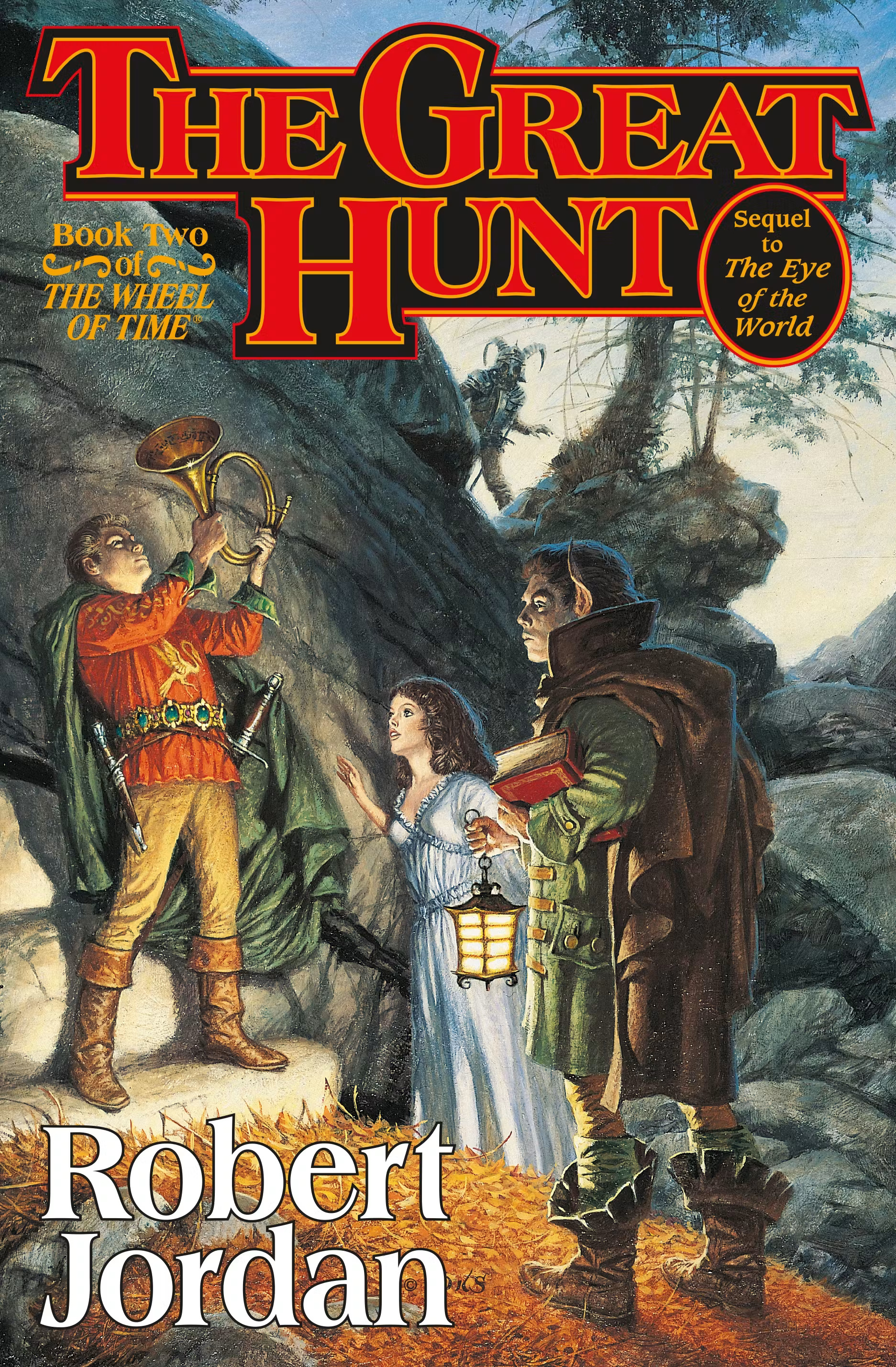
I will gladly reiterate that The Great Hunt is by no stretch of the imagination a literary masterpiece. I was often frustrated by how long it took me to read the novel, not because of its length (I adore fantasy doorstoppers), but in large part because of my complete and utter aversion to Rand as a character. Jordan wants Rand to happen; I want to erase Rand from my memory. But for all that—and Darrell K. Sweet’s miserably bad cover art does the novel no favors—The Great Hunt is a compelling continuation of Jordan’s Wheel of Time. It’s interesting, inventive, and is deeply engaged with the epic fantasy tradition, intervening thematically and conceptually in ways that cannot be ignored by fantasy critics who take seriously either this subgenre of fantasy or this period in fantasy’s history. I will almost certainly continue Wheel of Time into the third novel, The Dragon Reborn (1991), though time will tell if the Wheel wills me all the way to the Last Battle.
To get notifications about new essays like this one sent directly to your inbox, subscribe to Genre Fantasies for free:


2 thoughts on “Reading “The Great Hunt” by Robert Jordan (Wheel of Time 2)”