Heir to the Empire by Timothy Zahn. Bantam Spectra, 1991. Star Wars / Expanded Universe / Thrawn 1.
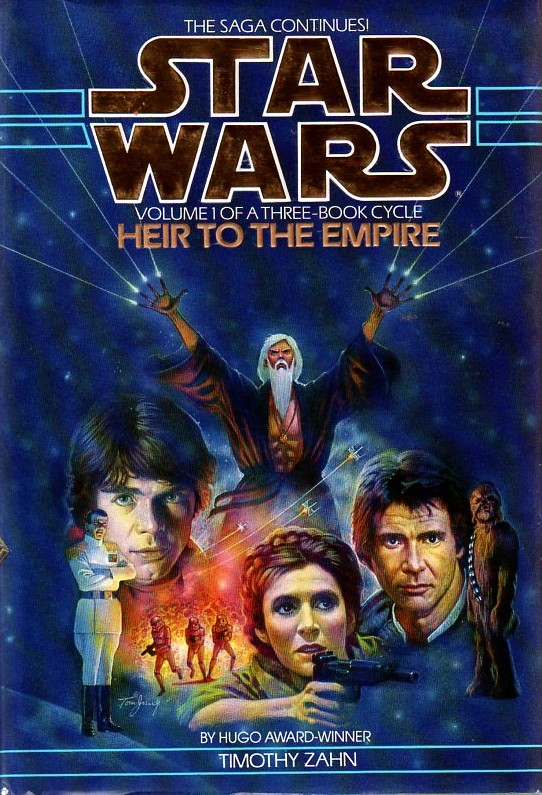
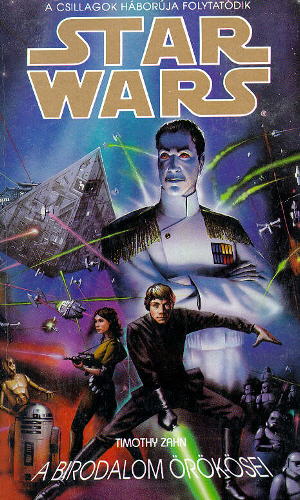
Table of Contents
The Rise, Fall, and Return of Star Wars Franchise Fiction
Reading Heir to the Empire
Parting Thoughts
In the annals of Star Wars franchise fiction, of which there are several hundreds novels and even more comics,Timothy Zahn’s Thrawn trilogy—Heir to the Empire (1991), Dark Force Rising (1992), The Last Command (1993)—is legendary. It’s the series that many fans point to as the best of what Star Wars novels have to offer: in writing, in story, and in how the series captured the Star Wars “feel.” It’s taken, for better and worse, as the benchmark for what a Star Wars novel should be. It also introduced a villain who has (inexplicably, I think) become an absolute fan favorite, the trilogy’s namesake: Grand Admiral Thrawn, a blue-skinned, red-eyed Chiss who leads the leftovers of the Empire against the reestablished New Republic some five years after the Battle of Endor, the destruction of the second Death Star, and the deaths of both Darth Vader and the Emperor in Return of the Jedi (1983).
Almost any discussion of Star Wars fiction involves Zahn and his Thrawn trilogy at some point, and the vast majority of listicles, articles, reddit threads, YouTube videos, etc. about how to read Star Wars novels without being overwhelmed by the sheer number of them recommend starting with Heir to the Empire and its sequels. In large part because they continue the story of the original film trilogy and offer a narrative that is of a similar scale and scope (sort of; I’ll discuss that below). But also because so much of the Expanded Universe of Star Wars fiction—i.e. the period of Star Wars novels and comics written between 1977 and 2014, and later rebranded by Disney and the Lucasfilm Story Group as Legends—takes Zahn’s series as a starting point. This is especially true of the dozens of novels and hundreds of comics set after the original film trilogy, which created their own semi-consistent pseudo-canon of events that took place anywhere between the moments directly after the Battle of Endor and the Legacy era, some 130+ years later.
Star Wars and D&D were the mainstays of my media consumption in the 1990s and early 2000s. I grew up mostly reading D&D and Star Wars novels. When I first got into comics, it was through Star Wars (and ElfQuest). This is my third time reading the Thrawn trilogy. The first time, I was in middle school. I’d seen the novel marketed years earlier in the mid-1990s through a line of micromachines toys that hung on Albertsons shelves in the cereal aisle. The micromachines box mimicked the size and look of the mass market paperback, whose cover art—especially the starlines shooting from Joruus C’baoth’s fingers—was forever branded in my memory. I read them again in college. And now, for the 35th anniversary of Heir to the Empire. Each time I’ve reread the Thrawn trilogy it has grown less impressive and more interesting—if not frustrating!
But first: historicize!
The Rise, Fall, and Return of Star Wars Franchise Fiction
The story of Star Wars franchise fiction—both its history as a publishing project, moving between publishers as a result of IP licensing deals, and the sprawling, often contradictory narratives that thrived in its pages—is long and convoluted, and cannot easily be summarized in a few hundred, or even a few thousand, words. A comprehensive history would take a book; and I hope there is a great critical history/study of Star Wars franchise fiction someday. Until then, here’s a too brief gloss of the period c. 1977–1999 to help understand the context in which Timothy Zahn’s Heir to the Empire came to exist and what it touched off.
Star Wars franchise fiction is as old as Star Wars itself. The first film’s May 1977 release was preceded by the Ballantine novelization—ostensibly written by George Lucas himself but actually ghost-written by Alan Dean Foster—in December 1976 and the launch of an ongoing comics series from Marvel in April 1977. The first six issues of the Marvel series adapted the film and proved so lucrative that Marvel kept the series going for another 101 issues, making up entirely new, incredibly wacky adventures for Luke, Han, Leia, Chewbacca, and the droids—not to mention the space-rabbit Jaxxon—until they cancelled the series in June 1986. Lucasfilm also hedged their bets against the financial failure of A New Hope (then, obviously, just called Star Wars) by commissioning Foster to write the pre-novelization of a would-be sequel for Ballantine’s new sf imprint, Del Rey, which could be shot for cheap to recoup money for Lucas’s next film. That book, the incredibly titled but not-so-incredible Splinter of the Mind’s Eye (1978), was the first original Star Wars novel and went through at least 15 printings before the original film trilogy was completed in 1983.
Following the financial success of Splinter of the Mind’s Eye, Del Rey released a handful of Star Wars novels over the few years. In addition to the novelizations of the next two films in the trilogy and prior to the release of The Empire Strikes Back (1980), Del Rey published the Han Solo Adventures trilogy (1979–1980) by Brian Daley (after Jack Chalker passed on the project) and followed it up in 1983, in the months after Return of the Jedi’s release, with the Lando Calrissian Adventures trilogy by the libertarian sf writer L. Neil Smith. Del Rey intended to publish a Leia novel, too, written by Leigh Brackett, who wrote the first draft of The Empire Strikes Back script, but she died in 1980 before seeing either the film or the Leia novel completed. After 1983, Star Wars novels were dead. The Marvel comics series continued for another three years and, in 1985 and 1986, respectively, Marvel also released short-lived children’s comics series tied to Lucasfilm’s animated TV series Ewoks (1985–1986) and Droids (1985–1986). Sadly, there were no tie-ins for the TV films Caravans of Courage: An Ewok Adventure (1984) or Ewoks: The Battle for Endor (1985). After the end of these comics series in 1986, Star Wars franchise fiction was dormant for the next half-decade. Until 1991, when Star Wars returned to novels and comics—and never went away.
A few things coalesced in the years leading up to 1991 to set the stage for a Star Wars franchise fiction renaissance. The first was that, in the late 1980s, Lucas was beginning to plan both the special edition edits of his original trilogy and production of a prequel film trilogy. This meant Lucas was open to new licensing deals that would put Star Wars back in front of people’s eyes and get the storyworld stuck in their minds again. As a result, longtime Lucasfilm exec Lucy Autrey Wilson became Director of Publishing to coordinate such deals. The second was that publishers were increasingly interested in low-effort, high-reward licensing deals, just like the kind that would bring Star Wars back to public consciousness. The third was that the 1980s—in large part because of the box office success of Star Wars, Star Trek, and Battlestar Galactica at the end of the 1970s—solidified sff as big business across media industries—film, television, publishing, and video games—at a time of intense conglomeration, with larger and larger corporate behemoths consolidating businesses across media industries under one roof. The fourth was that, as a result of publishers’ interest in licensing deals and the increasing profitability of sff franchises, a class of (mostly midlist) sff authors had sprung up in the 1980s that focused almost exclusively on writing franchise or tie-in fiction, often writing for the same company that their original sff writing was contracted to (though Star Trek fiction in the 1980s had proved that one could make a career writing just tie-in novels). And the fifth was that Star Wars had gained some attention in the tabletop roleplaying game (TRPGs) community through the publication of West End Games’s Star Wars: The Roleplaying Game beginning in 1987, which fleshed out Lucas’s thin but compelling storyworld from the films in greater detail, giving names to alien species, exploring the structure of the Empire, and even outlining Jedi powers, among much else.
On the comics front, Star Wars was relaunched via the six-issue limited series Dark Empire, written by Tom Veitch and drawn by Cam Kennedy (who hadn’t seen Star Wars until he was asked to do the project by Veitch). Veitch pitched the idea of a Star Wars comic directly to Wilson at Lucasfilm in 1988, initially with the idea that it would be set before the original trilogy and detail Darth Vader’s destruction of the Jedi. Wilson nixed that idea so as not to conflict with Lucas’s planned prequel films and Veitch settled, instead, on a story about the return of the Emperor (via cloning and soul transfer) and Luke’s fall to the Dark Side (albeit temporarily and only as a ruse to better understand how to defeat the Dark Side). Veitch originally had a deal with Marvel’s creator-owned Epic Comics imprint to publish the series, but that deal fell through after a management changeover and the comic was picked up by the indie publisher Dark Horse Comics. Founded in 1986, Dark Horse published a mixture of creator-owned titles and licensed comics for franchises like Godzilla, Alien, Predator, and Terminator. Star Wars was a perfect fit with the Dark Horse ethos and their model to support high-quality creator-owned material by supplementing their income with franchise work—most of which was pretty good stuff. Starting with Dark Empire #1 in December 1991, Dark Horse went on to publish hundreds of Star Wars comics until Disney bought Lucasfilm in 2012 and the license for Star Wars comics returned to Marvel in 2014.
While Veitch and Kennedy were busy trying to bring Star Wars back to comics in the years between 1988 and 1991, Bantam was negotiating a deal with Wilson at Lucasfilm to publish Star Wars novels. There had been some talk, early in the development of Dark Empire, about Bantam publishing a novelization of Veitch’s comic. But Bantam wanted one of their regularly contracted writers—and someone who would resonate more with sf readers—to do their first Star Wars novel. They offered several candidates to Wilson, who chose Timothy Zahn from among them. Zahn was a writer of space opera and military sf, who wanted nothing to do with Veitch’s Dark Empire. By 1988, when he signed a contract to write the Thrawn trilogy, Zahn had written nine novels and won a Hugo Award for the 1983 novella “Cascade Point.” Zahn hadn’t published with Bantam before but he must have already been under contract for the military space opera Conquerer trilogy (1994–1996) if Bantam considered him “their” writer. Most of his novels had been published by Baen Books, a successful indie publisher and a major force in the military and hard sf renaissance of the 1980s. He was always a midlist writer but one whose fiction was a sales leader for Baen and who had a devoted following because of his attention to space combat and scientific detail (he had pursued a PhD in physics before quitting to write sf full time).
Bantam’s and Wilson’s choice of Zahn would prove to be a smart one. The Star Wars brand would bring an audience by virtue of the franchise name alone and Zahn’s name would lend military sf credibility, hard sf seriousness, and the weight of a Hugo award. It was also a curious choice with significant impact on the development of Star Wars fiction, since Zahn’s style moved the Thrawn trilogy away from the mystical, space fantasy, pulp serial mishmash of the original films and toward something more grounded, “logical,” and space-combat-focused. This shift would ultimately be a hallmark of Star Wars’s Bantam era. Zahn’s Heir to the Empire and the two novels that followed were massive hits. Heir to the Empire topped the New York Times best sellers list for fiction the week of its release in June 1991, possibly the first time ever that an original media tie-in novel topped the fiction best seller list (I’ve checked some obvious candidates, but I might have missed something). Dark Force Rising debuted in the second spot in June 1992 and The Last Command in the third in April 1993.
Bantam was quick to build on the success of Zahn’s Thrawn trilogy and to diversify their Star Wars franchise fiction across age categories. By 1995, Bantam was publishing a Star Wars novel just about every month—and sometimes more—with one-off hardcover novels (by writers like Kathy Tyers, Vonda N. McIntyre, Kevin J. Anderson, Dave Wolverton, and more), short story anthologies (notably the Tales series, which told background stories, for example, about every single alien in the Mos Eisley cantina scene), at least one trilogy per year (e.g. the Jedi Academy trilogy by Anderson and the Han Solo trilogy by A.C. Crispin), and longer-running series (like the highly popular X-Wing novels by Michael A. Stackpole and Aaron Allston [9 novels, 1996–1999]) for adult readers releasing under the Bantam Spectra imprint, while middle grade series like Adventures of a Jedi Prince and the Goosebumps-inspired Galaxy of Fear were released by the Bantam Skylark imprint. The license for another middle grade series (Junior Jedi Knights) and a companion young adult fiction series (Young Jedi Knights), which collectively detailed the training of a new generation of Jedi at Luke’s new academy, and which focused on Han and Leia’s children—the twins Jacen and Jaina, introduced by Zahn, and the younger Anakin, introduced by Veitch—went to Berkley Books’s Boulevard imprint.
Bantam (and Berkley) published more than 80 novels in 8 years, all taking place after the original film trilogy, and attempted to build a relatively stable timeline of events across their growing archive. In doing so, they proved Star Wars franchise fiction could be a magnificent financial success and could sustain complex continuities for engaged fans while remaining equally open to new readers. (Indeed, the experience of reading a new Star Wars novel from the Bantam era, for me at least, was always one of excitedly chasing down events referenced from novels I hadn’t read; hence the need for the 1998 Star Wars Encyclopedia by Stephen J. Sansweet, which meticulously detailed everything from the Expanded Universe.) But in the lead up to The Phantom Menace in 1999, Lucasfilm switched things around and gave the rights for adult fiction to Del Rey (who had published the earliest Star Wars novels) and for all children’s fiction to Scholastic, who together expanded dramatically on what Bantam and Boulevard had built—all starting with Zahn’s Heir to the Empire.
Reading Heir to the Empire
The wonder of reading the first major Star Wars franchise novel (while interesting, the Daley and Smith trilogies were anything but major), published almost a decade before Lucas returned to his storyworld and fleshed out the events of the Clone Wars, the fall of the Jedi Order, and the rise of the Empire, is just how damn strange Heir to the Empire is—especially with decades of hindsight from the films, comics, novels, and games that all played a part in expanding Star Wars. Because in 1988–1990 when he was writing Heir to the Empire, Zahn had so little to go on: just three films and three West End Games RPG sourcebooks (it’s clear that the earlier Del Rey trilogies and the Marvel comics had no impact on Zahn, if he read them at all). Zahn also had the script for Dark Empire, then still in production, but he reportedly found it to be unserious and uninteresting, and didn’t want to put it in continuity with his novels. (Veitch brought back Palpatine! The space combat doesn’t make astrophysical sense! The planets are geologically impossible! All these complaints from the guy who described starships moving through space using “etheric rudders,” which suggests that space in Star Wars is not a void but an aether.)
Set five years after Return of the Jedi, Heir to the Empire begins a trilogy whose narrative arc is about Grand Admiral Thrawn’s challenge to the fledgling New Republic and the Dark Jedi (Sith hadn’t yet been applied to the Dark Side) Joruus C’baoth’s efforts to turn Luke Skywalker to the Dark Side. Zahn’s trilogy recycles the idea of the Empire and a Dark Side Force user vs. the same group of heroes (Luke, Han, Leia, Chewbacca, Lando, Ackbar, even Wedge Antilles—everyone is here!), with smuggler/crime lord/bounty hunter side quests thrown in for good measure, as the structuring principle of his own trilogy. In large part because, frankly, the structure works. But Zahn’s trilogy is uniquely iterative, it doesn’t simply recast the bad guys and it most certainly doesn’t give the Empire a superweapon for the heroes to inevitably destroy (this was a common narrative device in Bantam-era books). In fact, Zahn uses the familiar antagonism and enemy types to comment on the original films, broaden the storyworld, and deepen its history. The trilogy also introduced major elements of the storyworld that continued to play a role in the Expanded Universe timeline, including Mara Jade, Luke’s eventual wife; the Solo twins, Jacen and Jaina; the Outbound Flight project; the idea that the Empire, and the Emperor specifically, were xenophobic; multiple alien species, especially the Noghri and the Chiss; and the premise that the New Republic never fully defeated the Empire (indeed, even decades later in the timeline the Empire still existed as an official political entity and occasional ally of the New Republic).
Heir to the Empire is best thought of as an establishing shot, one in which the internal and external problems of the New Republic are laid bare, Thrawn and C’baoth are shown to be major threats, and several key sideplots—involving the Noghri, Mara Jade, and the smuggler Talon Karrde—are brought into focus. The novel opens with the mysterious, blue-skinned, red-eyed Thrawn—the secret thirteenth Grand Admiral, hand-picked by Palpatine himself, and newly returned from the Unknown Regions to assert his control over the Empire’s remaining forces, to destroy the “Rebellion” once and for all—demonstrating to Captain Pallaeon (the reader’s proxy) of the Star Destroyer Chimaera, the Imperial Navy’s flagship, just how brilliant a tactician he is. Pallaeon watches as Thrawn directs their small Imperial fleet in a sortie, making seemingly impossible predictions about the behavior of the Republic starfighters, and destroying them in record speed. How does Thrawn do it? He studies art history and from his studies he is able to deduce both the psychology of any human culture or alien species and, on the basis of that art-informed psychological profile, he infers what actions they will take down to their tactical maneuvers in battle. Thrawn’s theory that art is an apparently infallible psychological indicator that predicts the behavior of a statistically significant percentage of a culture or species, down to their movements in combat, drives his military success against the New Republic, which has retaken two-thirds of the galaxy from the Empire and established its capital in the Imperial Palace on Coruscant.
Thrawn is Zahn’s real interest and focus. He spends roughly a third of the novel detailing Thrawn’s quest-like efforts to assemble all the obscure components needed to pull off what would be a major victory—the heist of dozens of Republic capital ships from the Sluis Van shipyards—and establish the Empire’s long-term strategic advantage. Thrawn’s quest leads him to Wayland, where he intends to raid the Emperor’s secret storehouse of advanced weapons and technology, and also to recruit the storehouse’s guardian, a Dark Jedi left behind by Palpatine. But before he can go to Wayland, he has to go to Myrkr to harvest an obscure species native to the planet: the ysalamiri, furry sloth-lizards that have the unique ability to cancel out the Force at ranges of several meters (or kilometers, when amassed together). To get the ysalamiri, he needs the help of the smuggler Talon Karrde, who took over Jabba the Hutt’s criminal empire (minus the slaving and drugs, because he’s a good guy) and whose operation is headquartered on Myrkr; Karrde knows how to keep ysalamiri alive outside their natural habitat. With the ysalamiri, Thrawn can depower the Dark Jedi Joruus C’baoth (really an insane clone of the Jedi Jorus C’baoth) on Wayland long enough to convince C’baoth to join his cause. Thrawn needs C’baoth to use the Force to coordinate the activities of the Imperial fleet, just as Palpatine did (this is an interesting invention by Zahn, which later Star Wars texts dubbed Battle Meditation). And to get C’baoth on his side, he needs to give the mad man apprentices. To get the apprentices, Thrawn sends out the mysterious, sharp-toothed, gray-skinned Noghri assassins to hunt down and kidnap Leia, who is pregnant with twins, and plants rumors of a hidden Jedi master awaiting Luke on Jomark. And to pull off his heist of the Republic ships, Thrawn needs mining equipment, so he raids Lando Calrissian’s new mining outfit on Nkllon.
And so on.
You get the picture: it’s a series of set ups that all have to go exactly right for the plot to work out, with every new development depending on the perfect execution of the last. It makes for convoluted, yet entertaining plotting presented as a series of mystery boxes for Thrawn (Zahn’s proxy in this narrative) to open throughout the novel to reveal yet another detail, yet another example of his brilliant strategizing, his grand plan, to the captive audience of the always astounded Captain Pallaeon, who expertly models how the reader is meant to react. While Thrawn’s vision for an Empire reborn will eventually unravel by the third and final book of the series, The Last Command, in large part because his overconfidence leads to several key betrayals (by the Noghri, by C’baoth, by Karrde), in Heir to the Empire it’s clear that Zahn wants to make Thrawn into an untouchable genius, a different kind of enemy to Darth Vader and the Emperor. And, indeed, many fans think of Thrawn as one of the greatest Star Wars villains, if not one of the greatest sff villains, because Zahn is able to convincingly suggest Thrawn’s brilliance. Without, I must add, ever giving evidence of a brilliant thought forming behind Thrawn’s eerie red eyes. Rather, Zahn wonderfully torques the narrative around Thrawn and rhetorically positions everyone else in novels, allies and enemies alike, to think of Thrawn as brilliant, deep, calculating, brooding, unfathomable, etc.
This is what I have called “Thrawn syndrome”: when an author insists, usually through the narrator or through the reported speech of characters in the novel, that a character is brilliant, terrifying, supremely villainous, the ultimate antagonist, and more, but without offering actual evidence of those qualities in the actions, dialogue, or internal life of said character. Often, at first glance or in passing, the character seems to be compelling and deep, but that facade crumbles under even the faintest scrutiny. Thrawn’s theory of art is the perfect example of this kind of writing—if not the quintessential example. It’s a gesture at depth without ever having to be intellectually deep. To be sure, the idea that familiarity with a culture’s or species’s art could provide insight that might translate into a tactical upper hand is a fascinating, even compelling one. I certainly thought it was impressive, mind-blowing even, in middle school. And the idea seems, at first glance, like it makes some sense. After all, we are taught from an early age about how greed can be symbolized with the color green or anger with red. And is not the hermeneutic of suspicion a fundamental premise of contemporary literary criticism? Does not psychoanalysis posit that texts can, in fact, symptomatize underlying states of the artist or even the artist’s society?
But Thrawn’s theory of art assumes a slightly more disturbing reality than that of contemporary literary criticism or art history. His is a particular ideology, one in which biology translates to thought which translates to action. Demography is destiny. Behavior is an unbroken, predictable pattern that crystallizes in art. It’s Asimov’s psychohistory—that wondrous midcentury conception that married industrial management theory, psychology, and dialectical materialism into a reactionary intellectual novum—rendered into a tool of war. An aesthetic theory of mind for the science fantasy space opera. And yet there’s no substance to it, it’s the shiny chrome finish on the aluminum chassis of a thought-terminating idea, where the gesture at the idea, the meta-idea, is itself the point. Thrawn is a genius because he, like Hari Seldon, can see what others can’t, including you, the reader.
To that end, Zahn never gives us a single example of how Thrawn’s method of reading a species’s art translates into understanding their behavior—which elides anything like cultural difference within a species, to say nothing of differences between individuals—and how that necessarily translates into tactical advantages. In the novel’s opening military engagement, for example, Thrawn assumes two things: first, based on the movement of the Republic starfighters, that the pilots are Elomin; second, based on the accuracy of the first assumption and based on Thrawn’s study of Elomin art, that the starfights will respond predictably to certain tactics,. But there are no specifics here. What about Elomin art, for example, leads Thrawn to know (not suspect, but have sure knowledge) that because the Republic task force attacked a certain ship first, they were definitely Elomin. Hell, what allowed Thrawn to deduce, at all, anything about the species of pilot from that tactical choice—let alone how art explained the connection?! Zahn could say, he could offer some potentially interesting answer, but the very fact that Zahn does not offer an answer (because any answer would likely be underwhelming, if not silly) suggests the very thinness of the idea.
Later, in the only example where Thrawn comes close to suggesting how his theory works in practice, he claims that the Imperial attack on the Sluis Van shipyards must happen at a particular time because “Sluissi art clearly indicates a biannual cyclic pattern, and I want to hit them at their most sluggish point” (269). What does that mean? Surely, in a galaxy with hyperdrives and lightsabers and robotic prosthetics, “a biannual cyclic pattern” among the Sluissi—whatever that means—would be known by others means, through biological sciences, through Sluissi sociology, through any means other than a vague gesture at unspecified art that, for unspecified aesthetic reasons, suggests some secret knowledge about Sluissi biannual sluggishness. A sluggishness, by the way, which ends up proving irrelevant to the attack and is never mentioned again.
If it seems like I’m harping on Thrawn’s theory of art, it’s because it’s central to understanding the kind of character Thrawn is and what his appeal might be. Thrawn is faux-deep, faux-intelligent; to make Thrawn seem calculating and threatening, Zahn gestures at ideas that make little sense on inspection but look smart and shiny at first. Thrawn’s theory of art is also not the extent of the character’s logical leaps—ridiculous leaps that always prove correct and which further exemplify his genius, papering over the fact that the Sherlockian inferences he draws are anything but logical or exact or the only possible, or even probably, conclusion. Zahn spends two pages, for example, showing how Thrawn works out a logic problem involving who may or may not have been aboard Han’s Millennium Falcon and Lando’s Lady Luck, and who may or may not have transferred from one ship to the other, and in how much time, and in what arrangements—basically, Zahn’s version of the river crossing puzzle. Only Thrawn’s starting assumptions come from knowledge he cannot possibly have and inferences he could not have made based on his limited data, but his givens matches the knowledge the reader has and therefore allows the reader to follow how Thrawn solves the problem, demonstrating his supreme intelligence, while also, perhaps, flattering the reader if they were able to follow along. It’s a classic technique from detective fiction, but Heir to the Empire has too many moments like this that together amount to Zahn throttling the reader with the insistence, time and again, that Thrawn is really fucking smart you don’t even know! (He’s not.)
While Thrawn is Thrawning his way around the galaxy impressing Captain Pellaeon, completing fetch quests, and setting up the final, climactic attack on Sluis Van (which occupies an underwhelming 20 pages of a 360-page novel and results in a defeat for the Empire), Han and Leia are busy worrying about the state of the New Republic and Luke is seeking knowledge about the Jedi of the past. A major theme of Heir to the Empire is the growing pains of the New Republic and the rebuilding of what the Empire usurped. Of course, Zahn couldn’t say much about what existed before the Empire, in large part because that would interfere with Lucas’s prequel plans. The West End Games RPG gestured at the idea that the Emperor, once a senator of the Old Republic, assumed control at some vague point after the Clone Wars—and what the Clone Wars were was also vague, but many fans (and some franchise writers) assumed that it was a war between clones and originals. Hence Zahn’s Dark Jedi, Joruus C’baoth, is an evil clone, and eventually Luke will fight—I shit you fucking not—Luuke, his own evil double, in The Last Command. Because, according to Zahn, clones give themselves away by slightly lengthening a syllable in their name. Dude, what?
Central to the conflicts that emerge in Heir to the Empire is the Republic’s need for more shipping capacity—which means they need more ships. Everyone needs more ships in this book! But the Republic is so desperate to get tariff-free trade going, in an effort to encourage participation in the Republic and buy-in from non-Republic planets (there’s some hint that the Empire heavily taxed interplanetary trade, though Zahn gives nothing specific), that they have begun temporarily converting warships into freighters and Han has been clandestinely meeting with smuggling groups to offer them legit shipping contracts. It’s these Republic warships, stripped of their crews of thousands of New Republic officers, that Thrawn targets in his ultimately failed gambit at the Sluis Van shipyards. And Han’s efforts to recruit smugglers go poorly, too, with no one willing to trust that the pirate-executing Admiral Ackbar would ever play nice. While Han is trying to solve the Republic’s shipping needs, Leia spends her time traveling to planets trying to convince them to join the New Republic—while pregnant, while being stalked by Noghri attempting to kidnap her. Leia is also navigating the hot political waters of the New Republic Provisional Council, which is riven by factional disputes that pit, for example, the Bothans under Borsk Fey’lya against the Mon Calamari under Ackbar, and the latter is set up for a major political downfall by the end of the novel.
There are a dozen and more plot threads woven throughout this novel, but the general themes—that the Republic is experiencing myriad birthing pains, that its leaders are in sharp disagreement about the future and shape of galactic politics, that because of the long war against the Empire it lacks the infrastructure to sustain profitable free trade, that it desperately needs to bring in new planets, and that it is still fighting the Empire—of Heir to the Empire resonate profoundly and prefigure Lucas’s turn toward similar concerns with politics, trade, governance, and law and order in the prequel trilogy (it’s one reason why those films are such rich texts, even if, as films, they are sorely lacking). And yet, while I appreciate what Zahn is doing by emphasizing the multifaceted problems facing the New Republic, it’s clear that his interest doesn’t lie, once again, in the specifics. The state of the New Republic, as I’ve laid it out here in 250 words or so, is essentially all we get out of Heir to the Empire, albeit with more sf-y proper nouns.
Zahn focuses, instead, on lining up action set pieces that tumble down neatly along the narrative domino path, winding and weaving and twisting across storylines, so that a true plot summary of Heir to the Empire would better be presented as a list of bullet points. By the end of Heir to the Empire we don’t even know why Fey’lya dislikes Ackbar, despite setting the latter up for political failure and removal from office over trumped up charges of treason. Han and Leia accuse Fey’lya of too much ambition, but what are Fey’lya’s politics? What does his faction represent or believe or want? I couldn’t tell you, and it’s not even clear, as with Thrawn’s theory of art, that Zahn knows—it is, once again, a gesture at an idea, something that on the surface seems complicated, but has no substance below the waterline. And that’s a shame, because the birth of a new government from the ashes of tyranny, while trying to convince thousands of star systems that the new government can protect and advocate for them, while still fighting the remnants of the oppressive regime—that sounds like an incredible set up for a compelling, invigorating story. But Zahn only waves his hand at it and moves on to the next turn of the plot.
And, to be fair, a tightly plotted, wide-ranging, convoluted, multi-POV narrative that comes together in a final, climactic space battle can be truly compelling stuff. Indeed, there’s something remarkably engrossing about Heir to the Empire and especially Thrawn’s string of mystery box fetch quests. Part of the fun of this novel—and it is damnably fun!—is once again seeing these beloved characters, but older, wiser, more talented, dealing with new situations that are quite unlike what happens in the original trilogy but which nonetheless regularly call back to the events of the films.
Zahn’s treatment of Luke’s story is an example of how refreshing his approach to writing Star Wars can be. His novels regularly comment on the state of the Star Wars storyworld, about how unknown and limited it sometimes feels, and this willingness to subtextually critique the very franchise he’s writing for makes his novels all that more interesting. For example, Zahn repeatedly references Luke’s conversations with Yoda and Obi-Wan—in large part because what little those two characters said about the Jedi was, in 1991, quite literally the extent of what anyone knew about the Jedi Order, what powers Jedi had, how Jedi were trained, etc.—and he uses the paucity of Luke’s and the reader’s knowledge about the Jedi to emphasize just how out of his depth Luke is. Luke even fears to train Leia, or the coming twins Jacen and Jaina, because he simply doesn’t know enough and he’s worried that a misstep could lead to another Darth Vader. Luke’s fear of what he doesn’t know leads him to tracking down any hit of the Jedi, including returning to the Dark Side Cave on Dagobah (which Zahn awkwardly explains as the home of a former Dark Jedi whom Yoda apparently killed) and following rumors of a mysterious Jedi Master who emerged from hiding—rumors planted by the Empire to lead Luke to Joruus C’baoth.
All of this is compelling stuff. But, once again, there’s way too little of it in Heir to the Empire. Most of Luke’s time is, instead, spent as a captive of Talon Karrde on Myrkr and, after he tries to escape, trekking through a dangerous forest with his enemy, Mara Jade—a Force-sensitive former Hand of the Emperor (i.e. assassin) who hates, hate, hates Luke because he killed the Empire and ruined her life! Luke’s adventures on Myrkr and his mostly one-sided banter with Mara are anything but exciting; the conversations between him and Mara lack all substance. Hell, Luke’s in a forest full of ysalamiri who cancel out the Force, meaning that he cannot feel the Force, he is just a normal man again for the first time in nearly a decade, and yet this potentially powerful opportunity for self-reflection, for introspection, for growth, for questioning what the Force means to him, for anything at all goes unremarked. Luke merely treks on, saves Mara’s life, escapes the forest, fights some Stormtroopers, and goes back to doing Jedi shit again. If anything, the effect of the ysalamiri is treated like a temporary debuff in a video game (or a West End Games RPG).
Time and again in Heir to the Empire Zahn sets the stage for a potentially quite interesting observation, moment of critique, or deepening of his narrative or characters, and time and again he walks away from it. This is my major complaint about sff writing that focuses almost exclusively on the plot to the detriment of character and theme, because in the end, there’s almost nothing to reflect on, very little deeper meaning to this narrative, just some cool, even memorable, action scenes. But “cool” is a far cry from “interesting.”
Parting Thoughts
Still, Heir to the Empire is fascinating, for just how much it does in a few hundred pages and for how unique some of its concepts are (mining on Nkllon, the ysalamiri, Wookiee cities on Kashyyyk, the final attack on Sluis Van using the mining ships, etc.). It’s also tremendously disappointing, because in the end, no matter how many cool ideas Zahn packs into the novel, he says very little in among the finely interwoven narrative threads. It’s a plot-forward book that defines its characters by repeating lines from the films and reminding readers of various movie scenes, giving the impression that the extent of who Han and Leia and Luke are—aside from the fact that Han and Leia’s marriage and pregnancy—is limited to what we saw in the original film trilogy. Moreover, Leia and Mara, Zahn’s two women characters, are especially poorly served. Leia is barely in the novel and Mara spends her time fuming about how much she hates Luke (Zahn does elaborate Mara’s character and motivations in Dark Force Rising and The Last Command).
As such, Heir to the Empire manages to be both inventive and restricting, like so much franchise fiction. But I know from experience that this is not a limitation of the industrial form of the franchise novel and I think, rather, that it stems from Zahn’s own limits as a writer—or, perhaps, his interests: intricate military sf plots with the barest hints of social and political themes. As plenty of fans will tell you, while the Thrawn trilogy is a high watermark among Star Wars franchise fiction, Zahn is probably at his best, as a writer, in the later Hand of Thrawn duology (Specter of the Past [1997] and Vision of the Future [1998]). But for all of its limitations, Heir to the Empire is not a terrible novel. It’s a wild, inventive, engrossing read—but it’s not moreish, it’s just “fun,” which has its own sort of value, cultivates its own sort of fandom, and very obviously sells books.
Where I would normally try to overcome my frustration with a relatively simple but fun book by pointing to all the ways in which it can be read more generously (see, for example, my writing on Robert Jordan’s Wheel of Time novels, Anne Logston’s Shadow series, or Richard Knaak’s Dragonrealm books), I truly struggle to make much of Heir to the Empire because, at every turn, what could be an opportunity to think more deeply with this novel comes up short. Whether it’s Thrawn’s theory of art, Luke’s loss of Force abilities, or the factional struggles of the New Republic, Zahn opens avenues onto potentially interesting critical pathways that lead to dead ends. At best, what I can say in total admiration of Heir to the Empire is that it showed Zahn to be an inventive imaginer of sf storyworlds. And that Star Wars was better for the inventiveness that writers like Zahn brought to the Bantam era.
To get notifications about new essays like this one sent directly to your inbox, subscribe to Genre Fantasies for free:


Another great piece, Sean — I particular like the name “Thrawn Syndrome,” because it does offer a term for a real thing. Btw, I actually HAVE that data on bestsellers. The first original tie-in was ….Splinter of the Mind’s Eye, which spend 11 weeks on the PW list and 12 on the NYTBR list. (It also spent 3 weeks on Locus.)
After which point, the second original tie-in to reach a BS list was Yesterday’s Son by AC Crispin (1983). It was the first and only Timescape novel to reach a bestseller list … and got the status about two months after David Hartwell was fired for having no bestsellers.
Incidentally, I sorta pondered whether we can call Baen an “indie” publisher. I guess it’s technically true, though. It was brought into existence after Timescape went kaput, but Pocket only handled their distribution, sorta like how NAL handled DAW’s distribution.
LikeLike
Thanks, Dennis! Was really under the gun to get this out before a vacation started. Hopefully I captured the whole “Thrawn syndrome” thing well enough. It’s sort of difficult to put into words, but I hope by emphasizing the distinction between what the narrator/characters say about someone and the actual evidence in the narrative itself, that that’s a useful way of seeing how an author can create the illusion of writing a supremely smart villain without actually making the villain demonstrably smart.
Re: bestsellers, I appreciate you calling out Splinter and Yesterday’s Son as the first and second tie-in bestsellers, respectively, although I don’t think either ever reached the number one spot (at least in the NYT, which is all I looked at for this).
And I agree that, like DAW, Baen is an edge case for what an indie publisher is, but they did operate independently and successfully so, even if distributed by one of the major publishers (who wasn’t, at a certain point)! TSR is a much better example of an indie sff publisher, although even they benefited from an egregiously lucrative distribution deal with Random House.
LikeLike
Oops, you did say “tops” the bestseller list. My bad.
LikeLike