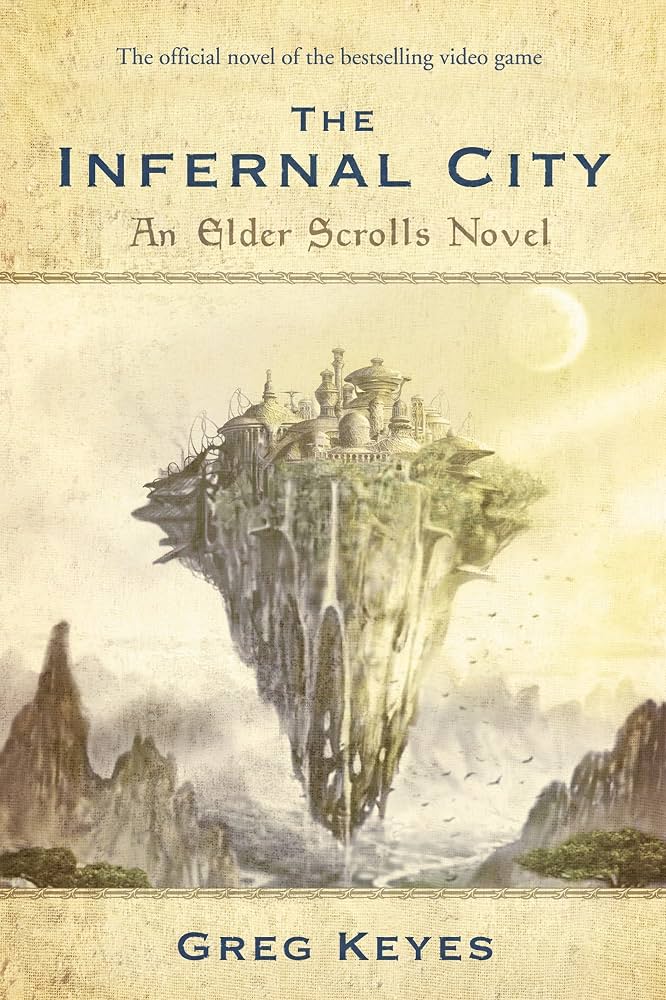
The Infernal City by Greg Keyes. Del Rey, 2009. Elder Scrolls 1.
It has long been my experience that games in the Elder Scrolls series are, generally, more promising as opportunities to explore a storyworld than they are as gaming or narrative experiences.
I have been playing games in the Elder Scrolls series for nearly a quarter of a century, since Elder Scrolls III: Morrowind debuted on the Xbox in 2002. I played Elder Scrolls IV: Oblivion (2006) when it came out, and for years after, and Elder Scrolls V: Skyrim (2011) almost ad nauseum, occasionally tweaking my incessant replays with mods from the robust modding community that sprung up around the game. I have, without doubt, spent more hours in Morrowind, Cyrodil, and Skyrim than I have in any other virtual gameworld, in large part because these games allowed almost total freedom to explore and create new experiences within the game without having to follow the often short and not particularly engaging main storylines (and the major side quests aren’t much better, involving fetching or killing something for some minor boon—iteratively unexciting play-as-work stuff). So, when I say that the Elder Scrolls games are, functionally, as games and as ludic narratives, quite boring, but that their storyworld is magnificently compelling, know that I speak from an ungodly amount of experience doggedly playing, replaying, overplaying these three video games just so I could be in the world they afforded access to.
Naturally, then, the prospect of reading Elder Scrolls novels appeals to me. I would jump at almost any chance—except playing Elder Scrolls Online [2015–], as MMOs are not my thing—to experience more of the weirdness of the storyworld, with its Daedric princes, convoluted cosmology, secret cults, arcane orders, ancient prophecies, lost races, competing pantheons of deities, and finely crafted history of mer (i.e. elves, but also dwarves [Dwemer] and orcs [Orsimer]), humans, Khajiit (cat-people), and Argonians (reptile-people) warring against one another, with men and mer locked in near-constant conflict that dates back millennia to the ancient Ayleid mer’s enslavement of early humans, who revolted, created their own empire, colonized the lands of the Khajiit and Argonians, and fought amongst themselves. The deep history of the Elder Scrolls world—mainly the continent of Tamriel on the planet Nirn in the material plane of Mundus—can be pieced together by players who explore ruins, ask questions of NPCs, and read the many, many books (really, works of microfiction, which present diegetically as both nonfiction and fiction) scattered throughout each game. Elder Scrolls franchise novels thus have the opportunity to elaborate what amount to mere crumbs of storyworld found in the games by focusing more explicitly on story and narrative and lore. For a lore-freak like me, who regularly watches Elder Scrolls lore YouTubers (e.g. FudgeMuppet), that’s bait.
Surprisingly, despite the richness of the Elder Scrolls storyworld, and despite the common practice in the 1990s and early 2000s of publishing novelizations of just about every major video game, there have only been two novels in the franchise to date: Greg Keyes’s duology consisting of The Infernal City (2009) and Lord of Souls (2011). I’ve owned both novels for about a decade, but, as with just about everything that’s been sitting on my shelves for way too long, it’s taken me until now to finally read them. The catalyst was my frustration with yet another attempt to replay Skyrim and finding it anything but fun. I’ve played and played Skyrim and Oblivion so many times now that, although I occasionally convince myself to start a new playthrough, I am almost instantly bored, annoyed even, within minutes. But I keep convincing myself to return because I want to be in those worlds, I want to wade in the lore and the history and the sheer weirdness of the nooks and crannies of Tamriel. So I finally turned to Keyes’s The Infernal City in frustration, and with hope, and I came away absolutely surprised by what I found.
The Infernal City was published by Del Rey almost exactly midway between the releases of Oblivion and Skyrim, and was a smart way for the game studio Bethesda to capitalize on player interest in the storyworld—all that much smarter because it expanded the storyworld and its history, rather than retreading minor events or side characters, something that too much franchise fiction is guilty of out of fear that putting major storyworld events into a franchise novel will ostracize fans of the “main” or “source” texts of the franchise. But The Infernal City plays on Elder Scrolls fans’ obsessive compulsion to learn all of the lore hidden throughout the games and it rewards readers familiar with both Oblivion and Morrowind, while planting seeds for canonical events distantly referenced in the later game, Skyrim, and especially the Dragonborn DLC (2012).
The choice of author was a good one, too, as Greg Keyes was highly regarded as a writer of both intelligent, complicated, and expansive original sff, as well as of several successful franchise novels. Keyes cuts his teeth as an sff novelist with the orientalist fantasy duology Chosen of the Changeling (1996, 1997) but made his name with the alternate history science fantasy series Age of Unreason (1998–2001). In the late 1990s and early 2000s, Keyes also published a number of franchise novels, including the Psi Corps trilogy of Babylon 5 novels and three novels in Star Wars’s New Jedi Order mega-series. Among readers of Babylon 5 and Star Wars novels, these are considered some of the best. But after writing six franchise novels, Keyes focused on his next big original series: the much lauded Kingdoms of Thorn and Bone quartet, beginning with The Briar King (2003). It was this series that brought Keyes to Bethesda’s attention and they floated the idea of Keyes writing an Elder Scrolls novel to Del Rey editor Keith Clayton. After a collaborative discussion, proposal, outline, and revision process that involved Keyes, Clayton, and Bethesda creatives like Kurt Kuhlman (writer and designer) and Bruce Nesmith (design director), The Infernal City and Lord of Souls were born. The intent was to offer a wholly original story that fleshed out the world of Tamriel and eschewed the idea of strictly adapting game mechanics, focusing instead on character, narrative, and ideas.
The Infernal City and its sequel are set some forty years after the Oblivion Crisis detailed in Oblivion, during which time the last Septim Emperor was assassinated, ending the Third Age of Tamriel, and the Daedric Prince of Destruction, Mehrunes Dagon, attempted to merge Nirn and Oblivion by opening gates to his plane of the Deadlands and sending armies of his Daedra minions into Tamriel. With each new gate, the barrier between the planes weakened, threatening to merge the two permanently, but the player’s character (canonically referred to the “Hero of Kvatch,” after one of the game’s battles) and the dead Emperor’s son, Martin, stopped Mehrunes Dagon and strengthened the barriers between Mundus and Oblivion. Picking up four decades later, a lot has changed in Tamriel, especially in the regions outside of the Imperial heartlands of Cyrodil, in the lands of the Khajiit and the Argonians, and Keyes’s novels explore how the traumatic events of the Oblivion Crisis have shaped history in the past forty years, while introducing a new crisis—the Umbriel Crisis—that leads to even greater devastation.
The driving conflict behind The Infernal City is the sudden appearance of a giant floating city, Umbriel, in the skies of Tamriel. Wherever it goes, ethereal tendrils that hang from the city’s underside eat up the souls of the living and leave an army of undead in its wake. Umbriel first reaches and destroys the rich merchant city Lilmoth in the Argonian province of Black Marsh, which threw off the Imperial yoke during the Oblivion Crisis when Argonians rallied to defeat the invading Daedra and took their independence to boot, leaving behind factional struggles between the revolutionary, anti-human An-Xileel, on one side, and the Lukiul or “assimilated” Argonians and the humans who remained in Black Marsh, on the other. To complicate matters, the An-Xileel have formed a tight bond with the telepathic trees known as the Hist, with whom all Argonians share a strong sense of kinship, but the Hist have cut off most non-An-Xileel Argonians from their telepathic community. And, Keyes suggests, it is the Hist who call Umbriel to Black Marsh to purify the population of its human taint, pulling Umbriel off of its intended path toward Morrowind for a time, and wreaking havoc in the Black Marsh. But by the book’s cliffhanger ending, Umbriel has reached Morrowind and the ruins of Vivec City. Keyes tells the story of Umbriel’s path of destruction through a rotating cast of characters, each in different social and geographic positions, who each play a part in piecing together some the puzzle of what’s happening in Black Marsh, what Umbriel is, and why it’s here, and who venture forth to try to stop it before it destroys all of Tamriel.
At the heart of the story are Annaïg, a Breton woman, and her life-long Argonian friend Mere-Glim. Annaïg is something of an experimental alchemist and regularly concocts outlandish potions; she is enamored with the Romance of the Empire, with its knights and sense of justice, and especially fascinated by the tales of the Emperor’s son, Atrebus, who is hailed throughout the land for his heroic deeds recounted in propagandistic poems and stories printed throughout the Empire. But the Empire is a distant fantasy to Annaïg, who has lived all her life in Black Marsh as the daughter of a once-important noble, Taig, an elite in the former colonial administration of Black Marsh; in the wake of the Argonian liberation movement, he has served the An-Xileel as an advisor on Imperial matters. By contrast, Glim is considered a political outcast, an assimilated Lukiul who maintains friendships with humans. Glim feels the internal struggle for identity quite intensely and Keyes articulates it well:
He was four people, really. Mere-Glim the Argonian, when he spoke the language of the Empire, which cut his thoughts into human shapes. When he spoke to his mother or siblings he was Wuthilul the Saxhleel. When he spoke with a Saxhleel from the deep forest, or even with a member of the An-Xileel, he was a Lukiul, “assimilated,” because his family had been living under Imperial ways for so long.
When he spoke with Annaïg he was something else, not between the two, but something very different from either. Glim. (33–34)
Keyes, who has graduate-level training in anthropology (including some PhD-level work, though he never finished the degree), is carefully attuned to the complexities of Mere-Glim/Glim/Wuthilul’s identity as it shifts and code-switches across the terrain of the postcolonial world of Black Marsh. The aftershocks of Imperial colonization are felt throughout the first half of the novel, especially in the often uneven relationship between Annaïg and Glim. The two are not lovers, they’re not exactly BFFs, but more like cousins—they look out for each other, Annaïg gets Glim into dodgy situations, Glim repeatedly saves her, and they have an endearing push-pull dynamic that feels true to life. Yet, at the same time, Glim is all too aware of the historical, social, political, and linguistic realities that complicate his relationship to Annaïg. But all of this is upended when Umbriel comes and, using one of Annaïg’s potions, the two fly up to Umbriel to investigate, not realizing that by touching ground on Umbriel they have inducted themselves into a new life as servants to the high lords of the floating city.
At the same time that Annaïg and Glim are interpolated into Umbriel’s rigid, otherworldly caste system, Prince Atrebus, the dashing young hero of Imperial ballads and epics, is warned by Annaïg—using a magical automaton bird, which allows her to communicate through a paired locket—that Umbriel is destroying Black Marsh and creating an undead army. Ever in search of heroism, Atrebus takes on the quest, only to have his company of elite soldiers murdered as part of a convoluted plot to assassinate him. In the process of being captured by the would-be assassins and being freed by the mysterious Dunmer (dark elf) Sul, who is also on a quest to stop Umbriel, Atrebus learns that his career as a hero has all been a set up, designed by his father, so that every battle, every rescue, every victory puffed up in the history books was nothing more than a fight against the weakest enemies possible, even starving prisoners forcibly posed as brigands. It’s an interesting touch by Keyes to spend so much of the novel undermining his hero, who must rebuild his sense of self as he learns just how widespread the fraud was, with even his childhood friends having been in on the Emperor’s plan to ensure the easy rise of Atrebus’s legend with no real threat to the Prince. It’s all the more interesting because it’s not that Atrebus is revealed to be a coward who was in on it, but he is nonetheless shook to his core by the revelation and consequently unsure whether he can, in fact, complete the quest before him, rescue the girl who sees him as a hero, and stand up to an army of the undead. But prove himself he does.
The other perspectives in The Infernal City are much more minor, but include Colin—an agent of the Penitus Oculatus (basically the Empire’s spies and assassins), who discovers that the assasination plot against Atrebus and the arrival of Umbriel might be related—and the aforementioned Sul. Sul is only a perspective character for a short time, appearing in the prologue but disappearing thereafter until he rescues Atrebus from the assassins halfway through the novel. From then on, what we learn of Sul is related through Atrebus’s perspective, and at the end of the novel, when Umbriel reaches Morrowind and is met there by Sul and Atrebus (who took a shortcut through Oblivion, through the Hunting Grounds of the Daedric Prince Hircine, which provides a thrilling chase scene that leads to the tragic death of Atrebus’s temporary Khajiit companions), we finally get the explanation of Umbriel’s origins and what it has to do with Sul.
This might take a minute, so bear with me: Umrbiel is held aloft by the ingenium, a powerful magical device that eats souls to keep the city aloft, and which recycles souls into matter that can be used to create new life, too. The ingenium of Umbriel was devised by Sul’s one-time friend, Vuhon, when the two lived in Vivec City and served the Tribunal (a trio of pseudo-gods). They were also responsible for the destruction of Vivec City 43 years earlier. As players of Morrowind well know, above the city hung a small moonlet, the Ministry of Truth. In actuality, it did not float there, so much as was held there, its celestial fall temporarily arrested by the semi-divine Lord Vivec. The force of the moonlet grew to be too much for Vivec, so Vuhon designed the first ingenium to keep the Ministry in place, feeding it the souls of prisoners—at first. Eventually, the ingenium grew hungrier, needed more particular souls, and one day Vuhon fed it the soul of Sul’s lover, Ilzheven, who had spurned Vuhon’s advances. Sul destroyed the ingenium in retaliation. And the Ministry, released from the forces holding it back, hurtled into the city like an asteroid, destroying it and triggering the explosion of Red Mountain, which destroyed Vvardenfell and left Morrowind and ash-covered wasteland.
But where did Umbriel come from? The lore runs fascinatingly deep here, and it’s all Keyes’s co-creation with the Bethesda team. The short of it is that the ingenium worked because of a pact with the Daedric Prince of Trickery and Bargains, Clavicus Vile, whereby he would allow the ingenium to leech energy from his Fields of Regret in exchange for mortal souls. In other words, the souls were feeding Vile, not necessarily the ingenium. At the same time, Vile had a sword, the Umbra Sword, an ancient artifact meant as a tool for slaying mortals and sending their souls directly to him. But the witch who made it imbued it with a part of Vile’s power, and so the sword became a sentient being: Umbra. Eventually, Umbra freed himself from the sword, tossed it into Vivec City during the chaos of its destruction by the Ministry of Truth, and hid himself at the edge of the Fields of Regret. When Vuhon and Sul were cast into Vile’s realm of Oblivion after the destruction of the first ingenium, Umbra asked Vuhon to build a new ingenium, which they used to separate Umbriel from the Field of Regret, to create, essentially, a free-floating pseudo-plane, a bubble of Oblivion existing unto itself. Umbriel is such a different world that, having been there for only a few months, Annaïg and Glim find themselves unable to leave: their bodies become incorporeal when they try to escape and pass beyond Umbriel’s power, technically crossing a planar barrier into Mundus. The final revelation in The Infernal City is that Umbriel traveled, ever so slowly, to Mundus to retrieve the sword from where Umbra threw it, to ensure his continued freedom from Vile.
It’s easy to see why some readers unfamiliar with the basics of the Elder Scrolls storyworld found The Infernal City difficult, if not unfinishable, as evidenced by Graeme Flory’s review from 2009 and the comments from other readers and critics. A 2011 interview with Keyes in the Sydney Morning Herald about the release of the sequel Lord of Souls even noted that “One criticism […] online is that some feel the novels are not very friendly to readers who have never played the games or studied the lore.” To be fair, though, familiarity with, say, the major fantasy races of Elder Scrolls and their general political dispositions, or the relationship between the planes, only gets the reader so far in parsing the complexity of the worldbuilding in The Infernal City. Indeed, when the novel debuted, Elder Scrolls fans had never been to Black Marsh (unless they played the first game, Arena, in 1994) and didn’t know much about Argonians. Those that read every in-game book or perused their transcriptions on the Imperial Library website might have been a little more in the know, but the aftermath of the Oblivion Crisis, the destruction of Vivec City and Vvardenfell, the Red Year, the An-Xileel liberation of Black Marsh, anything about Imperial administration of Black Marsh, and the complicated relationship between Vile, Umbra, and the ingenium—all of that is explored for the first time in The Infernal City, which means that knowledge of the Elder Scrolls games only helps a little. Even I, after a quarter-century of familiarity with the Elder Scrolls, needed to read multiple lore dumps at The Unofficial Elder Scrolls Pages to figure some of this stuff out.
So, yes, The Infernal City is a worldbuilding-heavy novel, all the more so because it’s a rather short fantasy novel at fewer than three hundred pages. But for all that The Infernal City offers a lore-heavy narrative, it never feels—to me, at least—weighted down by the lore. Every element of the storyworld expounded by Keyes is in service of character development, narrative momentum, and grounding the reader in Tamriel as a flesh-and-blood world. And Keyes does this astoundingly well, especially in the portions of the book set on Umbriel, in which Annaïg and Glim explore their new roles as cook and Sump-tender, respectively, and in which Keyes adapts all the weirdness and sprawling quality of the Elder Scrolls games when they’re at their best. Because for some, like me, after the aesthetic alienness of Morrowind, which explored a world of mushrooms and giant bugs and ash wastes and ancestor worshipping Dunmer, Oblivion and Skyrim were aesthetically dull and offered a middle-of-the-road vision of medievalist European fantasy. But Keyes, in both his Black Marsh sequences, but notably in his exploration of Umbriel, recovers the sense of eerie freakiness that inheres at the edges of the Elder Scrolls storyworld.
Keyes’s Umbriel is a wonder of modern fantasy fiction. It is a Peakean creation, a sprawling, oozing edifice alive with stolen souls who enliven beings that know nothing but the confines of Umbriel, who cannot fathom anything beyond its sphere, and who live short lives squabbling between themselves while enslaved in service of the city’s mysterious, ethereal lords. What results is something like Peake’s Gormenghast meets D&D’s Spelljammer campaign setting, but weirder. Umbriel’s soul-eating ingenium not only feeds off the souls it harvests, but recycles them into organic matter, growing bodies for new slaves brought to life by newer souls. All of this takes place in the Sump, a sort of compost heap-cum-body factory, filled with monsters and tended by slaves who harvest the fully grown bodies of the newly ensouled. This is where Glim is sent when he and Annaïg are captured. Meanwhile, Annaïg’s familiarity with the alchemical ingredients of Mundus makes her a boon to the lords’ kitchens, where enslaved chefs tirelessly produce doze-course meals for palates that extend beyond the corporeal. Chefs who fail to please are sent to the Sump (i.e. killed/recycled) and kitchens compete with one another, sometimes violently besieging rival kitchens to capture their best chefs—which is what happens when it’s discovered that Annaïg is the sharpest new chef.
Keyes is a talented writer, who brings the alien world of Umbriel, the eastern reaches of Cyrodil, the Oblivion realms of Hircine, and the wastelands of Morrowind to vivid life while also investing his characters with compelling motivations, worries, fears, and aspirations. Most importantly, Keyes is attuned to what it means to live in Tamriel or on Umbriel, with the latter becoming an opportunity to explore the epistemic limits of life on a bubble plane. Annaïg and Glim constantly confront the fact that the people of Umbriel have no way of understanding even basic ideas that people of Tamriel share, starting with the fact that there exists anything beyond Umbriel. Meaning and signification become major themes of the novel. When Glim explains, for example, that he’s an Argonian to someone on Umbriel, the man merely responds “A word […]. Not a word that signifies to me.” And when Glim explains that Argonian “is my race,” the man continues, “Another word I do not know” (92). But Keyes doesn’t limit the theme of epistemic conflict to Umbriel, as he occasionally explores the Argonians’ frustration with human languages:
The concept the Imperials called “time” did not even have a word in his native language. In fact, the hardest part of learning the language of the Imperials was that they made their verbs different to indicate when something happened, as if the most important thing in the world was to establish a linear sequence of events, as if doing so somehow explained things better than holistic apprehension. (90)
Far from being a thoughtless application of the dubious Sapir-Whorf hypothesis to the Argonians, Keyes emphasizes that the Argonian tension with Imperial concepts of time emerges from their practices and beliefs, from their telepathic connection with the Hist and from their belief in temporal simultaneousness, i.e. that “All of life—all of history—was one moment” (90).
Keyes’s attention to the anthropological is also at work in his descriptions of Umbriel’s foodways, which are described in astounding, inventive detail. Keyes offers not only a range of fantastical alien ingredients, but also new culinary theories—such as the idea of a “metagastrologic,” whereby an alchemical agent acts as a “drug” on the sense of taste, confusing different flavor profiles for one another, much like a miracle berry temporarily changes sourness into sweetness—and new ideas about the categorization of flavors, with people from Tamriel recognizing the basic flavors as “sweet, sour, salty, and hot” (which differs from our sweet, sour, salty, bitter, and umami), and the lords of Umbriel recognizing the additional tastes of “dead, quick, and ethereat” (131–132). Keyes also describes several of the dishes made for the Umbriel lords, each more bizarre than the last, but take for example a metagastrologic catfish dish Annaïg prepares for Lord Ghol:
[…] when he touches or breathes on it, it will deliquesce. That will release a series of odors viandic; the fish will liquefy and mingle with the void and fire salts there around the fish, which will then release their essences. That will lead nicely into the second course, here, a cold broth of tadpole bones garnished with live frog eggs. Finally, the white froth of Terriswort will cause his palate to vividly recall each aroma and taste—but in reverse order. (162–163)
This is bizarre stuff that rewards some familiarity with the Elder Scrolls storyworld (for example, knowing that void and fire salts are harvested from the remains of elemental Daedra known as Atronachs), but much of this is Keyes’s own creation. Descriptions like this permeate The Infernal City and restore to Elder Scrolls the strangeness of the storyworld lost, I think, in Oblivion and Skyrim, while also calling into question readers’ own sense of epistemic and ontological boundaries—what is food, what are its flavors, what should a meal be, what is possible or acceptable as a culinary experience? These are things so rarely addressed in fantasy, much like the cognitive possibilities of language or the different social structure of non-human peoples, and yet in Keyes’s The Infernal City they sit happily front and center in a story that is, on the surface, about a floating city that makes zombies.
Greg Keyes’s The Infernal City was a wonderful surprise. As a fantasy novel, I found it to be inventive and refreshing, and as an Elder Scrolls novel it was more than I could have asked for. Keyes’s understanding of the Elder Scrolls rhymed with my own love of the series and especially its storyworld, and he created a pleasantly expansive narrative that manages to be dramatic while also taking the time to sit with the reality-shock character experience when they find themselves in a new world, whether that’s Annaïg and Glim in the totally bizarre Umbriel or Atrebus learning that the world he thought he lived in was an illusion crafted by his father.
It does seem, however, that there is a split in reader responses to the novel: folks familiar with games like Morrowind and Oblivion responded quite positively to The Infernal City and those unfamiliar with the series were generally put off the novel. I can understand this, but it’s a shame (and I think the latter responses assumes that the novel is less original and more lore-beholden that it actually is), because The Infernal City deserves consideration as a truly good fantasy novel—and one that, I think, easily transcends what many see as the artistic limitations of the franchise novel. Although, perhaps this split response proves that no matter how well-written or inventive or critically interesting franchise novels are, they are nonetheless always also delimited by their franchise identity. This fiddly problem of the franchise novel form aside, I can only hope Lord of Souls fulfills the promise of The Infernal City.
To get notifications about new essays like this one sent directly to your inbox, subscribe to Genre Fantasies for free:


