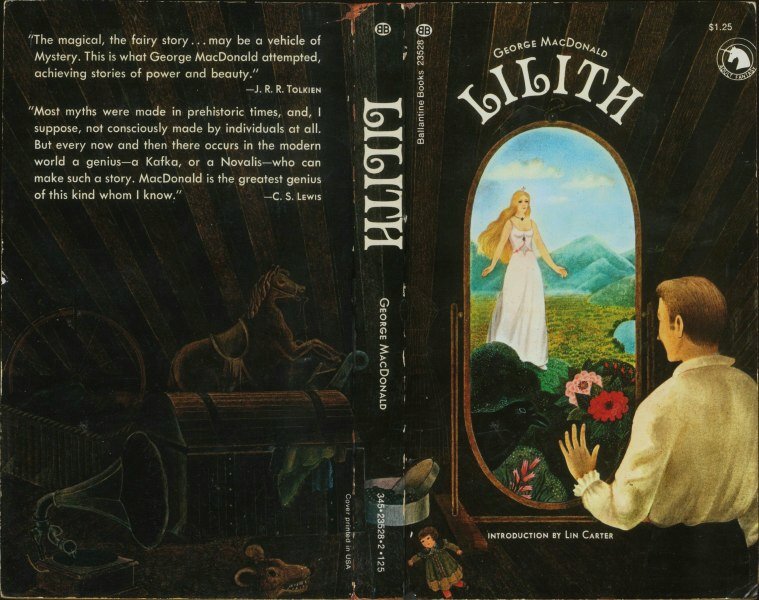
Lilith by George MacDonald. 1895. Ballantine Books, Sep. 1969.
This essay is part of Ballantine Adult Fantasy: A Reading Series.
Read Lin Carter’s introductory essay here.
Table of Contents
George MacDonald and His Times
Reading Lilith
Parting Thoughts
George MacDonald and His Times
The Scottish writer and minister George MacDonald (1824–1905), who looked not unlike a handsome Rasputin, was one of the most influential progenitors of fantasy, most often noted for the effect he had on the thought and writing of later authors whose work heralded fantasy’s emergence in the twentieth century, among them Lord Dunsany, C.S. Lewis, and J.R.R. Tolkien. In his lifetime, which spanned the Victorian era during which pre-genre fantasy began to coalesce around shared forms, traditions, and themes that would eventually be given firmer shape in the first decades of the new century, MacDonald was a prolific writer and cultural tastemaker, penning dozens of novels, poetry collections, and works of nonfiction, both religious and academic in nature. Though he is less and less read today, he is best remembered for his children’s fantasies At the Back of the North Wind (1871), The Princess and the Goblin (1872), and The Princess and the Curdie (1883). But he also published two fantasies—or (faerie) romances, as they were then called—for adults: his first book, Phantastes (1858), and one of his final books, Lilith (1895). Written almost as bookends to his career, these two novels gained new significance and a broader readership as now-canonical works of fantasy fiction when they were reprinted in the first year of the Ballantine Adult Fantasy series.
Until reading Lilith as part of this reading series, I knew of MacDonald only from references in the major works of fantasy scholarship that have influenced my own writing, like Farah Mendlesohn’s Rhetorics of Fantasy and Jamie Williamson’s The Evolution of Modern Fantasy. And, of course, I had heard of MacDonald’s influence on Lewis and Tolkien, as well as on David Lindsay’s A Voyage to Arcturus (1920). (Interestingly, it was MacDonald’s children’s novels that Tolkien liked best, and which lightly influenced The Hobbit, while he found his adult novels, like Lilith, much less successful as “fairy story.”) So MacDonald is almost entirely new to me, as so much Victorian literature is, although after reading Lilith—a thoroughly strange novel, in which whimsy, wildness, and wonderment are tinted with the occasional dark edge of Gothic Romance, heavy with allegory, at turns leaning toward the sincerity of children’s fiction, and always deeply Christian—it’s not hard to glimpse the effect MacDonald had on later writers and, consequently, on the development of genre fantasy in the twentieth century.
Like William Morris, who was a near-contemporary, having been born a decade later and died a decade earlier than his Scottish confrère, MacDonald is well outside of my comfort zone as a literary historian. As the editors of Rethinking George MacDonald lamented more than a decade ago:
Among his contemporaries, MacDonald was both respected by the literary establishment and popular with the reading public. This conception of MacDonald was lost in the twentieth century. His ideas fell out of fashion, and the majority of MacDonald’s works were relegated to dusty library shelves and visited by only a handful of niche critics. (v; as an aside, why do we always talk about academic libraries as being dusty, forgotten, and disused?!)
But while scholars of the past few decades have emphasized MacDonald’s “role as a literary descendant of the Romantics and an ancestor of modern fantasy,” “his place in his own time remains virtually untouched” (v). I, however, am not a Victorianist and so I will commit the crime in this essay of once again emphasizing MacDonald’s status as an ancestor of modern fantasy, insofar as the very act of reprinting books in the BAF series was Lin Carter’s way of making claims about the status of individual works and their authors as the foundations of the literary field that came to be called fantasy by the mid-to-late 1960s.
But who was MacDonald, in his day? Born in 1824 in Huntly, Scotland (which is not in the Highlands, as many commenters on his biography like to claim) to a middle-class farming family and educated first at Aberdeen University and later at Highbury Theological College in London, MacDonald started his career in the early 1850s as a minister in Arundel, West Sussex. But his tenure as a small-town minister lasted only two years and by 1853, just shy of his 30th birthday, MacDonald was sacked for his unorthodox religious views. A decade later, in his 40s, MacDonald became a “literary rock star” of Victorian society and spent the final decades of the nineteenth century among Britain’s, America’s, and Europe’s cultural elite, writing bestselling novels (realist fiction, children’s books, and the odd fantasy), books of essays (both literary criticism and theology), and even some mediocre poetry; embarking on sold-out lecture tours across Britain and the United States; and giving sermons that propounded his unique vision of a supremely generous, loving God who was the antithesis of the Calvinist image of the wrathful protector of the elect he had been raised to fear. In his late years, from 1879 onward, MacDonald maintained a residence in Italy—Casa Coraggio/Brave House—that he turned into a literary studio and cultural center for Brits in Italy. In 1900, MacDonald returned permanently to England and died in 1905.
MacDonald’s latest biographer (really, his hagiographer), the Christian writer Michael Phillips, author of several books on the writer’s life and works, describes George MacDonald as one of the most important cultural and religious figures of the latter half of the nineteenth century. When MacDonald began to write novels in the 1860s and 1870s, he became a bestseller and made his name with realist fiction drawn from Scottish history and inspired by his own upbringing, especially the memory of his severe Calvinist grandmother, against whose teaching he struggled for the first decades of his life. MacDonald was imagined in Victorian cultural life as one of its greatest voices, acclaimed as a novelist alongside Wilkie Collins, Anthony Trollope, William Makepeace Thackeray, and Charles Dickens. Despite being a mediocre poet, he was even considered (like his contemporary, William Morris) for the position of Poet Laureate following the death of Alfred Lord Tennyson. Queen Victoria was a fan of his writing, as were John Ruskin, Lewis Carroll, Mark Twain, Henry Wadsworth Longfellow, Ralph Waldo Emerson, Lady Byron, Oliver Wendell Holmes, Harriet Beecher Stowe, and many more—and some of these were his close friends. To the average educated Victorian, MacDonald was a household name, even if, by the middle of the twentieth century, he was virtually unremembered except in the occasional reminiscence of older authors who read his work in their youth, such as Lewis and Tolkien.
In the past forty or so years, there has been a small but ardent MacDonald renaissance, with new printings of his books, collections of his writings, and a number of biographical and literary-historical studies of his work—not to mention the founding of North Wind: A Journal of George MacDonald Studies in 1982—filling out bookshelves. This renaissance has been driven in part by thinkers, like Lewis and Phillips, drawn to MacDonald’s theological work. Indeed, to write about MacDonald is to write about his religious beliefs: the two are quite inextricable. And so to read his work is to wrestle with how it evidenced MacDonald’s particular vision of Christianity, which was not exactly universalist but which emphasized the all-redeeming love of God the Father and was heavily influenced by German romanticism, especially the poet-philosopher Novalis (1772–1801). Philips describes MacDonald’s vision of Christianity as:
death not closing the door to repentance, salvation not based on Jesus saving mankind from the wrath of God but rather leading us to our loving Father, hell being redemptive rather than punitive (God’s workshop intended to lead sinners to reconciliation with their Father), and the atonement being a mutual partnership between man and Jesus to conquer sin in this life, not a get-out-of-jail-free card for the next. (“An Introduction to the World of George MacDonald”)
These beliefs—as well as, apparently, a comment about animals existing in the afterlife—were what led to MacDonald’s dismissal from the ministry in Arundel, though they proved much more popular when coded in his fiction, which was deeply philosophical and had a “tendency toward preachy rambling” and “tangential discourses.” Unsurprisingly, MacDonald is easily one of the most important figures among the genealogy of writers we might call “Christian fantasy.”
An idea that has been central to my examination of the BAF series and the history of (pre-)genre fantasy more generally is that there is not one singular fantasy tradition, but in fact multiple (often overlapping) genealogies informing the emergence and genrefication of fantasy in the 1960s and 1970s. There is, of course, the medievalist epic fantasy tradition of Tolkien, with his marriage of the romance and the social novel in The Lord of the Rings; but there are also fairy tale and Arthuriana, which influence so much of fantasy; and there is the sword and sorcery (or heroic fantasy) tradition of the American pulps; and the small but influential tradition of “rational” fantasy that emerged from the American magazine Unknown (e.g. Fletcher Pratt’s The Blue Star, the first BAF novel); and the comedic (often satirical) fantasy tradition in the vein of James Branch Cabell; and the Orientalist romances of Eliza Haywood, George Meredith, or F. Marion Crawford; and, as James Gifford has studiously argued, there is an anti-authoritarian or modernist anarchist tradition as well.
These are just some of the genealogies behind the development of this rich, formally diverse, definitionally slippery genre. One major tradition only vaguely at the edge of my writing thus far is that of the Christian fantasy, which winds its way in and out of all these other fantasy traditions and can be glimpsed most readily in, for example, Lewis’s Narnia but has a strong presence in both medievalist epic fantasy and Arthuriana. MacDonald is no progenitor of Christian fantasy—which has earlier incarnations, as Colin Manlove has argued, in John Bunyan’s The Pilgrim’s Progress (1678), Spenser’s The Faerie Queen (1590–1596), Dante’s Divine Comedy (c. 1308–1321), and the Saint Graal romances—but we can’t talk about the present novel, Lilith, or his first novel, another BAF entry, Phantastes, without talking about the relationship between fantasy, allegory, imagination, and Christianity in MacDonald’s writing. More on that, though, once we’ve delved into what Lilith is all about. (Spoiler: it’s about God’s all-redeeming love.)
The above context of George MacDonald’s career explains rather clearly his significance to Victorian literary culture and to the development of not only Christian fantasy, but also children’s fantasy, as well as more discrete forms that became central to genre fantasy in the twentieth century, like the portal that leads to another, more fantastical world. Still, MacDonald’s work is a far cry from the vision of fantasy championed by BAF series consulting editor Lin Carter, for whom MacDonald was a fascinating but somewhat minor figure in the history of fantasy, relevant largely because of his influence on later writers. MacDonald gets only scant mention in Carter’s study of fantasy, Imaginary Worlds (BAF #58, 1973), and his introduction to Lilith gives the impression that Carter found him—like he found all “manly, robust” Victorian men of letters—impressive as a person, but rather unimpressive as a writer, and certainly as a writer of fantasy, since, for Carter, it wasn’t really fantasy if the story could be explained away as a dream (it can’t, but we’ll deal with that later, too). More praise goes to William Morris in the first paragraph of the Lilith introduction than Carter gives to MacDonald across the following five pages.
Despite his seemingly lukewarm response to MacDonald’s work, Carter (or perhaps Betty Ballantine, the Brit who oversaw the growing sff list and was the BAF series’s behind-the-scenes architect) recognized its historical importance, least not to writers considered more central to the development of the particular vision of genre fantasy Carter was canonizing. Three books by MacDonald were ultimately published in the BAF series, beginning with Lilith (because he simply thought it was a better book), first published in 1895, very late in the writer’s life; continuing with his first novel, Phantastes: A Faerie Romance (BAF #14, 1970), from 1858, which predates his eventual success with realist novels like David Elginbrod (1863) and Robert Falconer (1868), the latter a favorite of Queen Victoria; and ending with a collection of three fairy tales written between 1867 and 1875, chosen by Carter, and titled Evenor (BAF #53, 1972)). All three books were given incredible covers by the surrealist painter Gervasio Gallardo, whose style was totally apt to the dreamlike quality of MacDonald’s two adult fantasy novels. Like most BAF titles, the MacDonald books went through at least two printings, though unlike titles by writers like Morris, E.R. Eddison, or James Branch Cabell, MacDonald was not later reprinted under the Del Rey imprint.
Reading Lilith
“Strange” is the best word I have to describe Lilith.
It is strange in comparison to so much later fantasy, to which in whole it bears almost no resemblance but with which, in its various parts, in resonantes profoundly; but it is also strange to a contemporary reader in its rather uneven sense of narrative progression and in its blending of Victorian language of science with the dreamlike quality of the fantasy; and most of all it is strange because of how deeply, stunningly Christian is its story.
In Lilith, a young, college-educated man known only as Mr. Vane—both a play on “vain” and “vanity,” but perhaps also on “weather vane,” for he is as changeable in the wind of his circumstances as any weathercock—has inherited his dead father’s ancient estate, where he spends his days reading in the library. There he is visited by the mysterious Mr. Raven, a librarian of immense age who knew and served Vane’s grandfather, and many earlier generations of his family. Following Mr. Raven, Vane enters an allegory-laden fantasy world through a mirror. Here, Mr. Raven is revealed to be an actual talking raven, and yet he is also a man at the same time, and he’s the sexton over a small church upon the desolate heath of this world. We learn rather quickly that this fantasy world, which Raven simply describes as “the region of the seven dimensions” (19), may be the afterlife, or at least one plane of it, perhaps something like Purgatory, where souls go to repent, be cleansed, and be reborn. Everything about this world, though unsettles Mr. Vane, who wants a rigorous scientific explanation for all that he sees and experiences but is met, instead, with paradox after paradox from Raven, who describes “The universe [as] a riddle trying to get out” (46).
The first third or so of the novel is for the reader nearly as discombobulating as it is for Mr. Vane, who tries without much success to convey the indescribable—from colors that cannot be seen to how flowers give off the smell of Grieg’s “Wedding March”—and to rationalize the non-rational. MacDonald is rather expert at this, and engages the problem of “fantasy” at a meta-textual level, since the manuscript of Lilith is written in the first person as a reminiscence of the events as recalled by Mr. Vane, who regularly questions whether he is sane and makes clear to the would-be reader of his remembrances that what he sets down on paper can ever only be a faint impression of what he really experienced. MacDonald, through Vane, captures not only a fundamental philosophical question about literature’s ability to represent human experience, perhaps even anticipating postmodern and post-structuralist theory’s preoccupation with the failure of communication through language and other processes of mediation, but also emphasizes just how magnificent and beyond normative phenomenology and ontology are the realms of the fantastic.
Of course, in Lilith, the fantastic is not just enchantment or fairy tale or dream, but the realm of the divine—of God, of salvation and redemption, but also of temptation and sin and The Shadow. The fantasy world, the “region of seven dimensions,” the afterlife, whatever it is, is the place where Mr. Vane (and, perhaps, all of humanity) can “begin[…] to become an individual” (19): a full person with agency and free will, which MacDonald (via the Raven) equates with a process of bodily death in order to awake, again, and live in the afterlife. But what’s so fascinating (and occasionally frustrating) about Lilith is that the layers of meaning, such as the distinctions between life/afterlife, body/soul, or dream/reality, are never clear. Like Mr. Vane, the reader is never sure if what’s happening on the page is “real” or metaphorical, embodied or spiritual, experienced or dreamed, since everything that happens in the novel appears to be (impossibly) both/and.
But there’s no spiritual journey without failure, without the pilgrim’s temporary rejection of certain truths in order that they might learn those truths more deeply, and once Vane has put aside his ontological anxieties and embraced the fantasy world, he makes mistake after mistake, ignoring the advice and direction of Raven, and embarks on a very odd quest that blends aesthetic elements of Bunyan, Swift, Milton, and the Gothic, while anticipating elements familiar to later sword and sorcery fiction. This journey includes nighttime encounters with monstrous beasts, with a battlefield of ghosts, and with a danse macabre, as well as sojourns in the house of a woman who lives on the moon, Mara, and temporary enslavement to the Giants before being rescued by the perpetual children known as the Little Ones. Ignoring every warning from the friends he makes, Mr. Vane eventually finds himself nursing the pale, naked body of a mysterious raven-haired woman back to health, in a cave, for months on end, as she regains her pallor by secretly drinking his blood every night. When she is finally better, she is infuriated by Vane’s actions and reveals that she is the warned-against princess of the city of Bulika, the nightmarish tyrant whose citizens live in terror of her, who kills children like Herod massacring the innocent, and who stalks her enemies as a shapeshifting werecat.
This princess is the Lilith of the novel’s title. She is also the Lilith of Talmudic folklore (notably she is not in the Torah, but the idea of a she-demon was likely borrowed from Mesopotomian religions and incorporated into later texts, like the Dead Sea Scrolls, in the form of a singular woman): the first wife of Adam, who betrayed him and turned her back on God. She was transformed into a demonic manifestation of the monstrous feminine in medieval Jewish and Christian literature and theology, and depictions of her were common in the eighteenth and nineteenth century, both in art and literature, where she was occasionally imbued with the qualities of a vampire and a sexual temptress. With this revelation, Lilith becomes more than a trip into a fantasy dreamworld-cum-afterlife, but the continuation of an epic Christian myth that culminates in the question of whether even Lilith, who has fought against God for eons and committed untold sins, can be forgiven and redeemed.
Everything that has happened in Lilith takes on new meaning. Mr. Raven is the biblical Adam, the guardian over the souls of the dead as they pass into this fantasia afterlife. His quiet, distant, supremely beautiful wife is Eve. Mr. Vane’s purpose in the afterlife—his quest in this portal fantasy—is to overthrow Adam’s ex, Lilith, and help restore her to God’s love. We learn that she fears children because an ancient prophecy decreed that her own child would be her downfall and that the prophesied child is Lona, the childlike-but-ancient leader of the Little Ones for whom Vane has an uncomfortable romantic attraction (she is described as looking “not more than fifteen,” 71). Mara, the lady in the moon, who also takes the form of a cat, is Lilith’s antithesis, a pure white leopardess to Lilith’s sinfully spotted one, and she is the daughter of Adam and Eve, the Lady of Sorrows (possibly an allegorical figuration of Mary). And the Little Ones are the babies abandoned by the mothers of Bulika, who brought their children to safety in the first rather than risk Lilith’s wrath, while the Giants are those Little Ones whose cruel, inborn natures make them grow big, ugly, dumb, and mean—an on-the-nose allegory for the corrupting power of sin and an argument that children’s innocence is both sacred but also always subject to the possibility of corrupting sin.
The novel culminates with Mr. Vane and Lona training the Little Ones into a righteous army of God that rides miniature elephants and bears and horses into battle and sacks the wicked city of Bulika. Many die, including Lona, and Lilith is captured. Vane and the Little Ones bring their prisoner to the Lady of Sorrows, to her house on the moon, where Mara engages in spiritual torture and forcibly purifies Lilith with a sacred fire that burns her sins from the inside out. After a night that lasts ages, in which she is subject to the pain of every sin she ever committed, and after surviving several further temptations by The Shadow, Lilith awakes ready for repentance. The group travels then to Adam’s church, which houses the graves of all sleepers/the dead, and there Lilith is purged of her final resistance to redemption. And though The Shadow (i.e. Satan) tries to lure Lilith back, she returns to Adam, to God, and willingly sheds her sin, going to sleep with the rest of the dreamers to awake into the life beyond death. To mark this monumental change in the history of the universe, life-giving, baptismal water gushes from the lifeless lands of the fantasy world, bringing eternal life to the afterlife, purging Purgatory once and for all of death. And Mr. Vane goes to sleep, too, and awakes along with Lona and the Little Ones to travel to God’s Kingdom, to meet with the angels who joy in the eternal youth of the Littles, and to climb the mountain of God himself. But before Mr. Vane reaches the top, a hand yanks him through a door, which closes in the form of a book, ending his journey through/into the Christian fantasy, and returns him to “reality,” to his library.
For the rest of his life, Mr. Vane wonders whether it all really happened, but he lives differently now, as though the lessons of his quest and his journey were real. Occasionally, the surety of the real seems to blur and distort, as if another world, or many other worlds, or one final, True world hangs just behind a veil. Mr. Vane concludes, grandly, philosophically, and with the same emphasis on paradoxes that characterize the dialogue of Mr. Raven/Adam:
Man dreams and desires; God broods and wills and quickens.
When a man dreams his own dream, he is the sport of his dream; when Another gives it him, that Other is able to fulfil it.
I have never again sought the mirror. The hand sent me back: I will not go out again by that door! “All the days of my appointed time will I wait till my change come.”
Now and then, when I look round on my books, they seem to waver as if a wind rippled their solid mass, and another world were about to break through. Sometimes when I am abroad, a like thing takes place; the heavens and the earth, the trees and the grass appear for a moment to shake as if about to pass away; then, lo, they have settled again into the old familiar face! At times I seem to hear whisperings around me, as if some that loved me were talking of me; but when I would distinguish the words, they cease, and all is very still. I know not whether these things rise in my brain, or enter it from without. I do not seek them; they come, and I let them go.
Strange dim memories, which will not abide identification, often, through misty windows of the past, look out upon me in the broad daylight, but I never dream now. It may be, notwithstanding, that, when most awake, I am only dreaming the more! But when I wake at last into that life which, as a mother her child, carries this life in its bosom, I shall know that I wake, and shall doubt no more.
I wait; asleep or awake, I wait. (274)
And MacDonald’s final line in Lilith, the thesis of his book, is borrowed from that thinker who most influenced him, and is quoted by name: “Novalis says, ‘Our life is no dream, but it should and will perhaps become one’” (274). Dream and reality, in the end, switch places, or perhaps always were one and the same. In MacDonald’s theology and theory of fantasy (which are one and the same), the lived experience of humanity and the things humanity imagines are equally valuable, equally powerful, equally evidence of God’s wonder and creation. This is the thrust of MacDonald’s 1893 essay “The Fantastic Imagination,” which appeared as the introduction to a collection of fairy tales and has much in common with Tolkien’s later 1939 lecture “On Fairy-Stories,” insofar as both argue that the fantastic imagination—the ability to imagine and create other worlds—is an expression of God’s own creation, for what we do with our minds is an outgrowth of God’s making of us. What we create is made from the very stuff of God. “It is God’s things, his embodied thoughts,” MacDonald argues, “which alone a man has to use, modified and adapted to his own purposes, for the expression of his thoughts.”
Reading other critics’ descriptions of Lilith, it often seems as though they are trying very hard to downplay the intensity of the Christianity at work in the novel. The fact that the narrative exists primarily as an argument for the redeeming love of God and the ultimate redemption of all humanity, including the wicked Lilith and even The Shadow himself, is rarely highlighted in glosses of the novel—not even in Carter’s introduction, which gestures only at “a deep and sincere belief in the Divine, an inner faith that went beyond mere Christian orthodoxy,” and “hidden levels of allegory,” whose meanings Carter warns us against seeking, lest we ruin the experience of the fantasy. Which, I think, misses the whole point! In another example, Diana Waggoner describes the plot of Lilith in her important early bibliography of fantasy fiction, The Hills of Faraway (1978), as a quest into a “strange, faerielike world,” after which Mr. Vane “returns to our world, aware at last of the real meaning of life” (234); there is a single mention of Adam but no hint that the narrative is about God’s forgiveness. Even Mendlesohn’s and Williamson’s discussions of the novel downplay its stunning debt to Christian myth or that it is, essentially, a work of theological fiction (though, to be fair, they are mostly interested in the novel’s formal elements). I could go on; most general discussions of Lilith are like this. Scholars of MacDonald are keen to discuss the novel’s Christianity, especially as many of them are motivated by MacDonald’s theology, but among general critics, the novel’s debt to Christianity—which is about as subtle as a volcanic eruption, so much more obvious than even Lewis’s messianic lion—passes largely without comment.
Mari Ness’s excellent piece on Lilith for Reactor is a welcome exception to these oversights and also has the benefit of raising questions about the uncomfortable sexual politics of the novel, with regard to Lilith (the sexy vampiress who must be forcibly submitted to God’s love), Lona (the wonderfully pure perpetual teenager who becomes the object of Mr. Vane’s deep, romantic affection), and the Little Ones (children who crawl all over Mr. Vane, squeeze fruit juice into his mouth, and snuggle under his covers—although here I think that the creepiness of these scenes to a modern audience is probably a misreading of MacDonald’s claims about the purity of childhood, which are, admittedly, undercut by Mr. Vane’s not totally innocent obsession with the underage-but-ancient Lona). But, in general, when reading over other critics’ reviews and reactions to Lilith, I found the regular omission of just how Christian the novel is very, very odd.
Because, to me, Lilith is so deeply Christian that I found it at times unsettling. It’s difficult to read this novel without constantly being aware that MacDonald is telling a story about his particular vision of redemption from sin and the eons-long, time-bending war between Adam, as God’s representative and overseer of souls, and the evil of The Shadow, whose greatest representative is a manifestation of the monstrous feminine, a woman who is forced against her will to accept God’s forgiveness. To be sure, Lilith defamiliarizes Christianity, makes its ideas of sin and redemption, of eternal afterlife and of a war against evil, seem absolutely strange—and, well, fantastical—and in doing so it reminded me just how weird Christianity is. I found myself continually uncomfortable with Christianity, with God, with the insistence on a single, one Truth given by the inescapable Him: it disturbed me. And yet MacDonald meant the novel as a sublime celebration of God’s merciful, redeeming love. It was, thus, truly for me like reading the story of Christianity as passed through the looking glass of an unsatisfying fantasy novel, which lays bare all the strangeness of the religion and revealed it for the odd cult of (un)death that it is.
And yet the theological work MacDonald does in Lilith is important, since it argues for a liberatory vision of Christianity that is much more liberal, and much less terrifying, than so many other instantiations of the religion, and which puts the war between good and evil—common to so much of fantasy fiction and very obviously inherited from (though not wholly determined by) Western Christian notions of the conflict between God and Satan—into a wholly new light. In one of the novel’s most engaging lore dumps, after Mr. Vane discovers that Mr. Raven is the biblical Adam, the latter explains the history of Lilith and her struggle against God’s forgiveness, claiming that “even Lilith shall be saved” in the end (161). He then makes a significant theological argument:
Annihilation itself is no death to evil. Only good where evil was, is evil dead. An evil thing must live with its evil until it chooses to be good. That alone is the slaying of evil.” (166)
There are two important claims here: the first is that evil cannot be killed, it survives death; the second is that, since evil cannot be killed, evil is only defeated if it chooses to be good. These are radical propositions: the only end to the conflict between good and evil is the eventual (and perhaps inevitable) capitulation of evil to good. MacDonald insists that good will win, even if it takes eons, and that evil cannot be stamped out through force. MacDonald goes a step further to suggest the utopian hope that evil will, in the end, not simply be slain, but redeemed—like Lilith. In MacDonald’s telling, the wicked temptress of Judaic and Christian myth is rendered the hope of the world, for if she can be redeemed, if her sins can be forgiven, then anyone’s sins can be forgiven and anyone can be redeemed to God’s grace. Even Lilith, even The Shadow. That is why the novel is called Lilith. Lilith proves the rule of God’s universal forgiveness. Moreover, evil is not simply punished, it is reconciled with the good, returned to the light, forgiven, brought back into communion with God. Even Tolkien does not go as far as to suggest that Sauron is—or could be—redeemed; he is, instead, completely annihilated (even if it took a few tries over a few thousand years).
As a final note, I want to talk a bit about the ending of the novel, because the question of whether Mr. Vane is living in a dream—after waking in the House of the Dead and climbing up to God alongside Lona and the Little Ones, after being then sent back through the door/book to his library—is left unanswered. And this has caused some critics a bit of a headache, and even been called a “failure.” But whether Mr. Vane is dead or dreaming or in an afterlife is, ultimately, irrelevant. The fact that he knows the reality of God’s redemptive love has allowed him to see that life, as mortals know it, is a kind of death, and one has to die in order to live in the hereafter of God’s eternity. With that knowledge, all becomes dream, because the dream of eternity is all that remains. So, whether it is a dream or reality, in the end, doesn’t matter, or perhaps it is all that matters, because Mr. Vane’s knowledge of the Truth is secured.
And this ending makes sense with what Michael Phillips claims was fundamental to MacDonald’s theology, especially the idea that atonement for sin was “a mutual partnership between man and Jesus to conquer sin in this life, not a get-out-of-jail-free card for the next.” In other words, the story of the novel awakens Mr. Vane to the need to conquer sin in his own life, while alive, not for the sake of having a good afterlife, but for the sake of fulfilling God’s vision for humanity while alive. As Mr. Raven/Adam so often reminds him, to wake you must sleep, to live you must die; it would seem, then, that Lilith proclaims that to live a life worth living, which is a life in service to God’s love and in war against sin, you have to kill the notion that what matters most is the afterlife. In Lilith, Mr. Vane learns this lesson only when he has passed into the physical representation of the afterlife, and so he must wake again to practice the lesson learned in life. Whether his journey was a dream, whether the “afterlife” he experienced was “real” or not, is beside the point. The lesson learned, and the actions taken in response to that lesson, are all that matter.
This is anything but a “failure.” Rather, it’s a claim that fantasy and imagination are in fact fundamental to the work of redemption, atonement, and a life well lived. Without them, Mr. Vane (or the reader) would not have learned this lesson, would not have seen what it means to live in/with/through God’s love. This is fantasy as Christian theology, yes, but it also rhymes with the idea—so crucial to why so many of us today (some, like me, who are vehemently atheist [but still, and perhaps contradictorily, a little bit mystical]) value fantasy as a genre and/or literary mode—of enchantment as liberation. So while I reject MacDonald’s Christianity, even as I value his redemptive, liberatory vision of that religion, and while I reject the idea that fantasy and imagination are proofs of God’s creation (as he, Tolkien, and others believed), I nonetheless understand and admire his sincere belief that fantasy is meaningful, that it works on the world and in our lives in very real ways, that fantasy is, in effect, the very stuff of life.
Parting Thoughts
Lilith is a strange novel by a deeply reflective thinker who understood fantasy as a means for exploring the wonders of God’s creation and for expressing the power of God’s all-redeeming love. I can’t say it’s a pleasant read, though there’s a quiet, lilting, easily overlooked poetry to MacDonald’s otherwise plain, matter-of-fact language as it wends through the romantic, the Gothic, the biblical, the marvelous, and the weird, with occasional helpings of the saccharine that bespeak his success as a children’s writer. Lilith was a sort of precursor of the precursors of genre fantasy and what is most striking about reading it today is how generically diverse it is, how much it rhymes (albeit faintly) with later developments in fantasy fiction. I see wisps, strands, and hints of MacDonald, for example, in texts as different from one another as Robert E. Howard’s Canon stories, Peter Beagle’s A Fine and Private Place, Philip Pullman’s His Dark Materials trilogy, L. Frank Baum’s Wizard of Oz series, and even Richard Matheson’s What Dreams May Come.
I understand Carter’s lukewarm response to MacDonald’s Lilith as fantasy, but I think it’s a mistake to underemphasize the Christianity of the novel and not emphasize just how unique, radical even, MacDonald’s vision of God’s ultimate, redeeming love is—because it’s also a vision that speaks to the history of fantasy’s obsession with wars between good and evil. Indeed, MacDonald’s surety that evil will lose, and that it will lose because it chooses good, is one of the more interesting claims about evil in a fantasy novel I’ve ever read. And setting from MacDonald’s fantasia of Christian myth, there’s a wealth of bizarre moments and aesthetic and generic mismatches that remind readers just how unfixed and nebulous fantasy—or “the fantastic imagination”—was mere decades before its genrefication in the postwar period. Lilith is odd and a bit unpleasant, not my favorite novel, and not something I’m ever keen to reread, but I do feel I’ve read a special bit of fantasy’s literary heritage and better understand the Christian fantasy tradition that I have otherwise mostly overlooked.
Next up in Ballantine Adult Fantasy: A Reading Series are two collections of stories, poems, and excerpts collected by Lin Carter and released as companion volumes in October 1969. The first, Dragons, Elves, and Heroes, brought together texts—like Beowulf, Mabinogion, Kalevala, The Faerie Queen, Shahnameh, and more—that Carter felt best exemplified the history of fantasy prior to what he believed was the birth of modern fantasy in the writing of William Morris. The second, The Young Magicians, brought together stories and excerpts from work by Morris, Tolkien, Dunsany, E.R. Eddison, H.P. Lovecraft, Clark Ashton Smith, Robert E. Howard, L. Sprague de Camp, and others that Carter argued were the central figures of modern fantasy, the inheritors of the tradition laid out in Dragons, Elves, and Heroes and first described in Carter’s non-fiction study Tolkien: A Look Behind The Lord of the Rings (1969).
To get notifications about new essays like this one sent directly to your inbox, subscribe to Genre Fantasies for free:


One thought on “Ballantine Adult Fantasy: Reading “Lilith” by George MacDonald”