Queen’s Hope by E.K. Johnston. Disney Lucasfilm Press, 2022. Star Wars / Disney Canon / Queen Trilogy 3.
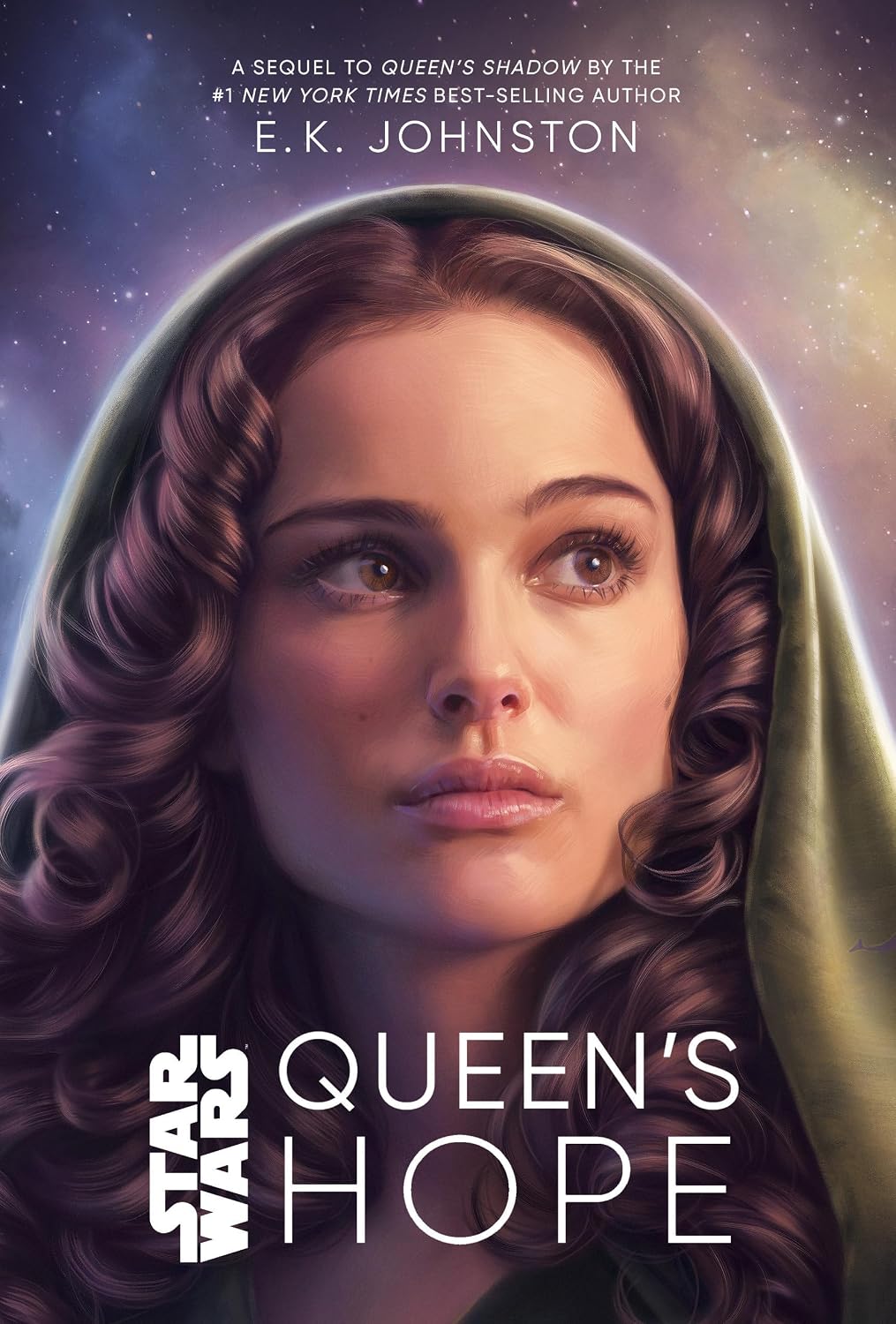
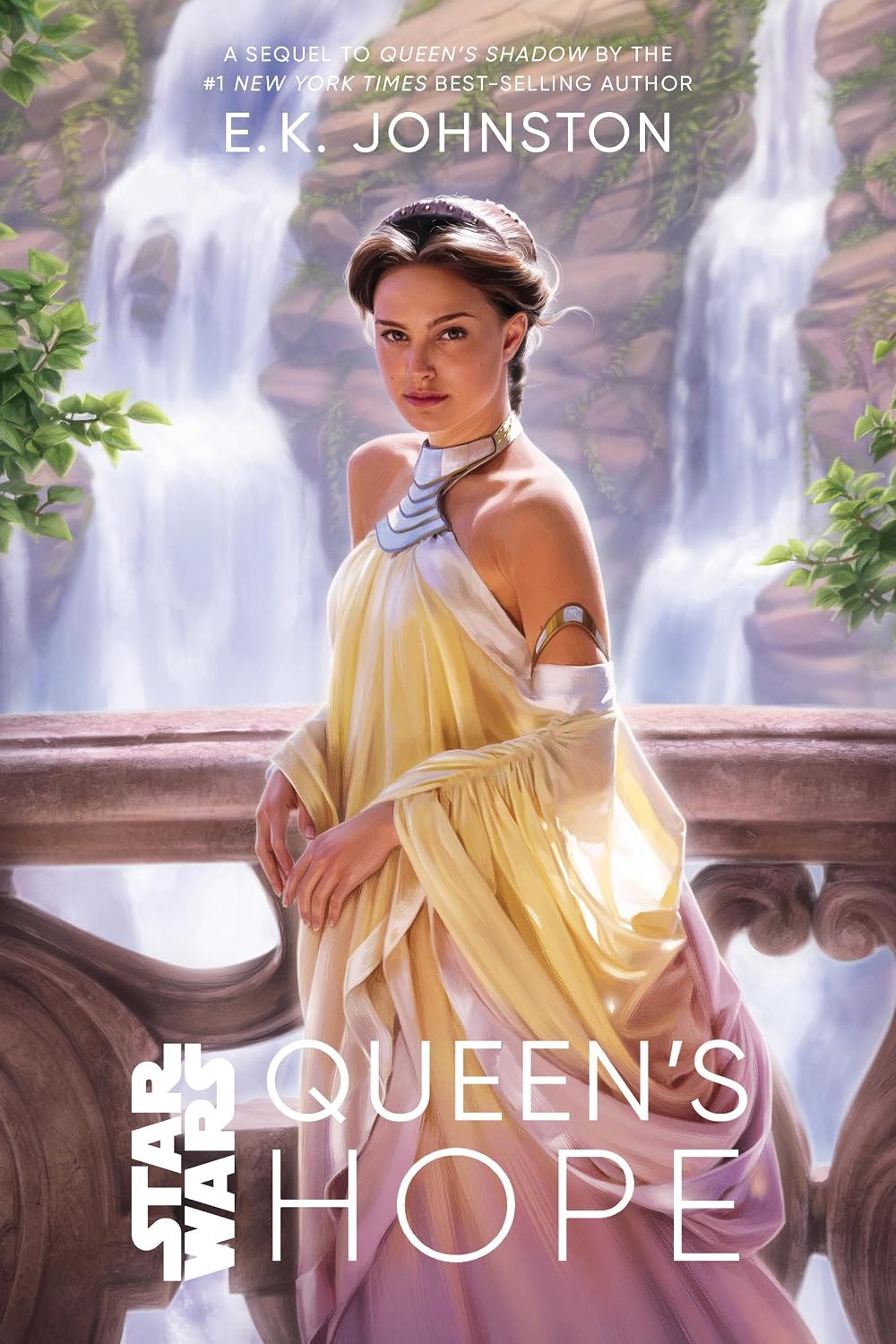
Table of Contents
On the Disappointments of Padmé
Reading Queen’s Hope
Parting Thoughts
On the Disappointments of Padmé
In May 2005, Lucasfilm committed a murder, marring the legacy of its victim with the claim that “She has lost the will to live.” With those words, Padmé—former queen of Naboo, later its long-serving senator, key member of the Loyalists and the Delegation of 2,000, wife of Anakin, mother of Leia and Luke—died in ignominy at the end of Revenge of the Sith (2005) with a line only outmatched in its horribleness, laziness, and mockability by The Rise of Skywalker’s “Somehow, Palpatine returned” (2019).
The Star Wars prequel trilogy is one the best examples of how to squander a character—well, several, really; oh, and also the whole narrative arc of Anakin’s transformation into Darth Vader—with such immense potential. While I retain an intense fondness for the prequel films, in the case of Attack of the Clones (2002) and Revenge of the Sith, my admiration of those films has to do more with what they could have been, than what they were, and how they massively expanded and gave weight to a storyworld that, in the original trilogy, was dull and thin. But the greatest tragedy of the prequel trilogy was its treatment of Padmé, who goes from the teenage queen leading a rebellion against capitalist goons in The Phantom Menace (1999) to inexplicably falling in love with a rizzless incel who just admitted to committing a massacre in Attack of the Clones to being a spineless, emotional wreck who fawns over her walking red flag of a manchild secret-husband in Revenge of the Sith.
Lucas, in behind the scenes footage of the making of the latter two films, regularly and seriously refers to this story as both romantic and tragic. Such is the copium of a man whose best films were written (and directed) by other people. But it’s the betrayal of Padmé’s character and the insistence that she and Anakin have anything vaguely approaching romantic chemistry that is tragic. One could read Padmé’s story as the narrative of a woman emotionally destroyed and eventually physically abused by her unstable lover. Of course, while I think that’s valid and is probably the best reading, it’s clear from both Lucas’s comments and other franchise texts that attempt to develop Padmé and Anakin’s relationship that theirs is not intended to be read as a bad, abusive relationship, but as a deeply loving one that was destroyed by Anakin’s descent to the Dark Side, as orchestrated by Palpatine.
Because Darth Vader is eventually redeemed (despite his myriad horrendous crimes), Star Wars has to side step that fact that Anakin and Padmé’s relationship is clearly twisted. We are supposed to think there’s something romantic there, we’re supposed to know that in the three years between Attack of the Clones and Revenge of the Sith Padmé and Anakin had myriad adventures and a deeply loving, caring relationship. We are supposed to intuit that the evidence from those two films is a misrepresentation of how they “really” were together. Text like Clone Wars (2003–2005), The Clone Wars (2008–2014, 2020), and various novels and comics that fill in the gaps of the events of that galactic conflict, occasionally touching on Padmé and Anakin’s relationship, are supposed to countermand any too damning interpretation of Anakin’s final treatment of Padmé.
In other words, the transmedia expansion of the storyworld and its narratives is always held in a (sometimes, but not always, productive) tension with the source/main texts of the franchise, even as new entries in the franchise try to subtly rewrite and reinterpret those source texts. The wonder, to me, of transmedia storytelling is those moments of friction when players in the franchise sandbox work against the grain to create new meanings, even when those meanings are superseded by or in obvious contradiction with other texts. Nowhere are these moments of friction more evident than in the novels and comics, which become a vehicle for authors to propose their own visions and interpretations of, and interventions into, the “facts” of a storyworld. And while they may ultimately be overwritten by other texts in the franchise, they’re very existence troubles and challenges how we interpret everything, while also revealing that, ultimately, all transmedia franchises and their storyworlds are unstable networks of narrative that lend themselves to contradiction and constant reinterpretation.
E.K. Johnston’s Queen trilogy—Queen’s Shadow (2019), Queen’s Peril (2020), Queen’s Hope (2022)—was just such an exercise. The trilogy collectively forces a reinterpretation of Padmé’s character during and between the events of the prequel films. It recuperates Padmé for the generation of Star Wars fans let down by the turn her character took, thanks to Lucas’s hamfisted writing, over the latter two installments of the prequel trilogy. Where Queen’s Shadow gave us a glimpse at the beginning of Padmé’s senatorial career just after The Phantom Menace and Queen’s Peril went back in time to take us through Padmé’s election to the queenship and the events of that first film, the final book in trilogy, Queen’s Hope, explores the days and weeks following the climactic Battle of Geonosis that touched off the Clone Wars in Attack of the Clones. Technically, the beginning of the novel fills in the gaps between the events on Geonosis and the final montage of events at the end of the film, which includes Anakin’s secret marriage to Padmé at a lakeside retreat on Naboo.
But let’s rewind a bit and talk about what, exactly, Johnston is inheriting from Attack of the Clones when she writes a novel set just after that film. For anyone who is reading this essay on the third book in a trilogy about Padmé but who doesn’t know what happens in Attack of the Clones, it goes like this: It’s ten years after The Phantom Menace. Anakin is a promising and supremely talented Jedi padawan. He’s the prophesied Chosen One who will bring balance to the Force (whatever that means). Padmé, meanwhile, has been a senator all this time and has become quite important in the Senate as a member of the Loyalist faction. The film doesn’t really explain what this is, but Johnston tries to explore the idea somewhat in Queen’s Shadow: it would seem to boil down to the idea that the Loyalists believe the Republic should serve the collective interest of the Republic, not the interests of individual planets or representatives. It’s sort of a liberal idealism. For Padmé’s part, she wants the Republic to help its people, to safeguard them, to ensure justice is upheld across the galaxy. She sees, for example, that the Republic puts committee meetings and commissions for further information ahead of taking action. She sees that there are laws against slavery, but still a thriving slave trade in the Outer Rim.
Attack of the Clones pushes Anakin and Padmé together in an effort to thwart an assassination plot against her. While Obi-Wan Kenobi pursues the assassin and discovers the titular clones, Anakin is sent into hiding with Padmé, to protect her. But he’s obsessed with her. He hasn’t stopped thinking or dreaming about her since he was ten years old. Padmé shows no interest and a lot of discomfort with Anakin’s continued efforts to flirt with and touch her. It’s genuinely creepy stuff, in large part because it is performed so awkwardly by both Hayden Christensen and Natalie Portman, who act as though they’re in an episode of Netflix’s stalker romance thriller You (2018–2025). There are some moments of levity in their relationship, some laughter, some growing close in between Anakin’s awkward, uncomfortable come-ons. And then Anakin and Padmé go to Tatooine to look for Anakin’s mother, Shmi. Anakin has foreseen her death through Force dreams (a real failure on the Jedi’s end is that, rather than work through Anakin’s fears and take seriously his clear penchant for foresight, Yoda dismisses him and waves him away to work on detaching from his emotions; really, Anakin’s fall to the Dark Side is as much their fault as Anakin’s and Palpatine’s). And, of course, Anakin is right. Shmi was freed and married into the Lars family after Anakin left Tatooine but she was recently kidnapped by Tusken Raiders, the Indigenous people of Tatooine. Anakin tracks them, finds his mother brutalized but alive in a Tusken camp, and she dies in his arms.
In one of the most horrific moments in Star Wars, Anakin kills the Tusken Raiders. Later, he explains to Padmé, with vile fervor:
I killed them. I killed them all. They’re dead, every single one of them. And not just the men, but the women and the children, too. They’re like animals and I slaughtered them like animals. I hate them.
Just before this confession, Anakin whines about Obi-Wan being jealous of him and proclaims that he will be the most powerful Jedi to ever live. This scene is a forest of red flags, all signalling “this guy is unstable, he needs help.” Anakin has just admitted to dehumanizing an entire people, to seeing them as animals, to slaughtering them—his words—like animals. Men, women, children, all of them. And how does Padmé respond, how does Lucas think a nurturing, caring woman would respond? “To be angry is to be human.” That’s it. That’s Padmé’s response to Anakin’s admission of a truly horrific crime, an admission so clearly evil that the “Imperial March” faintly accompanies Anakin’s confession. But Padmé plays it like Anakin just threw his controller across the room after getting sniped for the fortieth time by a shit-talking eleven-year-old in Call of Duty, or like he put his fist through the wall after his football team lost. Concerning stuff, but “totally normal” masculine behavior. Right? RIGHT?! Padmé strokes his hair and comforts him. Because, you see, he just lost his mother and he’s angry. After all, he’s only human. And the Tuskens are… only animals?
Shortly after this truly unbelievable response to a shockingly disturbing confession, Anakin and Padmé jet off to Geonosis. They seem emotionally stable, despite what just happened; they’re quipping and being funny, and when they are captured, before they are taken into the arena to be executed, Padmé confesses her love and they kiss. The film ends with their marriage. Their romance is not only improbable, it is not only incredibly unromantic, it is not only grossly unconvincing, but more than anything it makes no sense with Padmé’s character, given not only her sincere devotion to the Senate, her belief in the Republic and in democracy as the best form of governance (Anakin admits that he would prefer authoritarianism, so someone with “power” can fix everything, another hint at his future), and her desire for government to be an agent of justice and peace. Marrying the man who, in a fit of white hot fury, admits he massacred a village full of people, slaughtering them like the animals he believes them to be, is absolutely not in character for Padmé. If anything, it would make more sense that she would immediately report Anakin to the Jedi, not only for his obsessive behavior, but for this clearly disturbed action—because she would believe that it would be better for Anakin to face the consequences of his actions, to get justice for the murdered people, and to get Anakin help from the Jedi. But, alas. This is the story we have. Vader is Leia and Luke’s father, so he has to have a wife (in Lucas’s very sexually pristine storyworld) at some point.
This is the romance Johnston and all other writers who play in the sandbox of the Clone Wars era have to work with. Anakin and Padmé are married. They are deeply in love. This is Johnston’s departure point in Queen’s Hope, which in addition to trying to justify Padmé and Anakin’s romance, trying to flesh it out and make it, well, more romantic, is also a novel about the early days of the Clone Wars that rip the galaxy apart for the three years between Attack of the Clones and Revenge of the Sith—a war of such magnitude that it catalyzed the reorganization of the Republic into the Galactic Empire. Queen’s Hope is a novel, yes, about Padmé’s romance with Anakin, but it is more so about politics and war, direct action and black markets, supply lines and corporate responsibility during conflict, and the personal weight of war. It is also a novel about the strain of politics, war, and the effect of growing up and changing on the friendships Padmé formed with her handmaidens during her time as queen of Naboo. Those friendships, especially with Sabé, are the backbone of the trilogy; in many ways, the trilogy is not just the story of Padmé, but of all those otherwise anonymous women in orange robes we first saw in The Phantom Menace.
Reading Queen’s Hope
Queen’s Hope begins with the lead up to Padmé and Anakin’s wedding. On Naboo, recovering from the nexu scratches she received during the Battle of Geonosis, Padmé plans their wedding, asking Saché (now a planetary senator) and Yané—who are married and run an orphanage—for help making a dress. Yané, of course, catches on that it’s a wedding dress but Padmé keeps her and Anakin’s wedding a secret. Before they marry, though, queen Jamillia asks Padmé to rescue her sister from a planet in the Chommell sector that might soon be under Separatist threat (why is a little unclear and it’s somehow irrelevant to Saché’s plot about sector politics). Padmé and Anakin whisk off, rescue the sister, and in the process confront a group of political artists from Naboo who abandoned their planet for the hardships of this frontier colony. The meeting is brief but with it Johnston underscores that planets like Naboo, which are rich and politically important, don’t understand the hardships of life in the galaxy beyond the metropoles. This has been a mainstay of Johnston’s version of Padmé’s story and is anchored by Padmé’s experience in The Phantom Menace, when she discovers with disgust that slavery still persists in the galaxy. Padmé is reminded again and again of the hardships faced by those without the privilege of the circumstances of her birth; she fights for equality, but rarely addresses—or is prevented by Senate processes from more pointedly addressing—the systemic problems. But rescuing the queen’s sister is all in a morning’s work, and by evening Padmé and Anakin are married. He goes off to be a general in the Clone Wars and she to the Senate.
After this prologue of sorts, Padmé’s narrative arc focuses on a mysterious message delivered by the Jedi: a representative of one of the major medical supplies corporations in the Outer Rim who wants to meet with a Republic Senator. For what reason, no one knows. But only Padmé has the skills to take the meeting, because only she can be in two places at once—as Bail Organa well knows, having discovered her use of decoys in Queen’s Shadow. (Given that the Senate is 20,000+ years old, and considerable technologies exist to disguise people, I don’t buy that no one else has this capacity.) Padmé calls in Sabé from her anti-slavery work on Tatooine to pose as her in the Senate, while she adopts the identity of a merchant marine on a medical transport, the Namrelllew, a Wookiee-run ship, doing a supply run to the non-Republic planet of Hebekrr Minor on behalf of the corporation that wants to contact the Senate. If this seems like a whole mess of contrivances, that’s because it really is.
On Hebekrr, Padmé discovers how quickly the human cost of the war has come even to backwater planets. Already, Hebekrr is a war zone, with the Separatist besieging the capital and Clones stationed nearby but not technically fighting on Hebekrr’s behalf. Padmé offers her services to the planetary magistrate to save her granddaughter and her granddaughter’s wife, who have been captured by the Separatists and are being held hostage in an effort to get the planet to declare for the Separatists. Padmé enlists the nearby Clones battalion and they break into the Separatist base, save the hostages, and cripple the droid charging stations (This is a bit odd, because the Clones’ commander, Jedi Master Sivad, says he can’t get involved because then it would look like the Republic is helping the Hebekrrians, but I guess somehow units of the Grand Army of the Republic can be involved?). In the aftermath, Hebekrr agrees to join the Republic and the mysterious contact from the medical supply company reveals himself.
The man who wanted to meet Padmé is Oje N’deeb, a Neimoidian who runs one of the many megacorporations that make up the conglomerate Trade Federation. But N’deeb is sympathetic to the Republic—in fact, he feels particularly bad about Naboo—and he wants Padmé and the Loyalist faction’s help ousting Lott Dod to become the Federation’s official representative to the Galactic Senate. He proves this in part by purchasing slaves setting them free, since he knows this is a cause close to her heart (and also because it expands the Outer Rim workforce that his company relies on, but this doesn’t bother Padmé, who apparently has no concerns about Trade Federation labor practices). One very smart quirk of Lucas’s vision of the Galactic Republic is that megacorporations have voting representation in the Senate. And because the Confederacy of Independent States (the Separatists’ official name) is an unrecognized splinter group, the Trade Federation remains in the Senate and pretends to neutrality, constantly defending itself against accusations of treason, despite being active—and founding—members of the Separatists under Nute Gunray.
Despite her almost racial hatred for Neimoidians, Padmé knows that a pro-Republic representative from the Trade Federation to the Senate would severely undermine the Separatists (though no one really clarifies how it would undermine the Separatists), so she agrees to convince the Loyalists to support N’deeb’s efforts—and Bail Organa and Mon Mothma later agree. N’deeb is not mentioned in any other source, nor is his faction, so we don’t know whether Padmé’s mission and the Loyalists’ support was ever consequential. Certainly, by Revenge of the Sith the Trade Federation is still a principal member of the Separatist leadership. But the idea of tension within the Trade Federation leadership is certainly fascinating, even if we learn essentially nothing about the Trade Federation, its governance, or its internal politics. What the story does, instead, is underscore the importance of the “boring stuff” that so many fanboys complained about re: the prequel films—namely, the logistics, the trade policies, the supply lines, and the political dealings that make the star wars possible.
But the details, the narrative are ultimately thin stuff, so Johnston pads it with other things, for example, how cool Wookiee ships are (apparently they make better ships than the Naboo) or how Palpatine is so evil that he permanently dries up a well in a Jedi garden when he gets mad, or else she throws in side characters, like the Namrelllew engineer Idda, a small Mriss (not a Mrlssi, which are basically the same thing but from the EU canon) who offers cringey, cartoony comedic relief. Padmé’s story in Queen’s Hope is ultimately, disappointingly slight. It shows that, as in The Clone Wars, she regularly engages in crazy, dangerous antics on behalf of the Republic Indeed, Padmé’s narrative feels like an episode of that show, and the influences of The Clone Wars show are understandable felt throughout, such as in Sabé’s meeting with Barriss Offee, who expresses her concern over the Jedi’s involvement in the war, or the easter egg inclusion of Pong Krell (without mentioning his name). But the novel also demonstrates that she really loves Anakin, albeit more by saying that over and over than by showing that love (except for a vaguely steamy scene at the very end, where she sits on his lap and they make some tame-as-fuck sexual innuendo—which is not the same thing as showing a true romantic connection).
While Johnston’s primary focus is Padmé, the novel has two other interlocking storylines—featuring Sabé and Saché—that complement Padmé’s narrative. And for once, the latter two do not become completely subordinate to Padmé’s story, but in fact are the much more interesting of the three storylines that somehow fill the novel’s 352 pages.
For Saché’s part, she spends the novel negotiating the fallout from a recently rediscovered treaty Naboo signed with the planets its people colonized, such as Jafan and Karlinus, several hundred years ago. The treaty was brought to the Naboo government’s attention by Quarsh Panaka, who learned of it from his close friend Chancellor Palpatine. The forgotten treaty allows for Naboo to requisition any and all resources from its colonies, at any later date, in exchange for Naboo helping with the colonies’ initial start-up costs. For Panaka, the treaty would allow Naboo to take the resources it needs to survive the Clone Wars, perhaps to build up a military force for defense against the Separatists. But for Palpatine, he sees the treaty as a way to test how independent political actors operate when one side is given the opportunity to exploit the other, for its own safety, and the other side is exploited by the more powerful. Johnston’s version of Palpatine is, in the few scenes we see him, a cackling evil maniac, almost unhinged in his hatred and anger, and prompting the use of the Chommell sector treaty is one of many secret evil plans he uses to test and silently reshape the galaxy.
Saché’s space in the narrative is relatively minor, but the conflict over the treaty is important to Johnston’s attempt to show how the political machinations of the Clone Wars unfold not just at the macro-level of the Galactic Republic, but also locally. Every planet, every corporation, every sector, Queen’s Hope shows us, has to make choices about how to survive—and whether to take part in—the galactic conflict. Saché spends her limited time in the novel challenging the Naboo politicians who want to take advantage of this outdated treaty, first working to nullify it and, when there isn’t enough support, working instead to build a coalition within the sector that will increase economic and political cooperation between planets like Naboo, Karlinus, and Jafan. This is essentially a mirror of what Padmé did in Queen’s Peril with her Chommell sector summit and in Queen’s Shadow with the Mid Rim Cooperation Motion. For all that Saché’s story is limited, she nonetheless emerges as a compelling character full of promise. But promise is all she remains.
The details of what Saché achieves are, again, vague: some notion of a compromise that leads to great intra-sector cooperation, as well as changes in Naboo governance that grant slightly more authority to the queen. There’s no discussion of what Amidala or Réillata or Jamillia did re: intra-sector politics in the wake of the events of Queen’s Peril or, indeed, how the sector responded to the Trade Federation’s blockade that began quite literally the moment the Chommell sector summit ended. There’s also no exploration of how the Naboo justify using the treaty or what the opposition to the Naboo treaty might really look like, what planets like Jafan and Karlinus might do to protest Naboo’s exploitation—and that’s a huge shame. I second Arezou Amin’s observation that Johnston has this frustrating quality of never saying anything too deep or serious, preferring instead to cut away just at the beginning of a conversation (this especially happens when Johnston’s characters come to a point in the story where they are about to discuss politics or policy, you know, the stuff politicians spends most of their time doing!) or to suggest that some deeper, unexpressed meaning is communicated with a look between two characters who know each other well. Johnston (or Disney) either isn’t interested in the details or imagines her readers won’t be.
As the Saché storyline makes clear, Johnston’s characters throughout the Queen trilogy are always compromising, never really pushing for serious, transformational change—they don’t even seem to imagine such change as a distant possibility, a utopian dream of what could be. There are no revolutions, no serious critiques of systemic issues, just the claim that the only way forward, the only way to coexist, is through vague, undescribed compromises that everyone dislikes a little but that gives everyone something. It’s a depressingly unoriginal, unexciting, conservative vision of change and justice borrowed from American liberal ideas about the necessity of bipartisan coalition building and married with a disturbing sense of realpolitik. In the end, it’s hard to truly see how Padmé or Saché and all their politicking across this series are any different from the corrupt, committee-forward, do-nothing politics of Chancellor Valorum, who allowed Naboo to be put under Trade Federation occupation. As much as I value—and have praised in essays on the previous books in the trilogy—the idea that Padmé tries for the sake of trying (“Padmé Naberrie got out of bed every single morning and tried again,” loc. 2234, emphasis in original), the trilogy’s “Nevertheless, she persisted” theme is about the extent of the political vision Johnston musters. The one glimpse of a critique of this politics is in Sabé’s pittance of a storyline in Queen’s Hope.
Sabé is Padmé’s best friend and confidant. Throughout the Queen trilogy she has taken her own journey, starting (chronologically) as the girl who was always second-best, who devoted her whole life to being Padmé’s second, her decoy, the perfect handmaiden, and then gave her life over to the thing Padmé believed in but could not work on herself: fighting against slavery, on the ground, in the Outer Rim. In Queen’s Hope, Sabé gets a glimpse at the life of a Senator who is at the height of influence and power in the waning days of the Galactic Republic. While Padmé goes on her mission to Hebekrr, Sabé fills in as Senator Amidala (the novel clarifies that this is legal because Senators can designate a proxy; typically, that would be Jar Jar but he’s only mentioned a few times at the beginning of the novel, and it’s unclear why he plays no further role given the stakes of Padmé’s mission and his decade-long service as Representative of Naboo). And everything Sabé learns about life as a Senator bothers her. The life of parties and invitations and committee meetings and endless debates that go nowhere, all of this smacks of the same kind of politics that led to Naboo being illegally occupied and the Trade Federation being acquitted of any crimes—despite the wealth of evidence that likely would have existed. Sabé can’t stomach these politics. She wants action.
Moreover, Sabé discovers that Padmé both had the opportunity to tell her she had married Anakin and chosen not to—and this more than anything hurts Sabé, whom Johnston has written from the beginning of the trilogy as having a vague, unrequited romantic desire for Padmé (I guess Disney didn’t want Padmé to be a canon bisexual; readers will just have to settle with Yané and Saché or Sabé’s flirtation with Harli or the unnamed Hebekrrian lesbian couple or Tepoh who uses the neopronouns zhe/zher or the transgender Clone trooper Sister). Sabé’s discovery of the relationship comes as a pretty brutal shock, too, because Anakin sneaks into Padmé’s room where Sabé is sleeping as her decoy—and he shows Sabé how quickly he can become angry and threatening (but, hey, at least he apologizes later?). In awkwardly describing her love for Anakin to Sabé, Padmé even confesses that Anakin massacred a village of Tusken Raiders, and, to her credit, Johnston does acknowledge the gravity of Anakin’s atrocities in Sabé’s horrified reaction, even as Padmé shrugs it off as a bad thing, but understandable. Sabé notes that the entire planet of Tatooine is abuzz with talk about the massacre. In the end, Sabé essentially pre-empts Padmé’s line from Revenge of the Sith, when she discovers Anakin has killed Jedi younglings and she finally stands her ground: “You’re going down a path I can’t follow!” While Sabé doesn’t say exactly this, the sentiment is the same, and Sabé decides to leave the politics to Padmé while she fights for justice—against slavery, still fighting Padmé’s fight, really—her own way, with Tonra on Tatooine.
Sabé’s is the most satisfying arc in the Queen trilogy, because Sabé not only changes and emerges sure of herself by the end, but she does so by embracing the fact that she can no longer live in Padmé’s shadow. She transcends what she initially accepted as the limits of her identity and becomes a new person. Meanwhile, Padmé disappears into Anakin’s shadow, into the hopeless, hapless “romance” of her secret Jedi husband. She is certainly a new person, too. At least in the prequel films, Padmé is unrecognizable by Revenge of the Sith. But Johnston’s Padmé clearly maintains the political acumen and sharpness of spirit that drove her in The Phantom Menace and in her better moments in Attack of the Clones. Johnston works within the bounds of canon. While a fanfic writer might create an AU in which Padmé rejects Anakin for his atrocities and understands Sabé’s hesitations about Anakin and her concerns about the limits of Senate politics, Johnston works to do what she can to create a canon version of Padmé’s story that staves off the disappointment we all know is coming.
Parting Thoughts
“Once there was a girl…” Johnston opens each of the four sections of her novel with these five words, each refrain introducing a vignette about a different girl in the Star Wars storyworld. It’s a structural callback to Queen’s Peril, which opens and closes with similar vignettes that turn Padmé and Leia into parallels across time and space, women leaders at either end of the Star Wars story. But here Johnston brings in a wider range of women, first Shmi Skywalker (with an account of her virgin pregnancy by the Force), then Beru Lars (and her efforts to fight against slavery), then Padmé herself (retelling the story of Shadda-Bi-Boran), and finally Breha Organa (Leia’s adoptive mother). The refrain “Once there was a girl…” is a reminder that the Star Wars storyworld and its grand narratives of a long time ago in a galaxy far, far away belong equally to all these women, who are so often background or side characters, small parts in larger wholes, easily overlooked by the main narrative. Each is also the driver of a man’s story, rarely a person unto themselves.
But here, in Queen’s Hope, with this repeated refrain Johnston makes clear that the fairy tale of Star Wars belongs equally to these women. In the Queen trilogy, Johnston tries to give the story back to them, and she’s faced in Queen’s Hope with the unenviable tasks of both making Padmé’s romance with Anakin make sense, while also ensuring to some extent that Padmé retains her autonomy and her own political drive, that she doesn’t get lost in the romance (as she seems to be in Revenge of the Sith). It doesn’t always work and it’s ultimately undermined by the corporate IP logic that drives the canon of the film texts back to the center of the narrative. But for a time, in Queen’s Hope and indeed across Johnston’s Queen trilogy, the story belongs to the women, to the girls, to Padmé and Shmi and Beru and Breha and Leia and Sabé, to all of the women of Star Wars whose stories don’t get told, and to the fans who love them.
Still, Padmé deserved better than what Lucas gave her, and every Star Wars story that tries to make it make sense—no matter how skillfully or competently they justify it—only digs the hole deeper. Johnston worked with what the canon gave her. But canon is a trap, artificially restricting what is possible—or deemed possible by the storyworld authorities at that time—within a given storyworld. Transmedia franchises are composed of a mass of texts all competing for legibility as the story of what happened, and inevitably the texts chafe, they leave gaps, tensions and inconsistencies arise. Johnston sought the gaps in the storyworld, knowing what was expected and determined by canon, and she worked her way in, chafed at its limitations, and did the work she could. It was a limited, slight, often vague effort—but still she tried.
To get notifications about new essays like this one sent directly to your inbox, subscribe to Genre Fantasies for free:


2 thoughts on “Star Wars: Reading “Queen’s Hope” by E.K. Johnston (Queen Trilogy 3)”