The Silver Stallion by James Branch Cabell. 1926. Ballantine Books, Aug. 1969. Biography of the Life of Manuel.
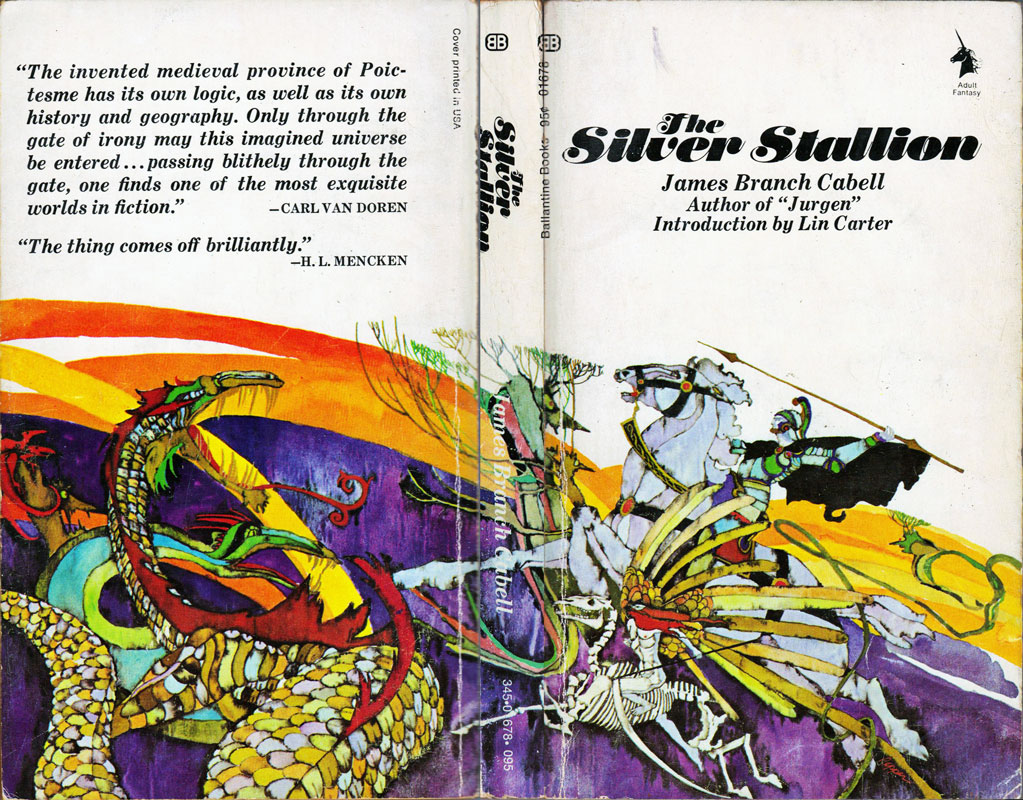
This essay is part of Ballantine Adult Fantasy: A Reading Series.
Read Lin Carter’s introductory essay here.
Table of Contents
James Branch Cabell and His Times
Reading The Silver Stallion
Parting Thoughts
Somewhere in Western Europe nearabouts France and Spain in the thirteenth century there ruled a Count Dom Manuel over the province of Poictesme, which he was granted by the King of Spain after Manuel raised himself up from a swineherd into a hero, and after he redeemed that land by driving out the Northmen against whom he and his captains—the nine men comprising, with him, the Fellowship of the Silver Stallion—fought many grand and devastating battles. Eventually, Dom Manuel passed out of Poictesme, perhaps accompanied by Death himself. But Manuel’s legend lived on as a symbol of virtue and valor, bolstered by the promise of his second coming. And his descendants ruled profitably over Poictesme for more than half a millennium, after which the land itself passed into legend.
Later epics told of Manuel’s rise, of the making of his legend, of his captains’ adventures after his departure from Poictesme, and of the many important goings on there over the centuries. Scholars argued over the veracity of the many accounts of Dom Manuel and his progeny, which appeared sometime in the eighteenth century and have turned up no earlier references, for example, in medieval and early modern sources. Some even suggest that Dom Manuel’s kin may have made their way to the Americas, while others believe all of it was dreamed up by one Felix Kennaston of Virginia, when he was hypnotized by the Sigil of Scoteia.
But the truth of a thing is not beholden to its accuracy. There are no sources attesting to Dom Manuel’s life, and yet we speak of it.
Such is the conceit of James Branch Cabell’s The Silver Stallion (1926)—which tells the stories of Manuel’s nine captains and how Manuel’s legend was established in Poictesme in the decades after he left that land in the company of Grandfather Death—and the larger literary cycle to which it belonged: the Biography of the Life of Manuel.
James Branch Cabell and His Times
The Virginian James Branch Cabell (1879–1958, his name rhymes with “rabble”) might well be likened, retrospectively, to the Mark Twain of early-twentieth-century fantasy fiction and his magnum opus, the multi-volume, multi-form cycle of novels, plays, essays, and poems called the Biography of the Life of Manuel, could be equally (rightly and wrongly) likened to a Discworld for the same period. If, of course, anyone at the time had had the anachronistic notion that Cabell was a fantasy writer or that fantasy fiction, as it was known much later, was what he wrote.
In 1969, Dorothy Schlegel noted, “Many Americans today seem scarcely to have heard of […] Cabell. The situation was quite different, however, in the 1920s,” in large part because Cabell’s 1919 novel Jurgen: A Comedy of Justice was briefly banned and taken to trial for obscenity by the New York Society for the Suppression of Vice on account of some silly allusions to the title character’s penis and perhaps also for the suggestion that God is just an illusion (223). But as the Ballantine Adult Fantasy series’s consulting editor Lin Carter later put it in Imaginary Worlds: The Art of Fantasy (1973), Cabell was highly regarded among“[p]erceptive critics of cosmopolitan taste” like Carl Van Doren, H.L. Mencken, Mae West, Sinclair Lewis, and F. Scott Fitzgerald, to name a few (39), who saw him as an American Voltaire meets Alexander Pope meets Anatole France meets Rabelais. High praise, indeed.
Born in Richmond in 1879, Cabell was the son of a wealthy and politically connected Virginia family who had recently fought on behalf of those failed defenders of slavery, the Confederates. But his family was progressive, in some limited sense, in that his parents divorced in the early 1900s and his aunt was a suffragist, and gender seems to have been a concern for Cabell, as evidenced in the constant satirical treatment of marriage in The Silver Stallion. Cabell was, as any elite young white Southern gentleman, well-educated and he even took a respectable job for a time in the early 1910s as a clerk in the offices of his uncle’s West Virginia coal mine (I’m sure the treatment of unions there was fantastic!) before marrying and returning to Richmond. But most of Cabell’s life was spent in writing—poetry, essays, plays, short stories, and, of course, novels—and he published some 50 books in his lifetime.
Most of Cabell’s output was devoted to the Biography of the Life of Manuel, with the earliest text in the cycle being his first novel, The Eagle’s Shadow (1904). It seems, however, that Cabell did not initially have the Biography in mind and many of the earlier texts were later edited to include references to Manuel and bring them in into the “world” of the Biography as it emerged only later, in the mid-to-late 1910s, in novels like The Soul of Melicent (1913, republished in 1920 as Domnei), The Cream of the Jest (1917), and his most famous novel Jurgen (1919). The “key” texts in the Biography followed soon after the notoriety of the court case against Jurgen—which was acquitted and became a landmark case for free speech and literature—made Cabell something of a literary celebrity. These novels were Figures of Earth (1921) and The Silver Stallion (1926), which told, respectively, of Manuel’s rise as count of Poictesme and of how his legend grew after he disappeared/died. Cabell’s novels in the Biography are all satires, witty and quippy, filled with irony and meta-references that constantly gesture to the falsehood of the text’s construction, ever prodding at the silliness of humanity and its efforts to make meaning.
Cabell continued to write his satires and plays and poems until his death in 1958, by which point he was a relatively obscure writer known for his one infamous book, Jurgen, but nonetheless highly regarded by the generation of American literati who defined the 1910s–1920s. No doubt the relative strangeness of what Cabell sought to accomplish with his idiosyncratic, pseudo-antiquarian, satirical take on medieval romances, with a wit and humor reminiscent of Twain but occasionally verging into the inanities of L. Frank Baum, and which he pursued across so many interrelated novels, made him something of an oddity in the heyday of literary modernism. Like William Morris and Lord Dunsany and E.R. Eddison, Cabell wrote within and against a clear literary tradition, even if he ranged farther afield than those British writers by drawing on, for example, Slavic, Islamic, East Asian, and Mesoamerican mythologies, and mixing them with a satirical impulse somewhere between Twain’s A Connecticut Yankee in King Arthur’s Court (1889) and Miguel de Cervantes’s Don Quixote.
For about a decade after his death, Cabell’s writing languished in the obscurity of niche fan societies and academic journals (Schlegel, quoted above, was remarkably timely, given that her piece was published mere months before BAF’s The Silver Stallion put any of Cabell’s novels aside from Jurgen in paperback). And along came BAF’s consulting editor Lin Carter, who clearly appreciated Cabell’s writing, calling him, in his introduction to the BAF edition of The Silver Stallion, “the only serious American novelist of genius to devote his full career to writing urbane, witty, subtle, and magnificently entertaining fantasy fiction” (ix). Carter included six novels from Cabell’s Biography of the Life of Manuel in the BAF series: The Silver Stallion (Aug. 1969), Figures of Earth (Nov. 1969), The High Place (Feb. 1970), Something About Eve (Mar. 1971), The Cream of the Jest (Sep. 1971), and Domnei (Mar. 1972). These put Cabell on par with Dunsany for representation in the series and together their books comprise 18% of the series’s 65 books.
But Cabell is in some ways an awkward fit with Carter’s vision of fantasy, which he tended at first to describe in an overlapping circle with epic or heroic fantasy (terms he used interchangeably, as the mood struck), but which increasingly made space for a broader genealogy of fantasy as the BAF series evolved. Indeed, Carter doesn’t mention Cabell in Tolkien: A Look Behind the Lord of the Rings and even L. Sprague de Camp’s Literary Swordsmen and Sorcerers (1976), which began appearing as essays in the late 1960s, has almost nothing to say about Cabell (this is significant, given how often Carter’s introductions ape de Camp’s ideas about pre-genre fantasy authors). Moreover, Cabell is odd fit for the BAF vision of fantasy because he doesn’t seem to mesh with any of the other writers Ballantine has put together so far, except insofar as the Biography novels constitute a satire of medieval romance set in the not-real place of Poictesme. There are no blurbs comparing Cabell, for example, to any of the writers Ballantine was publishing. Still, Carter praises Cabell’s writing as “eloquent, supple, and ingenious” or “polished, witty, subtly ironic” in his introduction, even admitting how pregnant his novels are with allegory—despite Carter being otherwise allergic to allegory.
I think, though, that what Carter found so appealing about Cabell is how Cabell’s writing responded to the tradition of the romance that descended through the late-medieval continuation of the Arthurian cycle, the early modern popularity of the Amadis cycle, and eventually culminated in Don Quixote, which, for Carter, “killed” the romance (along with Spenser’s The Faerie Queene) until Morris, in Carter’s telling, single-handedly revived the form and “invented” fantasy. Cabell’s fantasies thus fit neatly into Carter’s developing sense of the genre’s history. And Cabell’s picaresque satires of medieval romance draw from similar traditions that informed Morris, Dunsany, and Eddison, even as Cabell wrote far outside of their British contexts, not in conversation with any of those authors (though he admired Eddison’s The Worm Ouroboros), and to much different effect, especially in tone, deployment of the fantastic, and the wild, almost haphazard intermixing of cultural traditions. In some ways, too, Cabell’s Biography is strikingly similar to Eddison’s later Zimiamvia novels, despite preempting them by decades.
Cabell’s inclusion in the BAF is therefore a rather smart choice on Carter’s—or, perhaps, editor Betty Ballantine’s—part because it demonstrates precisely how fantasy emerged from disparate literary traditions in the writing of authors not consciously working together to produce something new (i.e. fantasy), but instead each doing new, weird, and sometimes quite singular things with old forms, genres, and literary modes—and how, with time, all of their efforts could be seen, together, to constitute the emergence of a literary form that later writers, like Tolkien or Fletcher Pratt or Clark Ashton Smith, would build on and that, even later, genre tastemakers like Carter would help canonize as genre fantasy through the BAF series. It makes sense, then, that so much of Cabell’s Biography appeared in the series, since it offered a surprisingly different way of doing fantasy—and one decidedly informed by the American literary tradition and its satirists and fantasists, a nice contrast to the other Americans Carter would pull into the series, like Lovecraft, Pratt, de Camp, Hannes Bok, etc. who came out of the pulps.
And the kind of fantasy Cabell wrote, the comedic and the satirical, has clearly been a powerful strain in genre fantasy fiction, and may even have been partly responsible for the explosive boom in fantasy sales in the 1980s, thanks in large part to writers like Piers Anthony. Cabell, though, doesn’t seem to have a lot of influence on writers today. He is, in fact, hardly ever mentioned, unlike Morris, Eddison, Dunsany, or even David Lindsay, who are regularly cited as founders of modern fantasy. But character and place names borrowed from Cabell’s writing, especially Poictesme, show up throughout sff of the 1970s onward, thanks, I’m sure, in no small part to BAF putting his work in mass market circulation.
So let’s turn, then, to the first of Cabell’s novels BAF published: The Silver Stallion.
Reading The Silver Stallion
Originally published in hardcover by Robert M. McBride & Company in 1926, The Silver Stallion was Cabell’s 26th book and a direct sequel to Figures of Earth. While The Silver Stallion is a sequel, and narrates the events of what happened after Manuel established himself as count of Poictesme, Carter and Ballantine chose to release it in August 1969 as the fourth book in the BAF series. Figures of Earth followed in November as the eighth book. The Silver Stallion can be profitably read independently but it doesn’t make all that much sense to release these two novels out of order in terms of both their original publication and the storyworld chronology, especially since the other novels in the Biography are much less directly intertwined with these two. Still, as an introduction to Cabell and as proof of the argument that he is indeed a master of smart, sharply written “adult fantasy,” The Silver Stallion is a great choice.
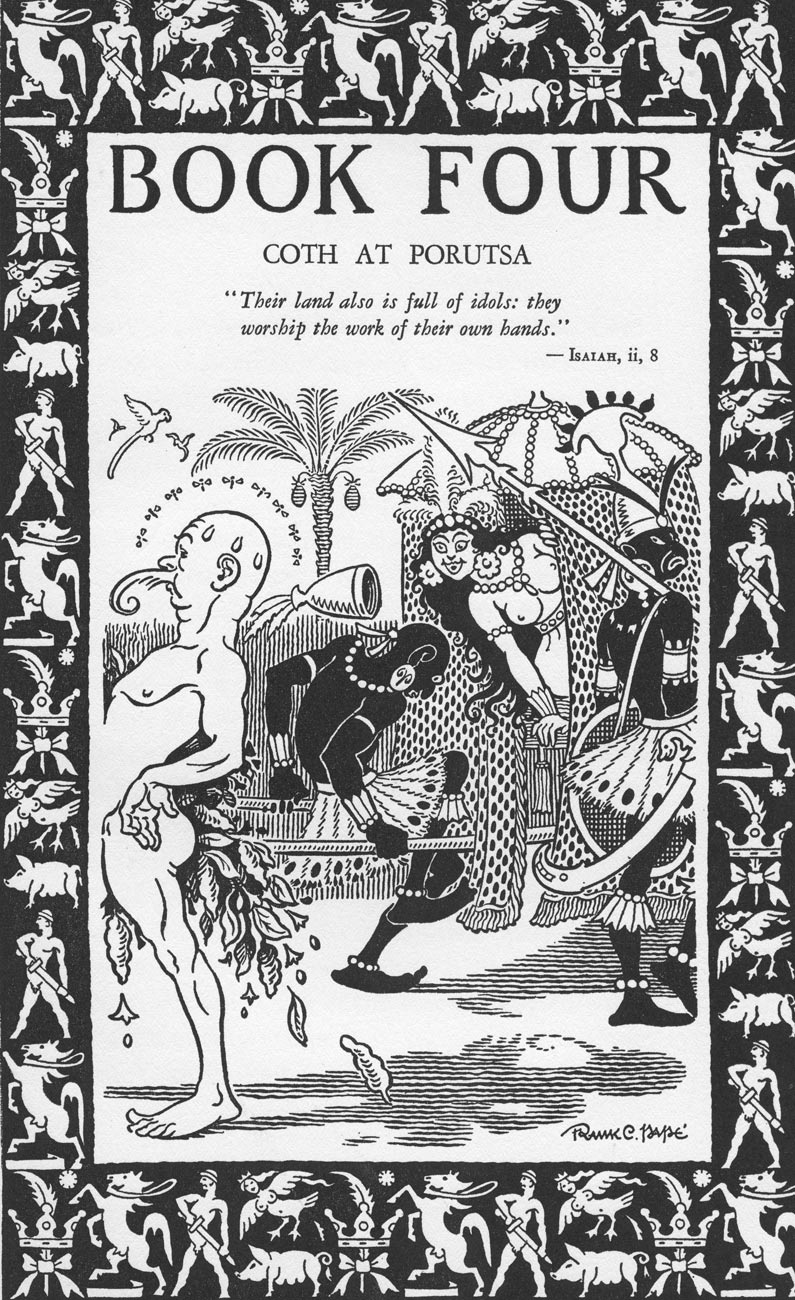
As Carter notes in his introduction, “The universe of the Cabellian novel is puzzling and paradoxical” (viii), and The Silver Stallion is indeed both puzzling and paradoxical—essentially a collection of ten vignettes of about 25 pages, each detailing the wild and rumbustious “dooms” of one of the members of Manuel’s Fellowship of the Silver Stallion, from confrontations with Koschei the Deathless, who created the universe as we currently know it, to travels in distant empires where the “savage” natives cannot help but fall in love with and give their empire to a bald, aging, pink-bodied European knight; from decades spent devouring all knowledge there is, only to discover that the single truth of existence is that there is no truth, to a journey into Asgard that makes one of Manuel’s captains into a demiurge who creates and destroys his own (and maybe our?) universe. All the while, the legend of Manuel grows—and it is a legend that bears no resemblance to reality but instead enshrines the life of a virtuous hero who never truly lived.
The winding, ridiculous, convoluted, contradictory narrative of The Silver Stallion is ultimately about one thing, enshrined in the motto of the land of Poictesme: mundus vult decipi, a Latin phrase of unknown origin that translates to “the world wants to be deceived.” Deception, memory, legend, and myth are all of a kind in The Silver Stallion—and they are distinctly ideological, for when you cut through all the craziness of Cabell’s novel, its many satirical episodes examine from every angle what it means to believe in something, how belief makes a thing “real,” and how belief in the reality of a thing can “redeem” people. The notion of redemption is especially significant to The Silver Stallion, which Cabell subtitled A Comedy of Redemption (most of his Biography novels have a subtitle fitting this formula; Figures of Earth, for example, is subtitled A Comedy of Appearance, and appearances, we know, can be deceiving). Of course, to get to what the novel is about, you have to wade through the constant, inane—and, to me, incredibly unfunny—“humor” of the author.
The novel opens, as so many sff novels did, borrowing from a tradition dating back to the earliest Gothic novels of the late-eighteenth century, with the frame that The Silver Stallion is a found manuscript, or at least a retelling based on The Text of Bülg, which would seem to be the earliest edition of the Biography that has been filtered through other texts, like Poictesme en Chanson et Légende, which the author refers readers to for “a discussion of the sources” (xvii). The author admits that scholars like “Codman” have “shown” the texts of the Biography are “spurious compositions of 17th century origin,” but we are nonetheless encouraged to seek the sources ourselves and decide on their veracity, knowing full well that no one can prove they existed prior to 1652 (xvii). This note on the text is then followed by additional commentary from the author, presumably but by no means assuredly Cabell himself, which establishes that the novel is about the theme of the coming Redeemer—which the author argues is a regular, expected, and cyclical element in human cultures all over the world, and Dom Manuel is just one such Redeemer who “awakened that sustaining faith which appears vitally necessary to men’s contentment” (xxiii).
I appreciate this opening because I find such faux scholarly frames incredibly endearing and, in this case, an apt gesture at the genealogy of romance The Silver Stallion draws on. By noting the questions about the text’s authenticity, by pointing to layers of translation and interpretation, as well as a whole (nonexistent) scholarly apparatus, Cabell not only does the expected in pointing to the “reality” of the story—which is set in a world as equally real as it is fantastical—but also references similar literary cycles in the history of the romance, especially the Arthurian and Amadis cycles, which proved so popular through the continued invention of dozens of new stories in the early modern period that Carter claimed they “corrupted” of “infect[ed]” the romance tradition, leading to the necessity of its lampooning in Don Quixote and its ultimate destruction. Raising the authenticity of the (imaginary) Text of Bülg, questioning whether it was a forgery or not, also points to the prevalence of such forgeries in the eighteenth century, most notably Thomas Chatterton’s “medieval” poems by Thomas Rowley and James MacPherson’s Ossian epics. Such forgeries drew on the same antiquarian impulses that informed the early pre-genre fantasy fiction written over the next two centuries (see Jamie Williamson’s The Evolution of Modern Fantasy for more context). All of this serves to highlight the novel’s principal theme, since Cabell tells us from the beginning that it’s all a fiction. Of course, to continue to read the novel is to in some sense believe in it, to take its story seriously enough to get something from it. Mundus vult decipi? More like lector vult decipi.
The novel itself is divided into ten “books” that each provide a glimpse at how one or another of the Fellowship of the Silver Stallion went to his foretold doom and, in the process, added to the legend of Manuel the Redeemer. In the first book, Manuel disappears and his passing is seen only by two youths: his daughter, Melicent, reported that he rode into the west with Grandfather Death, while the young Jurgen (yes, that Jurgen), son of Coth, after fleeing his abusive father, saw Manuel upon a hill, where he shared “a fearful eucharist,” was transfigured (into what is not said), heard portends of Poictesme’s future, and was then taken into heaven on glowing clouds. Of these two stories, no one believes Melicent’s, but, in a version of Pascal’s wager, “Good-hearted persons everywhere began, with virtually a free choice thus offered between belief and disbelief, to prefer to invest a little […] remunerative faith in the story told with such conviction by the sweet and unsullied child” Jurgen (5). From the seeds of Jurgen’s story—whether real or not—grow Manuel’s legend, nurtured principally by Countess Niafer, Manuel’s wife, and the living saint Holmendis from Philisita.
After Manuel’s mysterious departure, the Fellowship of the Silver Stallion—Gonfal, Donander, Kerin, Ninzian, Holden, Anavalt, Coth, Guivric, and the magician Miramon Lluagor—meets with Niafer and Holmendis, as well the red-haired Horvendile, a mysterious figure who through a secret contract gave Manuel rulership over Poictesme (and who is a stand-in for the author, who enjoys playing in the world he creates, as revealed in other tales of the Biography). Horvendile declares “So begins a new romance,” dissolves the Fellowship, and foreshadows the doom of each hero, whose ends will ultimately help to raise up the legend of Manuel (8). The remainder of the novel traces Gonfal, Miramon, Coth, Guivric, Kerin, Ninzian, and Donander to the appointed dooms (Anavalt and Holden are present but sidelined in these stories). What’s striking about book one, especially having not read the novel this is a sequel to (thanks, Carter!), is that each of the heroes glories (ironically, picaresquely) in the violence, murder, and horrors of war perpetrated by Manuel in their campaigns to free Poictesme of the Northmen. And, hearing these stories, Niafer is confused and disgusted, unfamiliar with the man they describe. From this discrepancy between the man Manuel was and the man his wife and subjects imagined him to be, arises the need for a legend about their heaven-elected ruler. Something greater and grander to deceive the world, to redeem it, a symbol of virtue and valor men could strive to live like.
Books two through nine are each devoted to a former member of the Fellowship, with Coth’s story told across two books. They are essentially standalone tales, each with its punchline and moral, about the zany mythological adventures the heroes take, in the course of which each is shown to us—but never to themselves—to be anything but heroic. Perhaps the most significant episode is that of Coth, who is a die-hard believer in Manuel’s martial image and hates the sanitized legend that has taken hold in new epics, stories, and ballads about his count. Coth also believes Manuel would never abandon Poictesme and so is the only one to follow Melicent’s story into the west in search of Manuel. He travels for years, waylaid often in his own goofy version of The Odyssey, staying here in the all-male harem of a foreign queen and there becoming the emperor over the Mesoamerican-coded Tollans, and when he finally finds Manuel in the Most High Place of the Gods, his former master instructs him to return to Poictesme and to let the legend of the “other” Manuel create the hero Poictesme needs:
For Poictesme has now, as every land must have, its faith and its legend, to lead men more nobly and more valorously than ever any living man may do. I, who was strong, had not the strength to beget this legend: but it has been created, Coth, it has been created by the folly of a woman [Niafer] and the wild babble of a frightened child [Jurgen]; and it will endure. […] The dream is better. For man alone of animals plays the ape to his dreams. (102)
In each book we get small glimpses at how the legend of Manuel grows, with churches built to worship him, cults forming in his honor, great gleaming statues raised to hail him, and the quality of humanity’s behavior improving throughout the realm of Poictesme. And as each hero meets his doom—for example, Miramon accidentally waking the evil of the Old Ones who organized the universe before Koschei the Deathless supplanted them; or Guivric being replaced by the shade-like Sylan named Glaum-without-Bones, who is meant to be his antithesis but, instead, becomes the most ardent believer in Manuel’s legend; or Kerin gaining all knowledge ever recorded by humans, while studying alongside a brown gander in a cage at the bottom of a well, only to learn that it is all useless—their stories are incorporated into Manuel’s legend as evidence that he redeemed these great men, too. For the legends spin each’s unfortunate mishaps into shining exemplars of virtue, so that the Fellowship is no longer the “hardie[st] gang of bullies” and “genial murderers” (7, 6) but doting husbands, valiant warriors, and devout believers.
At the same time, Cabell makes his point that the figure of the redeemer is a cultural and ideological necessity. Guivric learns, for example, that the redeemer is a vital part of the triad all men need to lead meaningful lives: something to fight against (an enemy), something to fight for (a lover), and something to believe in (a redeemer). And Kerin that redeemers are “messengers from the gods to our race upon earth […] sent with commendable regularity every six hundred years” (190). In relating the history of the world’s redeemers, Kerin puts Manuel in the company of Adam, Enoch, Fuxi (“Fo-hi”), Bhrigu (“Brighou”), Zoroaster, Thoth, Moses, Lao Tse, Paul of Tarsus, and Mohammed, and hails him alongside King Arthur, Charlemagne, Fionn mac Cumhaill, Siddartha Gautama, Saoshyant, Alexander, and even Satan himself as those mythic figures whose promise of a second coming deepens men’s belief. Each book of The Silver Stallion, each absolutely wild and unhinged tale of the Fellowship, hammers home time and again and with increasing fervor: mundus vult decipi.
The final book of The Silver Stallion returns to Poictesme and to Dame Niafer, whose efforts at spreading her husband’s legend in order to remember the man she imagined him to be have changed Poictesme for the better and have begun to spread the cult of Manuel, and the belief in his second coming, across the world. It’s worth noting that all of this starts, yes, with the child Jurgen’s story of Manuel’s miraculous ascent to heaven, which (if true) he only witnessed because he fled his home to escape his father’s physical abuse. And the legend of Manuel begun by that child spread because the awful, violent stories Manuel’s captains told of their liege lord disturbed his wife, Niafer, who felt as though she didn’t know the monstrous man they described. Manuel’s is a legend created by, as he himself puts it, “the folly of a woman and the wild babble of a frightened child” (102).
These are important origins for the legend of Manuel and they pin the necessity for the legend on the behaviors and actions of violent men. Gender is a concern through The Silver Stallion. Women are everywhere nagging, controlling wives, in that way so familiar to comedy written by men, where the women’s demands to not be treated like shit are the joke. But in The Silver Stallion it seems clear that it is the men who are the butt of the joke because they are all, to a one, dolts. Many of the heroes’ dooms come because they did not listen to women, because they ignored them, talked over them, looked through them. Some of the gendered humor is, still, I think a bit sexist (and cf. the repeated racism of the depiction of “dusky savages” throughout), but the whole structure of the mythmaking in The Silver Stallion, the social and cultural need for men to be redeemed, has everything to do with tempering and making safer a world in which violent, aggressive masculinity would otherwise run rampant. Dismal, but powerful, stuff.
And in the end, Niafer has to confront the fact that the legend of Manuel she has so dutifully proselytized is just that, a legend, when she dreams that Queen Alianora of England and Queen Freydis of Audele—women with whom Manuel had affairs and children during his many campaigns on behalf of Poictesme—journey to meet her at the monumental, jewel-encrusted statue of Manuel she erected in Storisende. In the dream, they reveal Manuel’s indiscretions and tease her for pretending to be unaware of the man he was. Shortly after awaking from the dream, Niafer comes across Jurgen, now grown in the intervening decades since Manuel’s legend has spread, and he intimates that he will never know if what he saw that day was the truth or the “the wild babble of a frightened child.” After Niafer leaves, Jurgen pries one of the jewels from the statue and discovers that Niafer studded Manuel’s statue with colored glass. The legend is, and always has been, a deception. A necessary one, though, that has reenchanted and, for a time, redeemed the world.
Parting Thoughts
The Silver Stallion is a great introduction to Cabell for the Ballantine Fantasy series, though I maintain that it would have made more sense to release Figures of Earth first, if only because there are characters, subplots, and references galore that make little sense in The Silver Stallion. Then again, a lot of The Silver Stallion makes very little sense. Much of what happens is purposefully nonsensical, following the logic of whimsy and peppered with hundreds of references to things real and unreal, making for a storyworld and a narrative that overflows with information and provides so few anchors to a graspable reality. And that is the point. The Silver Stallion is not just a sendup of romance, it is not just satire, it is a kind of absurdist, maximalist play on both of these things that, nonetheless, returns with rigorous regularity to the form of the romance, reaching out occasionally to other reference points, like fairy tales, katabasis, epic, and so on. It is somehow dense and breezy at the same time. And for all the puzzling paradoxicality packed in The Silver Stallion, Cabell’s points about redemption, deception, myth, memory, and legend are poignant and powerful.
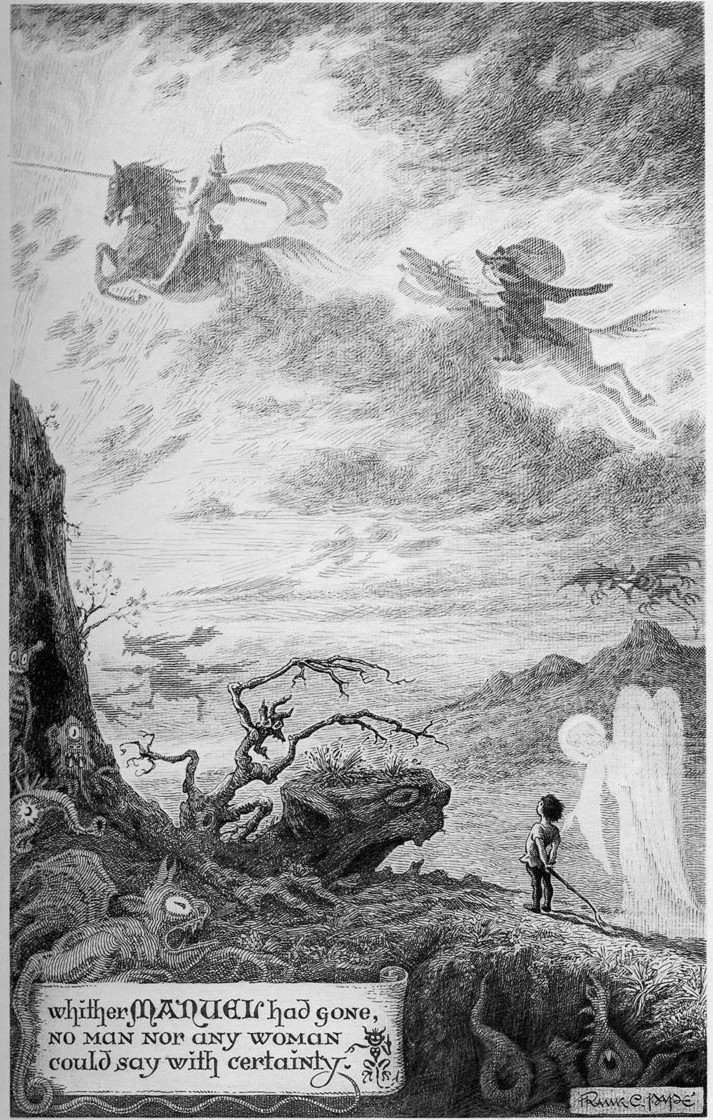
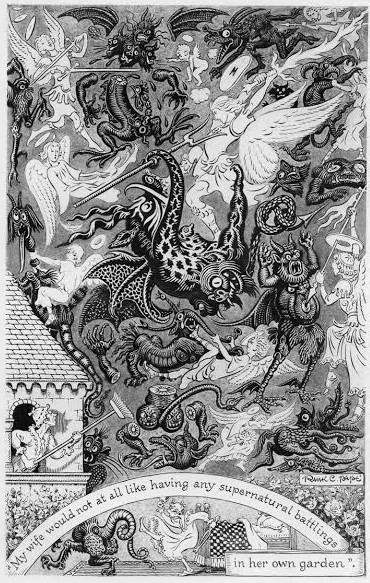
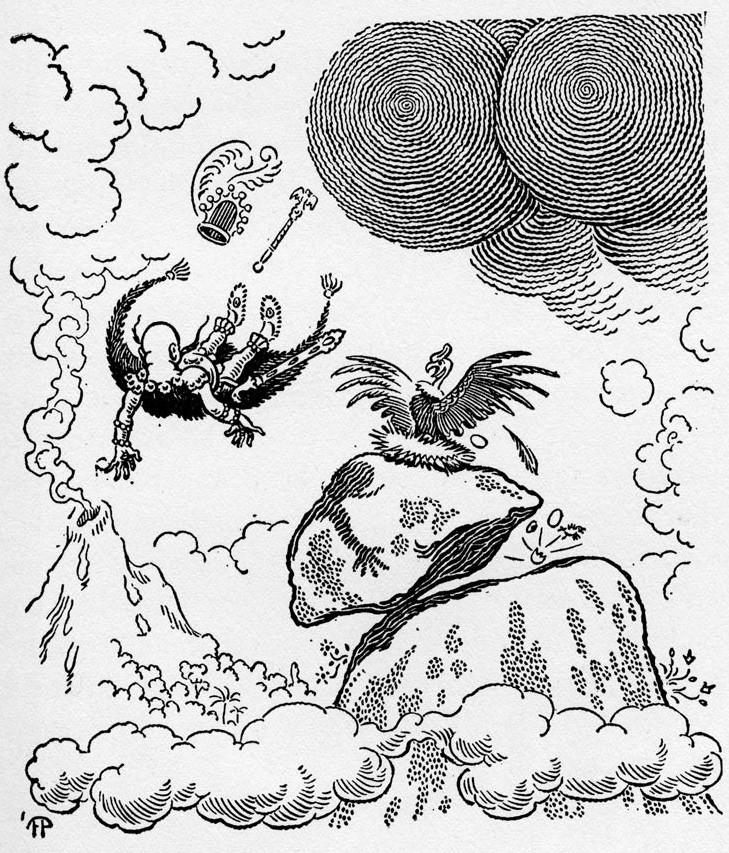
And all of this is aided by the illustrations done by the English artist Frank C. Papé, best known for his illustrations of Cabell’s and Anatole France’s books. Papé’s illustrations vacillate between the whimsical and the serious, and are therefore perfectly pitched to Cabell’s writing. For The Silver Stallion, Papé produced full-page illustrations of key scenes from the novel (images 1 and 2 in the gallery below), title pages for each of the novel’s ten books (image 3), and smaller, more cartoony incidental illustrations that appeared at the end of each chapter (image 4). Unfortunately, Ballantine skimped on their reproduction of the illustrations. The BAF editions include the smaller, more cartoony illustrations at the end of most chapters, as well as the title pages, but not the more impressive, glorious full-page illustrations. Also, like Cabell’s writing about race, Papé indulged the racist depictions, as image 3 below shows. And that’s hardly the worst one!
In terms of its presence in the BAF series, I think The Silver Stallion is an incredibly smart decision on Ballantine’s part. I’m not sure BAF needed six of Cabell’s novels, but The Silver Stallion shows an important side of what pre-genre fantasy was, the diverse literary traditions it drew on, and the many forms it could take—and it wonderfully prefigured how comedic, satirical fantasy would be integral to the development and growth of genre fantasy in the coming decades. Moreover, while I don’t enjoy Cabell’s humor in the least, I have a feeling that it would have played quite well in the late 1960s and 1970s, in the era of Mad Magazine, Monty Python, and National Lampoon. Indeed, National Lampoon’s incredibly unfunny Bored of the Rings (1969) parody of Tolkien was, somehow, a national bestseller. The Silver Stallion was far and above the story of Frito Bugger’s journey to Fordor, though to Ballantine’s dismay the more erudite Cabell novels didn’t sell nearly as well (although Ballantine did later reprint a number of them in the 1980s, with new covers, under the Del Rey imprint).
That said, do I like The Silver Stallion? Not in the least. I found it absolutely tedious, but for reasons that are wholly the fault of my own tastes and interest—and which I admit are my own limitations as a reader and critic. Simply put: I generally don’t enjoy satire, especially Cabell’s variety. (Verhoeven’s Starship Troopers [1997] is probably the only satire I really like.) But hopefully the rest of this essay proves what I have said time and again here on Genre Fantasies, namely that it doesn’t matter if I (or you or anyone else) like(s) a book. What matters is whether the book is productive to any discussion of literary history and criticism, and clearly Cabell and The Silver Stallion are.
Still, I can’t say I’m looking forward to reading five more Cabell novels in the course of this Ballantine Adult Fantasy reading series. To me, this is like being forced to sit through Monty Python and the Holy Grail and then five prequels and sequels to it. No, thank you! My readerly endurance has its limits.
But, thankfully, the next novel in the BAF reading series, Lilith (1896), is of a wholly different kind and from another of the major early names in pre-genre fantasy fiction, whom we have yet to meet in this series: the Scottish writer George MacDonald.
To get notifications about new essays like this one sent directly to your inbox, subscribe to Genre Fantasies for free:


2 thoughts on “Ballantine Adult Fantasy: Reading “The Silver Stallion” by James Branch Cabell (Biography of the Life of Manuel)”