The World Beneath by James Gurney. 1995. Calla Editions, 2012. Dinotopia / Dinotopia (Gurney) 2.
James Gurney’s Dinotopia: A Land Apart from Time (1992)—which I’ll refer to throughout simply as Dinotopia—was not only a publishing phenomenon, a bestseller that launched a dinomaniacal franchise spanning four illustrated novels by Gurney, 16 junior chapter novels, two adult novels by Alan Dean Foster, and a range of multimedia adaptations and expansions (including a TV miniseries, TV show, animated film, and several video games), it was also a beautiful exemplar of the power of the utopian imagination that drew heavily on adventure, lost world, and utopian fiction of the past several hundred years, as well as on Gurney’s own experiences as an archaeological reconstruction illustrator for National Geographic and more. When Dinotopia released to widespread acclaim (thanks in part to an expensive, extensive media blitz by Turner Publishing), Gurney was already a highly respected painter and illustrator. But his illustrated novel about a land the size of Sri Lanka where dinosaurs and humans lived together in harmony, nurturing a society of mutual care and respect that dated back thousands of years (and the dinosaurs’ society dating back tens of millions of years), made Gurney something of an artistic celebrity—especially among paleontologists, who in the 1990s were experiencing a glut of interest in their work thanks to the many dinofictions that proliferated in the decade after the end of the Cold War. Dinotopia also won Gurney two Hugo awards, for Dinotopia and The World Beneath, in 1993 and 1996 in the now-defunct Best Original Artwork category.
Dinotopia was unique among dinofictions, though, in that it sought to capture the idea, inspired by new insights in paleontology during the 1970s–1980s, that dinosaurs were caring, gentle beings. And, in Gurney’s vision, sapient. Had they survived the Cretaceous-Paleogene extinction of c. 65 million years ago, Gurney suggests that they might have built the kind of utopia that father Arthur and son Will Denison discover when their schooner was shipwrecked in the Pacific and dolphins brought them to safety on Dinotopia’s shores in 1862. What was so impressive about Dinotopia to me, as a critic and historian of sff and as someone who regularly engages the utopian imagination in my work, is that the illustrated novel was dense with information not just about how Dinotopian society works—that is, the logistics of how so many different kinds of beings lived together and the effects this had on everything from writing to architecture to storytelling—but also how it thinks and what it believes.
Gurney explains, for example, Dinotopians’ conception of time and change, which accepts both linear and cyclical temporality, seeing time as a spiral—an idea informed by millions of years of knowledge and thousands of years of interaction with different human societies’ thoughts. Moreover, Gurney shows that Dinotopians considers newcomers (dolphinbacks) an integral part of keeping Dinotopian society vibrant while also recognizing that, for some, the ontological and epistemological shock of life in Dinotopia is traumatic, that not everyone adjusts well—and Dinotopians respect that. Men like Crabbe, who hate the “scalies,” are nonetheless cared for and their disagreements with society tolerated to the extent that no one is harmed. So, too, are the needs of dinosaurs like Tyrannosaurus rex, who prefer to live alone and have biological needs that conflict with the largely herbivorous society of Dinotopia. They are accepted and managed as an example of the kind of natural difficulty that arises when different people and species coexist. As the ancient monk Levka Gambo puts it to Will and Sylvia, “[e]ach person who arrives in Dinotopia becomes reborn, and the birth is different for each individual” (141). Dinotopian society thrives on individual differences, embraces and celebrates it, within the context of a harmonious whole.
Dinotopia is nothing short of incredible and, were I still in academia, I would put it on a syllabus without hesitation, since I think it’s a fascinating, productive exploration of an ecological utopia that indexes and references the utopian tradition alongside texts drawn from a wide genealogy of sff, offering a vision of a cross-species society and attunement with the natural world that is deeply reflective and energetically original. At the end of Dinotopia, Arthur, who was initially skeptical of Dinotopia’s communistic society and of the equal value of dinosaur life, reflects that “Our old life was richly rewarding, and I am grateful to it. But here on Dinotopia my eyes have been opened to the wonders of a new world” (159). Dinotopia is a novel ultimately about the power of imagination as a political force, a novel that argues a world where “all these different people and dinosaurs […] get along without quarreling” is possible, “but only if you do imagine it” (79). What a shame, then, that Dinotopia: The World Beneath is a comparatively lackluster—if still beautifully and worthwhile—continuation of Arthur and Will’s story on Dinotopia.
Gurney’s anticipated 1995 sequel The World Beneath is a novel in which adventure outpaces utopia, in which Arthur backtracks on all he learned about the value of human-dinosaur coexistence, but in which Gurney also puts forward a parable about how technology divides people, species, and the natural world. The principal change Gurney makes in The World Beneath is to its detriment: he switches the narrative register from the first-person diary and sketchbook frame in Dinotopia to straightforward third-person narrative. In the process, The World Beneath loses all of the interiority and immediacy that made Dinotopia such a compelling exploration of Gurney’s utopia, since at the center of the story was the journey Arthur, and to a lesser extent, Will take—not just physically, but also psychologically. Arthur, for example, wrestles with his fundamental distaste for Dinotopian society and eventually accepts it as the better world Gurney imagines it to be, while Will journeys into adulthood, growing up immersed in Dinotopian society and offering a model to his father of what life in this incredible place can be like. The diary/sketchbook frame offered a contemplative, often vulnerable reflection on Arthur’s and Will’s experiences and served as a gateway for the reader to “learn” Dinotopia along with them as they traveled the land’s communities, met people who challenged their views, and eventually found their own place in this new world.
The World Beneath feels like a sequel to that story written by someone else who had little to no interest in Gurney’s characters or ideas, and saw Dinotopia instead as a sandbox for speedrunning cool ideas from adventure fiction. Not only does Gurney shift to a third-person perspective that immediately sheds what made Dinotopia compelling, but Gurney’s writing is hamfisted and voiceless. Thankfully, the accompanying paintings, which are as beautiful as ever, still manage to capture the visual exploration offered by the sketchbook frame, with Gurney providing both narrative paintings depicting scenes from the novel but also diagrams, maps, object studies, character profiles, and more. Gurney provides, for example, a study of the “Devonian seafloor community” complete with a chart of the different creatures present (42–43) and, later, three different visual interpretations of the same rock formation as seen by Arthur, Crabbe, and the newly introduced Oriana (88–89), with each seeing the formation through their own biases: Arthur seeing the accumulation of minerals of millennia, Crabbe a skull, and Oriana a mother and her children. And, as in Dinotopia, Gurney once again places documents written in the Dinotopian footprint font throughout the book for savvy readers to decipher.
Gurney’s magnificent art and unfortunate choice of narrative perspective are in service of a plot that is quite simply recounted because The World Beneath gives everything to its plot and little time to the careful exploration of Dinotopian life and beliefs. That might be a little unfair, and probably bespeaks my frustration with this novel being such a radical departure from the previous book, because what Gurney does in The World Beneath is generally commendable. Namely, he explores Dinotopia’s ancient past and, through that past, makes Arthur face the pitfalls of scientific progress for progress’s sake. This would seem to be a lesson Arthur had learned in Dinotopia, where he comes to accept that while Dinotopian society is radically different, it ultimately offers a better and more just way of cooperative life in tune with community and nature. But The World Beneath backtracks Arthur’s character development from the very beginning in order to tell a simple but nonetheless effective—if not particularly affecting—story that makes him question his view of scientific progress as an unalloyed good.
The novel begins with Will, a Skybax rider, testing his father’s invention: a flying machine called a dragoncopter, basically a steam-powered dragonfly-inspired biplane. Arthur is insistent that flying machines like his dragoncopter will one day help humanity “travel freely, not only throughout this island, but also across the ocean to the rest of the world” (12). But the dragoncopter’s test flight is not so successful and Will nearly dies. When he returns to land, Will is worried about his father’s disappointment at the loss of the machine, but the Protoceratops Bix assures him that a person’s life is more important and he criticizes Arthur for “putting too much faith in machines. Wonderful as they are, they have no judgment of their own. No heart, no sense, no love” (10). But Arthur’s belief that scientific progress will improve the world, allowing humans to surpass dinosaurs with machines, is unflappable and all the more insistent because he believes that Dinotopia was once a far more technologically advanced civilization. After all, in Dinotopia, Arthur and Bix went on a journey to the World Beneath that was not documented in that book, since the narrative switched to Will’s perspective. Gurney saved that story for this book.
Arthur recounts his expedition into the sacred underworld of the dinosaurs in Dintopia to a council of human and dinosaur elders, revealing that his and Bix’s progress into the World Beneath was stymied by a sealed door. He found one half of a key, but the other is missing. Moreover, they found carvings of a half-human, half-dinosaur being, whom the librarian Nallab names as Ogthar, the supposedly mythical king of the kingdom of Poseidos, an anthroceratops who was believed to have hatched giant metallic creatures from golden eggs. Arthur also found a sunstone, a source of energy in Dinotopia, and believes that more sunstones might be beyond the sealed door. The Amargasaurus Myops scoffs this all off as myth but the Triceratops Brokehorn encourages a second expedition once the other half of Arthur’s key is found. So word goes out across Waterfall city for all citizens to look for a key… and the other half just so happens to belong to the gorgeous young musician Oriana Nascava, who has peculiar dreams of an ancient cave. Together with Bix and Crabbe, Oriana and Arthur voyage back to the World Beneath, unlock the sealed chamber, and enter a realm of ancient advanced technology conjured by Gurney from a variety of sources, especially Jules Verne, Edward Bulwer-Lytton, and Edgar Rice Burroughs.
The dragoncopter prologue of The World Beneath established quite clearly that Arthur was willing to risk his own son’s life to test a potentially dangerous technology, setting up a philosophical conflict that runs through the book and that asks “What are the risks of technological advancement?” Bix has the answer from the beginning, but it’s not one Arthur is willing to hear or heed. For him, scientific progress will make the world better and, despite his having embraced the multispecies life of Dinotopia in the first book, Arthur nonetheless expresses considerable discomfort with living equally with dinosaurs in The World Beneath. It seems clear, then, that part of what Arthur wants is a way to separate himself from the dinosaurs, to not have to rely on them for transport or infrastructure, but to use machines instead. He hasn’t graduated to the anti-dinosaur hatred of the perpetual outsider Crabbe, but Gurney makes clear that in The World Beneath Arthur would very much like to live without dinosaurs. Poor Bix.
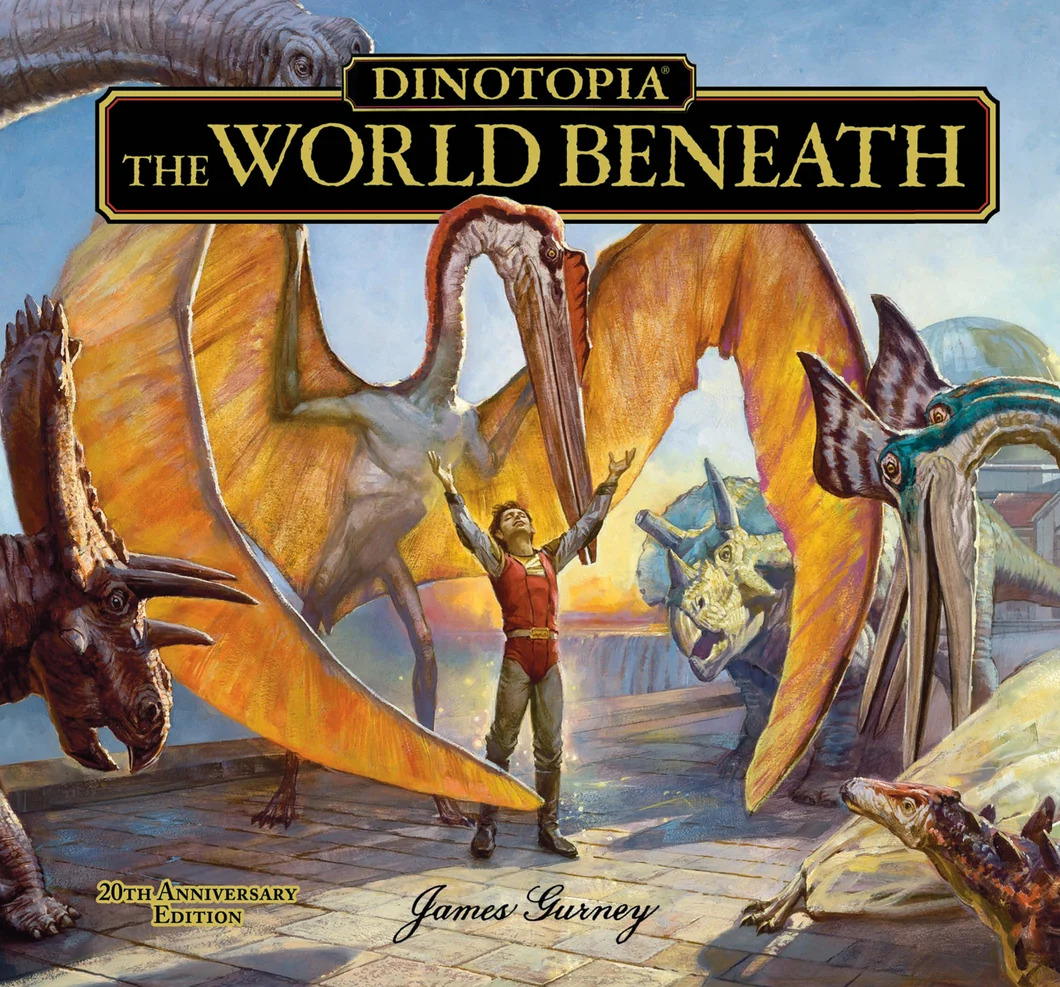
Indeed, the incident with the dragoncopter represents in miniature the conflict at the center of The World Beneath but is also telling in other ways. For one, the moment when Will returns to the landing platform in Waterfall City after being saved from the failed dragoncopter by Cirrus is used as the cover painting for the novel. It’s an odd painting, to be sure, since it shows Will with his arms raised like some hero, a yellowish glow encircling him, and dinosaurs surrounding him, some looking on with awe, others seemingly bowing. The painting, of course, celebrates Will’s survival: life measured beyond the worth of a machine. But it also, I think, is symptomatic of the subtle perspectival shifts in The World Beneath, which makes the dinosaurs less central to the story. Arthur’s interest in an anthropocentric world, a world where dinosaurs are secondary, is suggested by the cover painting. At a narrative level, too, I think Gurney makes the dinosaurs characters, especially Bix, far less interesting and personable. Although, as we’ll see, this is still a novel about living in harmony and multispecies community, there’s very little sense of that lived community in this novel compared to in Dinotopia.

Arthur’s hope for a society that relies on machines, instead of living in harmony with dinosaurs, is soon glimpsed. For when the explorers use Arthur’s and Oriana’s reunited key to unlock the sealed door, they discover what happened three thousand years ago when a hyper-advanced human civilization put progress above people. Gurney draws on the “lost race” subgenre of lost world adventure fiction, which takes Plato’s philosophical parable of Atlantis as a precursor, to depict Poseidos, an ancient society that relied on sunstone-powered machines that fundamentally changed Dinotopian society. The machines were vehicles as well as laborers, but the humans’ reliance on machines drove the dinosaurs to abandon Poseidos. Moreover, Poseidos had discovered a ruby sunstone, which amplified humanity’s dark desires and baser impulses. And so Poseidos fell. It relied too much on machines, it gave in to wickedness and violence, it built without regard for the natural environment, and its capital was destroyed in a cataclysm of its own making. King Ogthar led the survivors into the World Beneath, the sacred place where dinosaurs survived the Cretaceous-Paleogene extinction millions of years earlier, and built a new home. But this, too, in time was destroyed and the treasure of Podeidos, including the ruby sunstone, was given to the carnivores of the Rainy Basin to protect for all time so that humanity would never again be tempted to turn away from dinosaurs and toward the selfishness of anthropocentrism.
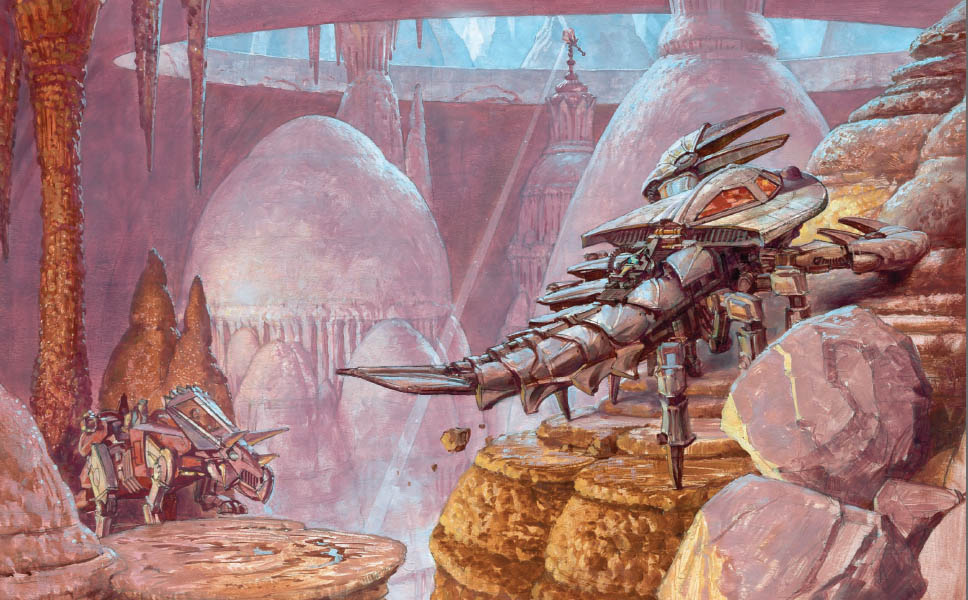
The story of Poseidos’s fall is learned after Arthur and company return from the World Beneath riding some of the sunstone-powered strutters. They surface in the Rainy Basin in the midst of a tyrannosaur attack on the trade caravan Will has spent the novel protecting as a Skybax rider (some of the novel is spent with Will during this mission, but it’s brief and limited in its exploration of life in Bonabba, except that it awkwardly suggests that Dinotopians think tyrannosaurs are greedy by nature—exactly the opposite of what Bix taught Will and Arthur in the previous book). Arthur befriends the “king” of Rainy Basin, a Giganotosaurus named Stinktooth, who grants them the right to view and take what they wish from King Ogthar’s treasury. (As an aside: Giganotosaurus was first identified in the mid-1990s and the paleontologist who did so asked Gurney to paint the first illustrations of the new dinosaur. Another recent paleontological discovery included in The World Beneath is Amargasaurus, first identified in 1991.) From ancient photographs recorded by the Poseidonians, Arthur learns how their society fell victim to its own hubristic ideology of progress. What’s more, Bix off-handedly reveals that ancient Egypt and China were both heavily influenced by an exodus of Dinotopians and that the Atlantis myth was almost surely about the fall of Poseidos.

The climax of the novel comes when Crabbe steals the ruby sunstone and makes to flee Dinotopia, which he might actually be able to accomplish now, after decades of trying, thanks to the aquatic strutter he took from the World Beneath. Crabbe first offers Arthur the chance to join him: they will escape Dinotopia and return with military force to subdue the dinosaurs and use the technology left by Poseidos to enrich themselves and rule over the “scalies.” Arthur refuses and, riding aback Stinktooth, pursues Crabbe to the sea, where he disables his strutter, tosses the ruby sunstone into the depths, and brings Crabbe back for punishment (which, in Dinotopia, is not severe: he is guarded day and night by two Pachycephalosaurs but still allowed his freedom, since there are no prisons here). In the tussle at sea, Arthur’s diary/sketchbook is also lost to the waves and eventually makes its way to a university library where James Gurney “discovers” it and publishes it as Dinotopia. (This goes some way to explaining why The World Beneath has a different narrative style, but it’s ultimately an unsatisfying explanation.) The World Beneath ends with the “Denison expedition” immortalized as a legend among Dinotopians. And, of course, Arthur and Oriana end up together.
The World Beneath is certainly a fun adventure. Where Dinotopia leaned into the utopia of it all, working out the logistics and exploring the thoughtways that might emerge in a multispecies society composed of hundreds of species of dinosaurs and a cosmopolitan array of humans whose cultures have accreted over millennia as new dolphinbacks brought ideas, customs, languages, and knowledge to Dinotopia, The World Beneath leans into a narrative that is pure adventure. It marries Vernian steampunk with Bulwer-Lytton’s idea that an ancient, lost civilization might have had a secret energy source. Bulwer-Lytton’s “vril,” from the 1871 novel Vril: The Coming Race, was massively influential on later fictions about advanced ancient civilizations and can still be seen in contemporary ancient aliens conspiracies (i.e. fictions). Gurney’s sunstones are just one iteration of this idea. And while stories of ancient, technologically advanced civilizations tend to have an undercurrent of racism, Gurney smartly sidesteps this by making clear Poseidos fell because of its reliance on advanced technologies, which caused Poseidos to break community with dinosaurs and the earth.
Gurney is very clear on this point. It is the shining beacon in an otherwise lackluster—if beautifully illustrated—story. Arthur believes doggedly in the creation of a technological society that will be better than what Dinotopia offers, despite the fact that Dinotopia is a utopia. Arthur is unable to recognize the world around him for what it is. Of course, Dinotopians are more than happy to adopt new ideas, practices, and technologies that fit into their lives and improve them, but they maintain a fundamental commitment to the common good above all else. In an especially moving scene, probably the only truly affecting moment in the novel, after Arthur and Oriana have returned from the expedition but before they meet with Stinktooth, they recuperate in the trading village of Bonabba on the border of the Rainy Basin. Arthur is ecstatic about the discoveries of Poseidos technology, “the miracle of this ancient science [that…] created machines on the verge of life” (122). Arthur tells Oriana “If we can tame [the machines], harness them for the good of this island, we can bring back a golden age to Dinotopia, an age without vulgarity and drudgery” (122). He says this despite there being neither vulgarity nor drudgery in Dinotopia, for this is a land beyond capitalism, where people work to support the common good and where all labor is valued.
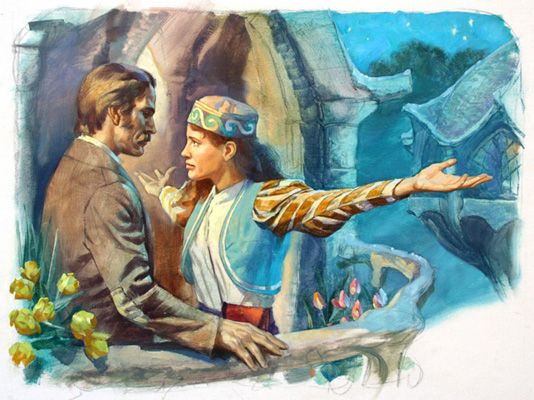
And Oriana says as much:
“The golden age is here right now[. …] You just don’t see it. No engineer ever invented anything as miraculous as a flower or an egg or a living dinosaur. It’s never drudgery to live among them.”
“But you can’t live like animals. What about the roof over your head and the shoes on your feet? Aren’t those inventions?”
“Yes, indeed, true conveniences. But for anything gained, something else is given away. I remember when I was a little barefoot girl, the day came to wear my first pair of shoes. The shoes protected my feet, but also separated me from the touch of the grass. In the same way, the roof divides us from the stars.” (122)
Oriana’s words are the crux of The World Beneath, they are the thesis, why the book exists. The adventure narrative, Gurney’s backtracking on Arthur’s character development, hell, even the ancient history of Poseidos—they all exist for this one point to be made. And it’s an incredibly powerful point that wonderfully captures the essence of Dinotopia as an idea(l). It is, unfortunately, followed immediately by Arthur’s ridiculously cheeseball line, “I would never want these machines to divide me from you.” Because, yes, Oriana is a hot young lady so naturally Arthur and her fall in love, despite there being no indication of her attraction to him or any effort at creating affection between them in the narrative. By the end, they kiss and it’s implied they engage in cumspiritik, the Dinotopian word for marriage and much more that translates as “breathing together.”
And Oriana deserved better than cumspiritik with Arthur, because she’s easily the most fascinating character in this book but is given almost no attention or development. She appears out of nowhere with the other half of the key Arthur needs and she has visions of the cave beyond the sealed door in the World Beneath. And although Arthur doesn’t believe she is capable of going on the expedition because she’s “a lady,” she proves to be formidable, using her skills as a musician to communicate with dangerous dinosaurs and save the day more than once. Moreover, she discovers her own ancestral lineage is connected to that of Poseidos when she enters a grove of sunstones and has a vision of every woman ancestor going back to an ancient Poseidonian queen. Oriana is fascinating because her story inserts a narrative of feminist solidarity across time and generations with her matriarchal ancestors, animating ideas drawn from the feminist spirituality movement, and Gurney is not at all dismissive—he just doesn’t spend any time with Oriana beyond these brief but inspiring moments. Oriana is easily a more compelling character than Arthur and delivers the powerful central message of the novel.
But despite Oriana’s lesson, it’s unclear whether Arthur really learns to see Dinotopia as “the golden age […] here right now” (122). And perhaps that ambiguity is the point. After all, both of Gurney’s first two Dinotopia books make clear that some people refuse to embrace utopia—and Dinotopians understand that people have every right to reject the vision of life offered by Dinotopia. Even the most learned among us fail to recognize what’s good for the world. Arthur may have learned in the first book that Dinotopia was a better world, but he may not have fully believed it. In The World Beneath he witnesses the consequences of an ideology of pure technoscience. Whether he believes, now, that Dinotopia is the best alternative, “the golden age,” or whether he still believes in progress but with the caveat that perhaps he can avoid Poseidos’s pitfalls, remains to be seen. And I truly don’t know if that’s what Gurney will explore in future books (or Alan Dean Foster in the adult novels that expand Arthur’s and Will’s stories), but despite my disappointment in The World Beneath I remain curious to see how Dinotopia grows and deepens in future books.
To get notifications about new essays like this one sent directly to your inbox, subscribe to Genre Fantasies for free:


I’d actually not been aware of further volumes of Dinotopia. It makes some gifting easier to know about it; thank you for this!
LikeLiked by 1 person
Thanks for reading! Not sure about the grifting, though, or rather I wouldn’t call Gurney’s sequels and the novels a grift.
LikeLike
No, I’m getting the sequel for my nephew as a gift!
LikeLiked by 1 person
Oh *gifting* haha I have no idea how I misread that but that makes 1000x more sense! Hope your nephew enjoys it! The chapter novels seem really fun, too, so I’m excited to read some of those but they’re all out of print (but also cheap from used sellers).
LikeLike